5 min read

Ezekiel Saw the Chariot With Wheels Full of Eyes

By the Chebar River, Ezekiel watched fire, wings, and eye-covered wheels rise into a chariot that thundered, fell silent, and carried mercy.

Curated by Arthur · Told by Maggid ·
Table of Contents
  1. The Riverbank Opened
  2. Four Faces Moved as One
  3. The Wheels Were Full of Eyes
  4. The Wings Knew Silence
  5. Mercy Rose From the Throne

The river in exile became a gate.

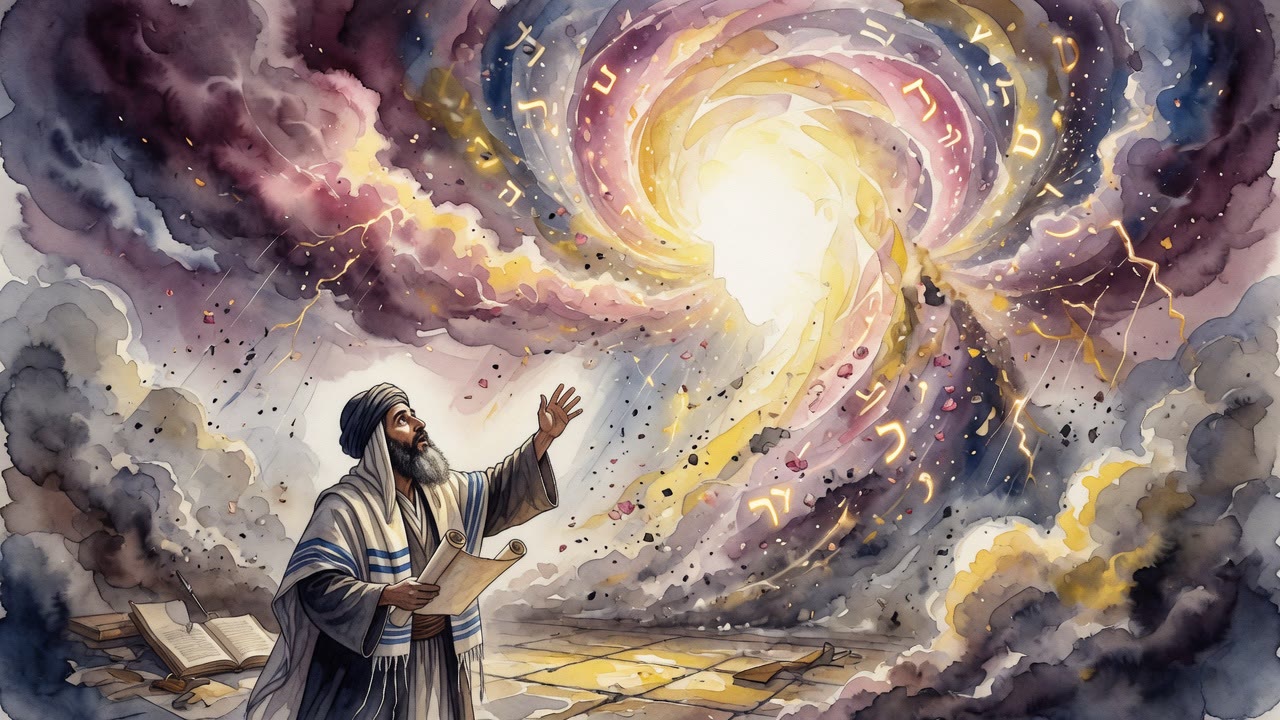
Ezekiel stood among the deported by the Chebar, far from Jerusalem, far from the Temple courts where a priest knew where holiness belonged. Then the heavens opened over Babylon, and holiness came looking for him.

The Riverbank Opened

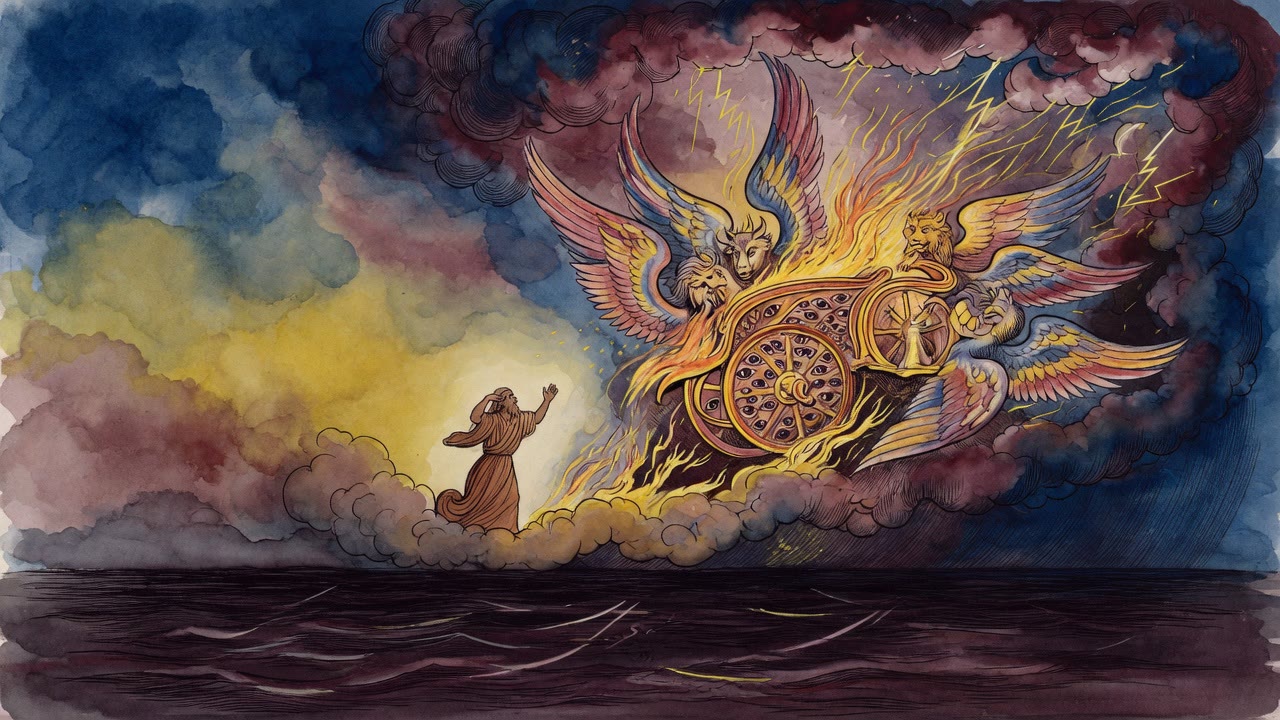
A storm came out of the north with fire folded inside it. Cloud, radiance, and flashing heat moved as one mass. At the center burned a color like amber, not the soft light of a lamp, but metal made alive in flame.

God did not wait for the exiles to return to Jerusalem before sending the vision. The chariot crossed empire, distance, and grief. Babylon had taken king, priest, artisan, and child from the land, but it had not sealed heaven. The riverbank shook with the answer.

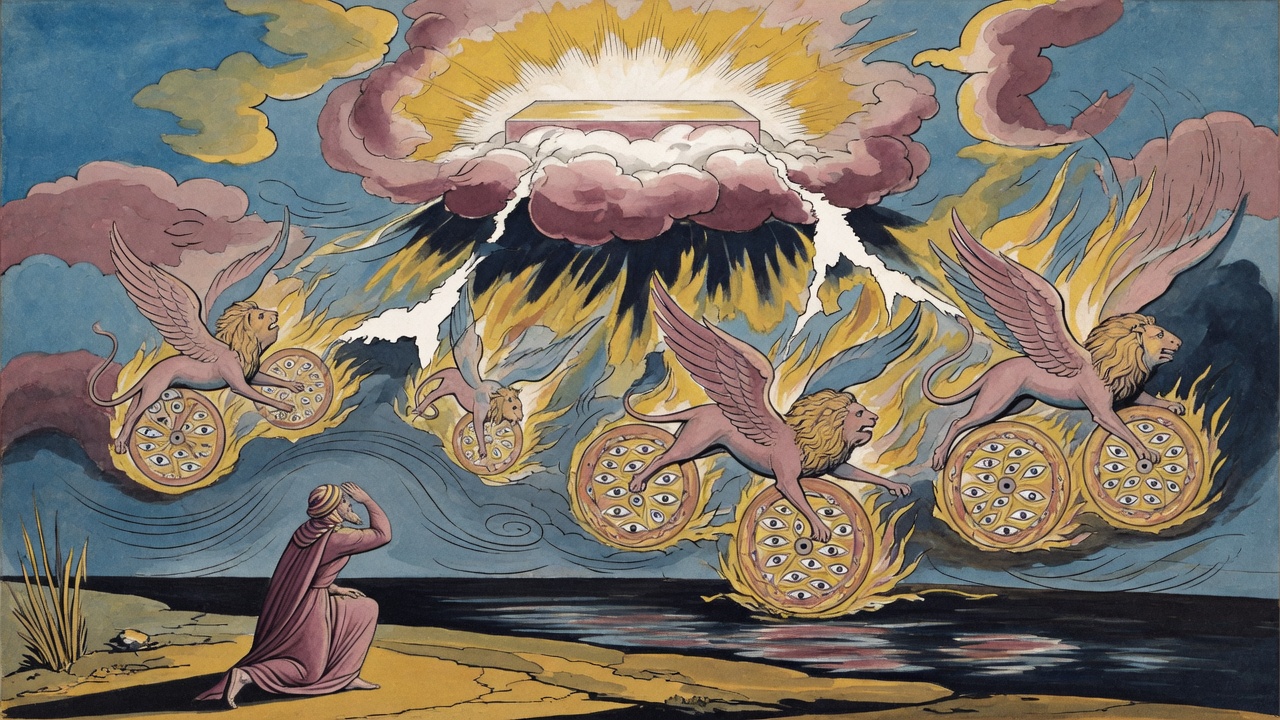
Out of the fire came living creatures. They were not beasts in a field and not men in armor. Each stood straight, with legs like columns and feet shining like polished bronze. Their wings touched one another, so no creature moved alone. When one advanced, all advanced. When one rose, all rose.

Four Faces Moved as One

Each creature carried four faces. A human face looked forward. A lion faced one side. An ox held the other side. An eagle watched from behind. No head turned to search for a path, because every direction already had a face.

They moved without twisting. They did not hesitate at the edge of east, west, north, or south. The spirit within them drove them straight ahead, and the shape of their bodies made turning unnecessary. The world below depends on corners, detours, and delay. The living creatures did not.

Their wings beat with the force of many waters. The sound was not music fit for a chamber. It was flood, army, and royal command joined together in one breath. Above them spread a surface like ice, bright and terrible, holding back another height.

The Wheels Were Full of Eyes

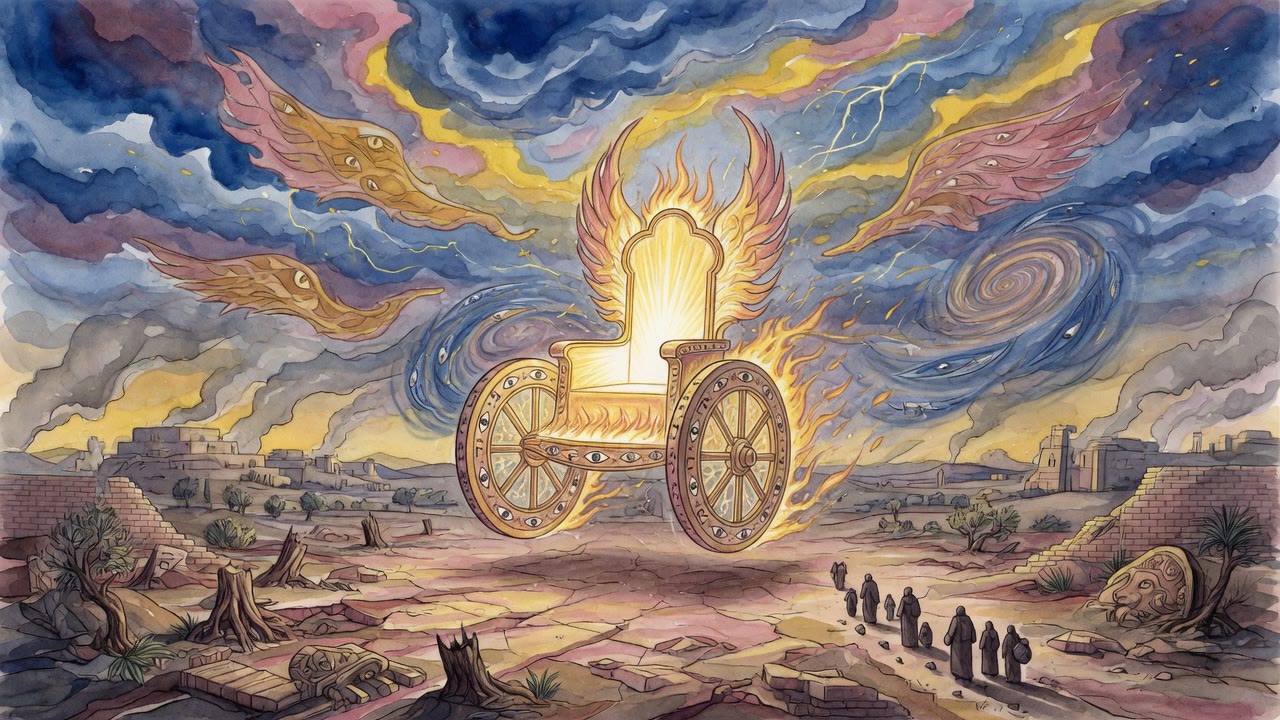
Beside each living creature stood a wheel. Inside each wheel stood another wheel, crossing it, fitted to it, ready for every side at once. The wheels did not roll like carts on a road. They stood high enough to make the earth feel low.

Their rims were full of eyes.

Not painted marks. Not jewels pretending to see. Eyes covered the height of them, watching from every side. The wheels stretched from below to the height of heaven, as if the axle of the chariot passed through every layer of creation. Nothing escaped that seeing.

The wheels moved only when the creatures moved. When the creatures rose, the wheels rose. When the creatures stood, the wheels stood. The life inside the creatures was inside the wheels too, so the chariot was not a dead machine pulled by holy animals. It was one body of motion, sight, and will.

The Wings Knew Silence

The wings thundered when the creatures blessed their Master, the living King of worlds. Thousands trembled below and rose into song. Four hundred and fifty thousand sighted beings joined the praise, and the wheels answered with their own turning cry.

Then the sound stopped.

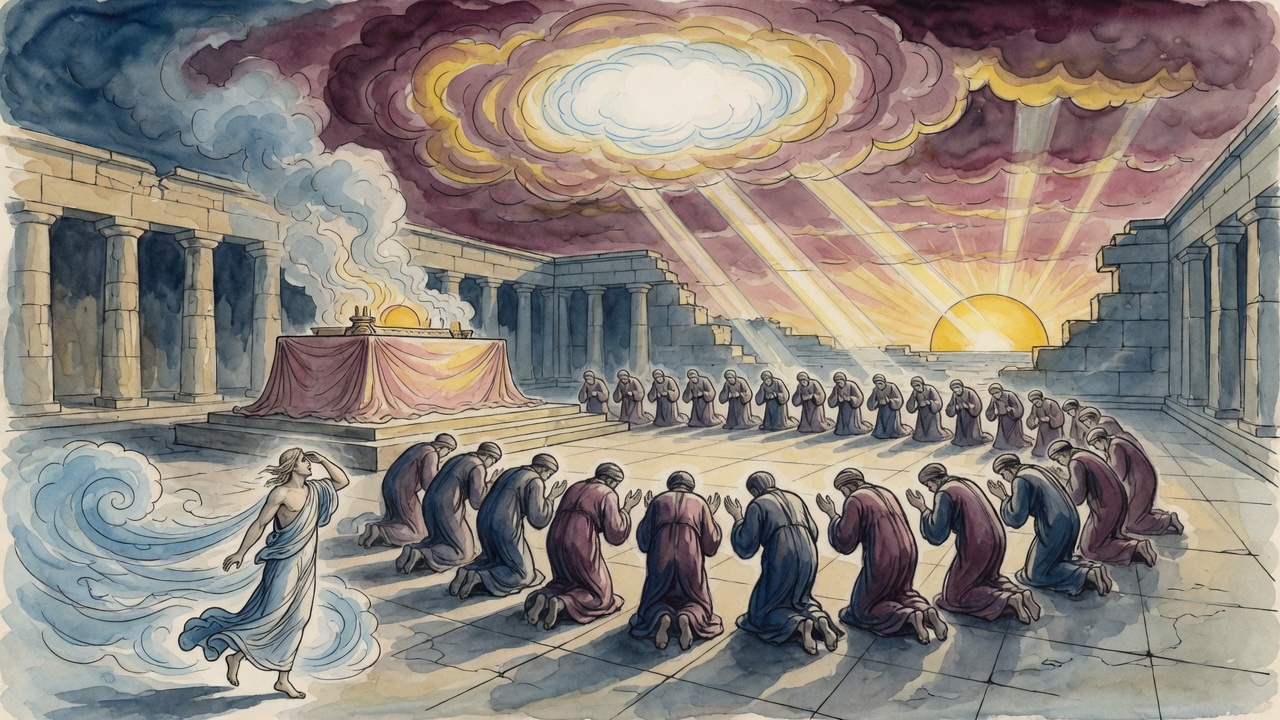
Silence did not mean emptiness. It meant command. When a word had to reach a prophet, heaven lowered its own voice. Wings that could roar like waters folded back. Wheels that could fill the worlds with praise held their place. The exiled priest at the riverbank was small enough to fall on his face, but the whole chariot made room for him to hear.

That silence was as frightening as the thunder. Praise can cover a man. Silence exposes him. Ezekiel lay before a throne he could not climb toward and a voice he could not confuse with his own thoughts.

Mercy Rose From the Throne

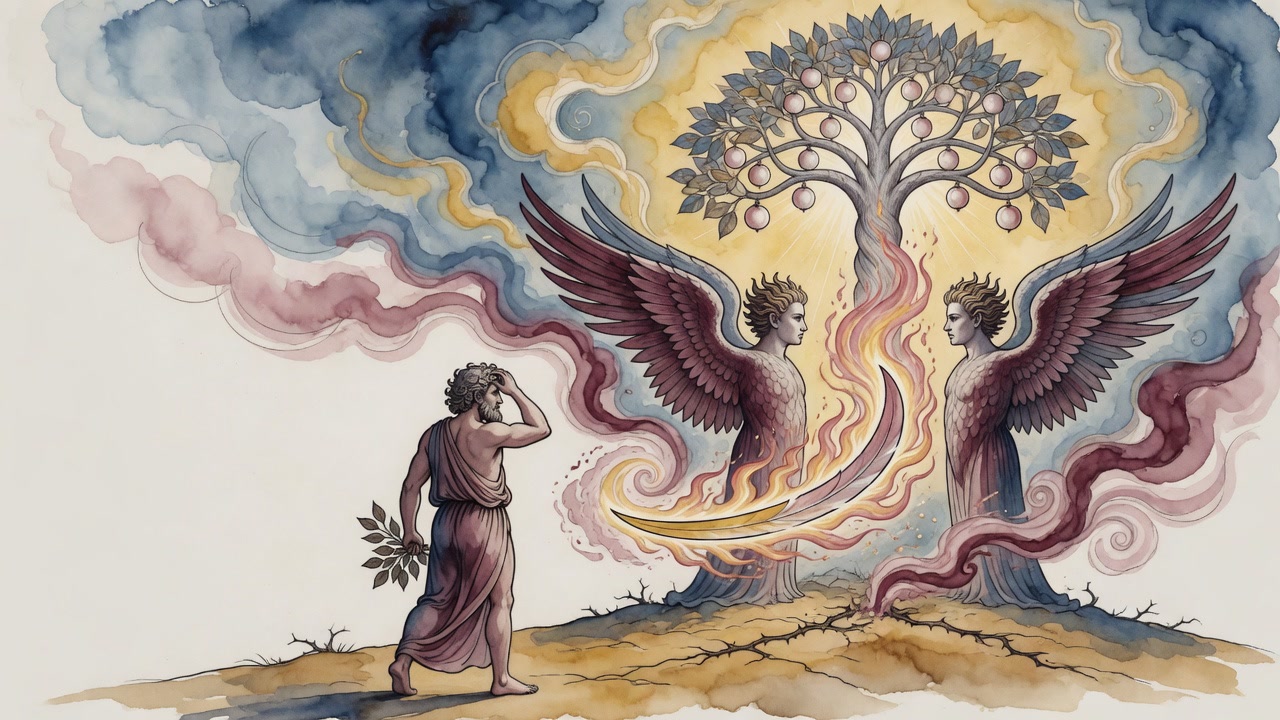
Above the icy brightness stood a throne like sapphire. Above the throne was a form with the likeness of a human being, wrapped in fire and brightness. Around the brightness spread the colors of the bow in the cloud, the sign that wrath has a boundary and destruction is not the last word.

The upper courts held judgment and mercy together. One side carried life. Another carried death. A scepter of fire rested in the hand of the King. Snow and flame could share one throne without putting each other out.

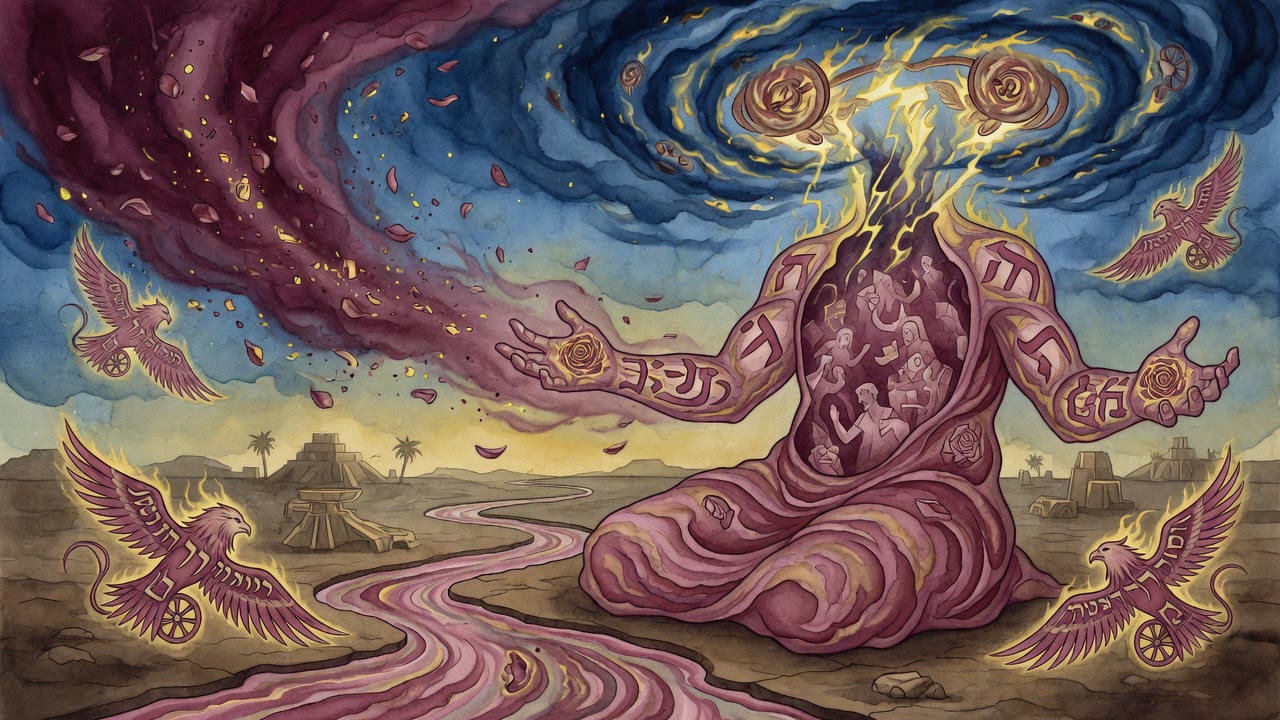
When judgment began, the songs fell away. Then the King rose from the throne of judgment and sat on the throne of reconciliation. The divine Name opened as a source of mercy and life. The wheels still had eyes. The fire still burned. The chariot did not become gentle. It became survivable.

Ezekiel fell on his face. The heavens had opened in exile, and the voice came through. He was no longer only a priest standing beside a Babylonian canal. He had seen the merkavah, the chariot, cross the border that empire claimed was closed.


← All myths

From the tradition

Sources

4 sources

The texts this telling draws on, in full. Open a card to read inline, or expand it for a wider, quieter read.

Legends of the Jews 4:261-264Legends of the Jews

The Book of Ezekiel, one of the most powerful and enigmatic texts in the Hebrew Bible, opens with just such an experience. We find Ezekiel, a priest, in exile, far from Jerusalem, by the Chebar Canal – likely a major irrigation canal in Babylonia. It’s a bleak time. The elite of Judea, including King Jehoiachin, have been forcibly relocated by the Babylonian empire. This isn’t just a political defeat; it’s a spiritual crisis. And in this moment of despair, something extraordinary happens.

“In the thirtieth year, on the fifth day of the fourth month…the heavens opened and I saw visions of God.” (Ezekiel 1:1). It’s a precise date – a detail that anchors this otherworldly experience in a specific time and place. And what a vision it is!

A storm erupts from the north. But this isn’t just any storm. It's a whirlwind of fire and light, a “huge cloud and flashing fire, surrounded by a radiance; and in the center of it, in the center of the fire, a gleam as of amber” (Ezekiel 1:4). From this fiery core emerge figures unlike anything Ezekiel has ever seen: four living creatures.

These aren't ordinary beings. Each has the form of a human, but with four faces: a human face, the face of a lion, the face of an ox, and the face of an eagle (Ezekiel 1:10). They each have four wings. Their legs are fused, ending in a single calf’s hoof that gleams like burnished bronze. And beneath their wings, they have human hands.

It’s a mind-bending image. What could it all mean?

Ezekiel emphasizes their coordinated movement. They don't turn as they move; each can go in any direction its faces point. “Each one’s wings touched those of the other. They did not turn when they moved; each could move in the direction of any of its faces” (Ezekiel 1:9). They move as one, guided by a single spirit. And amidst these creatures, there's fire, “something that looked like burning coals of fire…the fire had a radiance, and lightning issued from the fire" (Ezekiel 1:13). This fire isn't destructive; it's illuminating, a source of divine energy.

But the vision doesn't stop there. Next to these creatures, Ezekiel sees wheels, “one wheel on the ground next to each of the four-faced creatures” (Ezekiel 1:15). These aren't ordinary wheels either. They gleam like beryl, a precious stone. Each wheel seems to be two wheels intersecting, allowing them to move in any direction without turning. And their rims… well, “their rims were tall and frightening, for the rims of all four were covered all over with eyes” (Ezekiel 1:18). Eyes! Everywhere!

The wheels move with the creatures, wherever the spirit leads them. “Wherever the spirit impelled them to go, they went, wherever the spirit impelled them. And the wheels were borne alongside them; for the spirit of the creatures was in the wheels” (Ezekiel 1:20). The spirit that animates the creatures also animates the wheels. They are interconnected, inseparable parts of a single, unified whole.

Ezekiel's vision is a powerful, symbolic representation of God's presence and power. It's a reminder that even in the darkest of times, even in exile, the divine can break through. It challenges us to open our minds and hearts to the possibility of the extraordinary, to recognize the divine spark in the world around us and within ourselves. What parts of your everyday reality might contain the divine spark? Where do you see the faces of the lion, the ox, the eagle, and the human, all moving together, guided by a single spirit?

Full source
Targum Jonathan on Ezekiel 1:15-28Targum Jonathan on Prophets

I saw the creatures, and behold, one wheel was set from below up to the height of heaven, beside the creatures, for its four faces.

The appearance of the wheels and their work was like the appearance of a precious stone. The likeness was the same for all four of them, and their appearance and their work were like a wheel inside a wheel.

They moved on their four sides when they went. They did not turn when they moved.

Their backs were level with the firmament, and they had height, and they were fearsome. Their backs were full of eyes all around, for all four of them.

When the creatures moved, the wheels moved opposite them. When the creatures were lifted from below toward the height of heaven, the wheels were lifted.

Wherever there was a will to go, they went to the place where there was a will to go. The wheels were lifted opposite them, because the spirit of the creatures was in the wheels.

When they moved, they moved; when they stood in their place, they stood. When they were lifted from below toward the height of heaven, the wheels were lifted opposite them, because the spirit of the creatures was in the wheels.

Above the heads of the creatures was the likeness of a firmament, like the appearance of strong ice, bent over their heads from above.

Under the firmament their wings were aligned one opposite the other. Each had two wings covering them, and each had two wings covering their bodies.

I heard the sound of their wings like the sound of many waters, like a voice from before Shaddai when they moved. The sound of their speech, when they gave thanks and blessed their Master, the living King of the worlds, was like the sound of the camp of the angels on high. When they stood in their place, their wings fell silent before the speech.

When there was a will before Him to make speech heard to His servants, the prophets of Israel, a voice was heard from above the firmament, from between the cherubim, beneath the firmament over their heads. In their place, their wings fell silent before the speech.

Above the firmament over their heads was something like the appearance of a precious stone, the likeness of a throne. Upon the likeness of the throne was a likeness like the appearance of a human being above it, from above.

I saw something like the appearance of chashmal, like the appearance of fire within it all around, the appearance of glory that the eye cannot see and that it is impossible to gaze upon. Above was an appearance of glory that the eye cannot see and that it is impossible to gaze upon; below I saw something like the appearance of fire, with brightness all around it.

Like the appearance of a rainbow in a cloud on a rainy day, so was the appearance of the brightness all around. This was the appearance of the likeness of the glory of the Lord. I saw it, fell on my face, and heard the voice of one speaking.

Full source
Zohar, Shemot 7Zohar

The heavens go silent when judgment begins.

Zohar, Shemot 7 opens Rabbi Simeon's eyes onto the holy chariot. Wheels roll. Voices sing. Thousands upon thousands of beings fall trembling, then rise into song from below to above. Four hundred and fifty thousand sighted beings join the music.

The vision keeps climbing. The turning wheels chant, "Blessed be the Lord's glory from the place of His Shekhinah" (Ezekiel 3:12). A secret Garden shines in hidden worlds of light. The splendor of the Shekhinah reaches to the ends of creation, and the Garden of Eden is revealed to eyes that can bear it.

Then the singing stops.

Silence falls because judgment has begun. The Lord rises from the throne of judgment and sits on the throne of reconciliation. The divine Name is uttered as a source of mercy and life. The court has not disappeared. It has been sweetened.

The Zohar's chariot is not decorative heaven. It is a world of sound, terror, order, and mercy. The wheels sing until the moment they cannot sing. Then mercy takes the throne, and the Name gives life. The silence is part of the vision because awe also has a sound, and sometimes it is no sound at all.

Full source
Chagigah 12b-13bTalmud Bavli, Chagigah

Aravot is the heaven in which there are righteousness, justice, and charity, the treasuries of life and the treasuries of peace and the treasuries of blessing, and the souls of the righteous, and the spirits and souls that are destined to be created, and the dew with which the Holy One, blessed be He, will in the future revive the dead. Righteousness and justice, as it is written, "Righteousness and justice are the foundation of Your throne" (Psalms 89:15). Charity, as it is written, "And He put on charity as a coat of mail" (Isaiah 59:17). The treasuries of life, as it is written, "For with You is the fountain of life" (Psalms 36:10). And the treasuries of peace, as it is written, "And He called it the LORD is peace" (Judges 6:24). And the treasuries of blessing, as it is written, "He shall receive a blessing from the LORD" (Psalms 24:5).

The souls of the righteous, as it is written, "And the soul of my lord shall be bound up in the bundle of life with the LORD your God" (1 Samuel 25:29). The spirits and souls that are destined to be created, as it is written, "For the spirit should grow faint before Me, and the souls which I have made" (Isaiah 57:16). And the dew with which the Holy One, blessed be He, will in the future revive the dead, as it is written, "A bountiful rain You poured down, O God; Your inheritance, when it was weary, You established it" (Psalms 68:10).

There are the ophanim and the seraphim and the holy living creatures and the ministering angels and the Throne of Glory; the King, the living God, high and exalted, dwells over them in Aravot, as it is said, "Extol Him who rides upon the heavens (aravot), whose name is the LORD" (Psalms 68:5). And from where do we know that it is called "heaven"? It is derived by a verbal analogy between "riding" and "riding": it is written here, "Extol Him who rides upon the aravot," and it is written there, "who rides upon the heaven as your help" (Deuteronomy 33:26).

And darkness and cloud and thick gloom surround Him, as it is said, "He made darkness His hiding place, His pavilion round about Him, darkness of waters, thick clouds of the skies" (Psalms 18:12).

Full source