6 min read

He Lifted His Eyes to the Likeness of a Man Upon the Throne

At the seventh palace his knees gave out. The guardians stood taller than towers, and behind the last door was a roar that turned out to be singing.

Curated by Arthur · Told by Maggid ·
Table of Contents
  1. The Seventh Gate and the Roar Behind It
  2. The Throne Raised High Above the River of Fire
  3. He Lifted His Eyes Where No Man Lives to Look
  4. The Voice From the Glory Named What He Had Done
  5. Rise and Sit as You Sit in the House of Study
He Lifted His Eyes to the Likeness of a Man Upon the Throne Click for full size

The Seventh Gate and the Roar Behind It

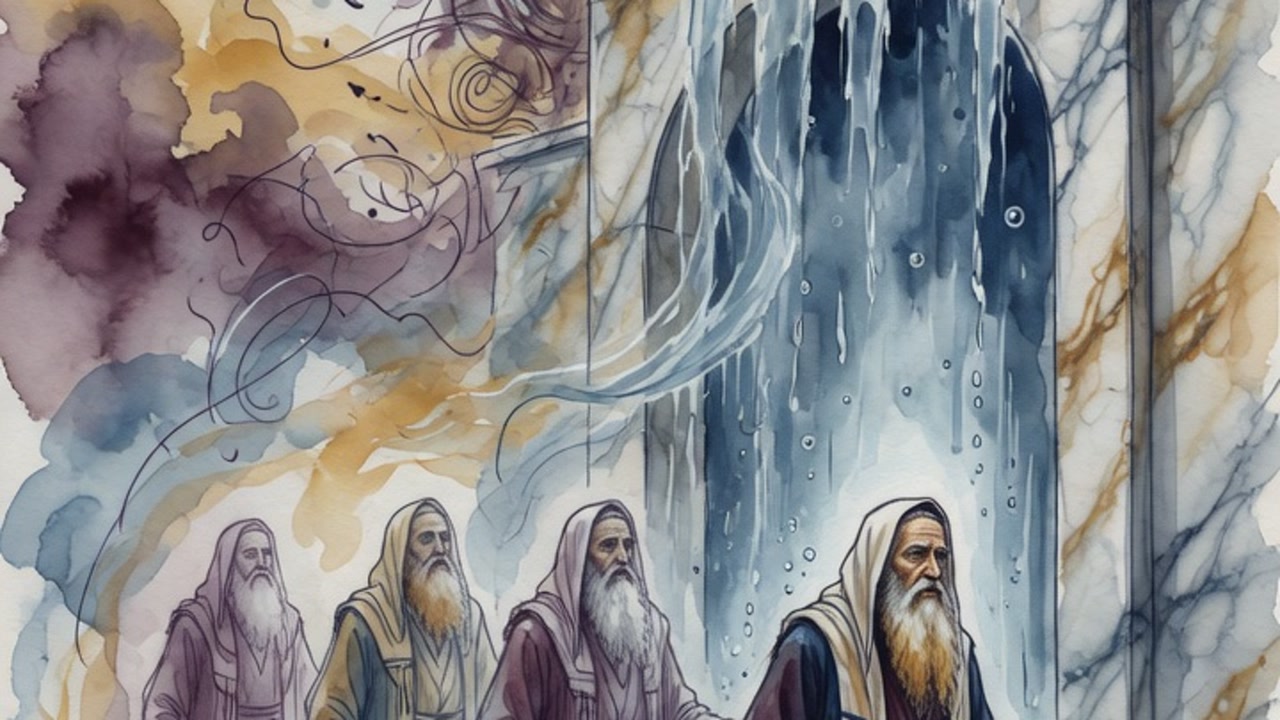
He had climbed all night, if night meant anything, and at the threshold of the seventh palace his knees gave out. The guardians stood on either side, taller than towers, their faces turned toward a light he could not yet look at. They did not stop him. They had weighed him at every gate below, tested the seals in his mouth, and let him pass. Now there was only the last door, and behind it a roar.

It was not the roar of any storm he knew. It was song. A thousand thousand voices, none of them still, rising and breaking and rising again over a floor that trembled as they sang. The servants of the throne were terrified even as they poured praise. He felt their terror in the shaking of the heavens beneath his feet, as if the whole sky were only a footstool, and something above it too heavy to be named.

The Throne Raised High Above the River of Fire

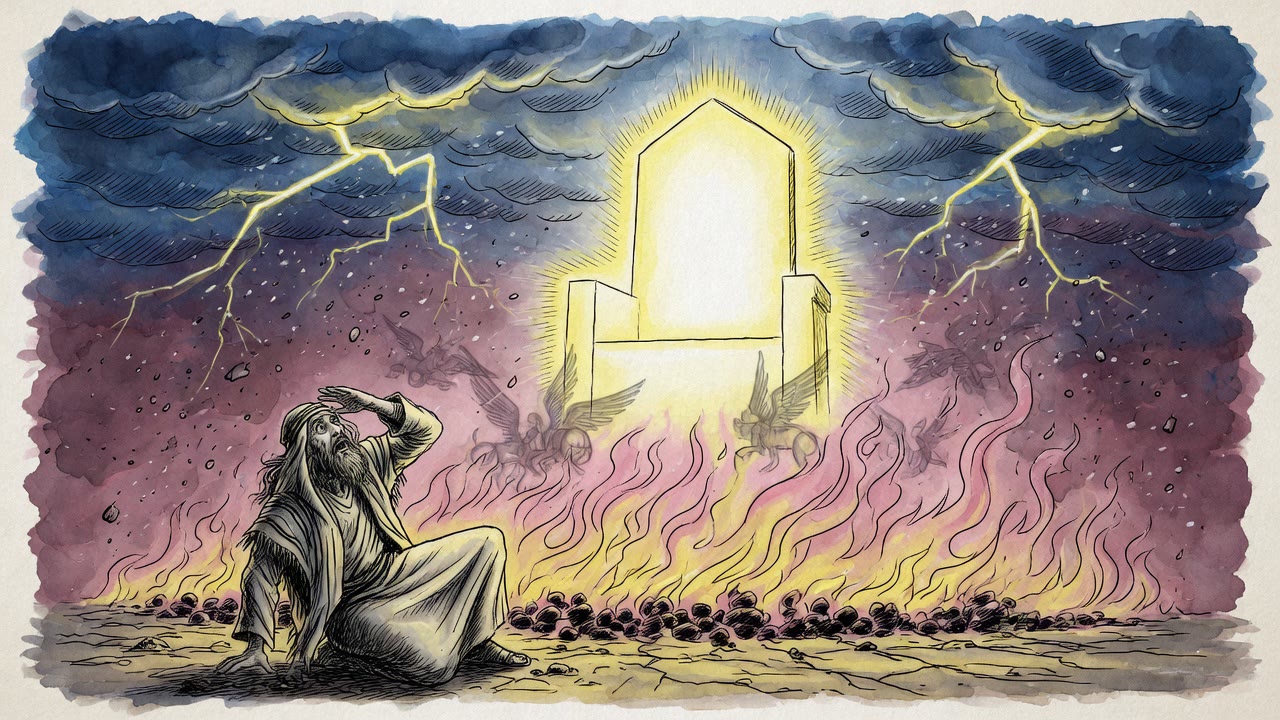
The door opened, and he did not fall so much as forget how to stand.

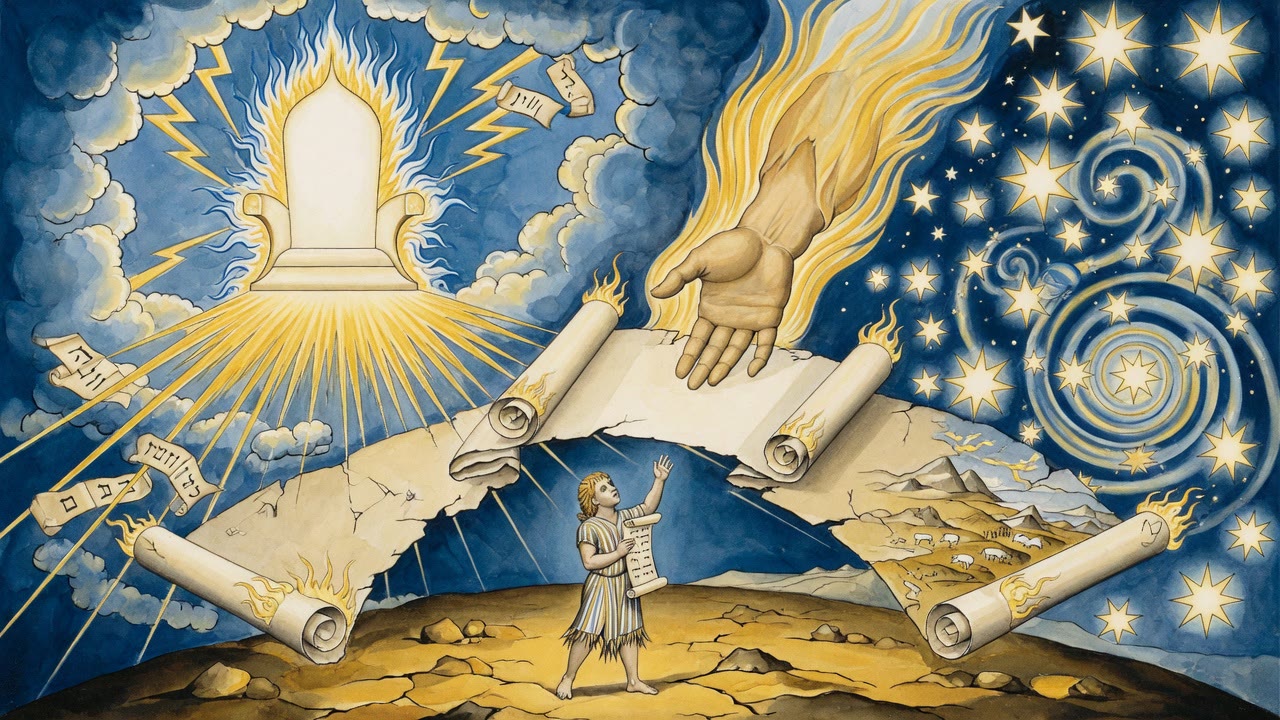
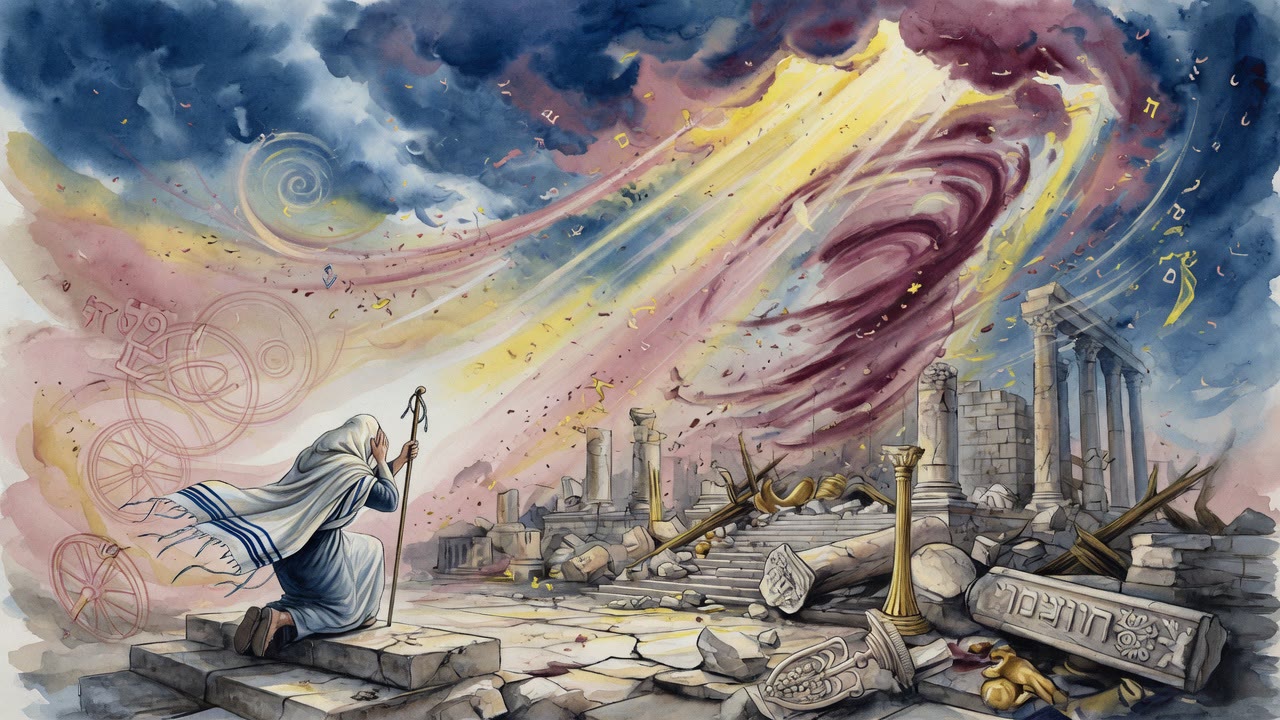
The throne was raised high and lifted up, and it was fearful, and it was terrible. Its wheels turned without moving. Beings bore it up on their shoulders and cried out as they carried it, "Sing for joy, supernal dwelling. Shout for joy, precious vessel." Beneath the throne ran a stream of flaming coals, a river of lava that poured and never emptied, and in that fire, unscorched by it, dwelt the One they carried. The messengers of the Power came and went along the banks of the burning river, and with sweet mouths they woke the Shekhinah (the Divine Presence), the Presence, and added their voices to the flood. "Holy, holy, holy," the heavens answered themselves, "is the Lord of Hosts."

He Lifted His Eyes Where No Man Lives to Look

He knew the warning. Every child of his people knew it. No one shall look upon the face and live. It was cut into him deeper than his own name, and he had carried it up through six palaces like a stone lodged in his chest.

He lifted his eyes anyway.

The thing he saw was not a fire without shape, and it was not a wheel, and it was not a wing. Fixed upon the throne, at the center of all that burning, was the likeness of a man. The infinite had chosen a form, and the form was his own. He gazed at the seated Glory and made out the outline of hands, of a face, the shape he washed each morning and thought nothing of, set now at the heart of heaven with the whole choir bent toward it. The angels around the throne wore it too. They had the face of a man, and under their wings were the hands of a man, and they ran and toiled and knelt and fell on their faces as he had fallen, and the fear of the King was upon them as it was upon him.

The Voice From the Glory Named What He Had Done

Then the Glory spoke, and the song did not pause for it, and still he heard every word.

"In the first temple," the voice said, "I did not speak with My children except by a voice. But you have come up here, and you have compelled Me. You have compelled My throne, and My servants, and all of these, to stand before you." There was no anger in it. There was something worse than anger, a kind of grief. "And would that it might last," the voice said. "Would that it might endure."

He understood then what he had done. He had not been invited. He had forced the door of heaven with the seals and the names and the long starving discipline of the climb, and the Presence had come out to meet the summons the way a father rises when a child will not stop knocking, half in love and half in sorrow.

Rise and Sit as You Sit in the House of Study

He was still on his face. The voice found him there.

"My children, why are you fallen, lying upon your faces? Stand. Seat yourselves before My throne in the order in which you sit in the academy below." The man rose, shaking, and there were others with him now whom he had not seen before, other climbers who had made the same terrible passage, and they arranged themselves before the fire as they arranged themselves in the house of study on earth, row upon row, as though the highest heaven were only another room of the same school.

"Take hold upon a crown," the voice told them. "Receive a seal. Hear the order of this secret of the Law, how you shall perform it, how you shall explain it, how you shall practice it, and how you shall climb the roads of your own hearts." He took the crown. He did not understand it. He understood only that he had been permitted to look upon the shape at the center, the man fixed in the fire, and that he had lived, and that the seeing was not the end of the road but the seal set upon its beginning.

The gates opened behind him. The song went on without him, as it had before him and would after, and he went down through the six palaces carrying what he had been given and speaking none of it aloud, back into the world where the sky is only sky and no one looks up and sees the throne.


← All myths
From the tradition

Sources

3 sources

The texts behind this telling. Some cards carry a translation of the source; others are our own retelling of it, and each card says which. Every card links out to the original.

Heikhalot Rabbati 9:3Heikhalot Rabbati

Retold in our words. Read the original at the link below.Sefaria-hosted English translation · CC-BY

Jewish mystical tradition offers glimpses, tantalizing hints of the unimaginable grandeur and power at the heart of creation. The source turns to.

Specifically, Buckle up.

This teaching paints a vivid picture of GOD on His throne. It’s not just any throne,. This is a throne "raised high and lifted up, fearful and terrific." The image is intense, awe-inspiring. There's a sense of overwhelming power and majesty. To "Be exalted, be raised on high, be lifted up, O splendid King!" This isn't a cozy, familiar deity

Who surrounds this King? Not silent, subservient figures, but beings of immense energy and sound. The servants of the throne, we are told, are "terrified" and they shake "the heavens which are the footstool of Thy feet." Imagine the sheer force! This isn’t a hushed reverence; it's a vibrant, resounding chorus of praise. Every day, they offer a "voice of exultation and tumult of psalmody and roar of songs." It’s all so loud, so energetic it’s almost overwhelming.

Sound familiar? It should. The text then quotes the famous verse from (Isaiah 6:3): "Holy, holy, holy is the Lord of Hosts." This isn’t just a pretty phrase; it’s the very anthem of the heavens, a constant declaration of God's ultimate holiness and power.

But the celestial choir doesn't end there. Heikhalot Rabbati speaks of "Messengers of the Power [of God] and awakeners of the Shekhinah (the Divine Presence)". Shekhinah refers to the divine presence, the immanent aspect of God that dwells within creation. These messengers aren't just singing; they're awakening the divine presence! They amplify the song, adding their voices to the already mighty chorus. They sing with "sweet mouth and with holy melody," praising "Him who dwelleth in the lava stream of flaming coals."

God dwelling in a "lava stream of flaming coals." It’s fiery, intense, and almost dangerous.

Finally, the text describes these celestial beings as bearing up the "wheel of the throne of His glory," singing, "Sing, sing for joy, supernal dwelling! Shout, shout for joy, precious vessel!" They are carrying the very mechanism of God's authority and presence, all while erupting in joyous song. The "supernal dwelling" and "precious vessel" are likely references to the heavens themselves, celebrating their role as the dwelling place of the divine.

So, what does all this mean? Heikhalot Rabbati is more than just a description of heaven. It’s an invitation. An invitation to contemplate the immensity of God, the power of creation, and the sheer, unadulterated joy of divine praise. It challenges us to imagine a reality far beyond our everyday experiences, a reality where the heavens themselves tremble with the force of God's glory.

Next time you look up at the night sky, remember the roaring chorus, the fiery presence, and the endless song of praise. It might just change how you see the universe – and your place within it.

Full source
Heikhalot Rabbati 32:2Heikhalot Rabbati

Retold in our words. Read the original at the link below.Sefaria-hosted English translation · CC-BY

These texts, steeped in mystical traditions, offer us glimpses into the heavenly realms. What does God actually say?

This particular passage plunges us into a unique moment of revelation. Picture this: the Divine Presence is addressing those who've managed – through intense spiritual practice and devotion – to ascend to the celestial throne room. It's an incredibly rare and intimate encounter.

Something's…off. God says, "For in the first temple I did not communicate with My children but by voice and in this temple ye have compelled Me and My throne and all My servants [to appear]." In the First Temple, communication was direct, straightforward – voice to ear, so to speak. But here, in this mystical ascent, the seekers have somehow forced God's hand. They've "compelled" the Divine Presence, the very throne, and all the celestial beings to manifest.

It’s a powerful statement, loaded with implications. Why "compelled"? Was it because humanity's spiritual state had deteriorated? Were they no longer capable of hearing that still, small voice? Did they need a more... dramatic intervention?

And then comes the poignant cry: "And would that it might endure!" It’s almost a lament. This forced revelation, this extraordinary moment, is fragile, unsustainable. There's a longing for a connection that is organic, natural, rather than… coerced.

Then comes a plea. God sees his children fallen, prostrate before the Divine Glory. "My children, why are ye fallen and lying upon your faces? Stand and seat yourselves before My throne in the order in which you sit in the academy…" It's an invitation to rise, to take their place, to learn.

They are to sit in their proper order, as they do in the academy – the yeshiva, the house of learning. This is a fascinating detail. Even in the highest heavens, there's a sense of structure, of established order. The earthly realm mirrors the celestial.

And what are they to do? "…take hold upon a crown and receive a seal and hear the order of this secret of the Law, how ye shall do it, how explain it, and how practice it, how ascend the roads of your hearts." They are to receive knowledge, wisdom, and a path. A way to understand, to teach, to live, and ultimately, to ascend the "roads of your hearts."

The "roads of your hearts" – isn't that a beautiful image? It suggests that the journey to the Divine isn't just an external ascent, but an internal one, a journey into the very core of our being.

So, what do we take away from this brief, yet profound glimpse into the Heikhalot (the heavenly palaces)? Perhaps it's a reminder that true connection requires more than just spectacle. It demands a willingness to listen, to learn, and to cultivate the inner pathways that lead us closer to the Divine – a connection that hopefully won’t need to be forced, but that flows freely, naturally, from the heart. What do you think?

Full source
Heikhalot Rabbati 27:3Heikhalot Rabbati

Retold in our words. Read the original at the link below.Sefaria-hosted English translation · CC-BY

Surprisingly, one answer comes to us from a rather… unexpected source. We find it tucked away in Heikhalot (the heavenly palaces) Rabbati, a text that pulls back the curtain on the mystical realms, the heikhalot (heavenly halls) that surround God's throne.

What does it say? Well, according to Heikhalot Rabbati 27, the most lofty of all creation is… man. for a second.

"The likeness of a man hast Thou fixed in Thy throne," the text proclaims. The angels themselves, those awe-inspiring beings of pure light and energy, reflect humanity. "They have the face of a man, and the hands of a man are under their wings," it continues. They run, toil, kneel, and prostrate themselves just as we do, singing praises to the King. And, crucially, "the fear of Thee, O King, is upon them."

That the very beings closest to God emulate human behavior, human devotion, human awe.

But the passage doesn't stop there. It throws us a curveball. Because right after declaring man the most lofty, it declares: "The most lofty of cattle is the ox."

Wait, what?

An ox? Really? The text doubles down: "The likeness of an ox hast Thou fixed in Thy throne: they run as an ox, they toil as an ox, they stand in the places as an ox, and the fear of Thee, O Holy One, is upon them."

So, what’s going on here? Is the text contradicting itself? Is it just being… weird?

I don’t think so. Instead, I think it's pointing to something profound about the nature of both humanity and divinity. Perhaps it's not about which is more important, but about the sacred spark, the divine image, that exists within all of creation.

Think about the ox. It's a creature of strength, of unwavering dedication to its task. It toils tirelessly, providing sustenance and support. In its own way, it mirrors the divine attribute of steadfastness, of unwavering commitment.

And maybe, just maybe, that's the key. Maybe the message of Heikhalot Rabbati isn’t about ranking creation, but about recognizing the divine reflection in every aspect of it. In the human capacity for devotion and the ox's unwavering toil, we find echoes of the divine itself.

So, the next time you're pondering the mysteries of the universe, remember the words of Heikhalot Rabbati. Remember the man, remember the ox, and remember the divine image that shines through all of creation. It's a humbling, and ultimately hopeful, thought.

Full source