Parshat Bereshit6 min read

The Throne That Sang the World Into Being

A descender to the chariot climbs through gates of fire to the Throne and learns the world was not hammered but poured out of beauty and light.

Curated by Arthur · Told by Maggid ·
Table of Contents
  1. The First Gate of Fire
  2. The Climb Through the Palaces
  3. The Throne at the Center
  4. The Beauty That Set the Deeps Ablaze
  5. Why the Lower World Runs Dim
The Throne That Sang the World Into Being Click for full size

The First Gate of Fire

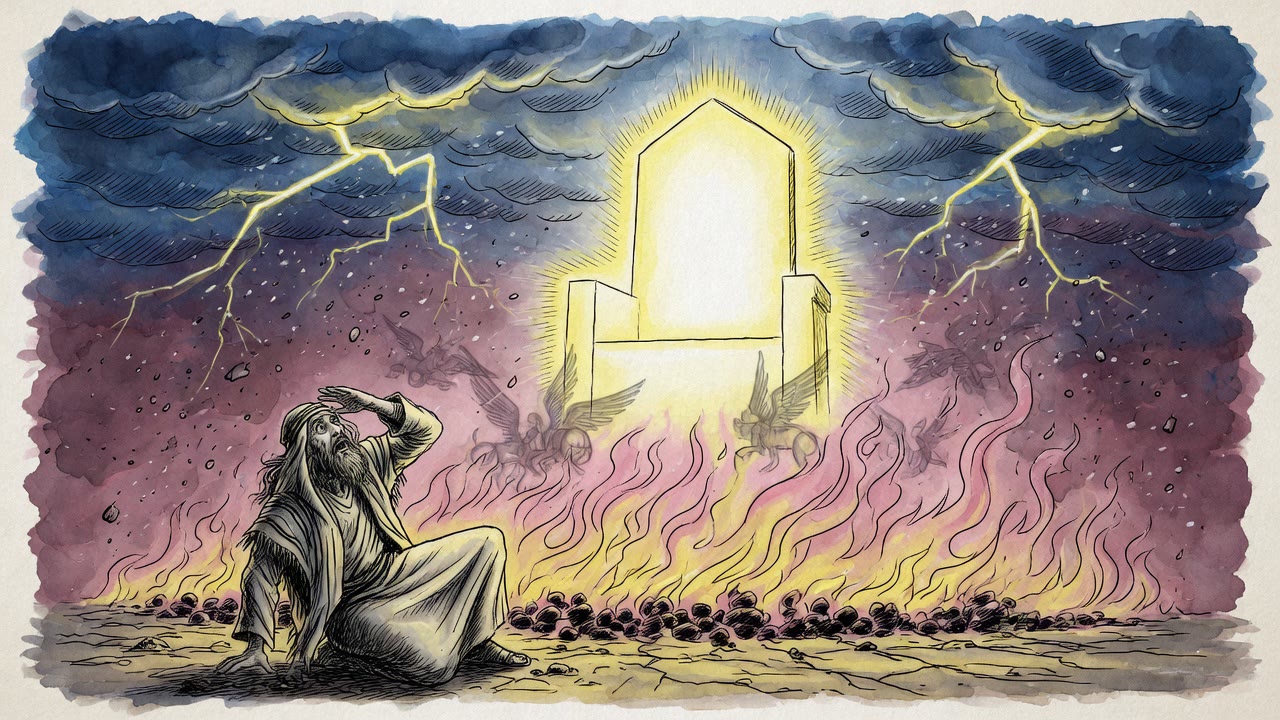
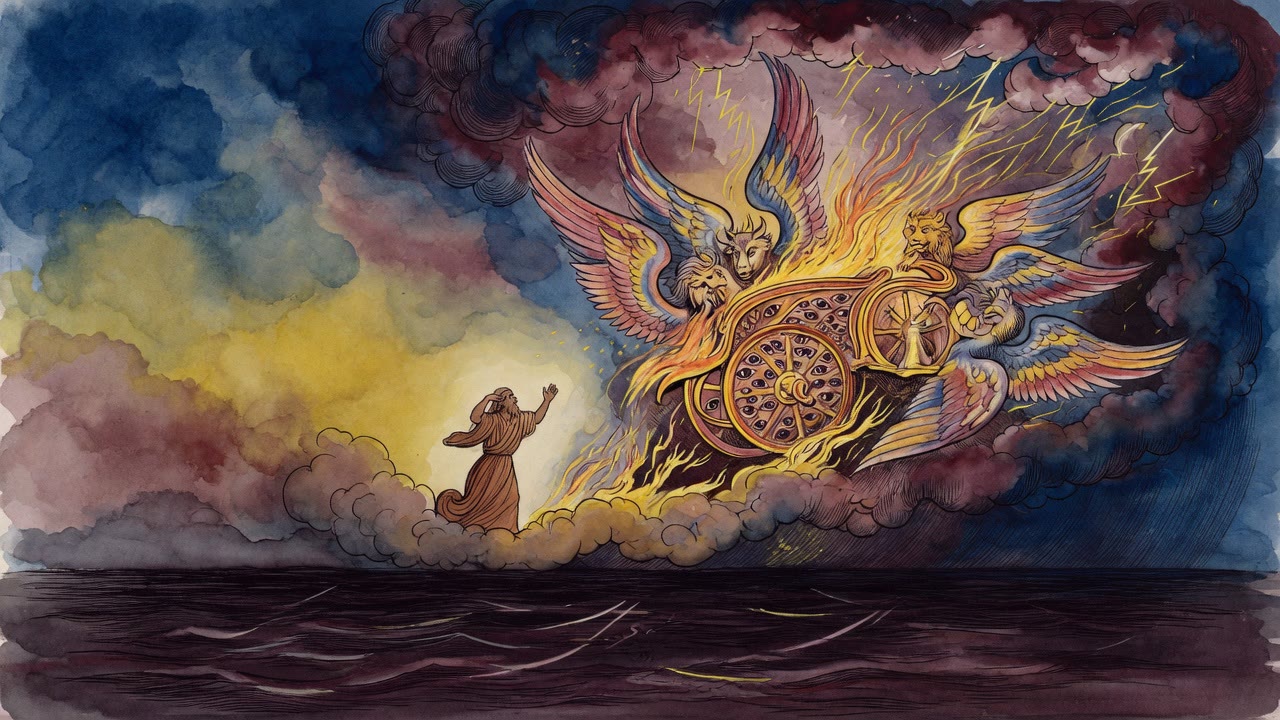
At the first gate stood angels with faces like lightning, and they did not want to let him through.

Rabbi Ishmael stood before them and did not run. He had heard the warnings from his own teacher, Rabbi Nehunya ben ha-Kanah, who had gone up before him and come back with his beard still smelling of the upper fire. The angels at the gates weighed a climber the way a moneychanger weighs a coin. A man who came without the right names, without a clean heart, they would burn where he stood, or fling him back down through all the heavens to break on the ground he came from.

Ishmael spoke the name he had been given. The angels lowered their swords of flame. The gate, which had no hinge and no wood, simply was not there anymore, and he walked into a hall of light so wide he could not see its far wall.

The Climb Through the Palaces

There were seven palaces, one folded inside the next like the chambers of a single burning heart, and at every threshold the test came again. Guardians with a hundred eyes. Rivers of fire he had to cross without flinching, and bridges no wider than a thread. At each gate he gave the name, and at each gate the keepers turned their terrible faces aside and let him climb.

The higher he went, the brighter it became, until brightness stopped being something he saw and became something that pressed on him from every side. Somewhere past the fourth palace he understood that he was not climbing up so much as climbing in, toward a center, toward the place from which all of it was pouring.

The Throne at the Center

In the innermost hall he found the Throne.

On it sat a figure whose shape the angels called Yotzer Bereshit, the Former of Creation. To this one, the old teachers said, every secret of how the world was made had been handed over. He sat upon the chariot, the Merkavah, at the still center of the wheeling palaces, and his form had a measure to it, vast past all counting, the figure the mystics named Adam Kadmon, the first and perfect human after whose pattern every other human was cut.

Ishmael could not tell, and the angels around the Throne would not say, whether this was God himself seated there or the one God had set over creation to do the shaping. The question hung in the burning air and got no answer. What he could see was the beauty. And the beauty was doing something.

The Beauty That Set the Deeps Ablaze

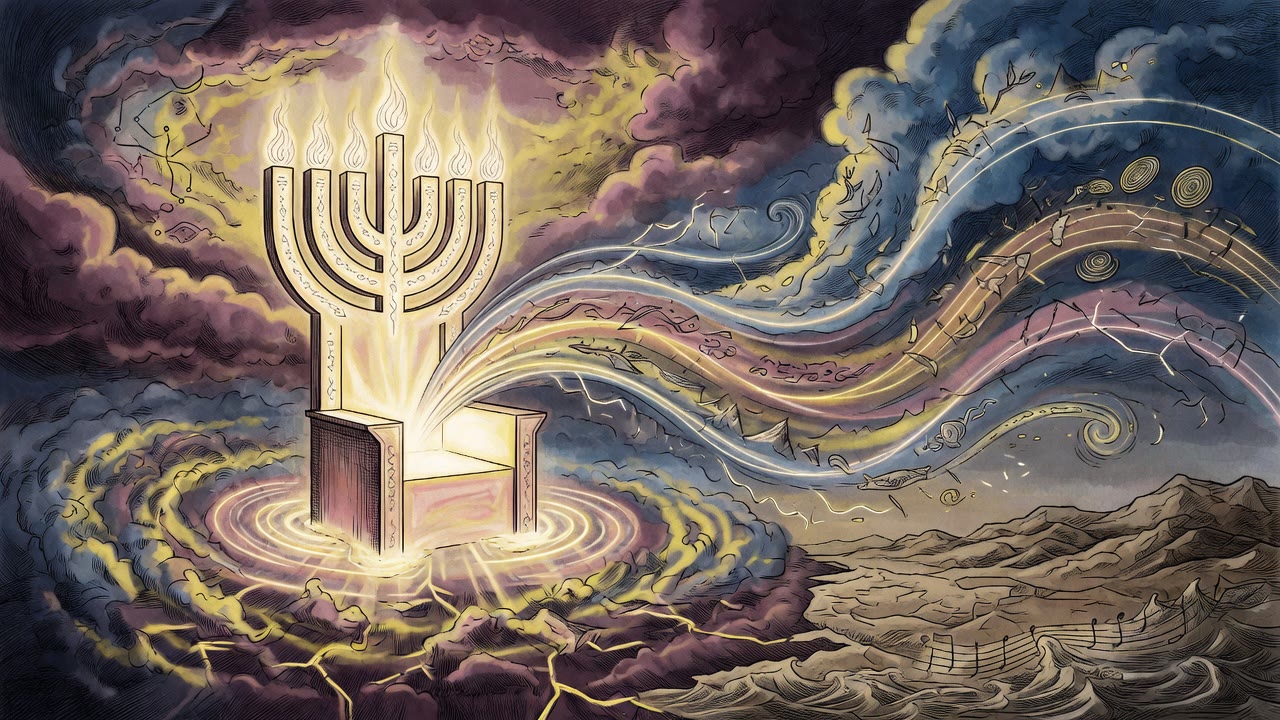
He watched, and it was as though creation were happening again in front of him, not by hammer, not by any tool, but out of the sheer loveliness of the One on the Throne.

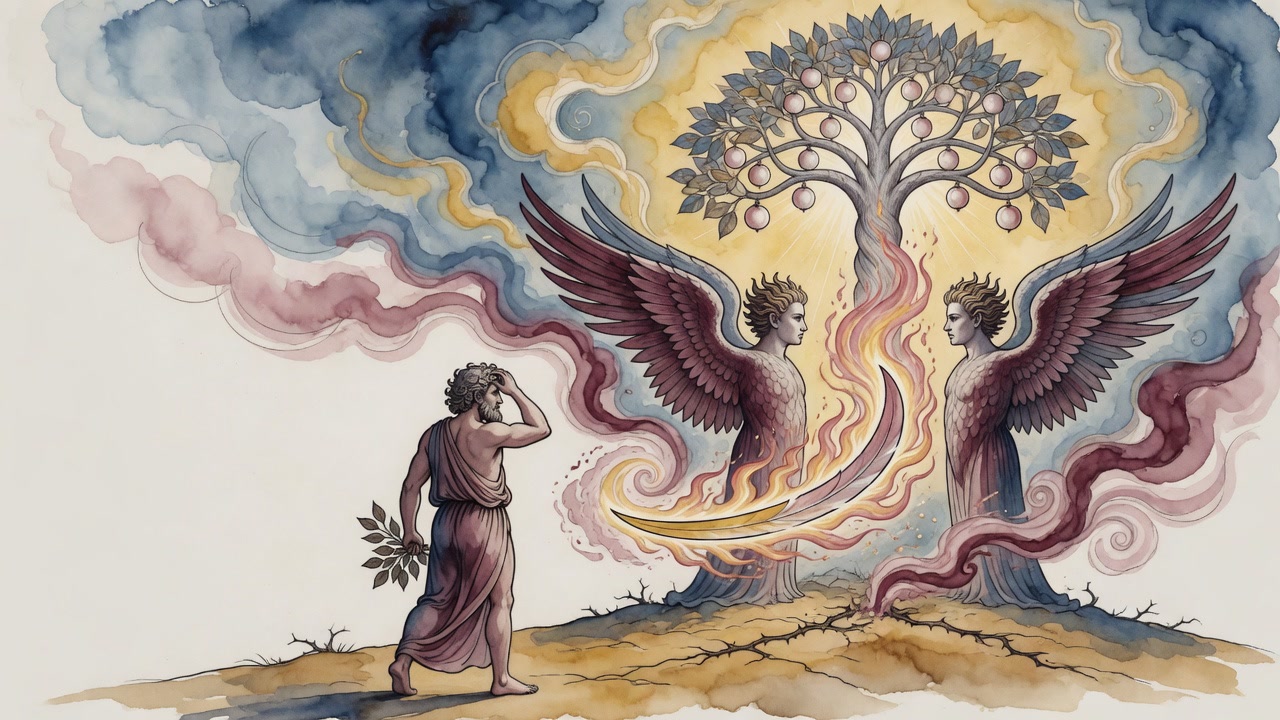
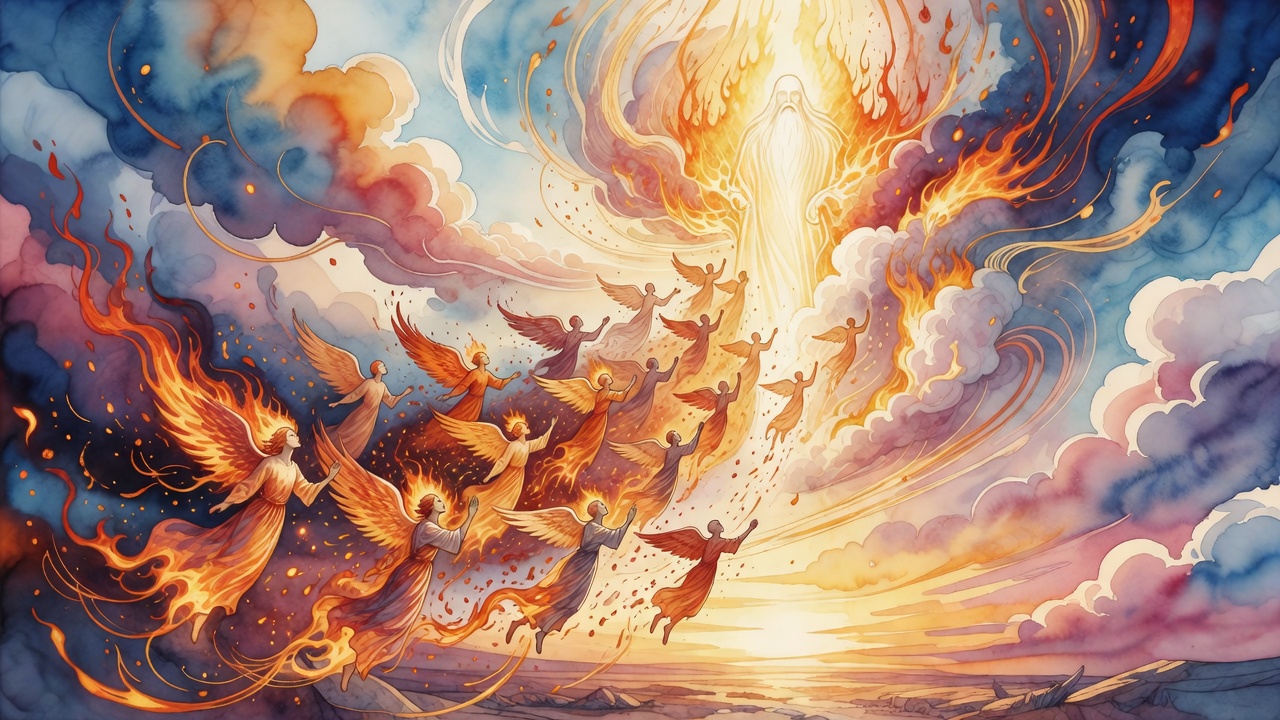
The deeps caught fire from his beauty. The firmaments kindled from his radiance. Angels burst out of his very stature, whole armies of them, and the mighty ones broke loose from his crown, and precious things spilled from the hem of his garment like sparks off struck iron. Then the trees came, and the grasses, springing up and shouting for joy, because his joy had made them and they could not help it. He rose over the heights in his majesty and stretched across the sky like one vast tree whose bough covered the heavens, rooted in the height and branching down over everything below.

Nothing had been built. It had all been poured. The world was not a thing God fashioned with his hands. It was what his beauty looked like when it overflowed.

Why the Lower World Runs Dim

Then Ishmael understood the thing that had gnawed at him his whole life, down in the dust among the study benches. The source was this bright, and the world below was dim, and he had never known why. He saw it now in the light itself.

The radiance did not come down whole. It came down veiled, stepped, contracted, dimmed one degree and then another and then another, the way a man cups his hands around a lamp so a child can look at it without going blind. Each dimming let one more measure of the world exist, one more rung on the ladder that reached from the Throne down to the ground. The lower world was not starved of the light. It was the light, folded and folded again until a creature of dust could stand inside it and live.

And there was one place the folding had not put out. Ishmael felt it in his own chest, a single unspent coal of that first radiance, buried under all the dimming, still burning. The same fire that set the deeps ablaze was sitting inside him, small and covered, and it had been there the whole climb.

He went back down through the seven gates. The angels let him pass without a word this time. When his feet touched the floor of the study house the light was gone from his eyes, but he could still feel the coal, and he never again believed that the world had been hammered into shape.


← All myths
From the tradition

Sources

3 sources

The texts behind this telling. Some cards carry a translation of the source; others are our own retelling of it, and each card says which. Every card links out to the original.

Hekhalot RabbatiHeikhalot Rabbati

Retold in our words. Read the original at the link below.Sefaria-hosted English translation · CC-BY

The familiar telling remembers God's word, God's actions.. but what about God's beauty?

Forget the image of a celestial craftsman hammering the world into shape.

A hymn from Hekhalot (the heavenly palaces) Rabbati, also known as the "Greater Hekhalot," one of the key Hekhalot texts describing heavenly journeys, offers a breathtaking alternative. It paints a picture of creation born not from divine labor, but from divine beauty itself. The deeps, it says, were set ablaze by His beauty, the firmaments kindled by His radiance. Think of it: the very foundations of existence ignited by sheer, unadulterated loveliness.

The image is staggering. Angels bursting from His stature, the mighty exploding from His crown, precious things erupting from His garment. And then, the trees, the grasses – all springing forth, exulting from His joy!

It's such a departure from the more active portrayals we often see. Genesis, of course, speaks of God creating through speech ("Let there be light!"). Other myths depict God shouting, or even smashing elements together with His bare hands. But here, in Hekhalot Rabbati, it's God's very attribute of beauty that takes center stage, identified as the creative element, the life-giving force behind everything.

Why this emphasis on beauty? What does it even mean to say that God's beauty created the world? It suggests that creation isn't just about functionality or order. It's about aesthetics, about wonder, about the sheer joy of existence.

The hymn doesn't stop there. Later on, it describes God as a cosmic tree, "who covered the heavens with His glorious bough, and appeared from the heights in His majesty." This image of a divine tree, rooted in the heavens and branching across the cosmos, further reinforces the idea of creation as an organic, blossoming expression of God's being.

The universe as a living, breathing extension of the Divine, brought forth by beauty and overflowing with joy. What beauty are we capable of bringing into the world? What joy can we cultivate?

Full source
Shi'ur KomahShi'ur Komah

Retold in our words. Read the original at the link below.Sefaria-hosted English translation · CC-BY

Yotzer Bereshit, the Former of Creation, appears in Shi'ur Komah as a mystery at the edge of how the world began.

Yotzer Bereshit – it literally means "Creator of Genesis" or "Former of Creation." Who is this guy?

Well, some say he's the one sitting on the Divine Throne, which is part of God's Merkavah (the Divine Chariot), or Chariot. This Chariot, as Now, is the one on the throne God Himself? Or is it Yotzer Bereshit? The sources differ. What we do know, according to some traditions, is that all the secrets of Creation were revealed to him. That's quite a resume. That's why he gets the title "Creator of the World," because, well, he's the maker of Creation.

The Shi'ur Komah, a text that explores the dimensions of God's figure (specifically, the Primordial Man on the Merkavah), actually identifies this figure as Yotzer Bereshit. The Primordial Man is usually understood to be Adam Kadmon (more on that another time!), the archetypal, perfect human.

But here's where it gets even more interesting. Is Yotzer Bereshit an independent divine figure? A subordinate creator? Or is he just another name for God? The ambiguity is palpable. Think about the Aleinu prayer, where we praise "Him who formed the world in the beginning." Is that God? Or Yotzer Bereshit?

This ambiguity, as some suggest, hints at the idea of a subordinate creator – that this divine figure had some kind of independent existence from the unknowable aspect of God, the Ein Sof, as understood in Kabbalah. It suggests a more complex, nuanced picture of creation than we sometimes realize.

According to 3 Enoch 11:4-5, and other sources, the Primordial Man, Adam Kadmon, is understood as both a transitional phase of Creation and the first created being. And as such, some see in him a reflection of the mystical idea of a subordinate creator acting under divine authority.

So, what does it all mean? Was Yotzer Bereshit a separate entity? A divine architect working under God's direction? Or simply another facet of the Divine, a way for us to understand the process of creation? Maybe the point isn't to definitively answer the question, but to confront the mystery itself. To appreciate the depth and richness of Jewish thought, and the many different ways we can understand the creation of…well, everything.

Full source
Hovat ha-TalmidimChassidic Literature

Retold in our words. Read the original at the link below.Sefaria-hosted English translation · Public Domain

The answer, as they see it, lies in light.

Not just any light,. But how does that translate into… us?

Rabbi Kalonymus Kalman Shapira, a remarkable scholar who lived in Warsaw and tragically perished in the Holocaust, offered a powerful image in his work, Hovat ha-Talmidim (a student) (students). He reinterprets the Kabbalistic idea of tzimtzum (צמצום), a concept central to understanding creation. Tzimtzum literally means "contraction" or "self-limitation."

Traditionally, tzimtzum refers to God contracting himself, creating a "space" for the world to exist. Rabbi Shapira takes a different angle. He suggests that it wasn’t God contracting Himself, but rather God contracting His light.

Think of it like this: imagine an infinitely bright light. To create a shadow, you don't diminish the source, but you block parts of the light, creating areas of less intensity. Through repeated "contractions" of this divine light, the physical world, with all its limitations and boundaries, becomes manifest.

This idea also connects to the sefirot (סְפִירוֹת), the ten emanations or attributes through which God reveals Himself and continuously creates the world. According to Rabbi Shapira's myth, each subsequent contraction of God's light leads to the unfolding of the next sefirah (a divine emanation). It’s a layered process, each step bringing the divine closer to our tangible reality.

So, according to this perspective, everything around us – from the smallest grain of sand to the most distant star – is ultimately an emanation of that divine light. God's kingdom truly has dominion over all, because all of creation is a reflection of His essence.

What I find so compelling is that this myth, created in the 20th century amidst unimaginable horror, demonstrates the enduring power of Jewish myth-making. Even in the darkest times, the human spirit seeks to understand its place in the cosmos, and finds new ways to express the relationship between the divine and the mundane.

It's a living, breathing narrative that continues to unfold with each generation. And perhaps, by contemplating the contractions of light, we can better understand the boundless nature of the source from which it all began.

Full source