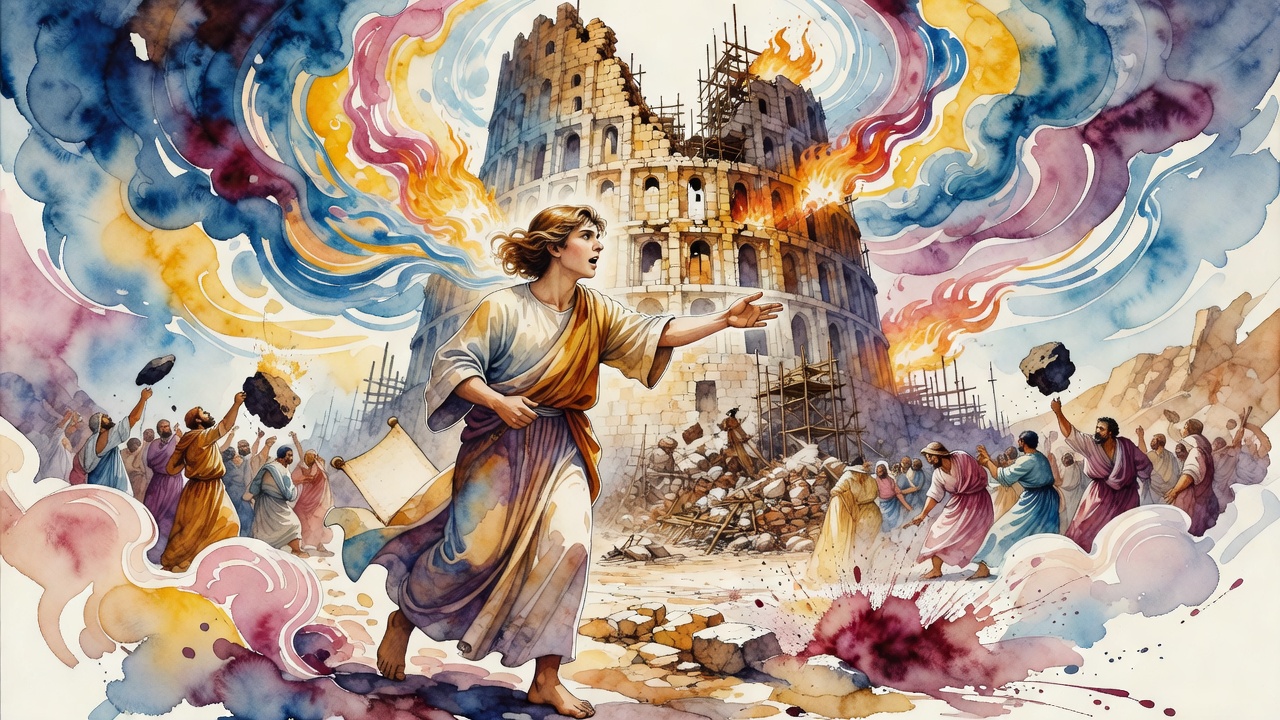
Rabbi Shimon Read the Trapped Bird and Purified Tiberias
A trapped bird teaches Rabbi Shimon ben Yochai that Heaven speaks every pardon and every snare, and he walks out to purify Tiberias.
Table of Contents
For thirteen years the cave kept them. Rabbi Shimon ben Yochai and his son Rabbi Eleazar sat buried in the dark of a rock that had split open to take them in, and they lived on the carobs of a terumah tree and the water of a spring, and they did not see the sun. The skin of a man does not stay whole that long without light. Their bodies cracked. A crust came over them like rust on iron, scabbed and weeping, and they learned to pray inside their own ruined hides.
 Click for full size
Then the cave fell quiet of danger, and Rabbi Shimon came out and sat at the mouth of it, blinking at the unbearable green of the world.
The Net and the Word From Heaven
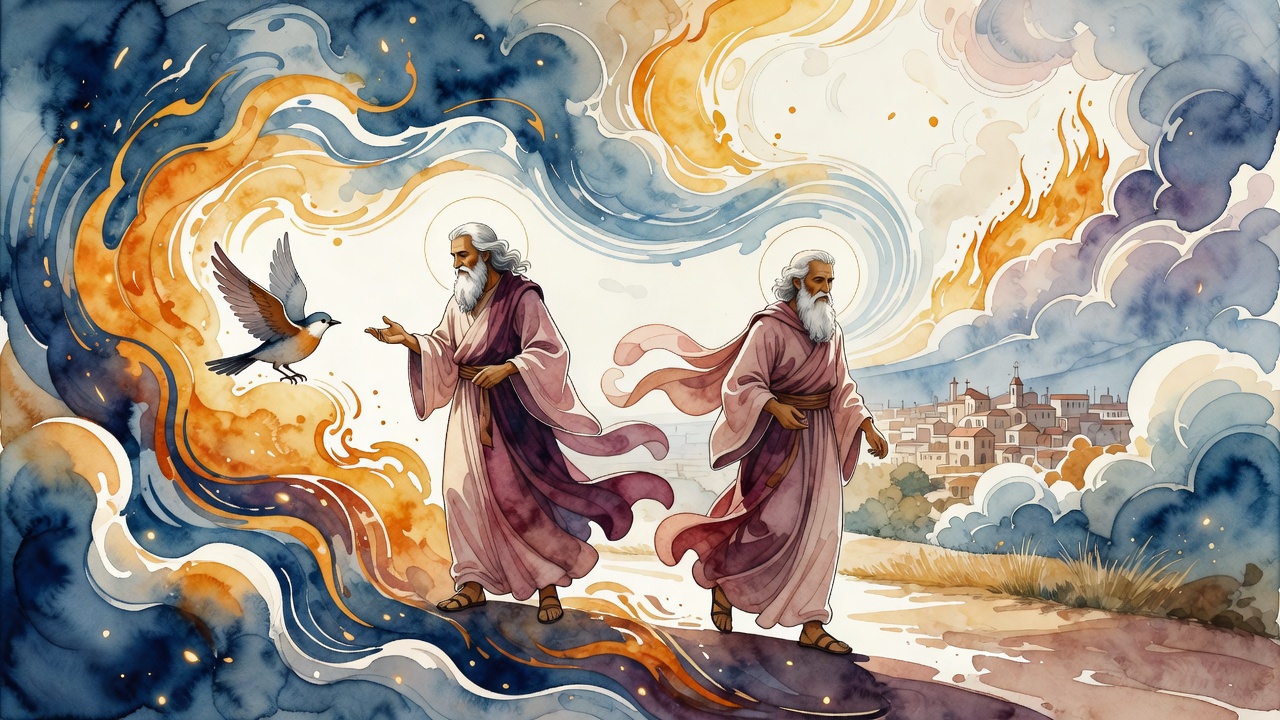
A man was standing in the field below, spreading a net to catch birds. Rabbi Shimon watched him fling it wide the first time. As the net opened, a voice came down out of the sky, one word only. "Pardon." And the bird that should have been taken slipped the mesh and rose and was gone.
The man gathered his net and threw it a second time. Again the voice fell from heaven, and this time the word was different. "Caught." And the bird was held.
Rabbi Shimon sat very still. A sparrow could not so much as blunder into a net unless Heaven said the word over it, first the pardon, then the snare, each one decreed from above before a single feather touched the cords. And he turned the matter on himself. If the smallest bird is not lost without Heaven, he said, then a man is not hunted without Heaven either. Why should he hide in a hole in the ground as though the decree against him were stronger than the One who decreed it? He had heard that the danger had passed. "Let us go down," he said, "and be healed in the hot springs of Tiberias."
The Markets He Set Up Cheap
The waters of Tiberias closed over the cracked skin and drew the crust away, and the two men came up whole. Rabbi Shimon felt the weight of what had been spared him, and he wanted to pay it back into the world.
"We should do as our forefathers did," he said, the ones who, when a kindness was owed, would open the markets and sell their goods cheap so the poor could eat. So he opened a market and sold cheap. But a debt of gratitude that size does not close with bread alone. The city itself had a wound in it, an old one, and he meant to clean it.
The Lupines and the Floating Dead
Tiberias was unclean. Somewhere under its streets and houses lay the dead, buried and forgotten, and no priest could walk there, and no one knew where the bones were. Rabbi Shimon took lupines, the bitter field-beans, and cut them into pieces, and he went through the city scattering them across the ground. Wherever a corpse lay hidden below, the earth gave it up. The dead floated, rose, surfaced to be marked and moved, and the streets behind him came clean one by one.
Word ran ahead of him. The old man of the Jews was purifying Tiberias.
A certain Samaritan heard it and was sick of the whole thing. "I will go," he said, "and make a fool of this old Jew." He took a corpse of his own, carried it to a lane Rabbi Shimon had already cleansed, and hid it there in the cleared ground. Then he came to the sage, smooth and respectful. "Did you purify such-and-such a street?" Rabbi Shimon said yes. "And if I bring a dead body out of it, right there behind your back?" Rabbi Shimon looked at him. "Go," he said. "Show me."
The man turned to lead the way, certain of his trick. But the Holy Spirit had already told Rabbi Shimon what was planted in that lane and who had planted it. He spoke once, like a man closing a door. "I decree upon the one above to go down, and upon the one below to come up." And it was so. The corpse the Samaritan had carried sank into the earth, and the living man who had carried it was brought up dead in its place.
The Child Who Could Not Hold His Tongue
His work in the city done, Rabbi Shimon walked out past the synagogue of Magdala, and a voice followed him, high and pleased with itself. It was a child, the local scribe's boy, calling out for everyone to hear. "Look, there goes the son of Yochai, who purified Tiberias!" The boy was needling him. There were those in Tiberias who held that the city had never truly been unclean, that the purifying had been an old man's performance.
Rabbi Shimon stopped. "And were you not among the ones counted," he said, "the dead I called up out of those streets?" He raised his eyes to the boy. And the look that had spent thirteen years in the dark went out of him, and where the child had stood there was a heap of bones.
The Aftergrowth and the Serpent in the Verse
Another road, another year. It was the sabbatical, the seventh year, when the land of Israel is meant to rest and what grows of itself is not to be gathered as a harvest. Rabbi Shimon was passing through and saw a man bent over the rows, scooping up the aftergrowth, the volunteer crop that had come on its own.
"My son," he said, "is this not the seventh year? This is forbidden to you."
The man straightened, unbothered, and threw the ruling back in the sage's face. "And are you not the very one who permits it?" For Rabbi Shimon was known to read the law of the aftergrowth leniently, and the man had heard as much.
"But what if my colleagues differ from me," Rabbi Shimon said, "and the fence still stands where they set it?" A man may lean on a lenient teacher, but he does not get to break the hedge of the law for his own belly and call it permission. And over the man Rabbi Shimon laid the words of Kohelet, quiet as the last decree. "And one who breaches a fence, a serpent shall bite him." And it was so.
← All myths