5 min read

Solomon Captures Ashmedai Then Loses Everything to Him

Solomon binds Ashmedai with the Ineffable Name to get the shamir. After the Temple is built, Ashmedai borrows the royal ring and throws Solomon into exile.

Curated by Arthur · Told by Maggid ·
Table of Contents
  1. The Problem Iron Could Not Solve
  2. The Demon Who Walked a Straight Line
  3. The Shamir, the Temple, and the Ring
  4. The Cook and the Long Road Back

The Problem Iron Could Not Solve

The Temple could not be built with iron. The Torah had forbidden iron tools on the altar, and Solomon, meticulous as he was, extended that prohibition to the entire sanctuary. Stone could not be cut with metal. But unhewn stone would not fit together with the precision the building required. The project was stalled by a theological constraint.

The solution was the shamir, a small creature that could split stone by gaze alone, without touching it. The shamir was in the possession of Ashmedai, king of the demons.

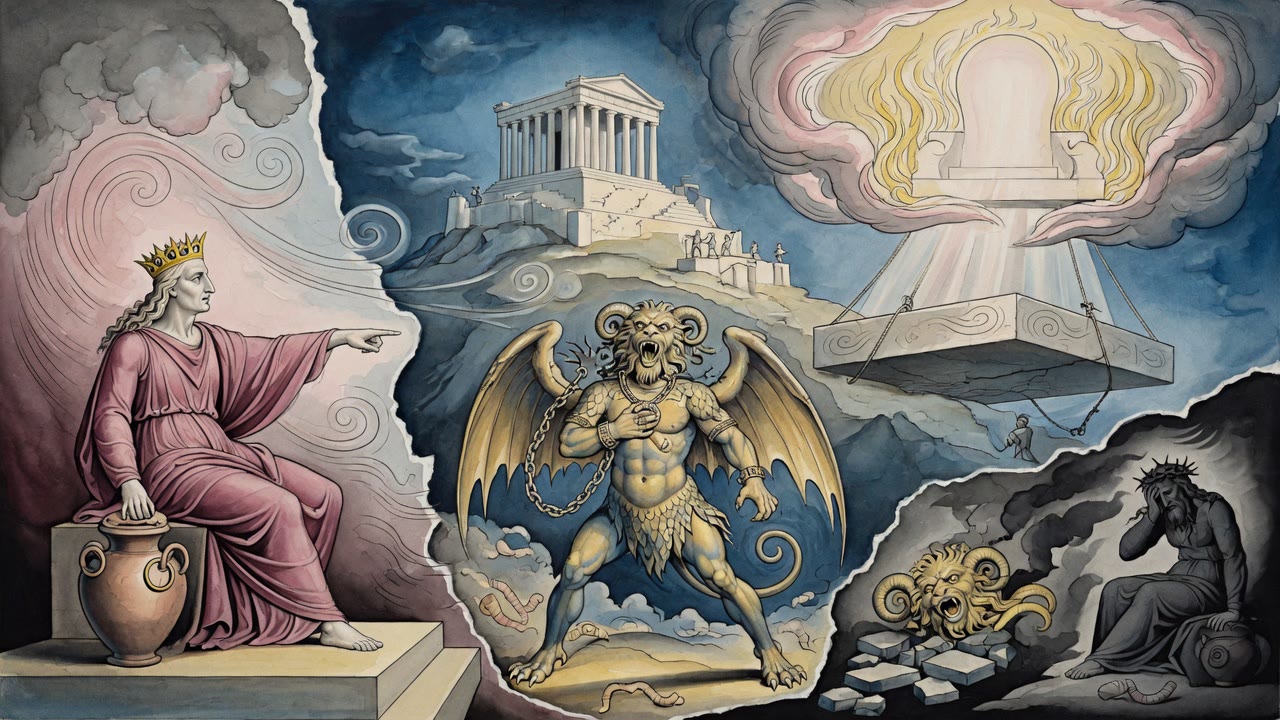
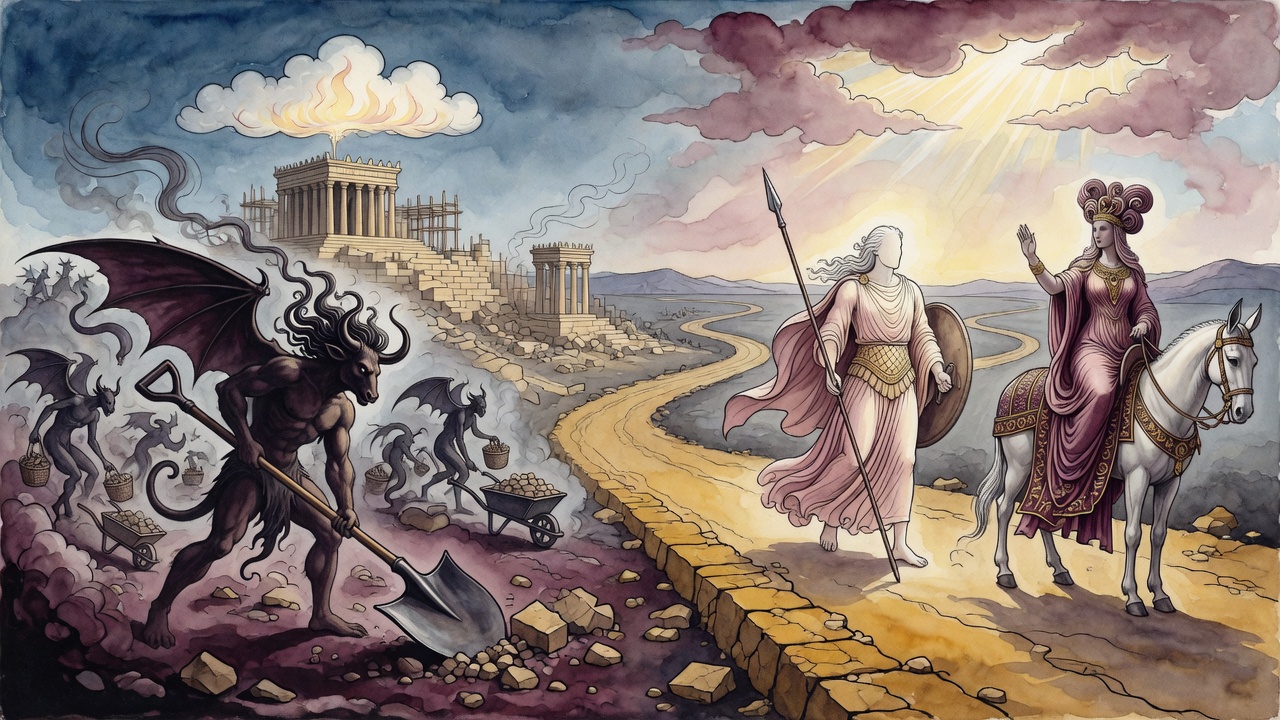
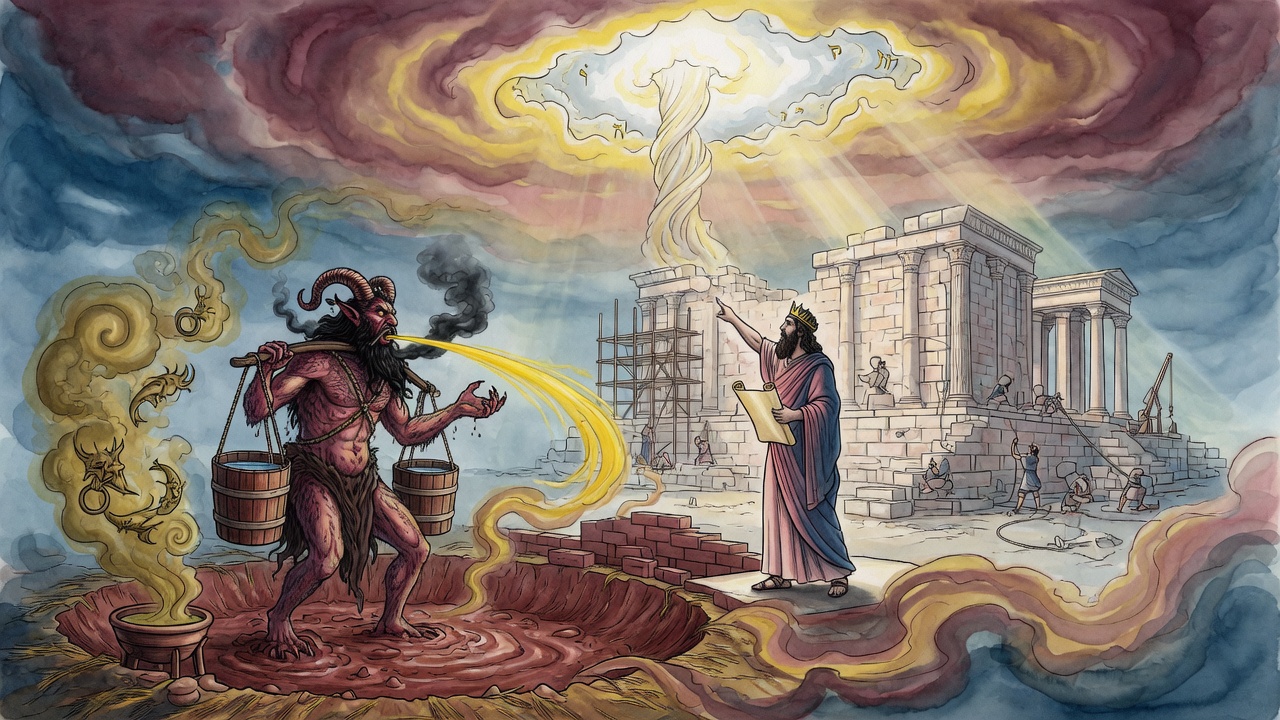
Solomon sent his general Benayahu ben Yehoyada to capture Ashmedai and bring him back to Jerusalem. The kit Benayahu took was unusual: a chain engraved with the Ineffable Name, Solomon's own signet ring, wool, and several skins full of wine. He located Ashmedai's drinking pool, dug a lower drain to empty it, and filled it with wine from the skins. The demon arrived at his customary drinking spot, found only wine, refused it initially because he never drank wine, then eventually drank until he was overcome. Benayahu bound him with the Name-engraved chain and led him toward Jerusalem.

The Demon Who Walked a Straight Line

The march to Jerusalem became a series of incidents that each demonstrated something about how Ashmedai saw the world. He wept when he passed a wedding. He laughed when he saw a man buying new shoes. He laughed when he saw a man hire a sorcerer for instructions on how to find buried treasure. He wept when he saw a blind man searching for a path. He laughed when he passed a school.

When Solomon finally asked him to explain, Ashmedai answered that he wept at the wedding because the bridegroom would die within thirty days. He laughed at the new shoes because the man who bought them would never walk far enough to wear them out. He knew where the buried treasure was and could see that the sorcerer would not find it. He wept for the blind man who, Ashmedai had seen, was actually righteous and would find his way despite everything. The school made him laugh because the teacher had sinned secretly and was teaching children about a law he was himself violating.

He was not cynical. He was accurate. He wept at real losses and laughed at real absurdities, and the only thing that separated his vision from human vision was that he could see the whole situation, not just the visible surface of it.

The Shamir, the Temple, and the Ring

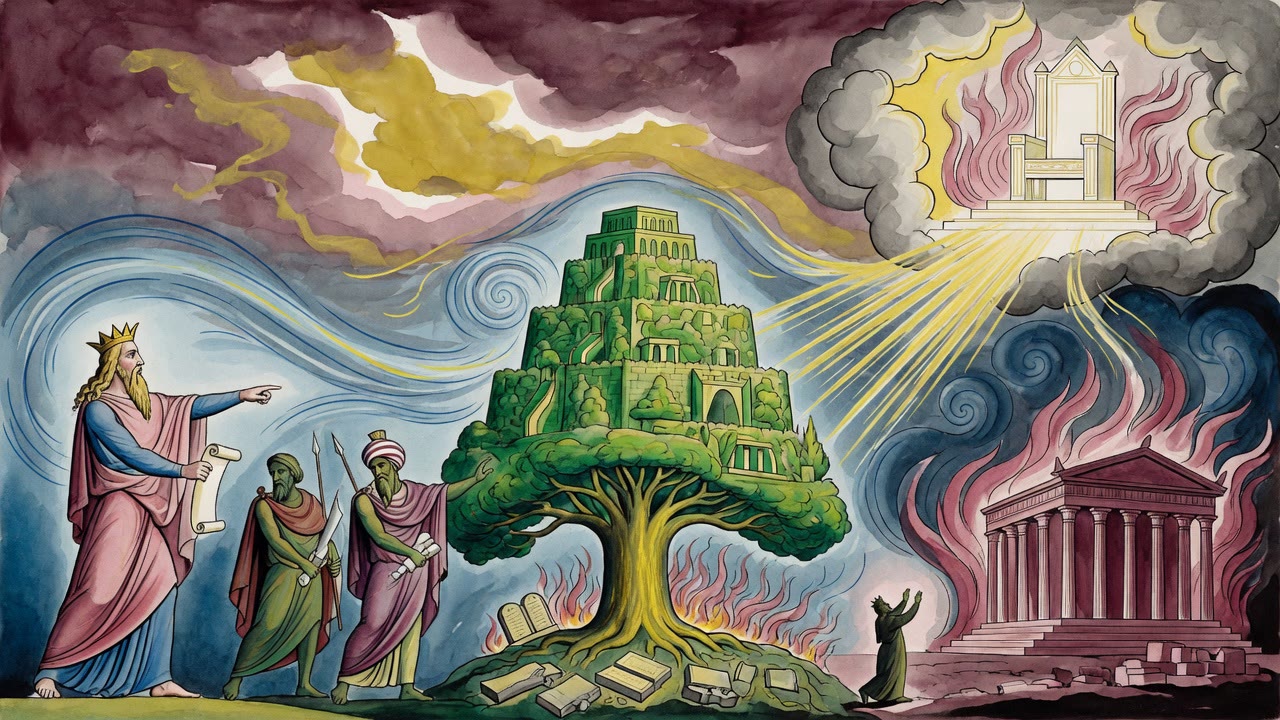
The shamir was obtained. The Temple was built. The stones were cut without iron and the building was raised and the work was finished and Solomon had accomplished the thing his father David had wanted to do but had been told by God was not his to build.

Then Solomon made an error. Ashmedai, still bound in Jerusalem, promised to show Solomon some wonders if the king would remove the Name-engraved chain and lend him the signet ring. The wonders were real wonders, the king was told. He would not be disappointed.

Solomon agreed.

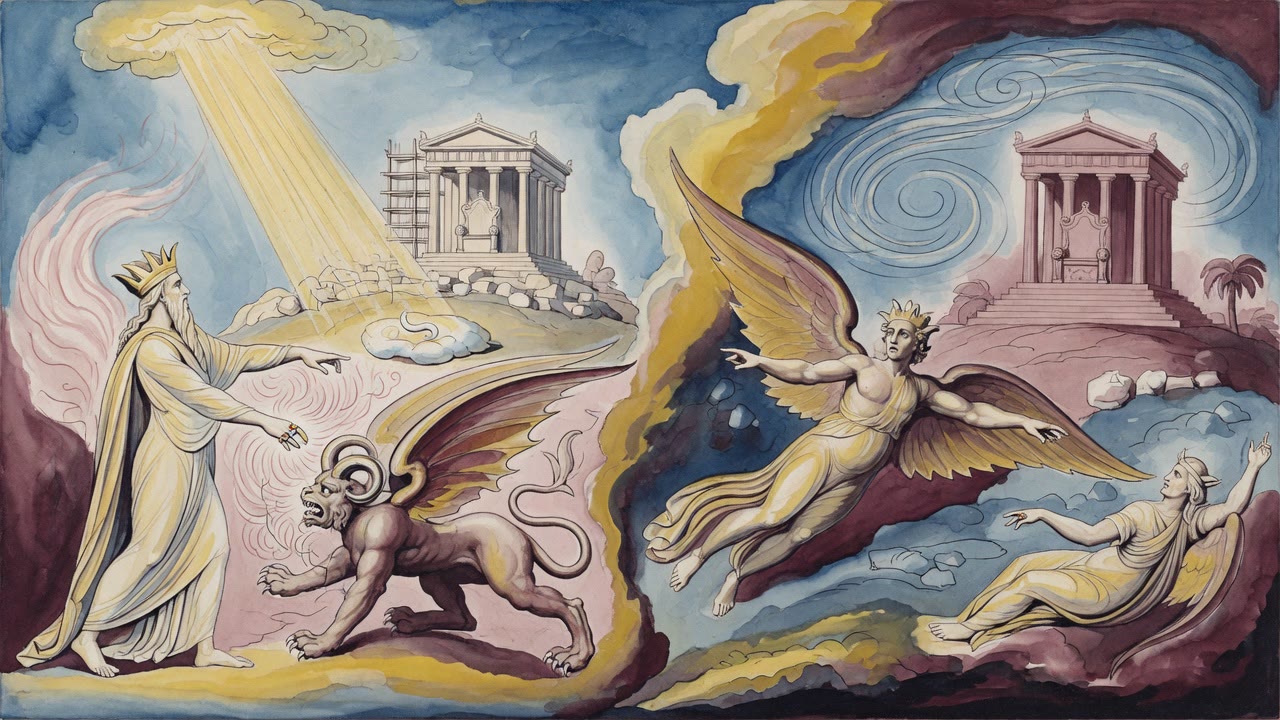
The moment the chain came off and the ring came loose, Ashmedai took hold of Solomon and flung him. The king sailed four hundred miles from Jerusalem and landed in the distant land of Ammon, penniless and alone. Ashmedai seated himself on the throne and took the form of the king and ruled in his name while Solomon wandered.

The Cook and the Long Road Back

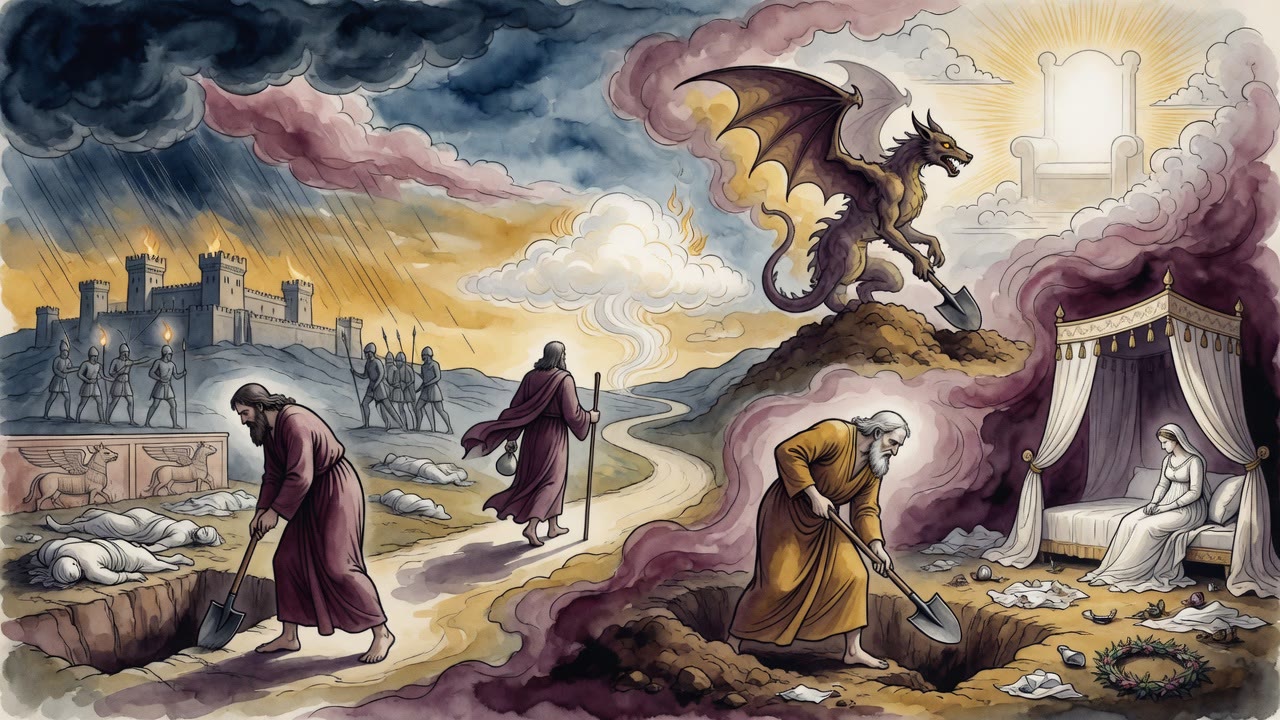
Solomon wandered for three years. He went from city to city and told his story: that he was Kohelet, Ecclesiastes, formerly king of Israel over Jerusalem, and no one believed him. He took work as a cook in the court of a lesser king, and while he was cooking he met the king's daughter, Naama, who saw in him what the world around her could not. She believed the story of the fallen king. The lesser king had them both beaten and thrown out, and they wandered together into the desert.

Naama found fish and cooked it. Inside the fish was Solomon's signet ring, the one Ashmedai had taken. He put it on his finger and spoke the Name and Ashmedai fled. Solomon went back to Jerusalem and found his throne waiting to be reclaimed and his kingdom intact and his three transgressions, the horses and the wives and the gold, now understood by him as clearly as Ashmedai had understood everything else from the beginning.


← All myths
From the tradition

Sources

2 sources

The texts this telling draws on, in full. Open a card to read inline, or expand it for a wider, quieter read.

Gaster, Exempla of the Rabbis, No. 114; Talmud, Gittin 68The Exempla of the Rabbis (1924)

King Solomon wanted to build the Temple from unhewn stone. The Torah forbade iron tools on the altar, and Solomon, meticulous as always, extended the prohibition to the whole sanctuary. But stone will not split without a tool.

The only solution was the Shamir, a tiny worm that could cut stone by gaze alone. The Shamir was said to be in the possession of Ashmedai, the king of the demons.

Solomon sent his general Benayahu ben Yehoyada with a chain engraved with the Shem ha-Meforash, the Ineffable Name. And with Solomon's signet ring, along with wool and skins full of wine. Benayahu located Ashmedai's daily drinking well. He dug a lower well, drained the original, and refilled it with wine. Ashmedai, thirsty, drank without noticing the switch. When he passed out, Benayahu bound him with the Name-engraved chain.

On the road back, Ashmedai behaved strangely. He tore up trees. He bent sideways to avoid a widow's hut. He helped a blind man and redirected a lost child. He wept at a wedding feast. He laughed at a man ordering boots meant to last seven years. He laughed at a fortune-teller performing tricks.

Brought before Solomon, Ashmedai waited three days to be received. Then he hurled a four-cubit cane at Solomon's feet. "When you die," he said, "that is the whole space you will occupy. But now the whole world cannot satisfy you."

Solomon asked how to obtain the Shamir. Ashmedai explained it had been entrusted to a certain wild bird. Solomon's men found the nest, covered it with a glass bell, and when the bird returned she dropped the Shamir onto the glass to split it open. Startled by a sudden noise, she flew off without it.

Later Ashmedai explained his behavior on the road. The blind man he helped was a pious man whose reward needed to be delivered in this world. The child would grow into a sinner whose credit needed to be paid out while he was still innocent. He wept at the wedding because the bridegroom would die within three days, and the bride would wait thirteen years for yibum, for her young brother-in-law to come of age. He laughed at the man ordering seven-year boots because the man would not live seven days. He laughed at the fortune-teller because the fortune-teller was sitting on a buried treasure and did not know it.

While the Temple was being built, Solomon grew curious. He removed Ashmedai's chain and handed him the signet ring, just to see some marvelous thing. Ashmedai swallowed the ring, unfurled wings that touched earth and heaven, and flung Solomon four hundred miles away. The king wandered, begging for bread, saying: I, Kohelet, was king in Jerusalem (Ecclesiastes 1:12).

Meanwhile Ashmedai, taking Solomon's shape, sat on the throne. The sages grew suspicious. They asked the queens to examine his feet. He always came to them in shoes. And demons have chicken-feet that cannot be disguised. When the real Solomon finally returned to Jerusalem and was given back the signet ring and the chain, Ashmedai vanished.

Gittin 68 and Gaster's Exempla #114 preserve this long adventure. The wisest king in the world built the Temple only by borrowing tools from the king of the demons, and learned along the way that his own throne could be stolen the moment he forgot who he was.

Full source
Gaster, The Exempla of the Rabbis (1924), no. 404 (Parables of Solomon); cf. Gittin 68bThe Exempla of the Rabbis (1924)

The Rabbis teach that King Solomon, for all his wisdom, committed three transgressions of kingship that the Torah had warned against. He multiplied horses. He multiplied wives. He amassed silver and gold beyond the limit set for a Jewish monarch (Deuteronomy 17:16–17). God decreed that he would be punished, and the punishment, when it came, was strange and elaborate.

After the building of the Beit Ha-Mikdash in Jerusalem, Ashmedai, king of the demons, whom Solomon had bound into service with the Ineffable Name, promised to show Solomon some wonders if the king would lend him his signet ring, the ring that carried the Name itself. Solomon, in a moment of pride, handed it over. Ashmedai seized the ring, grew to the size of a mountain, flung Solomon four hundred miles across the earth, and took his seat on the throne disguised as Solomon himself.

Solomon woke in a foreign country with nothing. No robe, no ring, no crown. He wandered as a beggar into the city of the king of Ammon, where the head cook of the royal kitchen pressed him into service, first as a load-carrier from the market, then as an assistant in the kitchen. One day Solomon prepared a dish that so delighted the king of Ammon that the exile was appointed head cook of the palace.

Naamah, the daughter of the king of Ammon, fell in love with the new cook. Her mother warned her off. She refused to listen. Her father was furious; he wanted to kill them both, but instead exiled them together into the desert to die. The couple wandered until they reached a town by the sea. Solomon, recognizing that his wife was hungry, bought a single fish that had just been pulled from the water. When Naamah opened it to clean it, she found inside, the signet ring. Solomon's own ring, swallowed by a fish on the other side of the world, carried through currents for years, finally come home.

He put the ring on. Ashmedai, back in Jerusalem, felt the Name return to its true bearer and fled. Solomon and Naamah traveled to Jerusalem. Solomon climbed the throne. He summoned the king of Ammon and asked why he had condemned two innocent people to the desert. The king of Ammon explained. Solomon made himself known. The king and queen of Ammon blessed the God of Israel and returned home.

The story, preserved as exemplum no. 404 in Moses Gaster's 1924 The Exempla of the Rabbis and appearing in the Talmud (Gittin 68b), is one of the strangest in the whole Solomonic cycle. Its quiet point is about the ring. The Name of God, carried by a man, can be loaned away for a moment. But it will always find its way back to the person to whom it was really given. Solomon lost his throne. He served dishes to a foreign king. He walked through the desert. And then a fish came out of the sea with his ring in its belly. Wisdom and power, the Rabbis are telling us, are not things you hold. They are things that circulate. Sometimes you have to lose them completely to learn that you never really owned them.

Full source