Solomon Summoned Every Creature to His Feasts and One Did Not Come
Solomon used a ring inscribed with God's name to call every beast, bird, and demon to his table. Every creature came dancing. Then one did not appear.
Table of Contents
 Click for full size
The Feast That Called All of Creation
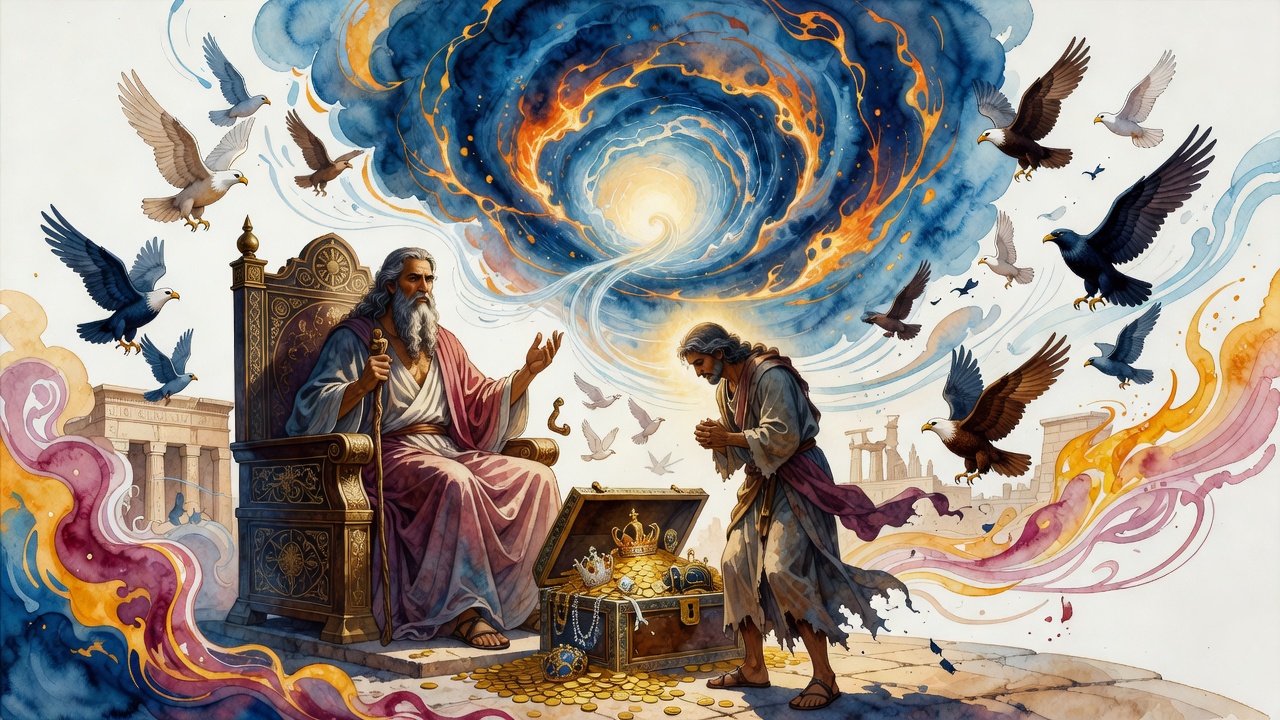
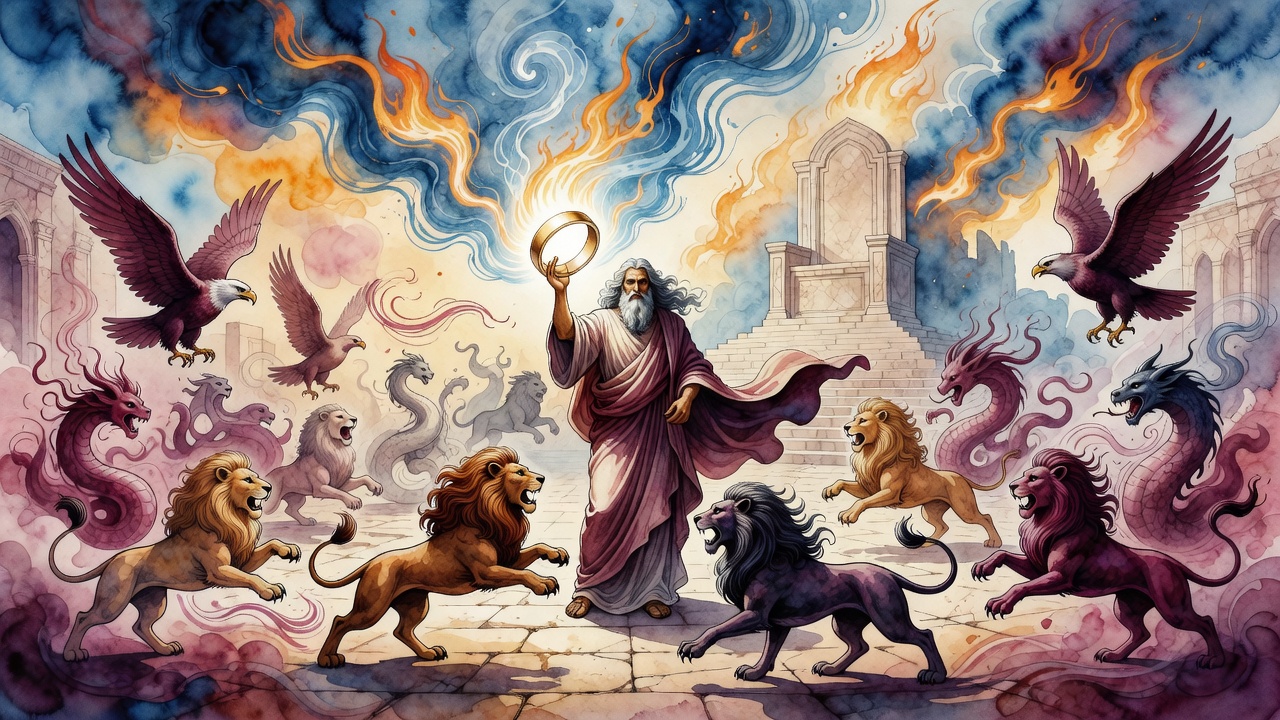
Solomon held banquets that the tradition describes as unlike anything else in human history. He would sit at the head of a table set for the great men of his kingdom, wine flowing, and he would take the ring inscribed with the divine name from his finger and hold it up. The ring gave him dominion over the spirit world, over the shedim, the demonic forces, the same authority that had allowed him to bind Asmodeus and build the Temple without iron tools. When he raised the ring at his feasts, every creature in creation received the summons.
They came. Every beast of the field. Every bird of the air. Every creature that crept on the ground. Every shade and specter and demon that inhabited the unseen world. They arrived without chains or coercion, dancing before the king and his guests, the wild and the tame and the demonic all present together at Solomon's table in something that looked, to the tradition's imagination, like a recapitulation of the sixth day of creation, when God had assembled the full inventory of living things before Adam and Adam had named them all.
Solomon was performing a kind of annual recreation of that naming. Every year at his great feasts, he called the roll. Every year, everything came.
The Unfinished Corner of the World
The tradition connects Solomon's power to something built into the structure of creation itself. When God made the world, there was a corner left unfinished. The world is not a closed circle. There is a place at the edge of the north where the boundaries are incomplete, where the firmament does not fully meet the earth, where the logic of creation runs out into something unresolved. Any entity that wanted to claim divinity could go there and say: I built that corner. I will finish it. The claim would be false, because God left it unfinished deliberately, but the false claim could still generate power for the one willing to make it.
The demons knew about this corner. The shedim lived in the regions adjacent to it. Solomon's ring gave him authority over them precisely because the ring carried the divine name that had created the world including its unfinished margin. He held dominion over what was complete and over what was deliberately left incomplete.
The Creature That Did Not Come
At one of these feasts, when the scribes had finished calling the names and the full assembly was present, one creature was missing. The rooster-demon, the hoopoe-bird, the Shamir's guardian, depending on the source, had not come. Solomon searched the assembly. The creature was absent. The most powerful king in the world, the man who could summon every spirit in the spirit world, had encountered the one creature that had not responded to his ring.
When the creature finally appeared, it came with a report. It had been traveling. It had found something Solomon did not know about: a kingdom at the far edge of the world, a queen ruling over a people who worshiped the sun. The creature, in most tellings the hoopoe, had found the land of Sheba.
Solomon sent a letter to the Queen of Sheba, carried by the birds. The letter announced that he was coming, that she should present herself before him, and that if she did not come willingly she would come unwillingly. The bird that had been absent from his feast became the messenger that opened the world's most famous encounter between a king who held dominion over creation and a queen who ruled a kingdom he had not known existed.
The Demon Solomon Interrogated
The feasts also produced stranger encounters. The tradition records that Solomon once captured a headless demon, a creature with human limbs but no visible face, that haunted the threshing floors. He brought it before his court and interrogated it about its nature and its origins. The demon described itself as one of the sixth-day spirits, created in the last moments before the Sabbath when God was still making beings without finishing their forms. It had been walking the earth without a head since creation, hungry and directionless, attaching itself to grain stores and causing ruin.
Solomon cataloged these encounters. The tradition says he wrote them down, that the Testament of Solomon, a collection of demonic interrogations, came from these feasts and these bindings, that Solomon's wisdom about the spirit world was not theoretical but empirical, gathered one demon at a time at his table over the course of his reign.
← All myths