Solomon Learned Humility From Ants and Beans
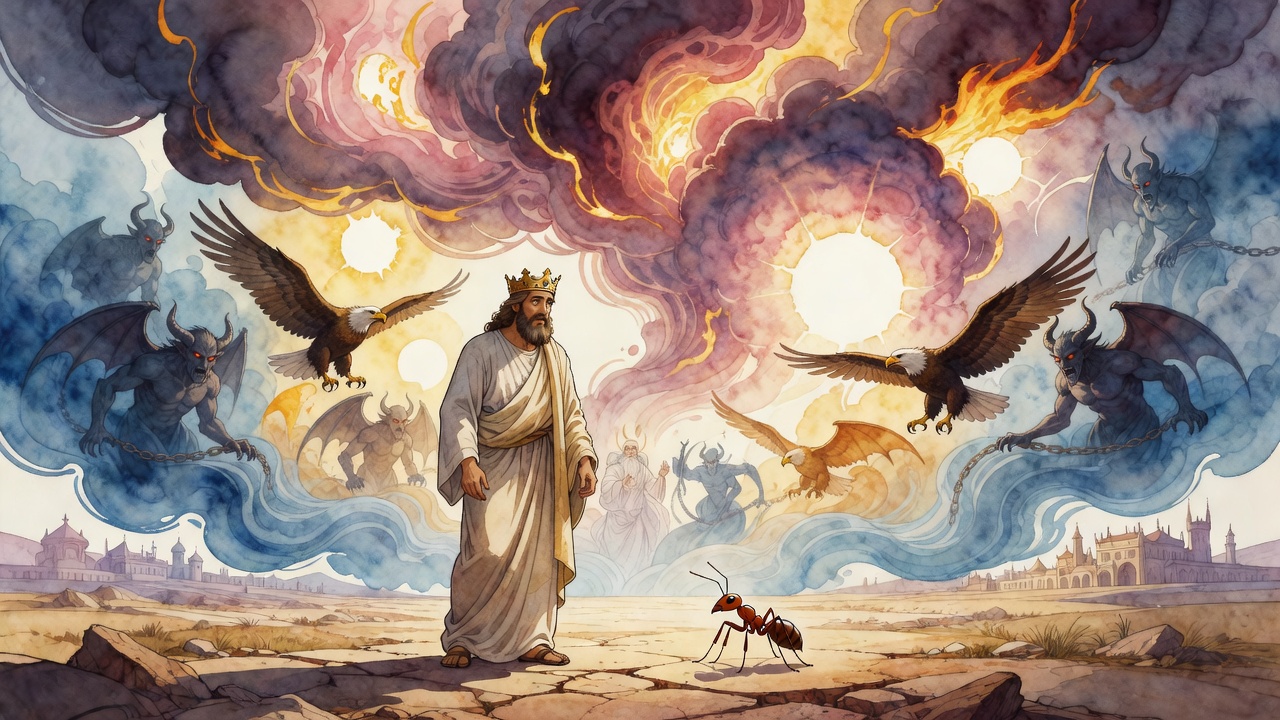
The king who speaks every language hears an ant warn her colony before his army crushes them and learns his glory looks like danger from the ground.
Table of Contents
Solomon had finished listing his achievements to his court. He had recounted the strength of his armies, the size of his fleet, the reach of his treasury. He concluded by declaring himself the greatest king who had ever lived.
 Click for full size
The Holy One heard him. And sent him an invitation, from an ant.
The Feast in the Anthill
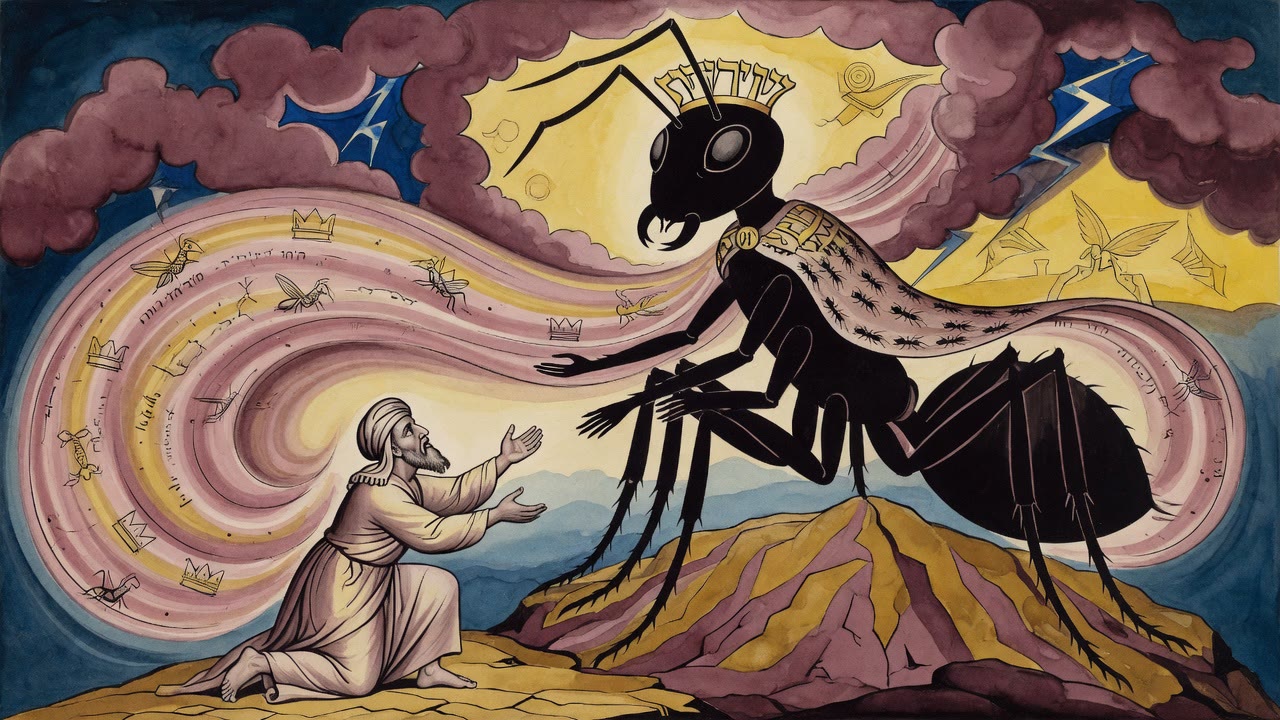
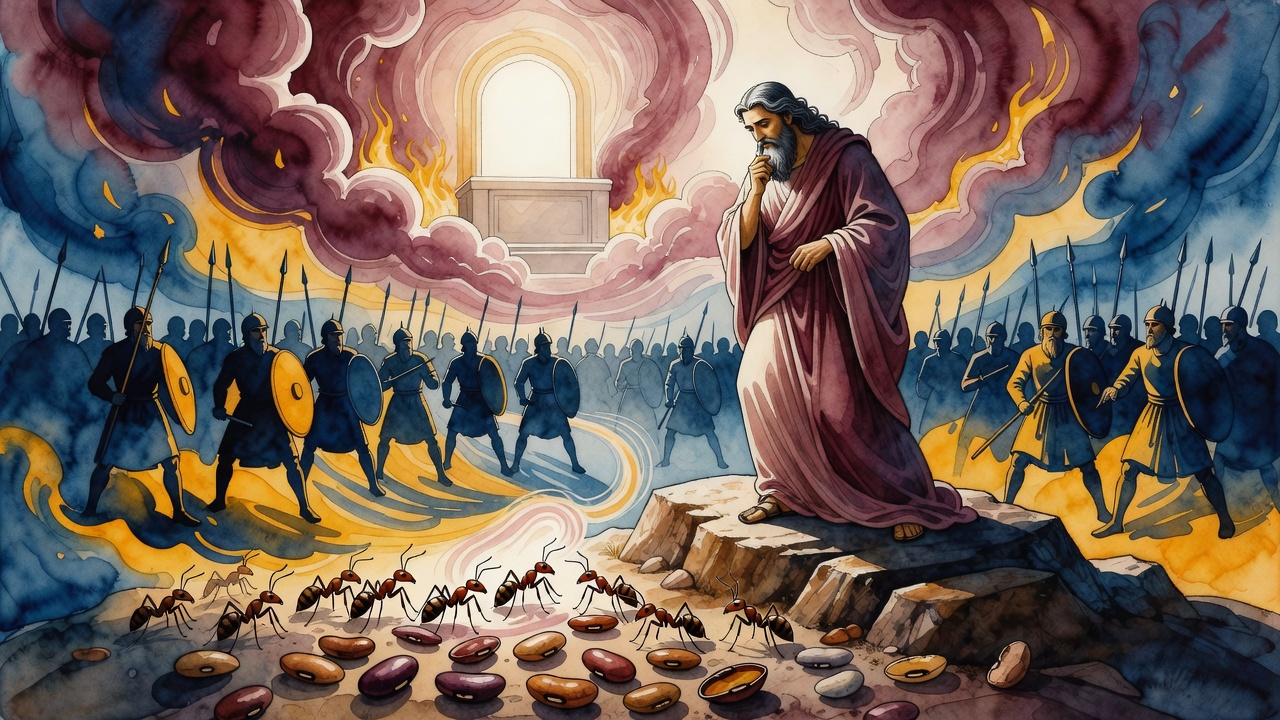
A tiny ant arrived at Solomon's palace and invited the king and his entire army to a feast. Solomon accepted. He traveled with his forces to a valley. He waited. The ant disappeared into the anthill and did not return for three days. When she emerged, Solomon asked what had taken so long. She said: "I was going through the rooms of my house, calculating whether they were large enough to hold you and your army."
Solomon laughed. He asked her name. She said: "I am the queen of the ants." He asked whether she knew who he was. She said: yes. He asked whether she would bow down to him. She said: "I should bow down to you? You should bow down to me. I am greater than you."
Solomon asked how that could be. She answered: "because God sent you to me. If I were not greater than you, God would have sent me to you."
Solomon could not answer. He had been measured by a creature he could crush underfoot, and the measurement was precise. His boast that he was the greatest king who had ever lived had not accounted for the hierarchy of divine assignment, in which greatness is determined not by the extent of one's kingdom but by who was sent to learn from whom.
The Ant Queen in the Valley
Legends of the Jews, compiled by Louis Ginzberg from earlier rabbinic traditions, preserves a parallel account. Solomon was traveling through a valley with his immense army when he heard a small voice ordering the ants to withdraw from his path before his forces crushed them. He halted his procession and spoke to the ant. He asked her whether she knew who he was. She said she did. He asked why she had not addressed him with proper deference.
Her answer: "if you were truly great, you would be afraid of God the way you expect me to be afraid of you. You are afraid of nothing. That is not wisdom. That is arrogance wearing wisdom's name."
Solomon picked her up to examine her. She told him to put her down: "you are nothing but a maggot's brother, born of a woman, and you are examining me?" He put her down. He went on his way quieter than he had come.
Solomon and the Boiled Beans
Another tradition from Gaster's Exempla preserves a different kind of humiliation, administered not by an insect but by a poor man's child. In the time of David, a famine struck Israel. A poor man with nine children was brought nine boiled eggs by a neighbor, one for each child. The children ate them. Twenty years passed. The neighbor, now harder-hearted, came back and demanded payment for those nine eggs, plus interest: the thousands of chickens those eggs would have become, had they been allowed to hatch and reproduce.
The case came before Solomon. The neighbor argued with the logic of compounding potential. The poor man had nothing. Solomon asked for time. Then he sent to the poor man a sack of boiled beans and a message: "plant these." The poor man protested: "boiled beans will not sprout." Exactly, Solomon replied. "Tell the court that."
Solomon's ruling was a lesson in the difference between theoretical potential and actual reality. The neighbor was demanding payment for chickens that had never existed, for a potential that the act of giving the eggs had already closed. Boiled eggs cannot hatch. Boiled beans cannot sprout. You cannot ask someone to pay for the unrealized future of something that was already completed when you gave it.
The Sword of Lead
Gaster's Exempla also records a stranger test. Solomon had written in Ecclesiastes that one man among a thousand he had found worthy but a woman among all those he had not found. Someone asked him to explain the line. Solomon said: "I will show you."
He summoned a man who loved his wife deeply and gave him a sword of lead and an instruction: "kill your wife tonight and I will give you one of my daughters in marriage." The man went home and told his wife. She said: "do it. He should not pass up such an opportunity. He should kill her and take the king's daughter." The man refused. He came back to Solomon and said he could not do it.
Solomon sent for a different kind of test on the wife's side. The pattern repeated. The wife's willingness to be sacrificed for her husband's advancement, and the husband's refusal to sacrifice her, told Solomon what he had already suspected about the particular kinds of failure human beings were vulnerable to. His line in Ecclesiastes was not a universal condemnation. It was a specific observation about what he had found in the particular tests he had run. Humility about generalizations is also a form of wisdom.
The Throne and the Animals of Gold
A final tradition describes Solomon's throne: thirty-three steps of gold, each step flanked by golden animals, a golden lion and a golden ox on each step. Above the throne a golden canopy with a golden chain, and from the chain a golden dove holding a crown in its beak with a gem inside it that lit the whole world. When Solomon placed his foot on the first step, the golden lion and ox rose and supported his leg. When he reached his seat, an eagle spread its wings and shaded him.
The throne that required a machine to raise him and animals to support his steps tells its own version of the ant's lesson. The greatest human throne ever built still needed the body it seated to be lifted by animals and sheltered by a bird. The glory of Solomon was real. It was also not self-sufficient for a single step.
← All myths