Parshat Haazinu6 min read

The Day God Unfolds the Robe and Draws the Blade

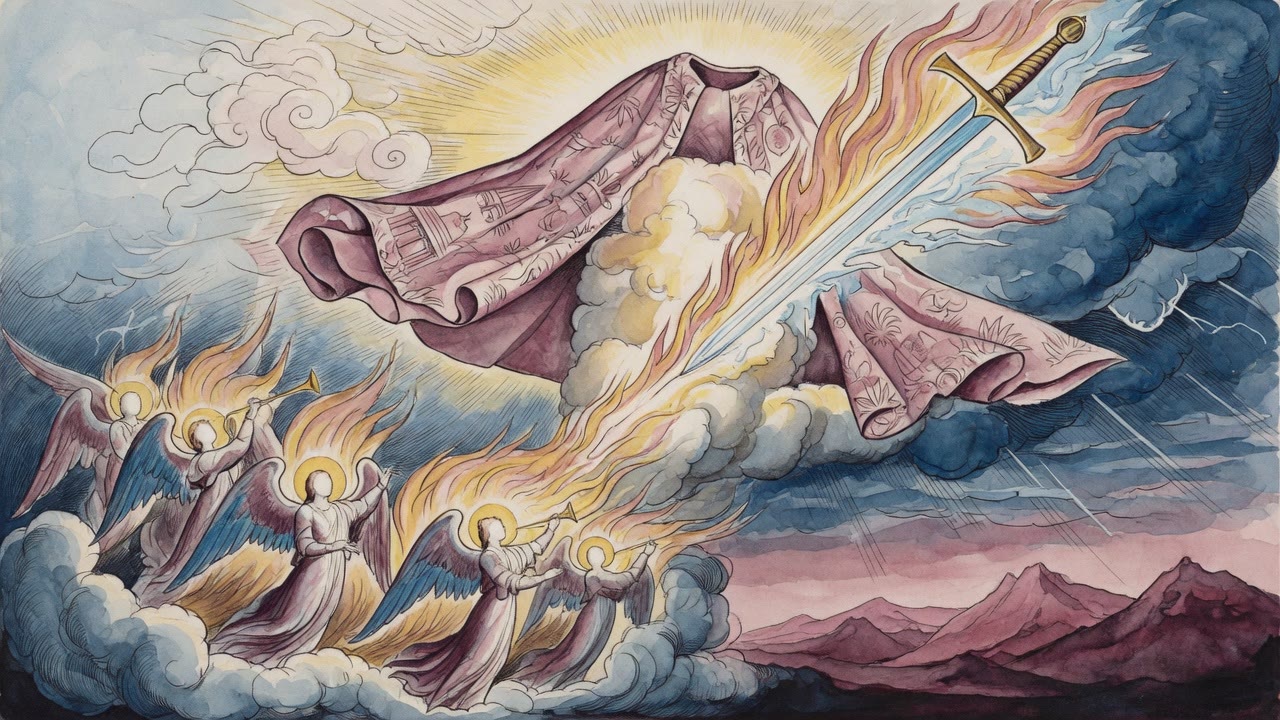
God folded the festival robe away when Israel sinned, and takes it up only on the day the avenging angels storm forth with His sword of fire and ice.

Curated by Arthur · Told by Maggid ·
Table of Contents
  1. The Robe Folded in the Dark
  2. The Seal Breaks on the Book
  3. The Angels Storm Out With the Blade
  4. Fire Falls Into the Temple
  5. The Silence After the Sword
The Day God Unfolds the Robe and Draws the Blade Click for full size

The Robe Folded in the Dark

There is a garment God has not worn in a very long time.

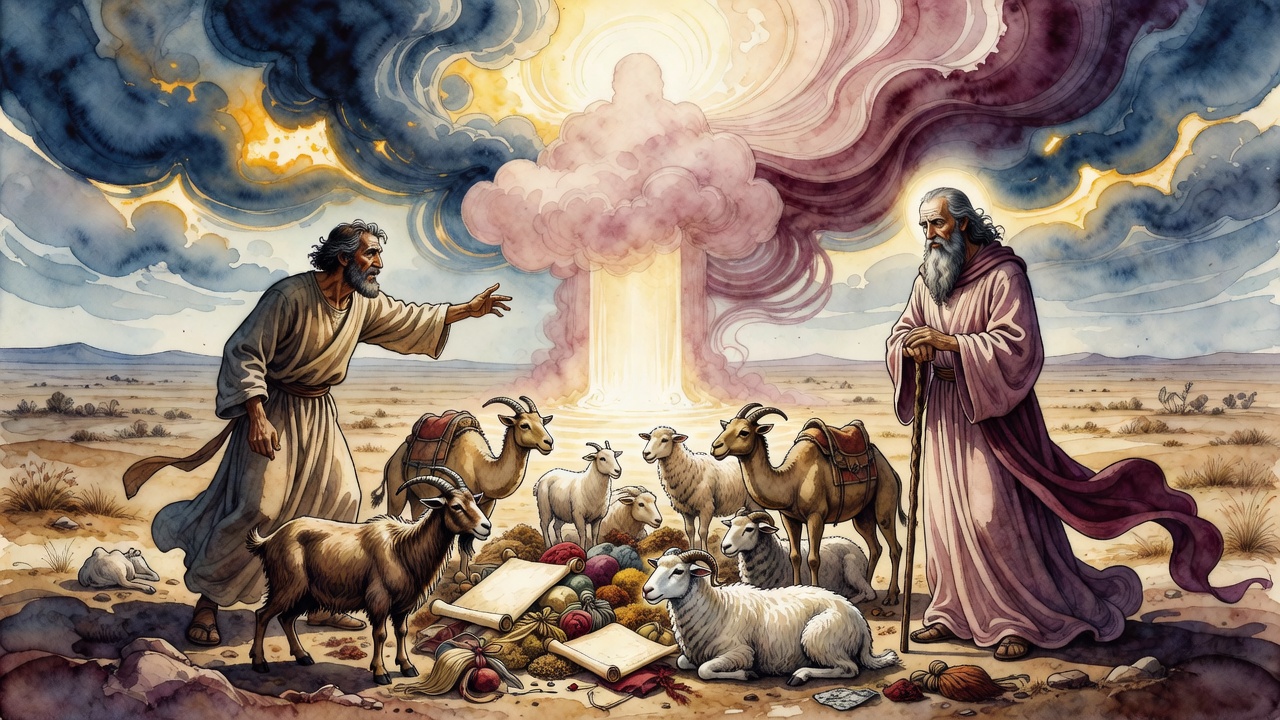
Once, on the far shore of the sea, when the water still hung in walls and Israel stood dripping and alive on the sand, He put it on. A festival robe, stitched bright with the promises of a good future. Along its hem ran words like living thread. "Then shall thy light break forth as the morning." Across the breast, "The Lord hath done great things for them." Israel sang, and the robe shone, and for one hour the whole future seemed already sewn onto the cloth.

Then Israel sinned. And God, the way a father folds away the letters of a son who shamed him, seized the robe in both hands and rent it. He did not throw it away. He folded the torn thing and laid it in the dark, and He swore He would not wear it again. Not in this age. Not until the world turns over into the age that comes after, the Olam Ha-Ba, the World to Come.

So it waited, folded, while the generations wore themselves out.

The Seal Breaks on the Book

The day it all ends does not begin with thunder. It begins with a book.

There is a volume kept shut since before the first light, and on the appointed day God opens it. It is the same kind of book He opens each year at the turn of Yom Kippur, when the Book of Life and the Book of the Dead lie side by side and every name is weighed between them. But this opening is the last one. When the cover lifts, nothing is written for next year. Everything written is now, and every sentence in it is a sentence carried out the moment it is read.

And out of the open pages they come.

The Angels Storm Out With the Blade

They are not the soft, round-cheeked messengers of a child's dream. They are avenging angels, and they carry God's own sword.

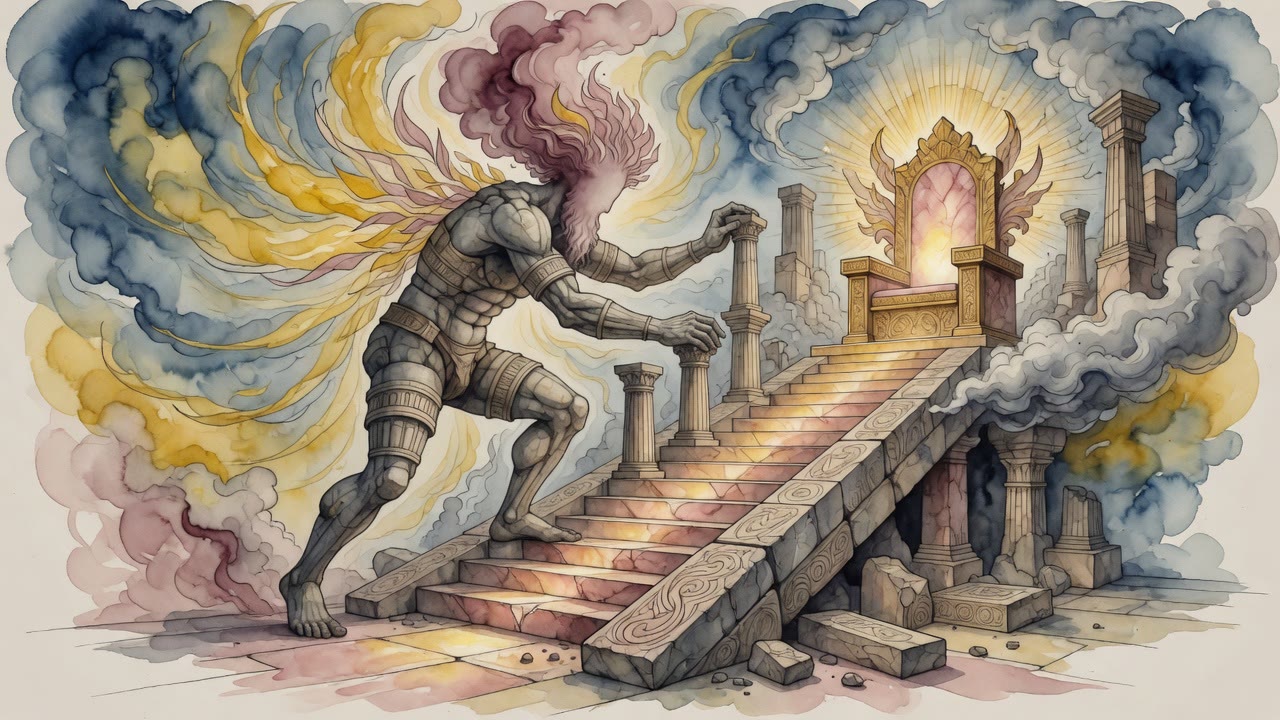
The blade is half fire and half ice, the two of them running the whole length of it and never quenching one another. Its brightness is not like a lamp. It is like lightning that does not stop, a single stroke of it wide enough to cut across the entire world at once. Sparks tear off the edge as the angels draw it, and each spark is not the size of an ember but the size of a star, whole burning worlds flung from the metal like filings off a whetstone. Long ago God had said of this weapon, "When I whet My flashing blade." Now the whetting is finished.

No one can look straight at the edge and go on breathing. The angels do not swing it in fury. They wield it the way a court clerk stamps a verdict, without haste and without mercy, because the judgment was decided long before their hands closed on the hilt.

Fire Falls Into the Temple

Over the city the sky splits open.

Fiery seraphim, angels made of nothing but flame, are hurled down into the Temple like coals dropped from a great height. The stars themselves catch and burn with a fire that is not their own, an unnatural light that was never in them before. Then the Shekhinah, the weight and glory of God's presence, pours into the Temple until the stone can barely hold it and no eye can rest on the doorway.

And God comes down. He brings His throne with Him and sets it in the Valley of Jehoshaphat, the low ground between the hills where the dead of every nation are gathered, and He sits to judge. This is the hour the folded robe was waiting for. He lifts it out of the dark, unfolds it, and puts it on, its torn seam closed at last, and the promise stitched along the hem burns as bright as it did the morning beside the sea.

The Silence After the Sword

Then, onto a high mountain, climbs the Messiah.

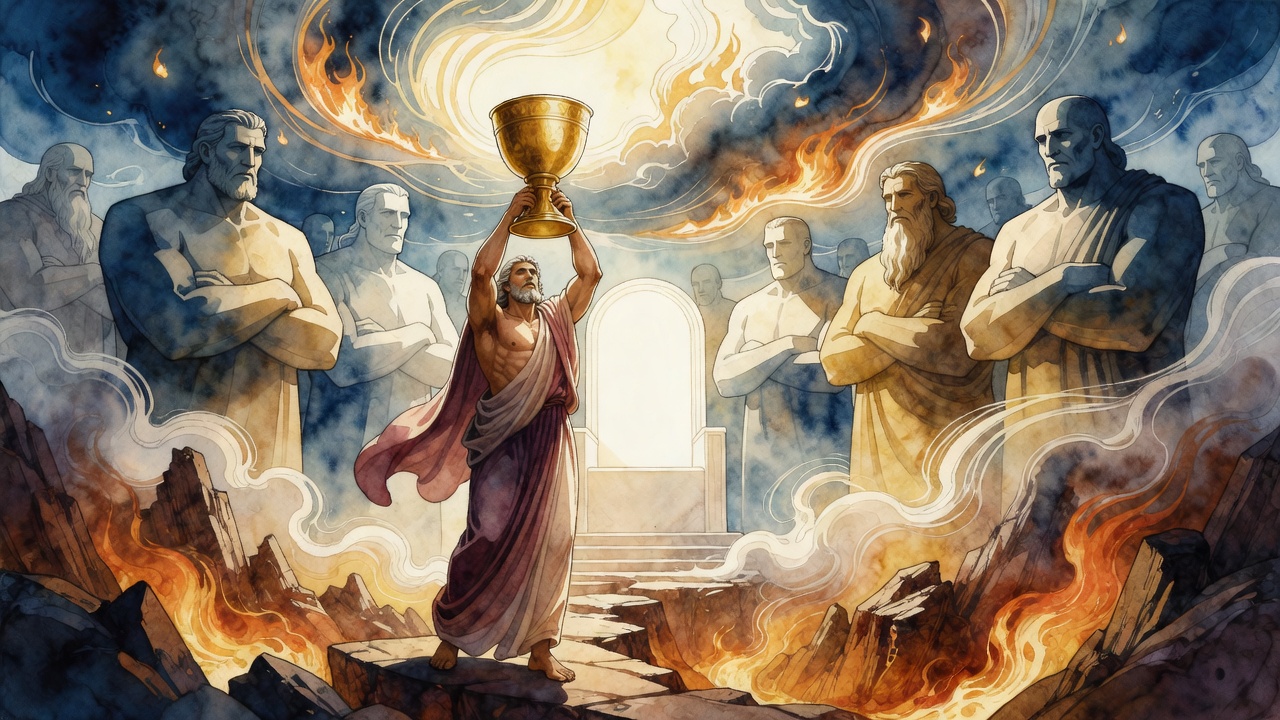
He is not merely born into the world. He is clothed for it. A crown is set on his head, a helmet of deliverance, garments of glory laid across his shoulders, and he lifts his voice over the ruined and remade earth with a single cry. "Salvation is near." He carries the news down to the fathers of the world, down into the cave of Machpelah where Adam has slept since the beginning, and he wakes them, Adam and his whole generation and every generation from the first day to the last.

The age they wake into is glorious, and it is counted. Four hundred years, and no more. When the four hundred years are spent, the Messiah dies, and with him dies everyone in whom there is human breath, and the world drops back into the silence it knew before anything was made. Seven days of that silence. Then the heavens roll up and thin away like smoke, and the earth wears out like an old garment and is laid aside, folded into the dark the way a torn robe was once folded, waiting for whatever God will choose to wear next.


← All myths
From the tradition

Sources

3 sources

The texts behind this telling. Some cards carry a translation of the source; others are our own retelling of it, and each card says which. Every card links out to the original.

Legends of the Jews 1:70Legends of the Jews

Retold in our words. Read the original at the link below.The Legends of the Jews by Louis Ginzberg (1909) · Public Domain

I know, it sounds a little irreverent, maybe even silly. But Jewish tradition, in its wonderfully imaginative way, actually does offer us a glimpse into the Divine wardrobe. And what it reveals is pretty breathtaking.

The story comes from Legends of the Jews, that incredible collection of rabbinic stories compiled by Louis Ginzberg. Ginzberg draws on centuries of midrashic (rabbinic interpretive commentary) and Talmudic sources to weave these beautiful narratives. He tells us that in the world to come, things will be like they were at the time of the Shirat Hayam, the Song of the Sea (Ginzberg, Legends of the Jews). Remember that moment? The Israelites had just crossed the Red Sea, Pharaoh's army was swallowed up, and they burst into song, praising God for their miraculous salvation.

In this legend, when Israel sang that song, God put on a special robe. Not just any robe,. This was a festive robe, shimmering with all the promises for a happy future for Israel.

The robe was embroidered with verses like "Then shall thy light break forth as the morning" (Isaiah 58:8), a promise of radiant renewal. And "Then said they among the heathen, 'The Lord hath done great things for them'" (Psalm 126:2), evidence of God's power, so evident that even the nations would acknowledge it.

But, and here’s the heartbreaking part, the story doesn't end there. When Israel sinned, when they strayed from the path, God, in a symbolic act of mourning and disappointment, rent that festive robe. Tore it. Ripped it apart.

Think of a parent heartbroken by a child's misdeeds, tearing a precious photograph. It's a powerful, visceral image.

And, according to the legend, God will not restore it. Not yet. He will not put it back on until the coming of the Olam Ha-Ba, the World to Come. This is a pivotal concept in Jewish eschatology, referring to the messianic age, a time of universal peace, justice, and spiritual fulfillment.

So what does this all mean? It's more than just a colorful story about God's wardrobe choices. It suggests that our choices have cosmic implications. When we act in ways that are aligned with God's will, we contribute to the creation of that radiant future, that "robe" of promise. But when we sin, we tear at that very fabric.

This idea that our choices, our collective behavior, actually impact the Divine "garment," delaying or hastening the arrival of a more perfect world. It places a huge responsibility on our shoulders.

The legend leaves us with a question, a challenge: What will we do to help restore that robe? What actions can we take, big or small, to weave back together the threads of hope and promise, and bring about the World to Come? Because according to this story, the future isn't just something that happens to us. It's something we actively create, stitch by stitch.

Full source
3 Enoch 32:13 Enoch

Retold in our words. Read the original at the link below.3 Enoch, or The Hebrew Book of Enoch, trans. Hugo Odeberg (1928) · PD-US-pre-1929

This one’s half fire, half ice. Quite the contrast. According to 3 Enoch 32:1, when God opens this extraordinary book, something incredible happens. Avenging angels are unleashed.

These aren't your fluffy, cherubic angels. These are serious messengers of divine judgment, and they go forth with God's own sword. A sword wielded by angels, commissioned by the Almighty. What does that look like?

The tradition tells us that the sword isn't just some ordinary weapon. Its splendor shines like lightning, piercing the entire world. Sparks and flashes fly from it, each one the size of stars! It’s an awe-inspiring, terrifying image. It echoes the words of (Deuteronomy 32:41): "When I whet My flashing blade."

What does it all mean?

The book of fire and ice is reminiscent of the Sefer Chayim and Sefer ha-Metim – the Books of Life and Death – that God opens on Yom Kippur, the Day of Atonement. It’s all connected. The sword, in this context, becomes a powerful metaphor for the execution of God's judgments. It’s not just about punishment; it’s about the swift and absolute carrying out of divine will.

This imagery presents a stark portrayal of God. It's a view of a God who doesn't just decree judgment, but ensures that those judgments are acted upon immediately. It challenges our perceptions. We often confront the idea of divine justice, wondering why some things seem to go unpunished. This tradition reminds us that, in the grand cosmic scheme, justice – however fiery or icy – will be served.

What kind of God do you envision? A God of mercy? A God of strict justice? Or perhaps, a God who embodies both, like the book of fire and ice, forever balancing these opposing forces.

Full source
4 Ezra 7:27-304 Ezra

Retold in our words. Read the original at the link below.R. H. Charles public-domain English translation (1913) · Public Domain

One vision, described in Tree of Souls, paints a picture so vivid, so intense, it’s hard to ignore. Imagine this: in the very generation when the Messiah finally arrives, the skies themselves erupt. Fiery seraphim, angelic beings of pure flame, are dispatched into the Temple. Stars blaze with unnatural fire. It's a spectacle of divine proportions.

That’s just the beginning. The Shekhinah – the divine presence, the very embodiment of God’s glory – floods the Temple, making it almost unbearable to look upon. God Himself descends, bringing His throne to rest in the Valley of Jehoshaphat, ready to judge. This isn’t a subtle affair; it’s a full-blown, cosmic unveiling.

Then comes the Messiah. He isn't just born; he's clothed in power. He receives a diadem, a helmet of salvation, garments of glory. He’s placed on a high mountain, a beacon of hope. And what does he announce? Simply, powerfully: "Salvation is near!"

It doesn’t stop there. The Messiah then proclaims the news to the patriarchs, to Adam himself, who slumbers in the cave of Machpelah. Adam, the first human, awakened from his long sleep, along with his entire generation, and the patriarchs, and all the generations from the dawn of time until that very day. It's the ultimate family reunion, a gathering of all who have ever lived.

This Messianic age, this golden era of peace and divine presence, isn’t forever, though. This vision gives it a timeframe: 400 years. As we find in 4 (Ezra 7:27-30), there are limits to how long this world can sustain perfection.

And then? Then comes the truly shocking part. After those 400 years, the Messiah dies. And not just him, but everyone "in whom there is human breath." According to Sefer Eliyahu (found in Beit ha-Midrash (rabbinic interpretive commentary) 3:68-78), this marks the end of an era, a grand finale before the ultimate reset.

The world then reverts to its primordial state of silence for seven days. A cosmic pause, a moment of reflection before the next act. The heavens themselves melt away like smoke, and the earth wears out like an old garment, as described in (Isaiah 51:6). Everything returns to its original, unformed state, echoing the beginning of Creation.

This isn’t just a story about the end of the world; it’s a story about transformation, about hope, and ultimately, about renewal. It's a grand fantasy of redemption, as Schwartz calls it. The rebirth of Adam and the patriarchs, figures of our collective past, is a crucial part of this vision of the Messiah. That even after destruction, there's always the possibility of something new, something better, something divinely inspired. What does that tell us about how we should live now?

Full source