The Talking Bird That Sold a Hunter Three Truths
A poor hunter trades a talking bird's freedom for three pieces of wisdom, then breaks every one of them before the bird is out of the tree.
Table of Contents
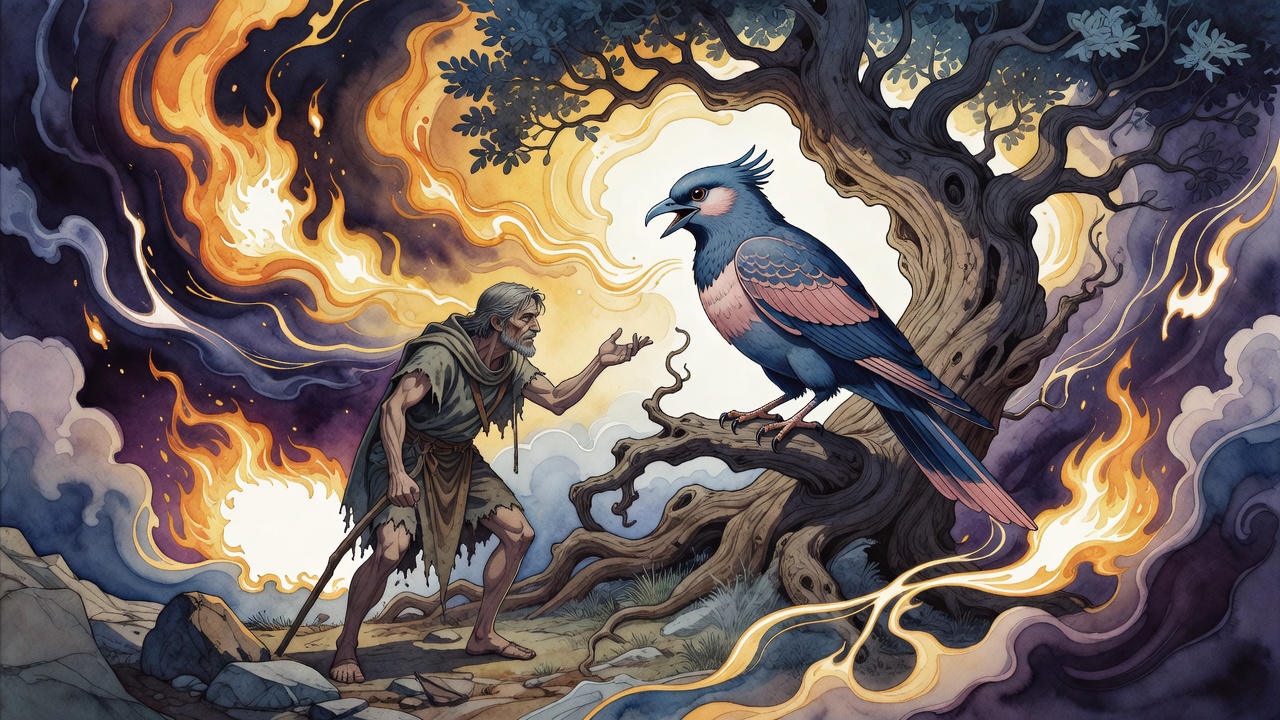
The hunter felt the net jerk and close, and from inside the tangle of cords a voice came up at him in plain human speech. "Spare me," it said. The bird was small and ordinary, a thing he would have plucked and roasted without a second thought, but it spoke the way a man speaks, and his hands stopped over it.
 Click for full size
He crouched in the brush and stared. The other birds in the snare beat their wings and made only bird noise. This one watched him with one black eye and waited for his answer.
The Bargain Struck in the Brush
"My flesh is nothing," the bird said. "A mouthful. You will be hungry again by nightfall. But I know three pieces of wisdom, and if you let me go I will give you all three. They are worth more than my body and more than the bodies of every bird in your net."
The hunter was a poor man, and a poor man learns to weigh things. A mouthful against three truths. He thought of the long walk home and the empty pot and the years ahead of him, and he decided that wisdom kept longer than meat.
"Teach me," he said, "and I will open my hand."
"First," said the bird, "do not grieve over a thing that is already gone. What has passed cannot be dragged back by sorrow. Second, never believe a thing that cannot be. If your own sense tells you it is impossible, then it is, no matter who swears to it. Third, never strain after what you cannot reach. The branch too high will break the man who climbs for it."
The hunter turned the three over in his mind. They sounded like the kind of thing his grandfather used to say. Plain. Almost too plain to be worth a bird. But a bargain was a bargain. He worked his fingers under the cords and lifted them, and the small body shot out of his palm and up into the air.
The Taunt From the Tall Tree
The bird did not fly far. It rose to the top of a tall tree, well out of any reach, and settled on the highest branch where the wind moved it gently. Then it looked down at the man and laughed in its human voice.
"Fool," it called. "If you had killed me when you had me, you would be a rich man tonight. I carry a pearl inside me, here, in my belly. A single pearl, round and white, worth a thousand dinars. You held a thousand dinars in your hand and you let it fly into a tree."
The words went into the hunter like a hook. A thousand dinars. He pictured the pearl, fat and gleaming, sitting warm inside the little body that had been pressed against his palm a moment ago. His whole life he had skinned rabbits and snared sparrows for copper, and the one time fortune had come into his net he had handed it away for three sentences any child could recite.
Grief took him by the throat. He groaned aloud. He cursed his own soft heart, his own poverty, his own slowness, and he began to climb.
The Fall at the Foot of the Tree
He clawed his way up the trunk after the bird. The bark scraped his hands raw. He got one leg over a low branch and reached for the next, and the bird hopped higher, just out of his fingers, watching. He stretched until his whole weight hung from his arms. The branch under his hands bent, then cracked, and the hunter came down through the leaves and struck the ground hard on his back, the wind knocked clean out of him.
He lay there gasping, looking up through the branches at the small dark shape against the sky.
The bird tilted its head and spoke down to him without pity.
The Bird Lays Bare His Folly
"You have not kept a single one of the three things I gave you," it said, "and I gave them to you not a quarter of an hour ago. I told you not to grieve over what is gone. I am gone. I am free in this tree, and nothing you do will put me back in your net, yet you are tearing yourself to pieces with regret over me."
The hunter said nothing. He had no breath to answer.
"I told you never to believe the impossible," the bird went on. "Look at me. I am smaller than your fist. How could a pearl worth a thousand dinars, a pearl as big as you are imagining, fit inside a body this size? It could not. There is no pearl. I invented it the way I invent everything, and you swallowed the lie whole because you wanted it to be true."
It shifted on the branch.
"And I warned you never to reach for what is beyond reach. The top of this tree was beyond your reach. You climbed anyway, and the branch broke, and now you lie in the dirt with an aching back and an empty net and an empty hand. You have the wisdom. You repeated it back to me. But you do not have it where it counts, because the moment it cost you something you threw all three away."
The hunter lay in the leaves and understood, too late, that he had paid for the three truths twice. Once with the bird he set free. And again with the fall that taught him he had never truly owned them at all.
The bird opened its wings and was gone over the treetops, and the man got up slowly, gathered his torn net, and walked home with nothing.
← All myths