5 min read

Solomon Lost Half the Torah and Saw Creation

Solomon reached for wisdom, folly, and desire until his memory emptied, but creation still answered him with dangerous goodness.

Curated by Arthur · Told by Maggid ·
Table of Contents
  1. The Bowl Went Empty
  2. Wisdom Opened a Door to Folly
  3. The Torah Rose Against the King
  4. Creation Pressed Back Against Him
  5. The King Kept One Living Thread

The lamp burned low in Solomon's chamber, and the king's mouth stopped over a line he had known yesterday.

The scribes waited. The scroll waited. Outside the palace, the city went on trading, judging, marrying, stealing, praying. Inside, the wisest king in the world reached for Torah and closed his hand on air.

The Bowl Went Empty

There was a word that betrayed him. It sounded like turning, the movement of a king who swivels his face toward wisdom. But the same sound could become emptying, the way a bowl pours itself out and flashes bare clay at the bottom.

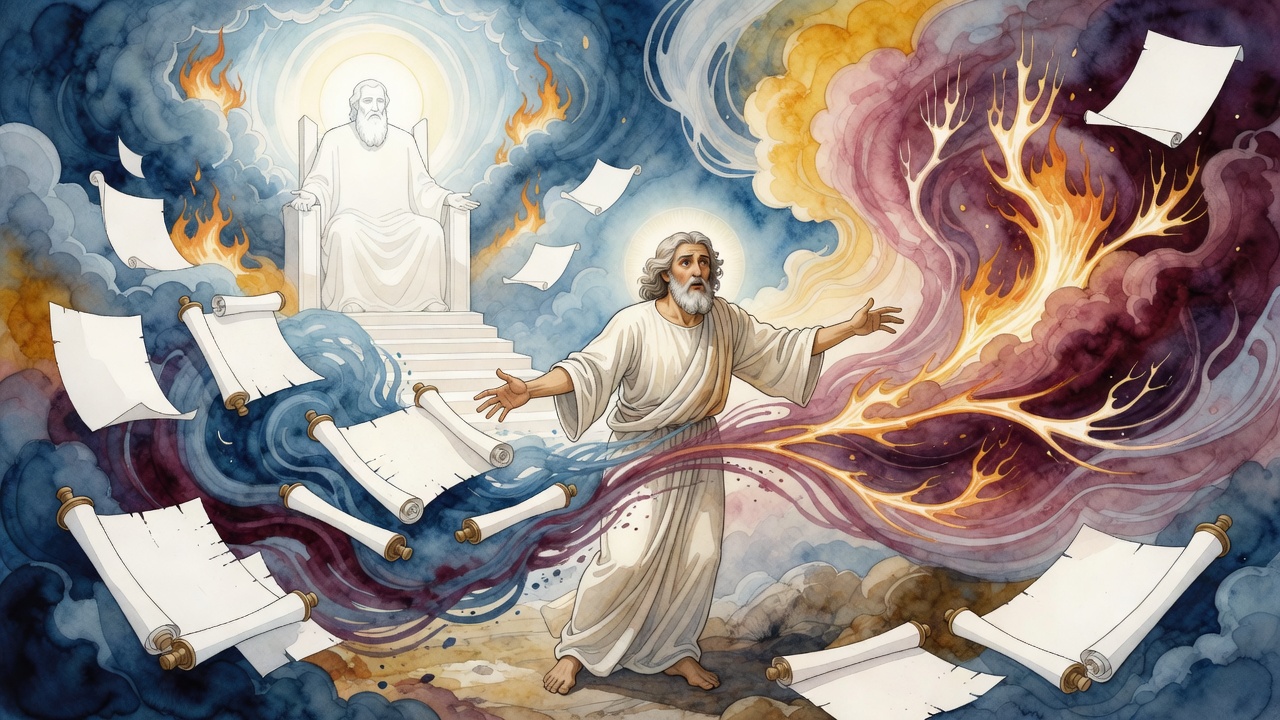
That was Solomon's condition. In the morning he filled himself with Torah. By evening, half of it had spilled somewhere behind him. Names loosened. Laws that had once stood in order slid apart. A verse opened its mouth and no longer gave him the next word.

He did not become a fool. That made it worse. A fool does not know what has been lost. Solomon knew. The missing half had weight. It left a hollow in him large enough for a kingdom to hear.

Wisdom Opened a Door to Folly

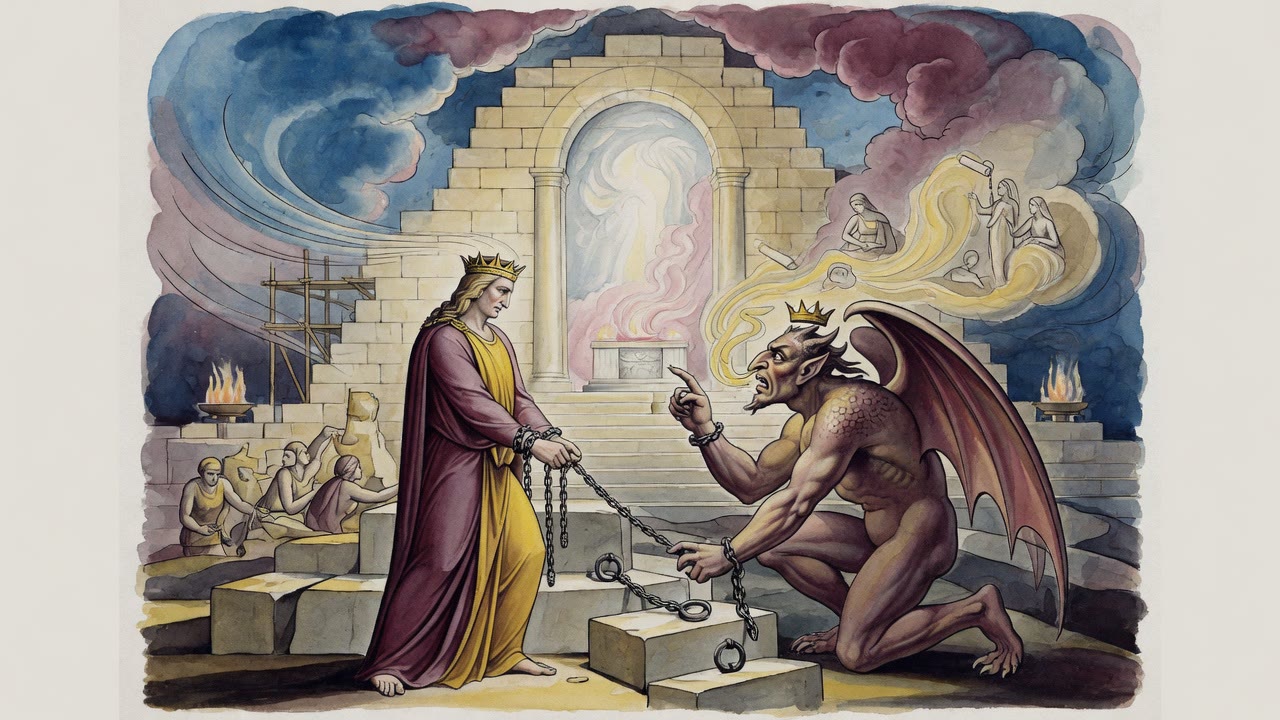
The king had asked for more than a clean wisdom. He had turned toward wisdom, and toward madness, and toward folly, all at once. He wanted to see the whole field of human life without flinching. Not only law in the study hall. Not only songs at the Temple. He wanted the alley where officials sold judgment, the banquet where desire made men stupid, the secret room where a clever mouth learned to deny heaven.

The palace brought those cases to him every day. A widow came with a debt contract no honest judge would enforce. A merchant swore by the Name and hid false weights under his cloak. A courtier smiled at Solomon with oil on his beard and a bribe folded in his sleeve.

The king looked at all of it. He looked too long.

Wisdom did not leave him because he had never possessed it. It left because he had tried to hold corruption in the same hand and still keep the hand clean. The bowl kept tipping.

The Torah Rose Against the King

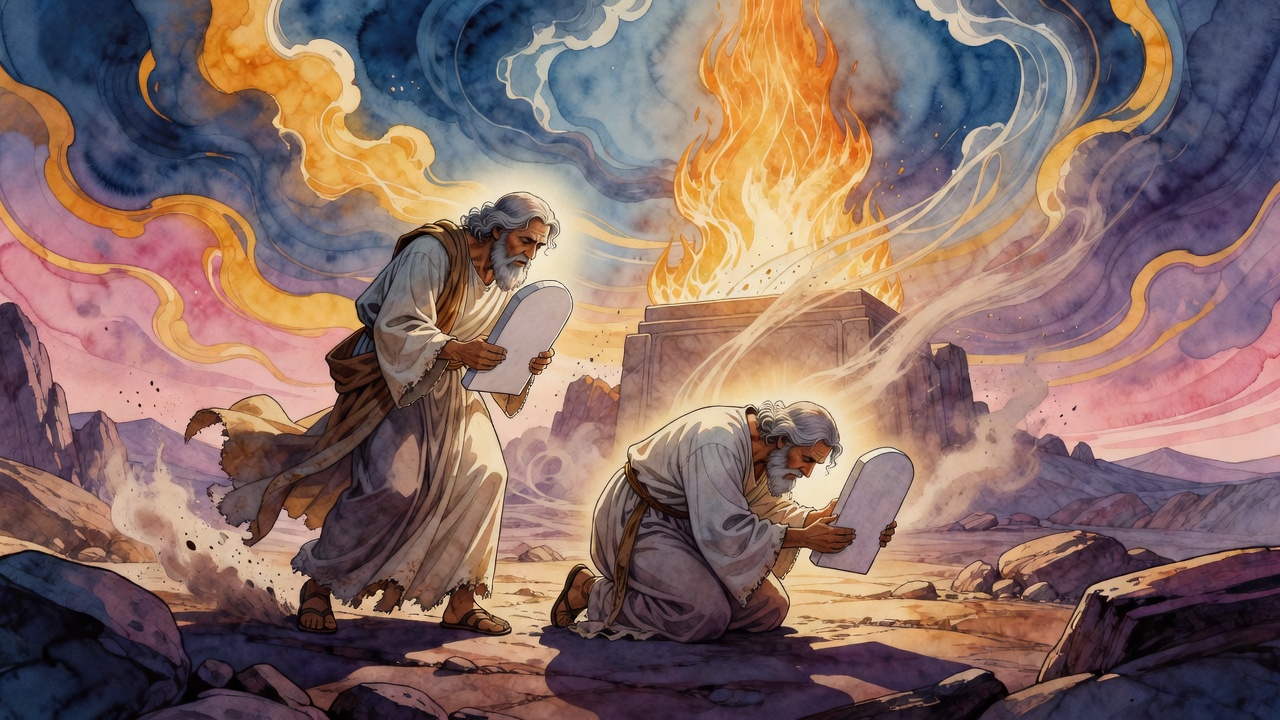
At night the Torah stood before heaven like an injured witness.

Here is the king who learned me, it said. Here is the king who forgot me. He carried me into places where royal appetite was louder than commandment. He set wisdom beside folly and asked them to share a throne.

Solomon had heard accusations before. Litigants shouted at his gates. Mothers clutched children. Men demanded land, silver, blood, honor. But this witness had no need to shout. The Torah did not rage. It simply named what had happened. A king had been given a vessel large enough for wonder, and he had let it leak.

He bowed his head. The crown did not help. Gold has no answer when memory itself takes the stand.

Creation Pressed Back Against Him

Then the court of heaven moved from the scroll to the first morning of the world.

Solomon had wanted to understand the design of the King above every king. He had stared at marriage and found both gift and bitterness. He had watched a household become shelter, and watched another become a trap with a warm voice. A good wife could make a life widen past its loneliness. A wicked one could make a table feel narrower than a grave.

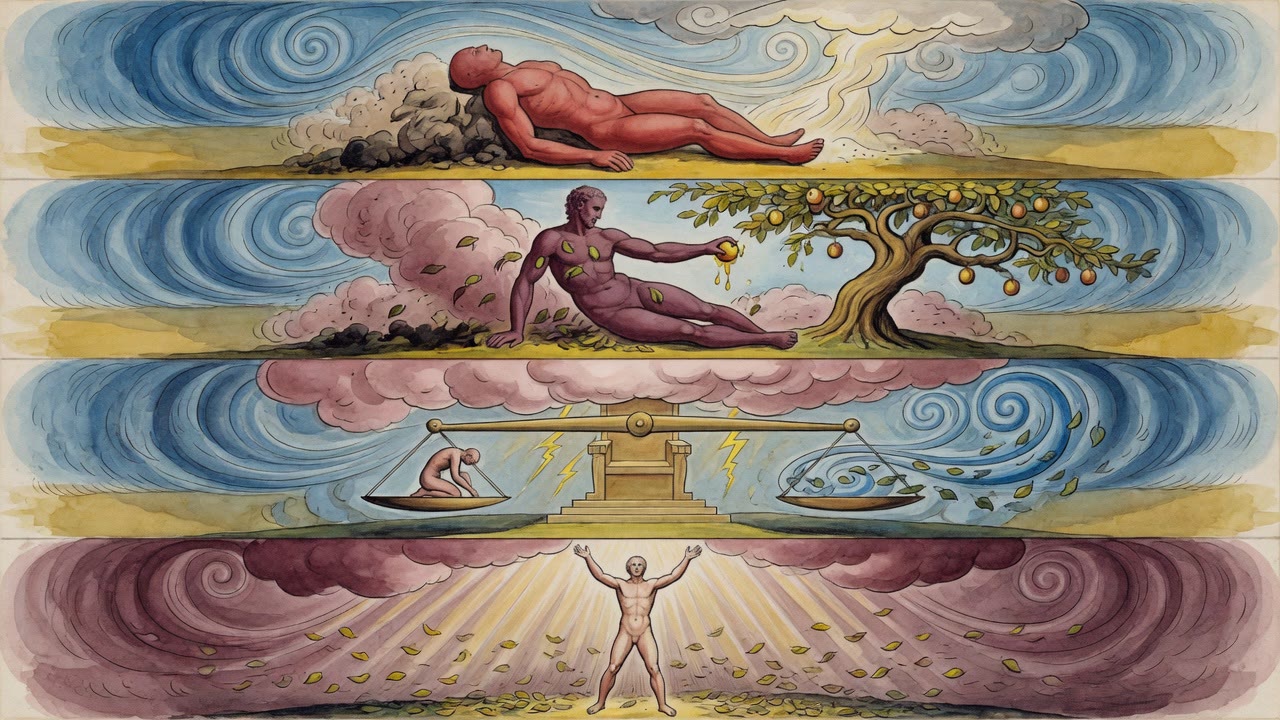
Creation had already carried that contradiction. Before woman, the first human stood alone in a world full of animals and trees and rivers, and God called that aloneness not good. After woman, the world changed. Only then did the goodness of creation become full, dangerous, and alive.

Solomon did not flatten the contradiction. He could not. His own books held both edges. One hand found good. The other found bitterness. The same door could open into companionship or calamity, and no royal decree could make the door safe.

The King Kept One Living Thread

Half the Torah had slipped from him, but one living thread remained in his fingers.

He still knew that creation's goodness was not the goodness of a locked box. It was the goodness of risk. God did not cure loneliness by making a stone. God made another face, another will, another voice that could answer, refuse, love, wound, rescue, betray, and build.

That kind of goodness cannot be held by a king who wants only control. It can only be received with trembling. Solomon had judged women, loved women, feared women, and written about women with a heart that did not know how to stop cutting itself on the subject. His wisdom survived there, not as mastery, but as pain that had learned to speak plainly.

The lamp burned down. The lost words did not return. But the king could still point to the first human no longer alone, and to the world after that meeting, bright and terrible and called very good.


← All myths
From the tradition

Sources

2 sources

The texts this telling draws on, in full. Open a card to read inline, or expand it for a wider, quieter read.

Midrash Tehillim 59:2Midrash Tehillim

Take, for instance, this fascinating passage from Midrash Tehillim, Psalm 59. It wrestles with a question that's been around since, well, the beginning: What's the deal with marriage? Is it a blessing or a curse?

The text throws us right into the deep end, quoting both (Proverbs 18:22), "He who finds a wife finds a good thing," and (Ecclesiastes 7:26), "And I find more bitter than death the woman." Quite the contrast. It's like the sages knew we'd be confronting this very tension for millennia.

The Midrash (rabbinic interpretive commentary) doesn't leave us hanging. It clarifies: if she's a wicked woman, the trouble never ends. But if she's a good woman? Her goodness is limitless. So, the message is clear: find a wife.and find a good thing! It even argues that before woman was created, (Genesis 2:18) tells us "It is not good for man to be alone." And after her creation, (Genesis 1:31) says, "And God saw all that He had made, and behold, it was very good." Food for thought, isn't it?

Our sages go even further, claiming that a man without a wife lacks five essential things. Five! What are they? Blessing, because (Genesis 1:28) says "And God blessed them," not him. Life, drawn from (Ecclesiastes 9:9): "Live joyfully with the wife whom you love." Joy itself, as (Proverbs 5:18) urges us to "Rejoice with the wife of your youth." Assistance, echoing (Genesis 2:18): "I will make a helpmate for him." And finally, goodness, returning us to (Proverbs 18:22): "He who finds a wife finds a good thing."

Of course, the Midrash acknowledges the flip side. A bad wife can, unfortunately, bring ruin. But a good woman? (Proverbs 31:10) asks, "A capable wife, who can find? Her value is far beyond pearls." And (Proverbs 12:4) adds, "A capable wife is a crown for her husband." It's a powerful image, isn't it?

And it doesn't stop there. The text emphasizes the divine connection to marriage. It points out how God's name is invoked in connection with marriage throughout the Tanakh (the Hebrew Bible). In the Torah (the first five books), (Genesis 24:50) says, "The matter emanates from God." In the Nevi'im (the Prophets), (Judges 14:4) states, "But his father and mother did not know that it was of the Lord." And in the Ketuvim (the Writings), (Proverbs 18:22) again: "And he obtains favor from God."

So, what's the takeaway from all this? Maybe it's that marriage, at its best, is a partnership blessed by the Divine. A source of blessing, life, joy, assistance, and goodness. And while the path isn't always easy, and finding the right partner can feel like searching for a rare pearl, the potential rewards are immeasurable. Perhaps the real question isn't whether to marry, but how to cultivate a marriage that reflects the goodness and favor the sages spoke of.

Full source
Kohelet Rabbah 11:1Kohelet Rabbah

It grapples with the very human experience of seeking knowledge, stumbling, and trying to make sense of it all.

The verse It's a loaded verse, isn't it? Full of questions about legacy, wisdom, and the cyclical nature of human experience.

The rabbis in Kohelet Rabbah really dig into this. "I turned [ufaniti] to behold wisdom," the text says. But one interpretation suggests we should read ufaniti as ufiniti – "I emptied." Like a bowl, sometimes full, sometimes empty. This resonates deeply. Haven't we all had moments of clarity, followed by periods of forgetfulness, where the wisdom we thought we grasped seems to vanish? The text suggests that even Solomon himself, famed for his wisdom, would study Torah and then, at times, forget it.

Then the text moves into interpretations of "debauchery and folly." Rabbi Ḥanina bar Pappa sees "debauchery" as the corruption of the kingdom, and "folly" as the heavy-handedness of those in power. Harsh taxes on the "foolish masses," as he puts it. Rabbi Simon offers a different take: "Debauchery" is the debauchery of heresy, and "folly" is just plain foolishness. It's fascinating how the rabbis use this verse as a lens to critique the society around them.

And what about that phrase, "As who is the person who would come after the king..."? The text takes this as a challenge to human arrogance. If you can't even understand the motivations of a human king, how can you presume to understand the ways of the King of Kings, the Holy One, blessed be He? It's a humbling thought.

Rabbi Naḥman offers two powerful parables to illustrate this point. One is about a field of reeds so dense that no one can enter. A clever person figures out how to cut through it, paving the way for others. The other is about a vast palace with so many entrances that people get lost inside. Someone uses a skein of reed grass to create a trail, allowing everyone to find their way in and out. Each of these parables highlights the importance of finding a path, a method, for working through the complexities of the world. A way to make sense of the seemingly incomprehensible.

Rabbi Shimon ben Yoḥai adds another layer with his analogy of a king who builds a palace. Passersby critique the palace, suggesting improvements. But, he asks, is it appropriate for people to critique themselves in the same way? Should a person wish for three hands, three eyes? The verse says "asuhu," which means "they have already done" (plural), not "asahu" (singular). It's as if God and His court deliberated over our creation, designing us with intention and purpose. As (Deuteronomy 32:6) says, "He made you and established you."

Rabbi Levi bar Ḥaita uses the image of a palace again. If a human king placed the drainpipe at the entrance, it would be ugly and inappropriate. But God placed our "drainpipe" – our nose – at our entrance, and it's part of our beauty and worth. Rabbi Yitzḥak bar Maryon emphasizes this idea of divine artistry. God is the Tzur, the Rock, a beautiful sculptor (tzayar). He takes pride in His creation, inviting us to admire the sculpture He has sculpted.

And finally, Rabbi Pinḥas, citing Rabbi Levi, points to the verse "behibare’am" (Genesis 2:4), meaning "when they were created." He interprets this as "He created them with the letter heh [beheh bera’am]." The letter heh is the easiest to pronounce, suggesting that creation required no exertion on God's part.

So, what does it all mean? Perhaps it's a reminder that wisdom is a journey, not a destination. That even in our moments of doubt and forgetfulness, we are part of something larger, a creation crafted with intention and love. It's an invitation to appreciate the beauty and complexity of the world, and to trust in the divine wisdom that shaped us.

Full source