6 min read

Three Youths Stayed in the Furnace for Permission

Hananiah, Mishael, and Azariah refused Nebuchadnezzar's image, entered fire, and would not leave until the king who bound them spoke them free.

Curated by Arthur · Told by Maggid ·
Table of Contents
  1. Ten Days of Legumes and Water
  2. The Image on the Plain
  3. Who Went Down to Get Them
  4. The Refusal Inside the Fire
  5. The King Came to the Door

The first thing they refused was dinner.
Three Youths Stayed in the Furnace for Permission Click for full size

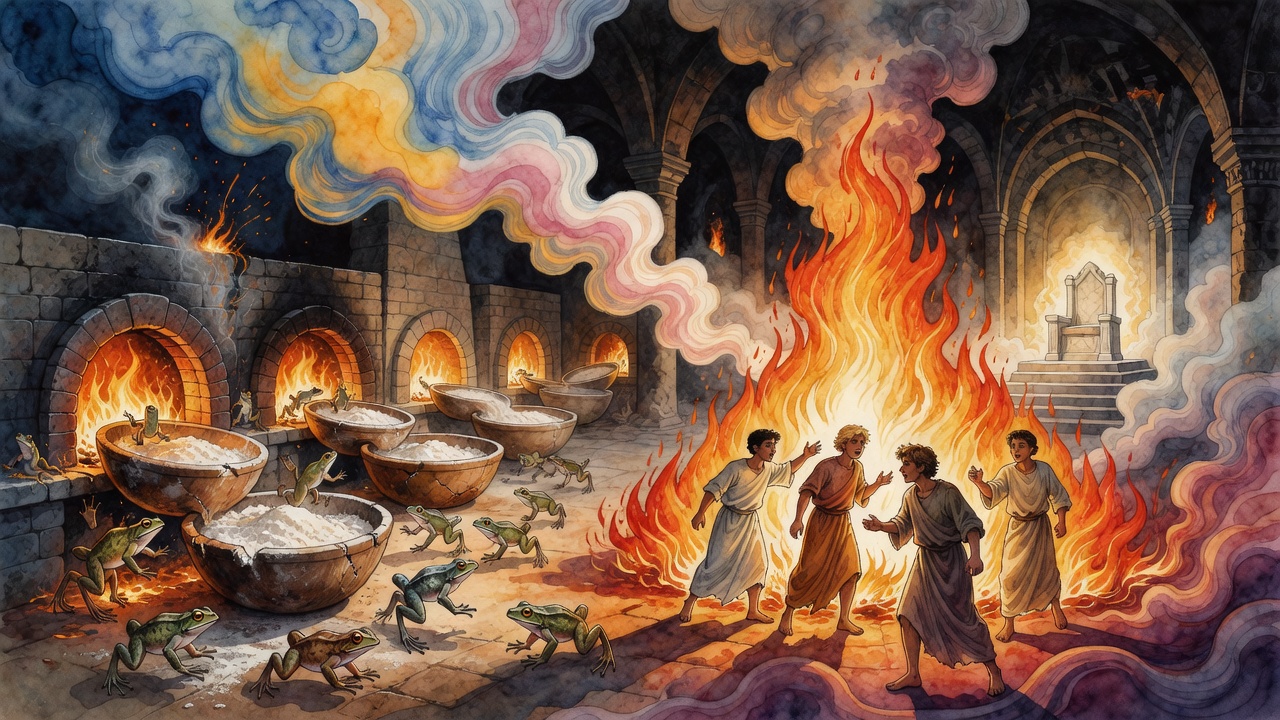
The chief of the guards had orders about the captive boys from Judah, and the orders were that they ate what the king ate, meat off the king's kitchen and wine out of the king's cellar, because a king who is building administrators feeds them himself. Daniel would not touch it, and neither would Hananiah, Mishael, and Azariah. "We will do our part," Daniel told him, "and the Holy One will do his."

Ten Days of Legumes and Water

The guard had a neck to protect. If these four came to the king's table thin and grey while the rest of the intake filled out, he was the man who would answer for it, so he said as much, in the plain way of an official who is not cruel and is not going to lose his post either.

"Test your servants ten days," Daniel said. "Give us legumes and water, nothing else, and at the end of the ten days look at our faces and at the faces of the boys eating the king's bread, and then do whatever you decide."

Could they really stand it, the guard wanted to know. Ten days on pulse and water.

"We are the children's children of the man who stood up under ten trials from God," they told him. "Abraham's merit will stand for us." So he gave them the legumes, and on the tenth day he walked the line of young men and looked at each face in turn, and the four who had eaten nothing off the royal table were the brightest faces in the room.

The Image on the Plain

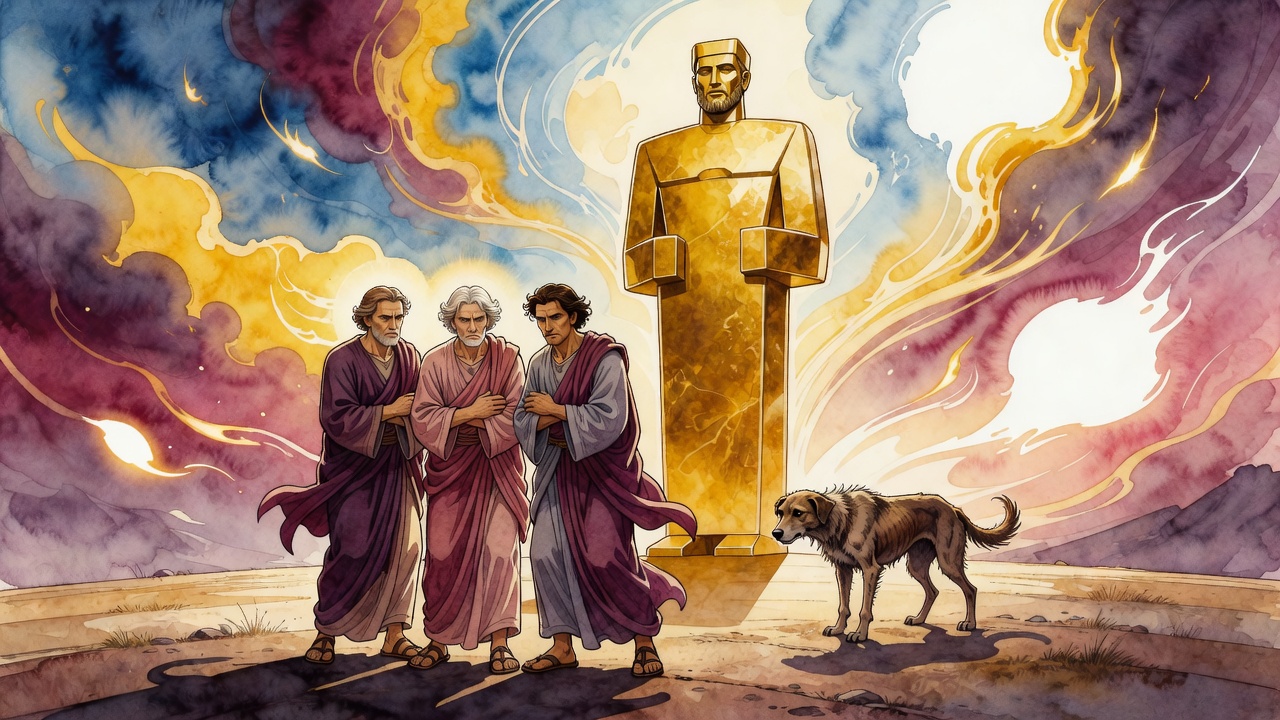
Years later Nebuchadnezzar put up a golden image on the plain and called in every officer he had, and the order went out that when the horn sounded, everyone in the empire went down on his face.

The three of them came to the king with the account already divided. "Taxes we will pay you," they said, "and tolls, and levies, and whatever else the crown assesses, since you are the king and the road is yours. Deny the Holy One we will not." Then they said the part that took the argument away from him. "Whether God saves us out of your hand or does not save us, we are not bowing to that thing."

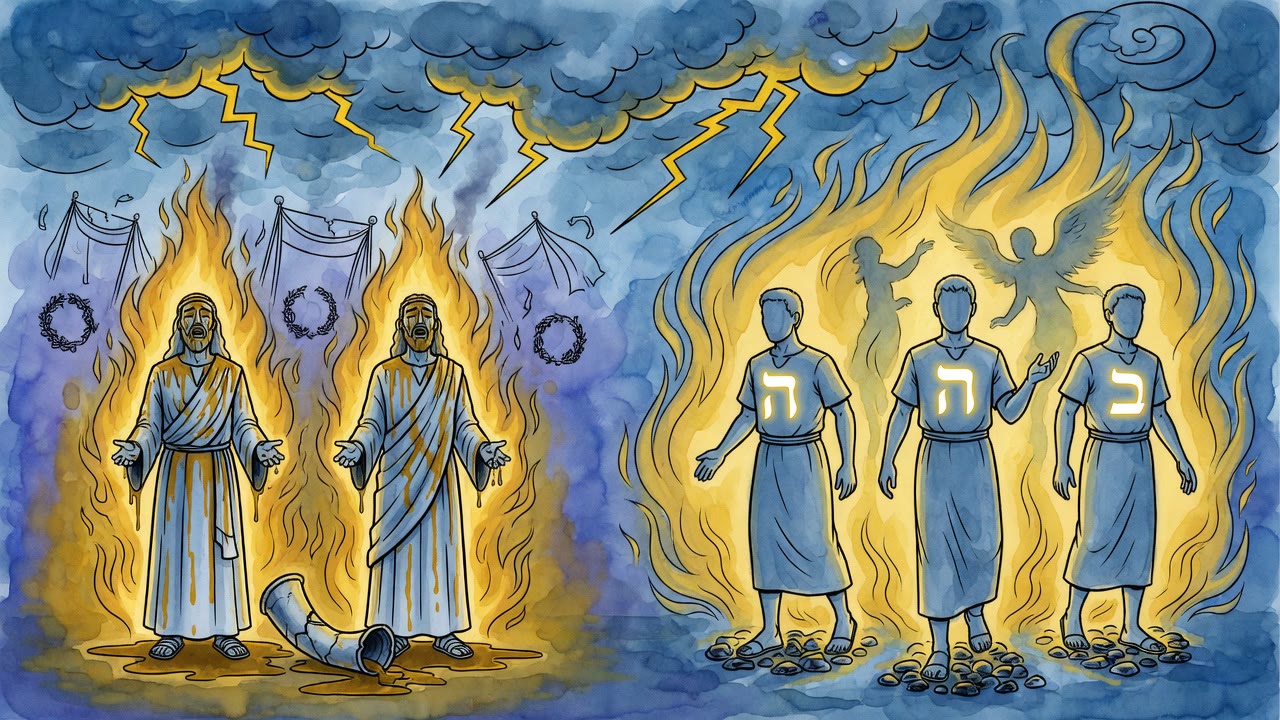
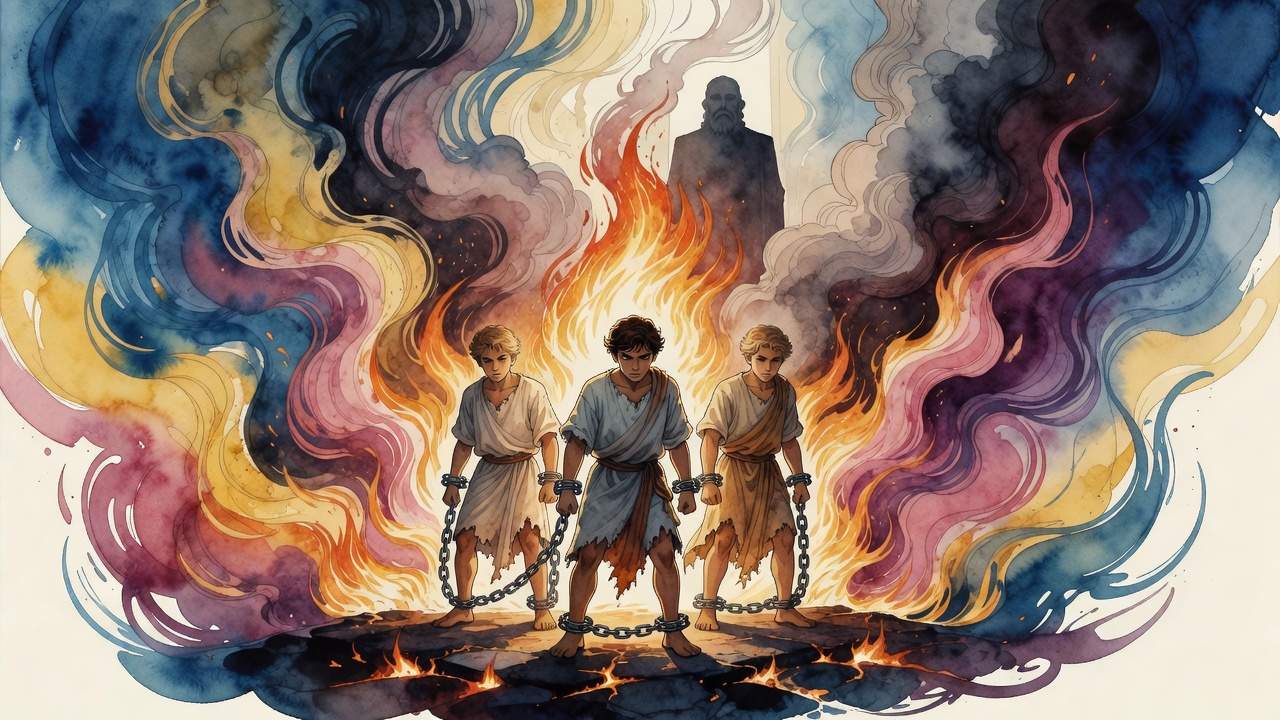
So he had them tied, hand and foot, in their coats and their hats, and thrown into a furnace he had ordered heated past any working temperature. Inside the fire they lifted their eyes and prayed, and the prayer was not for rescue. "Not unto us, O Lord, not unto us, but unto your name give glory."

Who Went Down to Get Them

The angels stood up to go, since angels do not need to be asked twice about fire. The Holy One stopped them where they stood. "For my name they went down," he said, "and I will go down myself and loose them, because the Lord looses the prisoners."

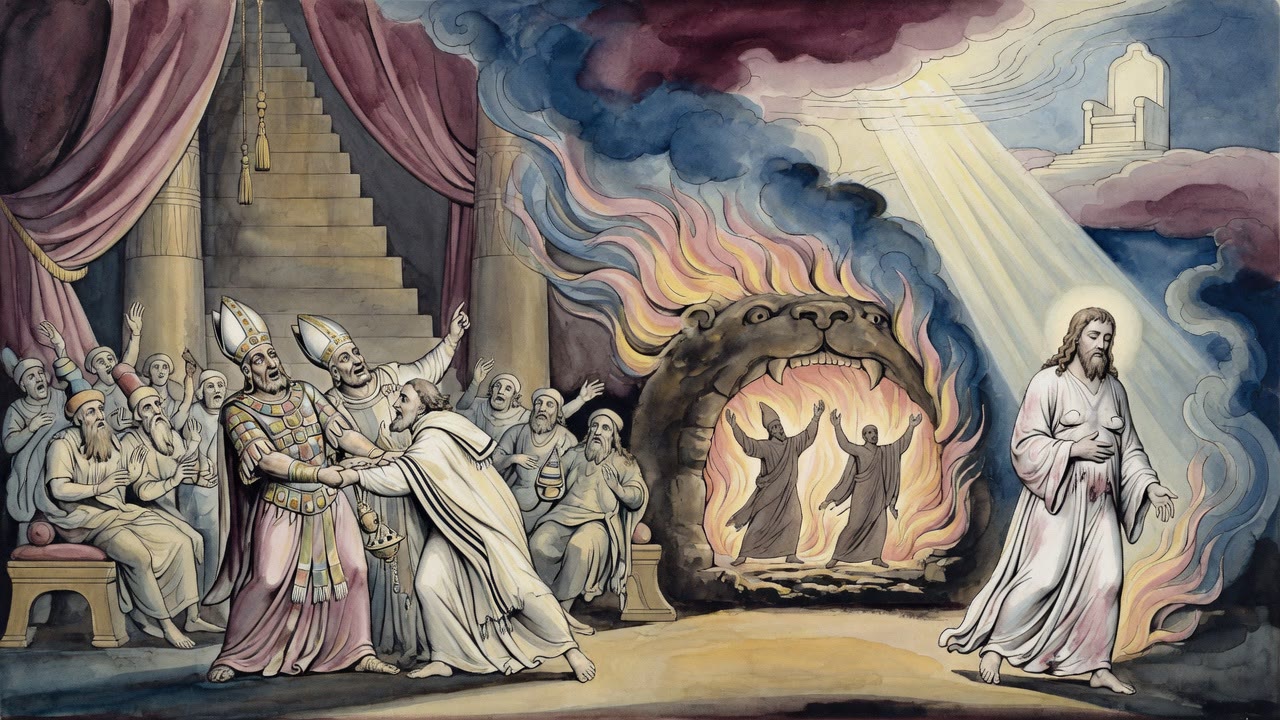
Then he flooded the furnace. He put water through the whole burning shaft of it and brought the structure down level with the ground, and the three of them stood in the middle of that with the ropes gone off their wrists and a fourth figure beside them.

"Come out," the angel said.

The Refusal Inside the Fire

They would not.

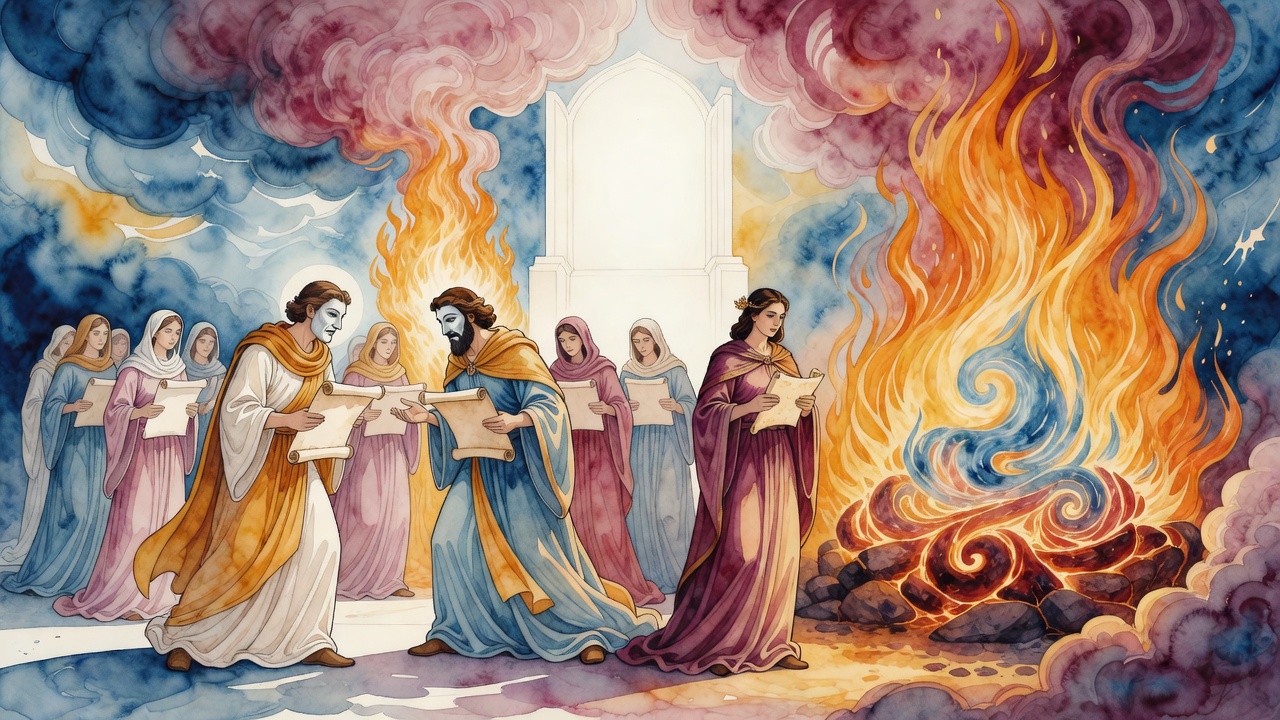
The fire had already lost. The way out stood a step and a half in front of them with an angel holding it open, while the king who had tied them was somewhere outside the wall among his officers, so every hour they stayed was an hour spent inside a furnace on the word of a man who had wanted them dead by supper. They looked at the opening and did not take it.

"We came in here by the king's permission," they said, "and by the king's permission we will go out, or else it will be said afterward that we ran."

They had it from Noah. When the water was down and the ground was dry and his sons were pushing at the door of the ark, Noah would not let them open it, because they had gone in at God's word and they were going to come out at God's word, and they waited in that boat on dry land until the word came. "Go forth from the ark." So the three of them stayed in the leveled furnace and waited for a mouth that had never in its life said a true thing about God.

The King Came to the Door

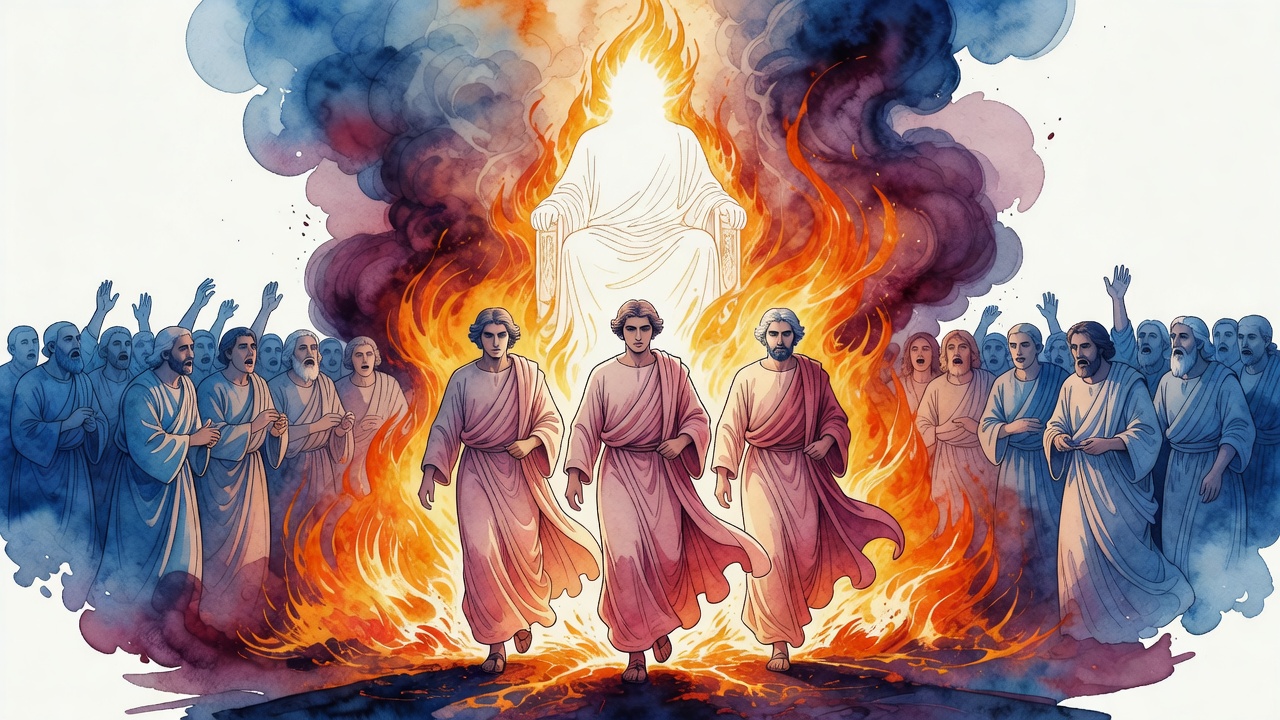
Nebuchadnezzar had to walk to it himself. Not send a herald, not shout it from the platform, but come down off his seat and cross the ground in front of the whole administration of Babylon and stand at the door of his own furnace, near enough to feel what it was doing to his face.

He called them by the names he had issued them, the Babylonian names, Shadrach and Meshach and Abed-Nego. Then he had to put the rest of it in his own mouth in front of his officers. "Servants of the Most High God, come out and come here."

Only then did they come out, one at a time, past the satraps and the prefects and the governors who had all bowed at the horn, with nothing burned on any of them but the ropes. Behind them the furnace kept burning, since nobody had thought to give it any orders.


← All myths
From the tradition

Sources

3 sources

The texts behind this telling. Some cards carry a translation of the source; others are our own retelling of it, and each card says which. Every card links out to the original.

Midrash Tanchuma Buber, Noach 15:1Midrash Tanchuma Buber, Noach

Translation of the source text.Midrash Tanchuma (Buber), Public Domain, on Sefaria · CC-BY-SA

Another interpretation of "Go forth from the ark" (Genesis 8:16). This is what Scripture says: "I keep the king's command, and that in regard of the oath of God" (Ecclesiastes 8:2). The Holy Spirit said to them: I adjure you that if a kingdom should decree decrees upon you, do not rebel against it in anything that it decrees upon you; rather, "I keep the king's command." But if it should decree upon you to nullify the Torah, the commandments, and the Sabbath, do not listen to them. "I keep the king's command" in every matter that it requires; but "in regard of the oath of God, be not dismayed; go from before him, [stand not in an evil thing]" (Ecclesiastes 8:3). Why? Because they are not nullifying you from the commandments, but rather that you should deny the Holy One, blessed be He. Therefore, "in regard of the oath of God."

And so did Hananiah, Mishael, and Azariah do, at the hour when Nebuchadnezzar set up the image. They said to him: What do you suppose, that you cast us into the midst of the fiery furnace and the Holy One, blessed be He, does not deliver us? Whether He delivers us or does not deliver us, we do not bow down to the image, as it is said: "Behold, our God whom we serve is able to deliver us from the burning fiery furnace, and out of your hand, O king, He will deliver" (Daniel 3:17). And it is written after it: "But if not, be it known to you, O king, that we will not serve your gods, nor worship the golden image which you have set up" (Daniel 3:18). Nebuchadnezzar said to them: Is it true what you say, as it is said: "Is it true, O Shadrach, Meshach [and Abednego]?" (Daniel 3:14). They said to him: "We have no need to answer you in this matter" (Daniel 3:16). They said to him: Everything that you decree upon us, crop taxes, imposts, and poll taxes, we listen to you; but to deny the Holy One, blessed be He, we do not listen to you, "in regard of the oath of God, be not dismayed; go from before him."

When he heard this from them, he began to rage, as it is said: "Then was Nebuchadnezzar full of fury" (Daniel 3:19). When they had heated the furnace, they cast them in bound. When they descended into the midst of the furnace, they lifted their eyes to the Holy One, blessed be He, and said: Master of the worlds, You know that we did not trust in our deeds but in Your name. "Not unto us, O Lord, not unto us, but unto Your name give glory" (Psalms 115:1). And behold, this wicked one had gathered all the tongues, as it is said: "Then the satraps were gathered together" (Daniel 3:3). [Why should the nations say...] Immediately the angels sought to descend and to free them. The Holy One, blessed be He, said to them: Was it for your name that they descended? For My name they descended, and I will descend and free them, as it is said: "[who executes judgment for the oppressed]... the Lord looses the prisoners" (Psalms 146:7). Immediately the Holy One, blessed be He, freed them, and flooded the furnace, and brought them up, and leveled it with the ground, for it had been deep.

When the angel saw this, he said to them: Go forth from here, for the Holy One, blessed be He, has freed you and performed miracles for you and leveled the furnace with the ground; go forth! They said to him: We do not go forth without Nebuchadnezzar, lest they say they fled from the furnace. "I keep the king's command", with his permission we entered here, and with his permission we go forth. When Nebuchadnezzar came and saw them, he was astonished, and he began to cry out to them, as it is said: "He spoke and said: Shadrach, Meshach, and Abednego, servants of the Most High God, [come forth and come]" (Daniel 3:26). "Come forth and come up" is not written here, but "come forth and come", from here that the furnace was leveled with the ground. Immediately they said to the angel: Now we go forth, as it is said: "Then Shadrach, Meshach, and Abednego came forth [from the midst of the fire]" (Daniel 3:26). From whom did they learn this? From Noah, who entered the ark by the permission of the Holy One, blessed be He, as it is said: "And God spoke unto Noah [Go forth from the ark]." And when the earth had dried and the ark had rested, as it is said: "And the ark rested" (Genesis 8:4), his sons said to him: Let us go forth. He said to them: Heaven forbid! By the permission of the Holy One, blessed be He, we entered, and by the permission of the Holy One, blessed be He, we go forth. And when the Holy One, blessed be He, heard this, immediately He gave them permission, as it is said: "And God spoke unto Noah, Go forth from the ark" (Genesis 8:15-16).

Full source
Mekhilta Tractate Pischa 13:20Mekhilta DeRabbi Yishmael

Retold in our words. Read the original at the link below.Mechilta, translated by Rabbi Shraga Silverstein · CC-BY

The Mekhilta, the tannaitic midrash on Exodus, illustrates a remarkable principle about obedience to authority through the story of Chananiah, Mishael, and Azariah, three Jewish men thrown into a fiery furnace by the Babylonian king Nebuchadnezzar.

The verse from (Daniel 3:26) describes the aftermath of the miracle. Nebuchadnezzar approached the door of the burning furnace and called out: "Shadrach, Meshach, and Aved-Nego, servants of the Most High. Come out!" The Mekhilta draws attention to a crucial detail: only then, at the ruler's command, did the three men emerge from the flames.

They had survived a furnace heated to extraordinary intensity. They were standing in fire, unburned, with a mysterious fourth figure beside them. They could have walked out at any moment. The miracle was complete. God had already demonstrated His power. But Chananiah, Mishael, and Azariah remained inside until they were told to leave.

The Mekhilta uses this to teach that even in extraordinary circumstances, even when God has clearly intervened, the righteous do not act on their own authority. They wait for the proper command. They came out only when Nebuchadnezzar, the temporal ruler, gave his permission. Miraculous deliverance did not override proper conduct. The three men honored the structure of authority even while standing, unharmed, in a furnace of fire.

Full source
Midrash Tanchuma Buber, Vayera 43:1Midrash Tanchuma Buber, Vayera

Translation of the source text.Midrash Tanchuma (Buber), Public Domain, on Sefaria · CC-BY-SA

"And God tested Abraham" (Genesis 22:1). This is what Scripture says: "You have given those who fear You a banner to be displayed (nes lehitnoses)" (Psalms 60:6), a refuge (manos) through which Israel was rescued from the judgment of Gehinnom. (Another interpretation: "a banner to be displayed") "because of truth, Selah", in order to give their reward in truth, as it is said, "And I will give their recompense in truth" (Isaiah 61:8). But the wicked have no refuge, as it is said, "But the eyes of the wicked shall fail, and refuge shall be lost to them" (Job 11:20).

"You have given those who fear You a banner." Come and see the difference between the first ones and the last ones, for the first ones were tested by the Holy One, blessed be He, as it is said, "And God tested Abraham," and likewise the people of the wilderness generation, as it is said, "that I may test them, whether they will walk in My Torah or not" (Exodus 16:4), and likewise it says, "in order to afflict you [and in order] to test you" (Deuteronomy 8:16). But the last ones were tested by the nations, as it is said, "Now these are the nations that the LORD left, to test Israel by them" (Judges 3:1). Thus, "You have given those who fear You a banner to be displayed because of truth, Selah." What is "because of truth, Selah"? Whoever was tested and stood firm in the trials.

And so you find with Daniel and his companions: when they were exiled, the Holy One, blessed be He, decreed upon them that they would eat unclean bread, as it is said, "Thus shall the children of Israel eat their bread unclean among the nations where I will drive them" (Ezekiel 4:13). Nebuchadnezzar arose and carried out the matter; he began and said: I decree that they shall eat of my food, as it is said, "And the king appointed for them" (Daniel 1:5). Daniel did not accept it upon himself, but said: Even though the Holy One, blessed be He, decreed upon us that we should eat unclean bread, He sought to test us, rather, let us do our part, and the Holy One, blessed be He, will do His part. He began to say to the chief of the guards: "I beseech you, please test your servants ten days, [and let them give us legumes to eat and water to drink, and let our appearance be examined before you, and the appearance of the youths who eat the king's food, and as you see, deal with your servants]" (Daniel 1:12-13). He said to them: Are you able to be tested ten days, not to eat bread and not to drink wine? They said to him: Yes, for we are of the children's children of that man who was tested with ten trials by God; may his merit stand for us, as it is said, "please test your servants" (Daniel 1:12). Have you not already found us ten times better (than the magicians)? By whose merit? By the merit of Abraham, who was tested with ten trials. Since they stood firm in their trial, what is written? "And God gave Daniel [favor and compassion before the chief of the eunuchs (Daniel 1:9), and he heeded them in this matter and tested them ten days, and at the end of ten days their appearance was seen to be better and fatter of flesh than all the youths who ate the king's food (Daniel 1:14-15)]." Thus, "You have given those who fear You a banner to be displayed." What is "a banner"? You make them great, as it is said, "and like a banner on a hill" (Isaiah 30:17). And why did the Holy One, blessed be He, test them? In order to make them great, so as not to give an opening for the nations of the world to say: He makes them great, yet He did not test them and they did not stand firm in their trial. Therefore, "after these things, [and God tested Abraham]" (Genesis 22:1).

Full source