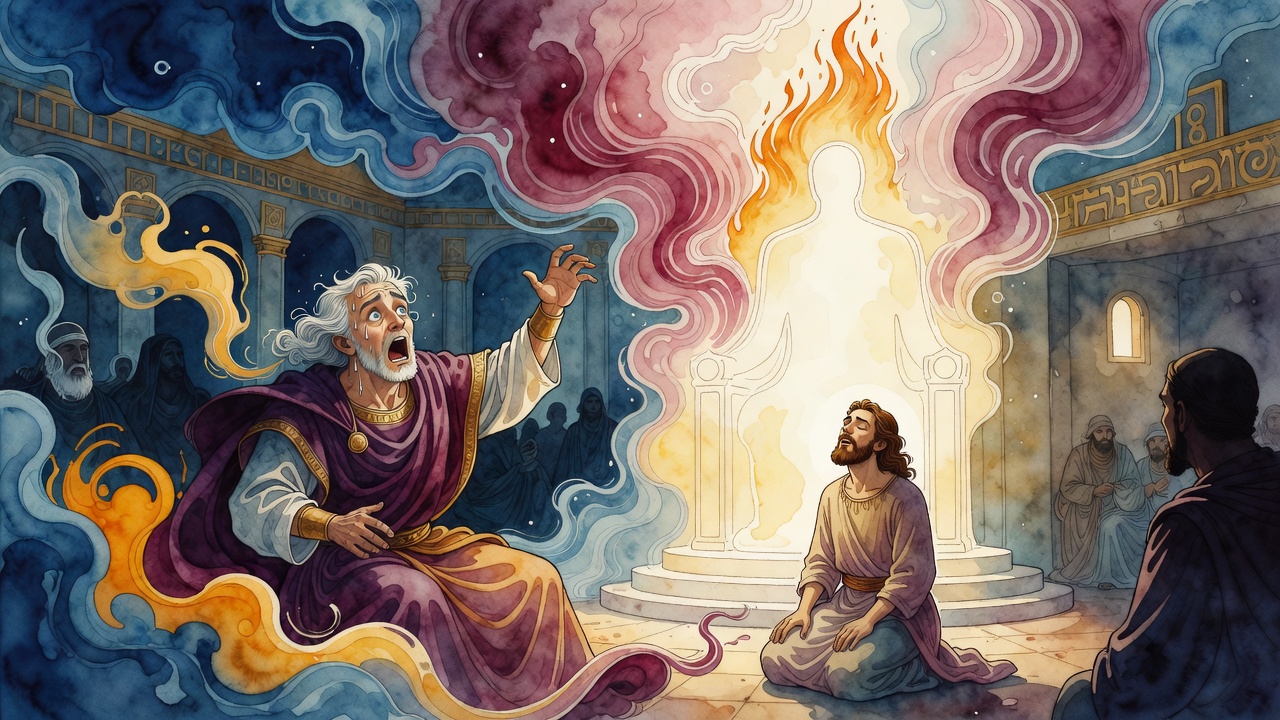
False Prophets Drag Joshua into Babylon's Fire
Ahab and Zidkiah seduce a court with borrowed holiness, then pull the high priest into a furnace test. They burn. Joshua walks out singed.
Table of Contents
 Click for full size
Prophets for Hire in a Foreign Court
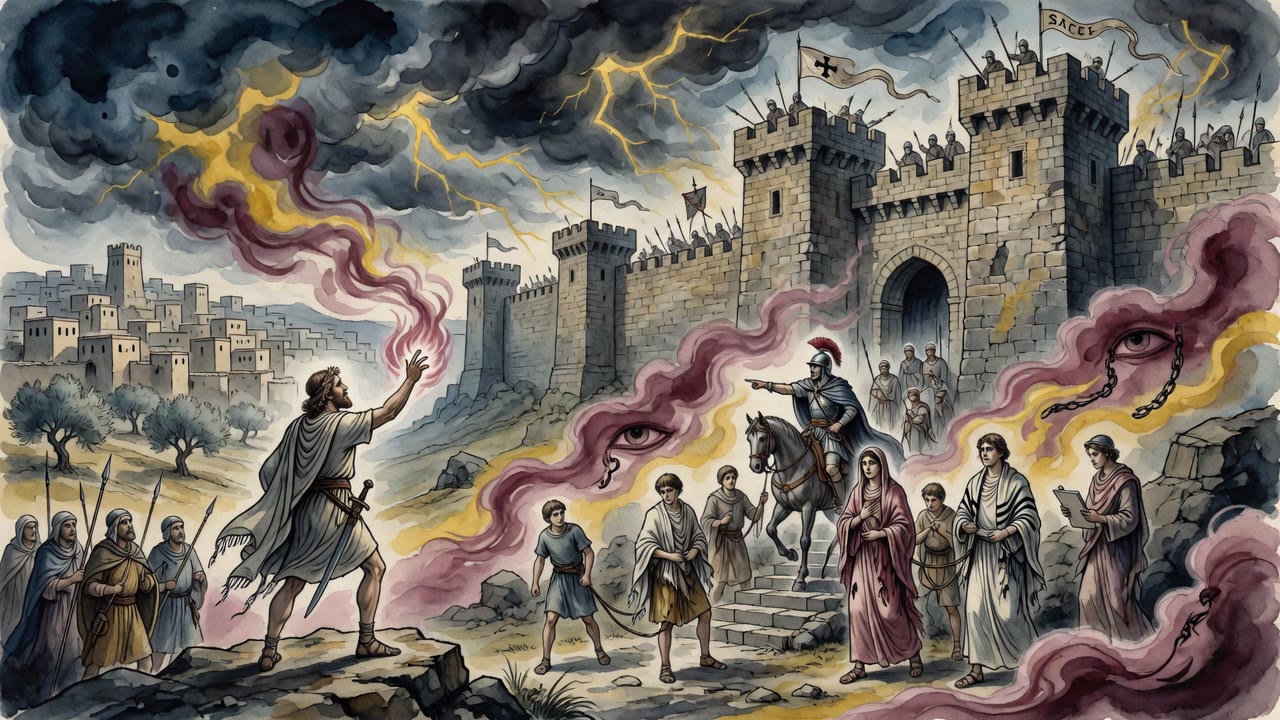
In the Babylonian exile two men wore the language of heaven like stolen cloaks. Ahab ben Kolayah and Zidkiah ben Ma'aseyah claimed to speak for the Lord. Jeremiah had already named their filth (Jeremiah 29:21-23). The longer tale says they worked into the inner rooms of Nebuchadnezzar's court and tried to seduce the king's daughter. They told her the God of Israel had revealed their union in prophecy. She took the claim to her father.
Nebuchadnezzar knew enough of Jewish stories to set a brutal exam. He lit a great fire and announced the rule of Hananiah, Mishael, and Azariah: true servants walk out of flame. False ones become ash.
Borrowed Holiness
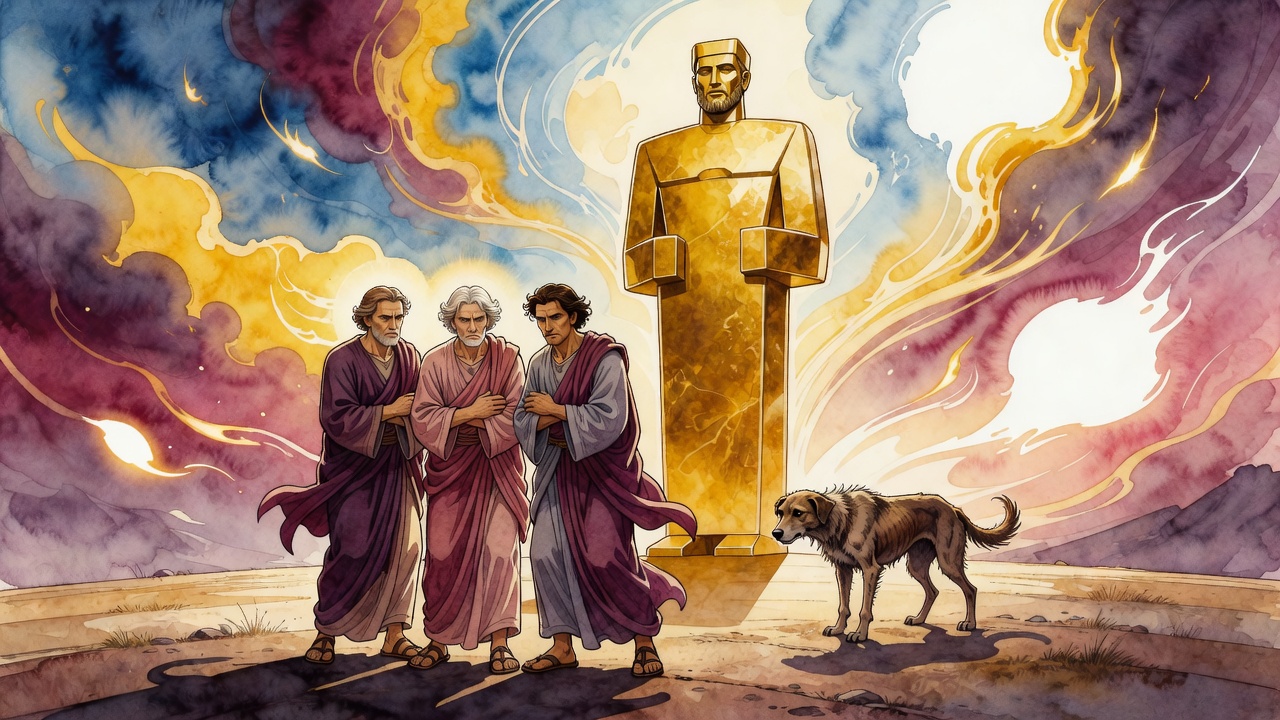
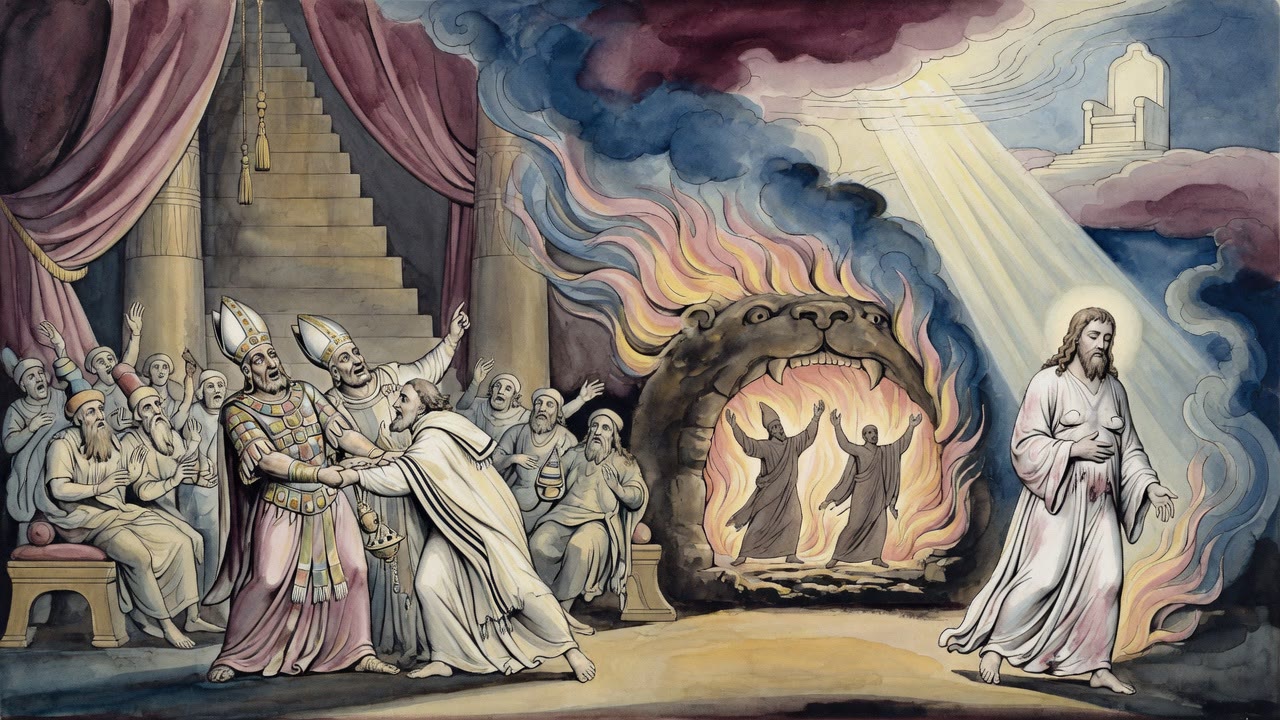
Ahab and Zidkiah tried to cheat the furnace. They asked that Joshua the high priest, a righteous man living in the same exile, be thrown in with them. Perhaps his merit would cover three bodies the way a cloak covers thieves. The appearance of a trio would echo the old miracle. They would pass by proximity.
The fire was not fooled. Ahab and Zidkiah burned to ash. Joshua walked out alive, but singed. The rabbis gave two reasons for the scorch marks. He had been willing to stand beside bad company, and in his own house he had been too soft with his children. Merit is not a fireproof coat you can lend. Near-miss holiness still leaves a smell of smoke on the robe.
Another Exile Argument About the End
In a different confrontation a heretic pressed Gaboha for proof that God raises the dead from the Torah itself, not only from Prophets and Writings. Dry bones in Ezekiel and sleepers in Daniel were not enough for him. He wanted the Five Books. Gaboha opened Deuteronomy and read God saying to Moses that he would sleep with his fathers and rise (Deuteronomy 31:16), then pushed past the heretic's grammar games into the larger claim: a God who creates life from nothing can restore life from dust. The heretic left without a closing thrust.
Exile produces two kinds of speech. One steals the Name for lust and politics. The other fights for the hope that death is not the last word. The furnace and the debate are sibling scenes under foreign roofs.
What Smoke Teaches
False prophecy loves company. It drags the clean toward the dirty so the fire will look confused. Joshua's singeing warns the righteous that nearness to liars is not neutral. Standing in the wrong trio is already a choice. The high priest survived because his core was not fraud. He was marked because he had not guarded his distance.
Ahab and Zidkiah wanted heaven's brand on a bedroom crime. They received heaven's verdict in public flame. The court of Babylon became, for one hour, a courtroom that even an emperor could understand.
Exile's Two Mouths
Babylon held Israel's scholars, priests, and frauds in the same foreign air. Ahab and Zidkiah show what happens when the vocabulary of revelation is rented out for lust and court access. They did not invent false prophecy. They perfected its brazen form: tell a princess that heaven wants her body, then hide behind a righteous man when the fire is lit.
Joshua's singeing is the tale's moral center more than the villains' ash. The high priest did not share their crime. He shared their company at the worst possible moment. Distance is a discipline. Parents who cannot rebuke children, leaders who cannot refuse a photo beside scoundrels, scholars who lend their names to schemes: the smoke finds them. Survival is not the same as unscarred survival.
Gaboha's argument with the heretic belongs to the same exile climate. One mouth steals the Name. Another mouth defends the hope that the Name will wake the dead. Resurrection is not a parlor proof. It is the claim that God's first creation was not a one-time trick. If life can be spoken into clay, life can be spoken back into dust. The heretic wanted a single verse as a trap. Gaboha gave him a worldview that makes the trap look small.
Between furnace and debate, the tradition draws a line: do not borrow holiness, and do not abandon hope. The first is fraud. The second is despair dressed as sophistication. Exile tests both.
Nebuchadnezzar's court learned a Jewish lesson without converting to it: the God of Israel does not rent miracles to cover seduction. The three in the earlier furnace walked out because their refusal was pure. The two in this furnace fell because their speech was a lie from the first bedroom whisper. Joshua's scorch marks keep the middle case alive so no righteous reader can say company is costless.
When the ash cooled, the exile still held. False prophets would rise again under other names. Heretics would still demand a single verse as if faith were a riddle contest. The tradition keeps both trials so that hope and honesty travel together. Do not fake a mission. Do not abandon the waking of the dead. Carry the singe as a warning and the argument as a shield.
← All myths