5 min read

Two Mute Grandsons Sat in the Study Hall

Every time the sages pushed open the door of the study house, the two men pushed in behind them. Heads nodded with the argument. Lips moved. No sound came.

Curated by Arthur · Told by Maggid ·
Table of Contents
  1. Longing Without a Voice
  2. A Fountain That Overflows Sinai
  3. Eight Days Without Bread on the Road
  4. When the Door Opens, Go In

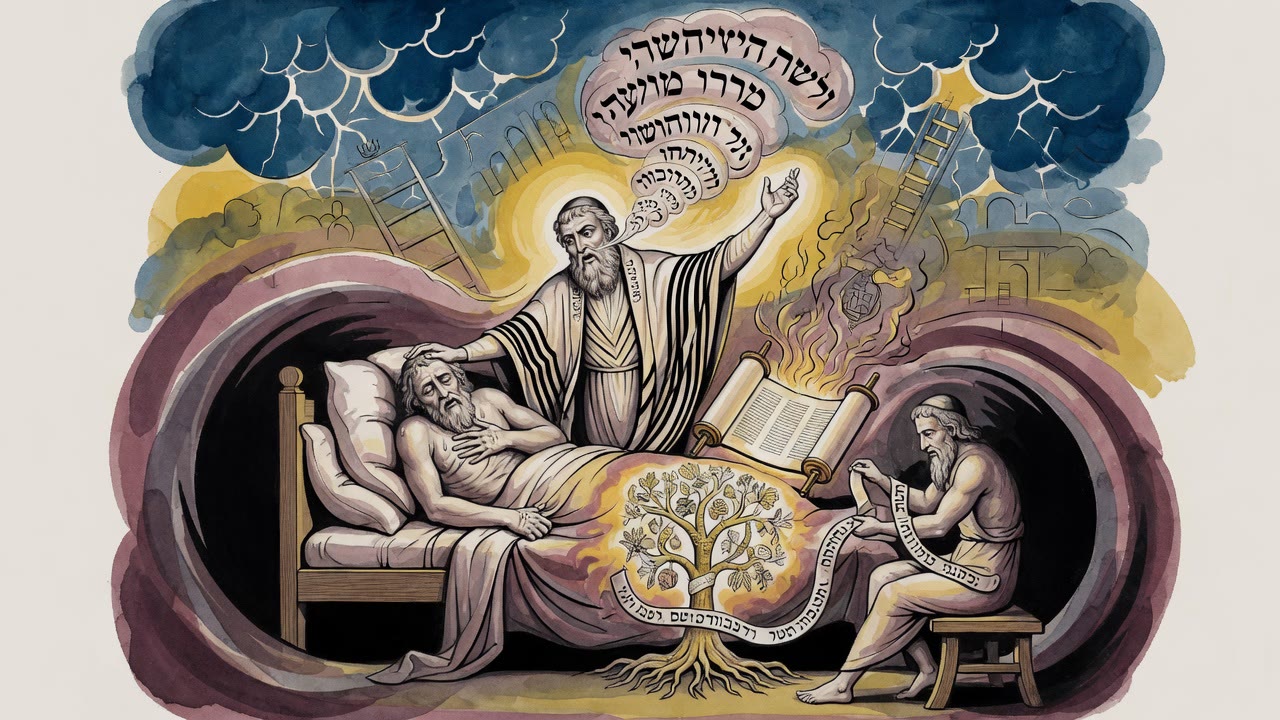
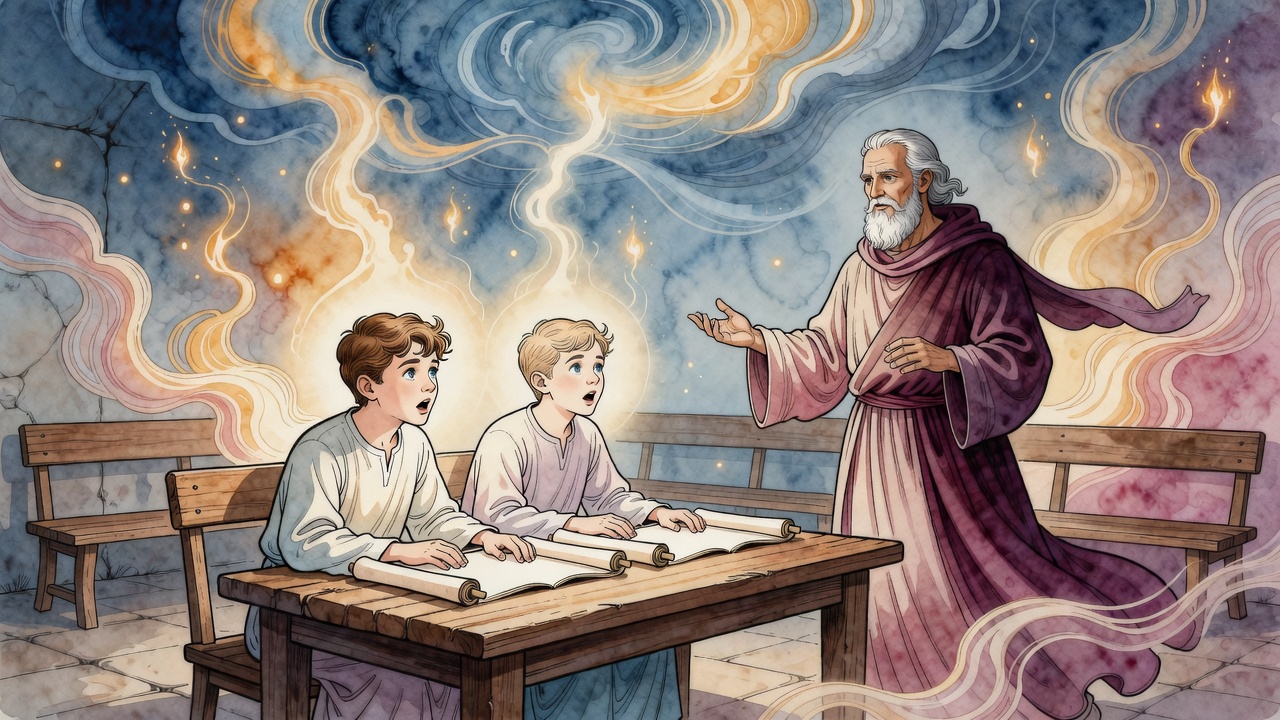
They could not speak, yet every time the sages pushed open the door of the study house, the two mute men pushed in behind them. Grandsons of Rabbi Yochanan ben Gudgada, neighbors of Rabbi Judah the Prince, they took seats among the scholars. Heads nodded with the argument. Lips moved as if reciting. No sound came. The body insisted on being present where Torah was spoken, even when the throat refused its work.
Two Mute Grandsons Sat in the Study Hall Click for full size

Longing Without a Voice

Debate rose and fell around them. Questions were thrown like stones into a well. Answers climbed back up dripping. The mute men could not throw a stone. They could only lean over the rim and watch the water. Still they refused to stay home. Learning, for them, was not performance. It was air. On days when the hall was crowded they pressed against the wall and still mouthed the phrases, as if silence itself could be trained into shape.

Rabbi, the editor of the Mishnah, saw the longing and prayed. Through his prayer they were healed. Speech returned like a gate unbarred. The first words they spoke were not small talk about weather or prices. They spoke words of Torah, as if the years of silent mouthing had been storage for this release. The room that had grown used to their quiet had to relearn their voices.

Presence before ability is the first hard teaching. They did not wait until they could contribute aloud. They contributed their bodies to the quorum of attention.

A Fountain That Overflows Sinai

In another room of the same tradition, Rabban Yochanan ben Zakkai listens to Rabbi Eliezer and reaches for a parable. Eliezer is like a fountain bubbling and sending forth water more powerful than what it seems to hold. He can speak words of Torah in excess of what Moses received at Sinai, not because Sinai is small, but because a living fountain multiplies what it was given. A spring does not apologize for overflowing. It does what water does when the channel is clear.

The mute grandsons reverse the image and complete it. Before the fountain can overflow, someone must sit thirsty beside the stone. Their silence was not emptiness. It was a dry channel waiting for water. When speech returned, the channel was already cut by years of listening. Yochanan ben Zakkai's praise of Eliezer and Judah the Prince's prayer for the mute pair are two sides of one hunger: Torah that will not stay outside the door.

Eight Days Without Bread on the Road

Young Eliezer's path to that overflowing mouth was not gentle. Hosts reported to Rabbi Yochanan that Eliezer had not eaten with them, that he had fasted eight days without tasting food. Joshua ben Chananiah and Yose the Priest confirmed the report. Family conflict sharpened the hunger. Brothers urged their father Hyrkanos to go up to Jerusalem and vow that Eliezer would enjoy none of the estate. The father traveled toward disinheritance while the son traveled toward a life made of verses.

Festival guests filled Jerusalem, magnates at a gathering hosted by Yochanan ben Zakkai, while a private war between father and son moved under the public joy. The sources leave the knife edge visible: devotion that risks the vessel, family that cannot understand why a son would choose books over inheritance. Rabbi Yose would later warn against fasting that ruins the body into dependence. Eliezer's eight days sit on that warning's ridge. The myth does not pretend the ridge is safe. It only shows how badly some souls want the water.

Hunger of the belly and hunger of the mute mouth rhyme. Both mark a person who will pay almost any price to stay near the teaching.

When the Door Opens, Go In

Judah the Prince's prayer did not create desire. It released what desire had already practiced. The grandsons had rehearsed speech with soundless lips for years. Eliezer had rehearsed Torah until a master called him a fountain. The study house door is the recurring miracle: it opens, and those who refuse to stay outside eventually find a voice equal to their hunger.

If you cannot yet speak, sit anyway. Move the lips over the words. Bring the body even when the throat is locked. The healing may come through another person's prayer, but the seat you take is your own. Do not wait for perfect readiness. The mute men were ready only in longing, and longing proved enough to start.

And if your fountain finally overflows, remember the years you sat dry. Speak for those still mouthing along the wall.

Some who can speak waste the gift on empty noise and never enter. These two entered without the gift and forced heaven to notice the mismatch. When their voices returned, the hall gained more than volume. It gained proof that attention is already a form of speech, waiting only for breath to catch up.


← All myths
From the tradition

Sources

3 sources

The texts behind this telling. Some cards carry a translation of the source; others are our own retelling of it, and each card says which. Every card links out to the original.

Ein Yaakov, Chagigah 1:2Ein Yaakov, Chagigah

Retold in our words. Read the original at the link below.En Jacob, Agada of the Babylonian Talmud, S. H. Glick (1916-1921) · Public Domain

This story from Ein Yaakov, drawn from the talmudic tractate Chagigah, tells of two mute men who lived in the neighborhood of Rabbi Judah the Prince, known simply as Rabbi, the editor of the Mishnah. The two were grandsons of Rabbi Yochanan ben Gudgada, either through his daughter or, by another account, his sister. Though they could not speak, they were drawn to learning.

Whenever the sages entered the house of study, these two men would go in as well. They would sit among the scholars, shake their heads as if following the give and take of the argument, and move their lips as though reciting along, even though no words came out. Their bodies showed the longing to study even when speech was denied them. They could not join the debate aloud, yet they refused to stay away from the place where Torah was taught.

Rabbi prayed on their behalf, and through his prayer they were healed and their speech restored. When at last they could be examined, a remarkable thing was discovered. The two were thoroughly versed in the laws of Halacha and had mastered the entire six orders of the Mishnah, the earliest code of rabbinic law. Though they had sat silent all those years, they had absorbed everything through their attentive presence. The story teaches that earnest attendance in the house of study, even in silence, can carry a person to the heights of learning, and that sincere desire to learn does not go unrewarded.

Full source
Pirkei DeRabbi Eliezer 2:3Pirkei DeRabbi Eliezer

Retold in our words. Read the original at the link below.Pirke de Rabbi Eliezer, trans. Rabbi Gerald Friedlander, London (1916) · CC-BY

The tradition turns to the Pirkei DeRabbi Eliezer, a fascinating work of Jewish literature that blends biblical narrative with folklore and homiletics. It tells us of a powerful encounter between two great sages, Rabban Jochanan ben Zakkai and Rabbi Eliezer.

The story begins with a conversation, a sharing of Torah. But it quickly becomes clear that Rabbi Eliezer possesses an extraordinary gift. Rabban Jochanan ben Zakkai, recognizing this, offers a parable. "I will tell thee a parable," he says. "To what is the matter like? To this fountain which is bubbling and sending forth its water, and it is able to effect a discharge more powerful than what it secretes; in like manner art thou able to speak words of the Torah in excess of what Moses received at Sinai." image for a moment: a fountain overflowing, its output surpassing its source. Rabban Jochanan is saying that Rabbi Eliezer’s understanding and articulation of Torah is so profound that it seems to exceed even what Moses himself received at Sinai.

There’s a delicate balance here. Rabban Jochanan, a senior figure, is careful not to make Rabbi Eliezer feel uncomfortable or ashamed by such lavish praise. He even says, "Lest thou shouldst feel ashamed on my account, behold I will arise and go away from thee." He understands that sometimes, the best thing a teacher can do is step aside and let their student shine.

So, Rabban Jochanan ben Zakkai leaves, and Rabbi Eliezer begins to expound on the Torah. And here’s where the story takes a truly remarkable turn. That "His face shone like the light of the sun and his effulgence beamed forth like that of Moses, so that no one knew whether it was day or night."

Rabbi Eliezer, immersed in the wisdom of the Torah, radiating such light that the very distinction between day and night blurs. It’s a powerful image, reminiscent of Moses’ own face shining after receiving the Torah on Mount Sinai (Exodus 34:29).

The people, witnessing this extraordinary display, rush to tell Rabban Jochanan ben Zakkai. He returns and, upon seeing Rabbi Eliezer, kisses him on the head, proclaiming, "Happy are ye, Abraham, Isaac, and Jacob, because this one has come forth from your loins."

What does it mean to say that Abraham, Isaac, and Jacob are "happy" because of Rabbi Eliezer? It suggests that the wisdom and spiritual light embodied by Rabbi Eliezer are a continuation of the legacy of the patriarchs, evidence of the enduring power of Jewish tradition. It’s a beautiful moment of recognition, a celebration of the transmission of knowledge from one generation to the next.

This story from Pirkei DeRabbi Eliezer isn't just about two rabbis. It's about the transformative power of Torah, the potential for human beings to connect with something truly divine, and the importance of recognizing and celebrating the gifts of others. Perhaps we can all strive to be a little more like Rabbi Eliezer, radiating the light of wisdom and inspiring those around us.

Full source
Pirkei DeRabbi Eliezer 2:1Pirkei DeRabbi Eliezer

Retold in our words. Read the original at the link below.Pirke de Rabbi Eliezer, trans. Rabbi Gerald Friedlander, London (1916) · CC-BY

There's this story in Pirkei DeRabbi Eliezer, a fascinating early collection of Jewish stories and traditions, that gives us a glimpse into his life and the esteem in which he was held.

The story starts with a question. Rabbi Jochanan, a prominent figure himself, sends a message to his hosts, inquiring: "Did Eliezer eat with you today?" Their response? A surprising, "No; moreover has he not fasted eight days without tasting any food?" Can you Eight days without food! What drove him?

Rabbi Joshua ben Chananjah and Rabbi José the Priest, clearly concerned, confirm this to Rabbi Jochanan ben Zakkai, another towering figure of the time: "Verily during the last eight days (Eliezer) has not partaken of any food." This detail alone paints a picture of Rabbi Eliezer as someone utterly committed to his spiritual path, willing to endure extreme hardship. What was he seeking? What prompted such a rigorous fast?

The drama doesn't end there. Oh no. We then learn about a conflict brewing between Rabbi Eliezer and his own family.

Rabbi Eliezer and his brothers, the sons of Hyrkanos, found themselves at odds. So much so, that they actually convinced their father: "Get thee up to Jerusalem and vow that thy son Eliezer should not enjoy any of thy possessions." Can you imagine the family tension? The pain of being disinherited?

So, Hyrkanos, the father, journeys to Jerusalem to disinherit his son. As fate would have it, his arrival coincides with a festival hosted by none other than Rabbi Jochanan ben Zakkai. The guest list is a who's who of Jerusalem's elite: Ben Zizith Hakkeseth, Nicodemus ben Gorion, and Ben Kalba S'bu'a, all magnates of the district.

This gathering sets the stage for a confrontation, a moment of reckoning. What will happen when Hyrkanos publicly disinherits his son? Will Rabbi Eliezer's dedication be vindicated? Will the community intervene?

But sometimes, the unanswered questions are the most powerful. They force us to reflect on our own relationships, our own commitments, and the challenges we face when pursuing a path that others may not understand.

The story of Rabbi Eliezer isn’t just a historical anecdote. What are you willing to sacrifice for what you believe in?

Full source