Parshat Beha'alotcha7 min read

When a Physician's Limbs Revolted and the Tongue Saved His Neck

A physician dreams his hands, feet, and eyes mock the tongue as worthless, until one wrong word drags him to the gallows and the tongue alone can save him.

Curated by Arthur · Told by Maggid ·
Table of Contents
  1. The Quarrel of the Members
  2. The Word That Walked Him to the Gallows
  3. The Confession on the Scaffold
  4. How the Tongue Won the Crown

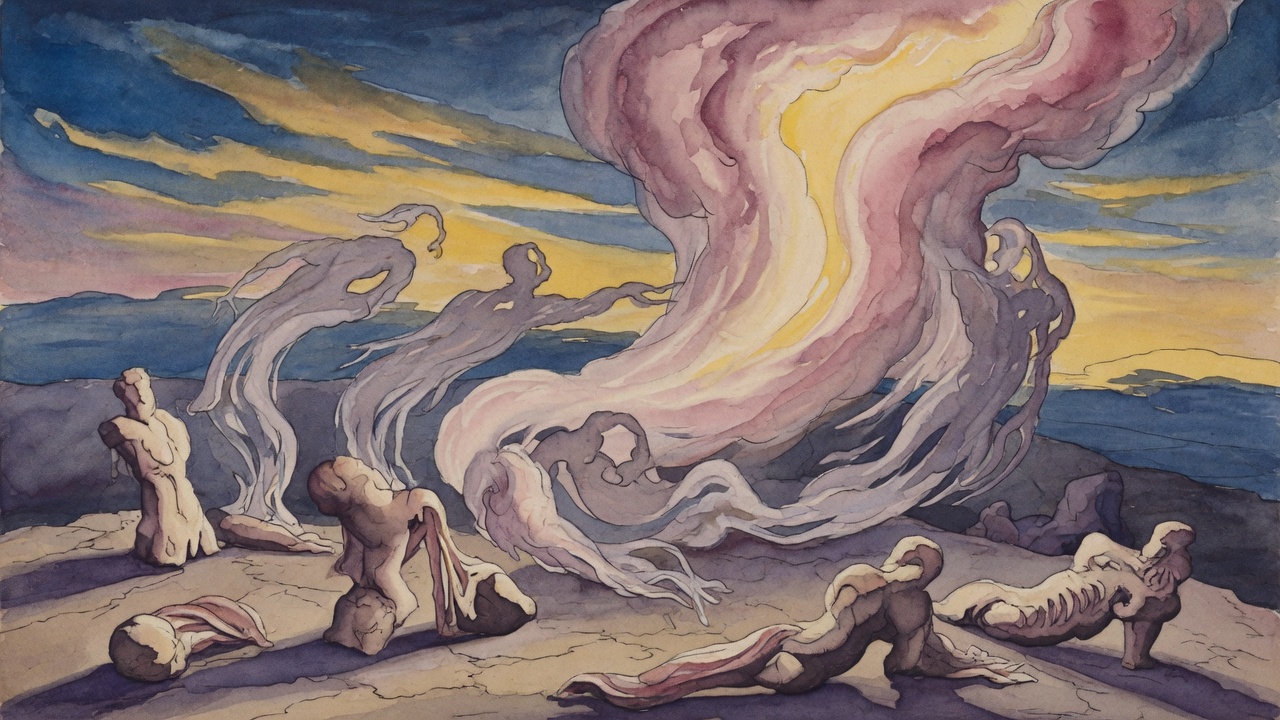
The physician lay on his cot with the king's sickness pressing on his thoughts, and the moment sleep took him his own body turned against itself. He felt it the way a man feels a riot start in the next street. First a muttering, then shouts, then the whole house of his flesh up in arms.
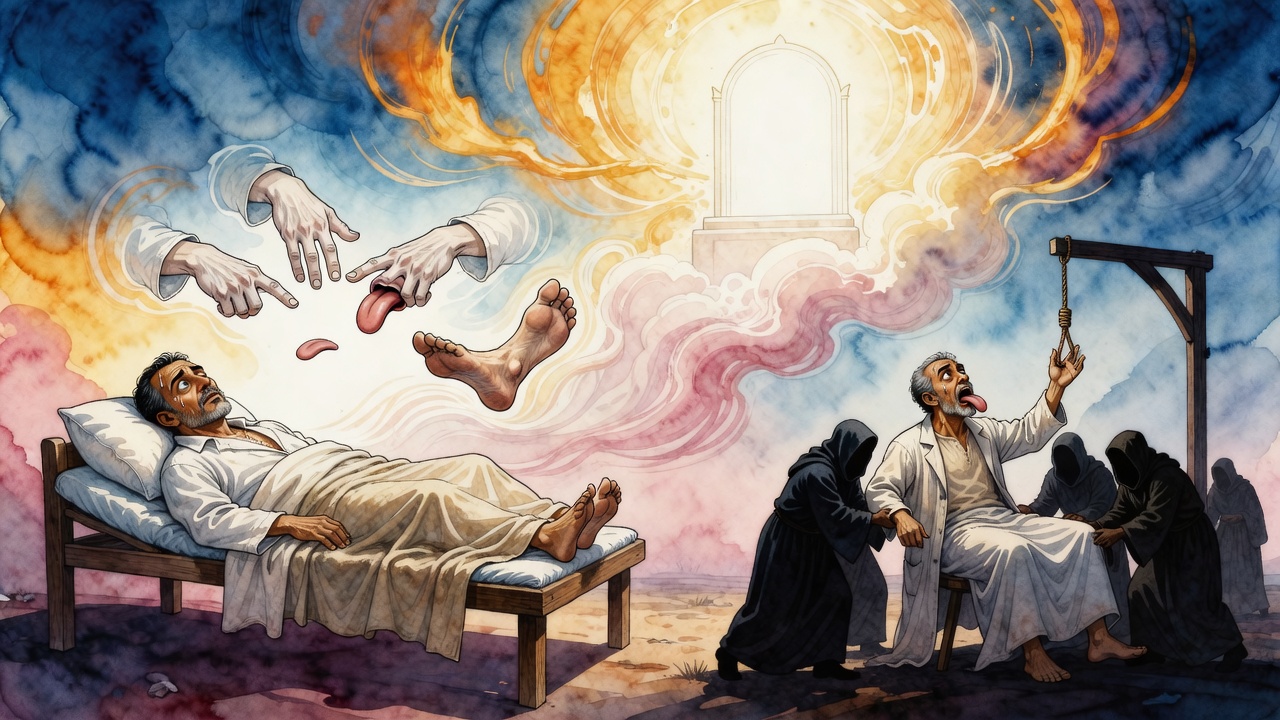
The hands spoke first, lifting themselves before his closed eyes. "We gripped the rope. We hauled the beast down. Without us there is no cure and no king and no reward." The feet stamped beneath the blanket. "You gripped nothing until we carried you across three days of stone. The credit is ours." The eyes opened in the dark of the dream and burned. "You walked where we pointed. We found the den. We found the milk." And so the council of the body argued, each limb staking its claim to the cure, each one certain it alone had earned the king's gratitude.

The Quarrel of the Members

Then the tongue stirred in the floor of his mouth, and the noise of the dream-body changed. It did not shout. It lay flat and small behind the teeth and said, quietly, "I too had a part in this."

The hall of the flesh fell silent for one beat, and then they laughed at it. The hands curled into fists. The feet stilled. The eyes narrowed. "You?" the limbs said together. "You have no bone. You cannot lift, cannot stand, cannot see, cannot hold. You are a wet thing in the dark that has never once carried weight. You did nothing. You are nothing." They turned their backs on it, all of them, and went on dividing the glory among the strong.

The tongue did not argue. It went quiet, the way a wronged thing goes quiet when it has decided what it will do.

The physician woke with the dream still wet on him, and he did not shake it off the way men shake off ordinary dreams. He was a man who listened to the night. He rose, washed, took up the vessel he had carried across the wilderness, and went to stand before the king.

The Word That Walked Him to the Gallows

The whole court waited. The king lifted his eyes from the sickbed, and the physician opened his mouth to say lion's milk, the cure he had risked the den to draw, the thing that would buy his life and his fortune in a single breath.

What came out was, "Here is the dog's milk we went to fetch for you."

The word hung in the air of the throne room. Dog's milk. Brought to a king. Offered to a king as his cure. The strong limbs froze inside the physician's body, every one of them, the proud hands and the tireless feet and the sharp eyes, all of them suddenly aware of what the small wet thing in the mouth had just done with no bone and no muscle at all.

The king did not ask for an explanation. His face closed like a door. "Hang him," he said. "He has mocked me on my deathbed."

They took the physician out. The proud limbs that had argued over the reward learned in an instant what the reward had become. The hands shook so badly they could not be tied straight. The feet would not hold him and had to be dragged. The eyes that had found the den now found only the rope and the beam and the gathering crowd, and they could do nothing but stare. Not one limb could lift the sentence the tongue had laid on all of them.

The Confession on the Scaffold

And in that last place, with the noose waiting, the tongue spoke again, low, where only the trembling house of the body could hear it.

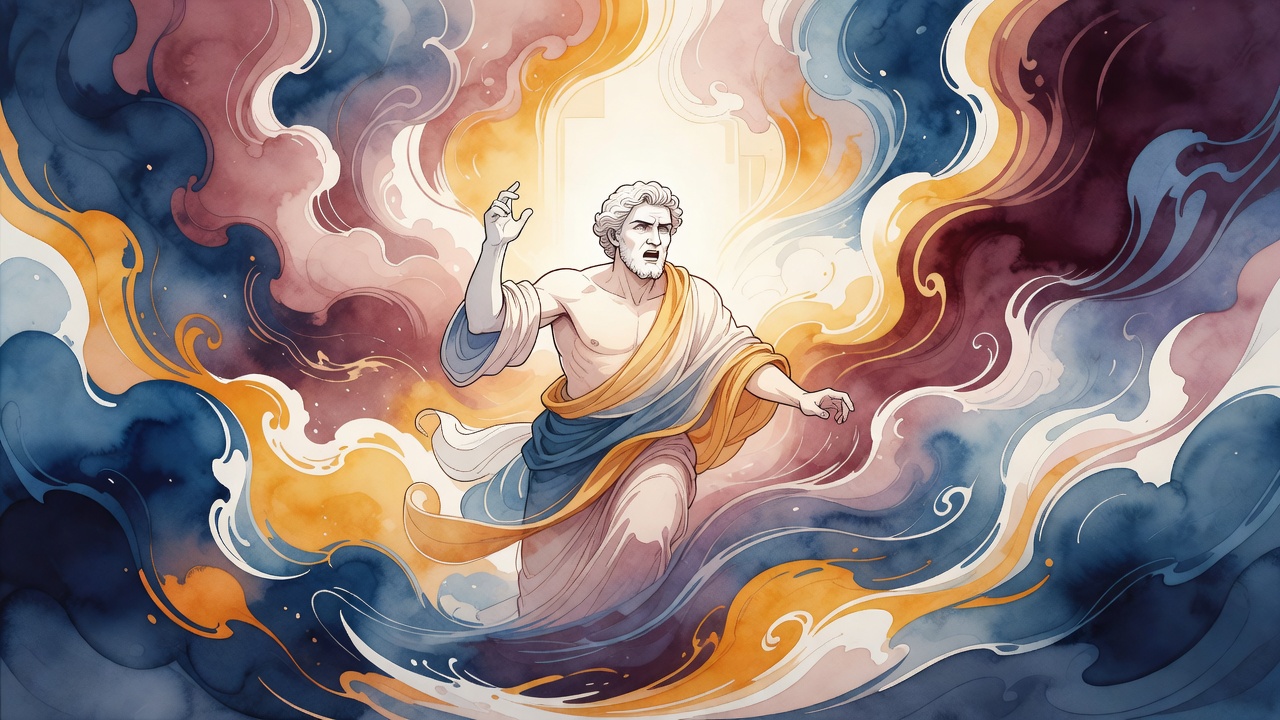
"Did I not tell you that you are good for nothing? You boasted. You divided the spoils. You shut me out as a thing too small to matter. Now you stand at the edge of death and not one of you can save the man you live in. Acknowledge that I am above you, all of you, and even now, from here, I will pull him back from the grave."

The limbs surrendered. The hands and the feet and the eyes, all the proud strong members, bent the knee inside the flesh and granted the tongue its crown. And the moment they did, the tongue went to work.

The physician turned to the executioner and begged. "Bring me back to the king. One word, then do as he commands." The man relented and walked him back into the hall, where the sick king lay waiting to watch him die. The physician knelt. "As a last favor to a dying man's enemy," he said, "let the king only taste what I have brought. Taste it, and then hang me, and I will go in peace."

How the Tongue Won the Crown

The king, sick and bitter and curious the way the dying are curious, agreed. He took the milk the physician had named for a dog and drank.

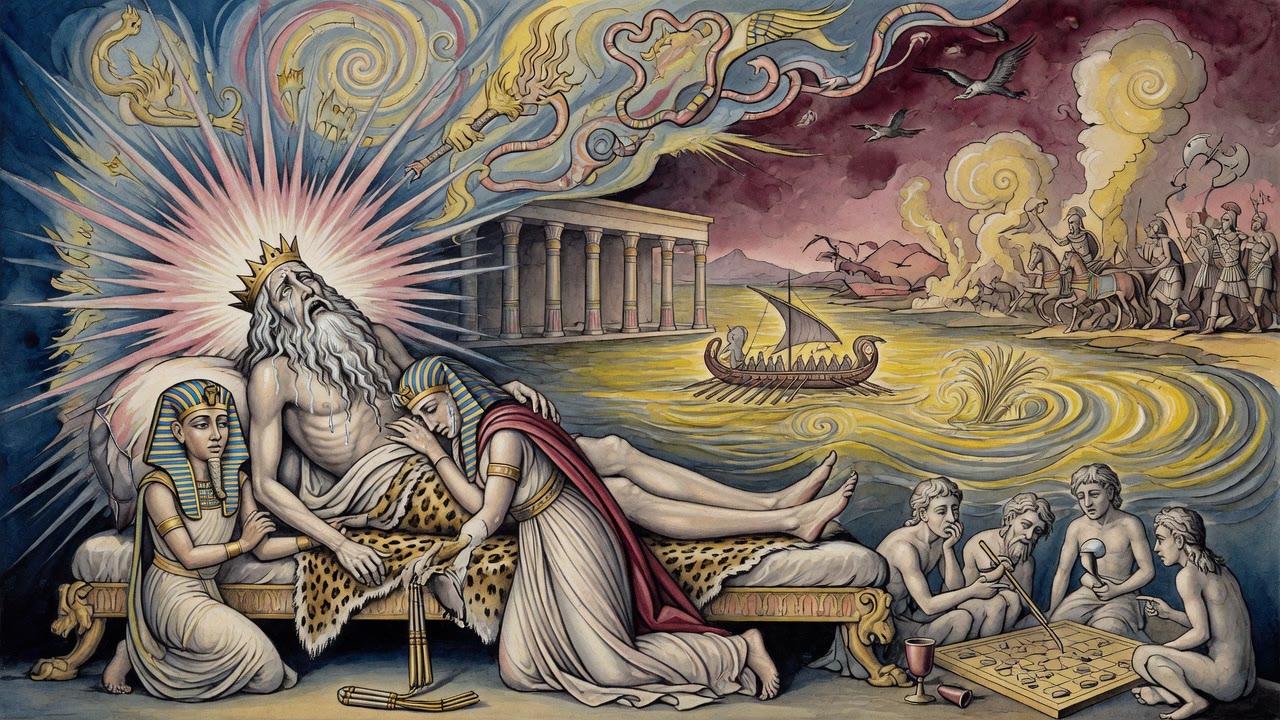
And he rose. The fever broke and ran out of him. The strength came back into his arms. The thing he had been certain was an insult became the very cure that emptied the sickness out of his body, and the king who had ordered the rope now ordered the man set free, and sent the physician home in peace with his life and his name intact.

So every part of the body came at last to confess what it had laughed at in the dark. The hands that grip and the feet that carry and the eyes that find can do nothing for a man whose mouth has already destroyed him, and nothing against death once the small wet thing behind the teeth decides to save him. The strong members are servants. The one that rules has no bone in it at all.

And the strange arithmetic of it held even further back than the physician's dream. When the first woman was shaped, the tradition says her Maker took care not to build her from the eye, lest she be all curiosity, nor from the ear, lest she be all eavesdropping, nor from the mouth, lest she be all chatter, nor from the hand, lest she steal, nor from the foot, lest she wander. He built her from a hidden limb, a quiet bone. And still the mouth in her did its work, and still the word went out, and still the members of every body after her have gone on quarreling over who is master, never quite believing that the smallest, softest, most boneless thing among them holds their life and death in the dark behind the teeth.


← All myths

From the tradition

Sources

3 sources

The texts this telling draws on, in full. Open a card to read inline, or expand it for a wider, quieter read.

Legends of the Jews 5:147Legends of the Jews

Legends of the Jews turns to A Physician's Dream Where Body Parts Argue Over Speech.

He had a dream. In this dream, all his body parts – hands, feet, eyes, mouth, tongue – they were all bickering. Can you imagine the chaos? Each one wanted the lion’s share of the credit for finding the cure for the king. But when the tongue chimed in, boasting about its contribution, the others scoffed. They dismissed it, saying it had done absolutely nothing.

The physician, wise enough to pay attention to the whispers of the night, didn’t forget this dream. He knew something was up. So, when he stood before the king, he uttered the words: "Here is the dog's milk which we went to fetch for you."

Dog's milk? Not lion's milk, as intended?

The king, understandably, flew into a rage. He ordered the physician to be hanged for such blatant disrespect and failure. As the execution preparations began, the physician’s limbs started to tremble, seized by terror. And then, the tongue spoke again, this time within the dream-echoing mind of the physician: "Didn't I tell you that you all are of no good? If you acknowledge my superiority, I shall even now save you from death."

Desperate, they all conceded. The physician then begged the executioner to bring him back before the king. He pleaded with the king to, as a special favor, just try the milk.

Intrigued, perhaps even a little amused, the king granted his wish. And what happened? He recovered! He was healed! The king, overjoyed, dismissed the physician in peace.

The story concludes with a simple, yet profound statement: all the organs of the body acknowledge the supremacy of the tongue.

But what does it all mean? What's the moral of this bizarre, almost comical tale? Is it simply about the power of speech to avert disaster? Perhaps. It highlights the idea that our words can have immense consequences, that what we say can literally mean the difference between life and death. The tongue, often seen as a source of gossip, lies, and negativity, becomes the savior in this story. It's a reminder that even the most seemingly insignificant part of ourselves can possess incredible power. It's a evidence of the potential for redemption, for turning something perceived as negative into a force for good. It also reminds us to listen to our inner voice, our intuition, even when it seems strange or illogical. Maybe, just maybe, it holds the key to our salvation.

Full source
Devarim Rabbah 6:11Devarim Rabbah

In Devarim Rabbah, a collection of rabbinic teachings on the Book of Deuteronomy, we find a powerful exploration of this very feeling, wrapped in a story about snakes and the prophet Moses.

The passage begins with a striking parable. Rabbi Yitzḥak compares the situation to a poisonous snake, an akhina, lurking at a crossroads, biting unsuspecting passersby. Then, a non-venomous snake, a darvon, joins it. A snake charmer arrives and wonders why the harmless snake would associate with such a dangerous creature.

This imagery sets the stage for understanding Moses's hurt. He's confronting the fact that both Miriam and Aaron, his own siblings, spoke against him. As Moses laments, "Miriam spoke, and also Aaron?" (Numbers 12:1). He understands that Miriam, perhaps, might be prone to certain. tendencies. But Aaron? That cuts deep.

He cries out, quoting (Psalms 41:10): "Even my ally, upon whom I relied, who partook of my bread, has lifted his heel against me?" He refers to Aaron as "ish shlomi," "my ally," the one who bestows peace – shalom – upon him, echoing the priestly blessing, "He will grant peace to you" (Numbers 6:26). Aaron was also the one who, as the text reminds us, stopped the angel of death, as recounted in (Numbers 17:15). And, as a priest, he received twenty-four priestly gifts from Israel. With all that history and shared experience, how could he turn against Moses?

The text then veers into a somewhat uncomfortable, though revealing, tangent. Rabbi Levi suggests that women have four negative traits: they are gluttons, eavesdroppers, jealous, and lazy. These claims are supported with biblical examples: Eve eating the forbidden fruit (Genesis 3:6) as evidence of gluttony; Sarah listening at the tent entrance (Genesis 18:10) as proof of eavesdropping; Rachel's jealousy of her sister (Genesis 30:1); and the need to hurry Sarah to prepare food (Genesis 18:6) as evidence of laziness. The Rabbis add two more: that women are sensitive and talkative, again referencing biblical stories to support their claims.

Now, it's important to acknowledge that these are interpretations from a specific time and place. We can read them today with a critical eye, recognizing the historical context and potential biases. What's fascinating, though, is the underlying attempt to understand human nature and to confront perceived differences between men and women.

Rabbi Yehoshua of Sikhnin offers another interpretation, a midrashic (rabbinic interpretive commentary) exploration of Eve's creation. He suggests that God deliberately avoided creating her from certain body parts to prevent specific negative traits: not from the eye (to avoid curiosity), not from the ear (to prevent eavesdropping), not from the mouth (to avoid chatter), not from the hand (to avoid stealing), and not from the foot (to avoid wandering). Instead, she was created from a "concealed limb," the thigh.

Yet, despite God's intentions, these traits still emerged, even in the most upright women. Eve still saw the fruit; Sarah still listened; Rachel still stole (the household idols, as mentioned in (Genesis 31:1)9); Leah still went out to greet Jacob (Genesis 30:16); and Miriam still spoke out. As the text concludes, "See what befell her: 'Remember what the Lord your God did to Miriam.'"

What does all this mean? Perhaps it’s a reflection on the limitations of even divine intervention in shaping human character. Or maybe it's a commentary on the enduring power of free will. It definitely highlights the complexities of relationships and the pain of betrayal, even within families. It also serves as a reminder to examine our own biases and assumptions about others, especially those who are different from us. And it compels us to remember Miriam, and to consider the consequences of our words and actions.

Full source
Midrash Tehillim 19:13Midrash Tehillim

Midrash Tehillim, a collection of rabbinic teachings on the Book of Psalms, offers a beautiful interpretation of (Psalm 19:9), "The precepts of the LORD are straightforward." But what does "straightforward" really mean here?

Rabbi Hizkiyah son of Ḥiyyah, in this Midrash (rabbinic interpretive commentary), presents us with a powerful image: the words of the Torah as a multi-faceted cure-all. He sees them not just as rules or laws, but as something far more profound – a source of healing and vitality for the entire being.

He begins by saying that the words of Torah are a "crown for the head," drawing a parallel to (Proverbs 1:9): "For a graceful wreath are they on your head, a necklace on your throat." imagery for a moment. The Torah isn't just something you study; it's something that adorns you, elevates you, brings you honor and beauty.

The healing doesn't stop there. The Midrash continues, saying the Torah is a "remedy for the heart," making it rejoice. It’s a "salve for the eyes" – as the verse itself says, "The commandment of the LORD is clear, illuminating the eyes." Suddenly, those "straightforward precepts" aren't just about following rules; they're about gaining clarity, seeing the world with renewed vision.

And then it gets even more interesting. Torah is described as an "elixir for plague" and a "potion for the intestines." Now, this might sound a little strange to our modern ears, but consider the ancient understanding of the body. Physical ailments were often seen as connected to spiritual imbalances. So, if the Torah could heal the spirit, it could also impact the physical body. (Proverbs 3:8) chimes in: "Cure for your gut it will be."

The Midrash even goes so far as to connect the Torah to the 248 organs of the body! Citing (Proverbs 4:24), "..and to all his flesh it heals," the text implies that the Torah's influence permeates every single part of our being. It suggests that engaging with Torah on a deep level can bring about a complete and total healing.

Another version of this same teaching emphasizes the restorative power even more dramatically. Rabbi Hizkiyah bar Hayya equates Torah with balm for the heart, joy for the soul, remedy for wounds (citing (Jeremiah 17:14), "Heal me, O Lord, and I shall be healed"), and strength for the bones (referencing (Proverbs 3:8) again). It’s a total revitalization!

What's truly remarkable about this Midrash is its holistic view of the Torah. It's not just a set of instructions; it's a living, breathing force that can heal us, strengthen us, and bring us closer to the Divine.

So, the next time you open a Torah scroll or explore a Jewish text, remember this image of the Torah as a powerful medicine. Remember that engaging with these words isn't just about intellectual understanding; it's about nourishing your soul, healing your heart, and illuminating your entire being. Could it be that the cure we're all searching for has been here all along?

Full source