6 min read

Yishbi-benob and the Mule That Leaped Four Hundred Miles

Old and trapped beneath a giant's press in Philistia, David is saved when the earth softens, the road folds, and the Ineffable Name holds him in the air.

Curated by Arthur · Told by Maggid ·
Table of Contents
  1. The Hart That Was the Accuser
  2. The Giant Who Knew the Face
  3. The Signs in Jerusalem
  4. The Spindle on the Wall
  5. The King Suspended Between Earth and Heaven

The Hart That Was the Accuser

Heaven had given David a choice, and he had already made it. The slaughter of the priests at Nob, the long shadow of Bathsheba, the bodies counted after his census: the reckoning had to land somewhere. Either his line would end and he would reign without an heir, or he himself would fall into the hand of his enemies. He chose his own body over the extinction of his house. Better a king crushed than a dynasty erased.

So when the hart broke from the brush one afternoon and David, old now and grayer than the boy who had once gathered five stones, gave chase, he did not know he was running toward the bill he had signed. The deer stayed always a length ahead. He drove his mule harder. The trees thinned, the land changed, and the smell of the air was wrong. It was no deer. It was Ha-Satan, the Accuser, wearing antlers, and it had led the king of Israel out of his own country and deep into the fields of Philistia, alone.

The Giant Who Knew the Face

Yishbi-benob looked up and recognized him at once. He was a giant, broad as a doorway, and he had spent years studying the face of the man who killed his brother. "This," he said, "is the one who struck down Goliath." He did not draw a weapon. He simply reached down, took the king the way a man takes a sack, and carried him home.

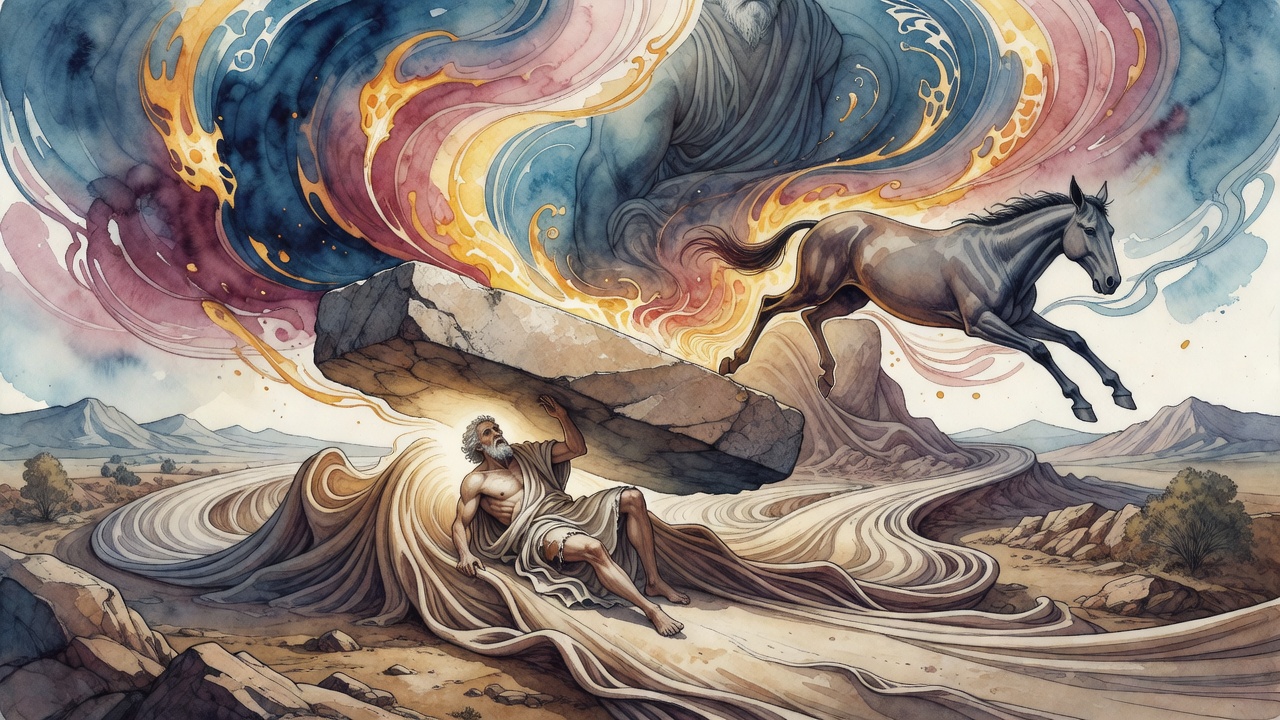
Inside, Yishbi forced David to the ground and set a great olive press over him, the heavy beam that crushed fruit to oil, and lowered his own weight onto it. "After I have eaten and drunk," he said, "I will kill him." The beam came down. It should have ended there. The stone should have driven the breath out of the king and left a stain on the floor.

Instead the earth under David turned soft as kneaded dough. The ground gave where his body pressed into it, swallowing the force, refusing to hand the king over. The press groaned down and met no resistance it could finish. David lay pinned in a hollow the soil had opened to save him, alive, waiting, while the giant went to his table to eat.

The Signs in Jerusalem

Four hundred miles away it was Friday afternoon, the light already slanting toward the Sabbath. In Jerusalem Abishai ben Tzeruyah, David's cousin and the fiercest of his fighters, was washing his head before prayer when the omens began.

A dove flew at his face and beat its wings against him, frantic, as though something had wounded it. He went to his prayers and the wine in his cup turned to vinegar on his lips. He looked up and saw David's mule standing in the yard, riderless, stamping and circling, unable to be still. The crown of leaves in Abishai's hand browned and curled and died between his fingers. He read the four signs the way David had once read a lion and a bear. "The king," he said, "is in danger this very hour."

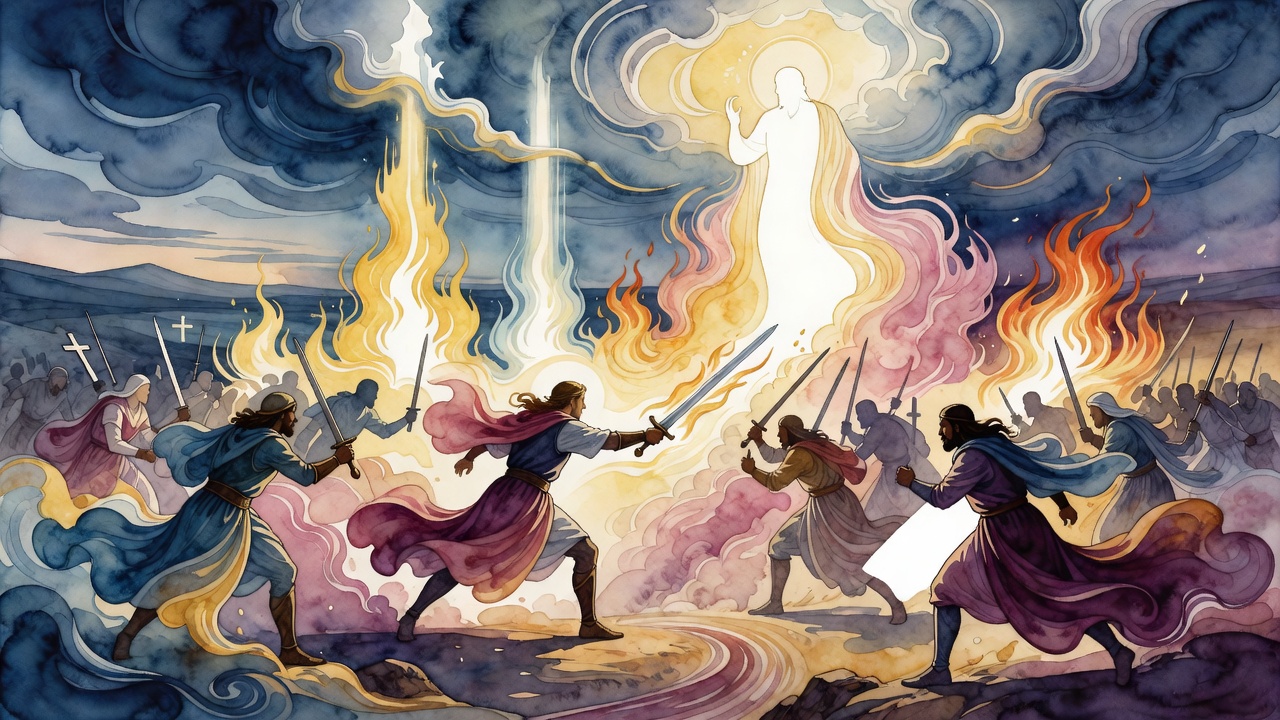
He did not wait to gather men. He swung onto David's own mule and turned its head toward Philistia, and the beast leaped, and the world bent to let it. The road that should have taken days folded under a single stride. Hills slid together, the horizon rushed in, and the distance between Jerusalem and the giant's house collapsed into the length of one leap. The mule came down at the gate of the Philistine city with the dust of Judah still on its legs.

The Spindle on the Wall

On the wall above the gate sat Orpah, the giant's mother, spinning. Long ago she had stood at a crossroads in Moab beside her sister Ruth, and where Ruth had clung to Naomi and walked into Israel, Orpah had kissed her goodbye and turned back. The sons of the one who turned back were giants. Now she saw a lone rider at her son's gate and reached to fling her spindle down to crack his skull. Her own servant caught her arm, wrenched the spindle free, and struck her dead with it before she could throw.

Inside, Yishbi heard the noise at the gate and understood that someone had come for the king. He would not be cheated of his vengeance. He snatched David out from under the press and hurled him straight up, three miles into the sky, and drove the butt of his spear into the ground so its iron tip stood up like a stake. He stepped back to watch the king of Israel fall and split himself open on it.

The King Suspended Between Earth and Heaven

Abishai came through the gate and looked up and saw the small dark shape of David turning far overhead, dropping toward the waiting point. There was no time to reach the spear and no time to break the fall. So he pronounced the Shem HaMeforash, the Name that may not be spoken, and the descent stopped.

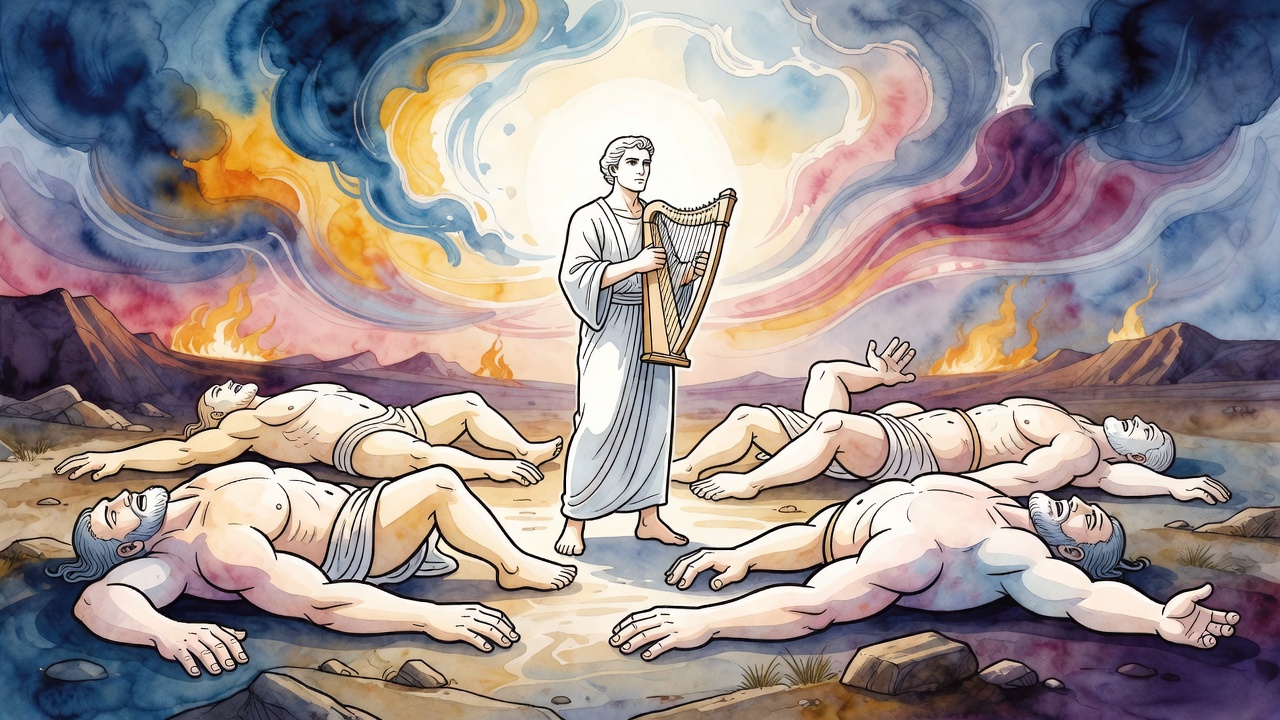
David hung in the open air between earth and heaven, neither rising nor falling, held by the sound of the Name while the spear waited beneath him for nothing. Abishai spoke the Name a second time and the king came down slowly into his cousin's reach, and Abishai pulled him clear of the waiting tip and set him on his feet.

The two of them turned together on the giant. Yishbi-benob was the last of Goliath's line, the brother who had carried the king home like grain, and between the two warriors he went down at last. The boy who had once dropped a giant with a single stone had been saved from a giant only because heaven softened the ground, folded the road, and caught him in the air.

When David came back to Jerusalem alive, his men made him swear an oath. He would never again ride out to battle alone. The lamp of Israel had nearly gone dark in a Philistine field, and they would not gamble it a second time on a hart in the brush.


← All myths
From the tradition

Sources

4 sources

The texts this telling draws on, in full. Open a card to read inline, or expand it for a wider, quieter read.

Gaster, Exempla No. 155; Sanhedrin 95aThe Exempla of the Rabbis (1924)

Toward the end of his reign, David was asked by the Holy One to choose a punishment for the chain of disasters his decisions had caused, the slaughter of the priestly city of Nob, the deaths of Saul and Jonathan, the long shadow of Bathsheba. Heaven offered him two options: either be delivered into the hand of his enemies, or lose all his descendants and reign without an heir.

David chose to fall into the hand of his enemies. Better his own body than the extinction of his house.

One day, hunting alone, he saw a hart and gave chase. The hart fled just beyond his grasp, always just beyond it. It was no ordinary deer, it was Ha-Satan, the heavenly Accuser, drawing him farther and farther from his companions. Before David understood, he was deep in Philistine territory, alone.

Yishbi the giant, brother of Goliath, recognized the king at once. "This," he said, "is the man who killed my brother." He caught David, carried him home, pushed him down under his seat, and sat on him. "After I have eaten and drunk," he said, "I will kill him." The earth beneath David softened miraculously; otherwise the giant's weight would have crushed him on the spot.

It was a Friday afternoon. Back in Jerusalem, David's cousin Abishai ben Tzeruyah noticed that David's mule was restless. A dove struck him in the face as he prayed. His cup of wine turned to vinegar. The crown of leaves he held withered in his hand. "The king is in danger," he said.

Abishai mounted David's mule, which by a miracle sprang four hundred miles in a single leap. At the gates of the Philistine city, the giant's mother Orpah, the sister of Ruth who had kissed Naomi and turned back, sat on the wall and saw him. She reached for her spindle to hurl at him. Her servant grabbed it first and killed her.

Yishbi, seeing Abishai coming, snatched up David, hurled him three miles into the air, and planted his spear point-up in the ground for the king to fall upon. Abishai pronounced the Shem HaMeforash, the Ineffable Name, and David hung suspended between heaven and earth. Together the two men confronted the giant, and together they killed him.

When David returned home alive, the people of Israel forbade him ever to go into battle alone again (Sanhedrin 95a; Gaster, Exempla No. 155).

The story is lurid and operatic, but its teaching is sober. Even a king's freely chosen punishment comes with a rescue hidden inside it, and the Name of God is strong enough to hold even a man falling from three miles in the sky.

Full source
Pirkei DeRabbi Eliezer 43:2Pirkei DeRabbi Eliezer

Rabbi Abbahu, a sage from the Amoraic period, tells us to look at the story of King David to understand this power.

You probably know the story of David. Shepherd boy, slayer of Goliath, eventual King of Israel. But there's this particular episode, recounted in Pirkei DeRabbi Eliezer (Chapter 43), that highlights something profound about repentance, or teshuvah as we call it.

God, as the story goes, had sworn to the forefathers – Abraham, Isaac, and Jacob – that He would multiply their descendants like the stars in the sky. A countless, infinite number. A beautiful promise. So what could go wrong?

Well, David, in a moment of… perhaps pride, perhaps insecurity, decides to count the people of Israel. He wants to know exactly how many he rules.

Now, the Holy One, blessed be He, is not pleased. "David!" He says, essentially, "I promised to make your descendants like the stars. You're trying to undo My word!" According to Pirkei DeRabbi Eliezer, God saw this act of counting as a lack of faith, a desire to quantify something that was meant to be limitless and a questioning of His promise.

And the consequences were devastating.

"For thy sake the flock is given over to destruction," God tells David. And in a mere three hours, seventy thousand men fell. We find this explicitly stated in (1 (Chronicles 21:1)4): "And there fell of Israel seventy thousand men."

Seventy. Thousand.

Imagine the weight of that. The guilt. The grief.

But then Rabbi Simeon offers a… well, a slightly different interpretation. He suggests that only Abishai, son of Zeruiah, actually fell. But here’s the kicker: Abishai was so righteous, so learned in Torah, that he was equal to seventy thousand men! Rabbi Simeon points out that the verse doesn’t say “men,” but “man.” It’s a subtle difference in the Hebrew, but it changes the whole understanding.

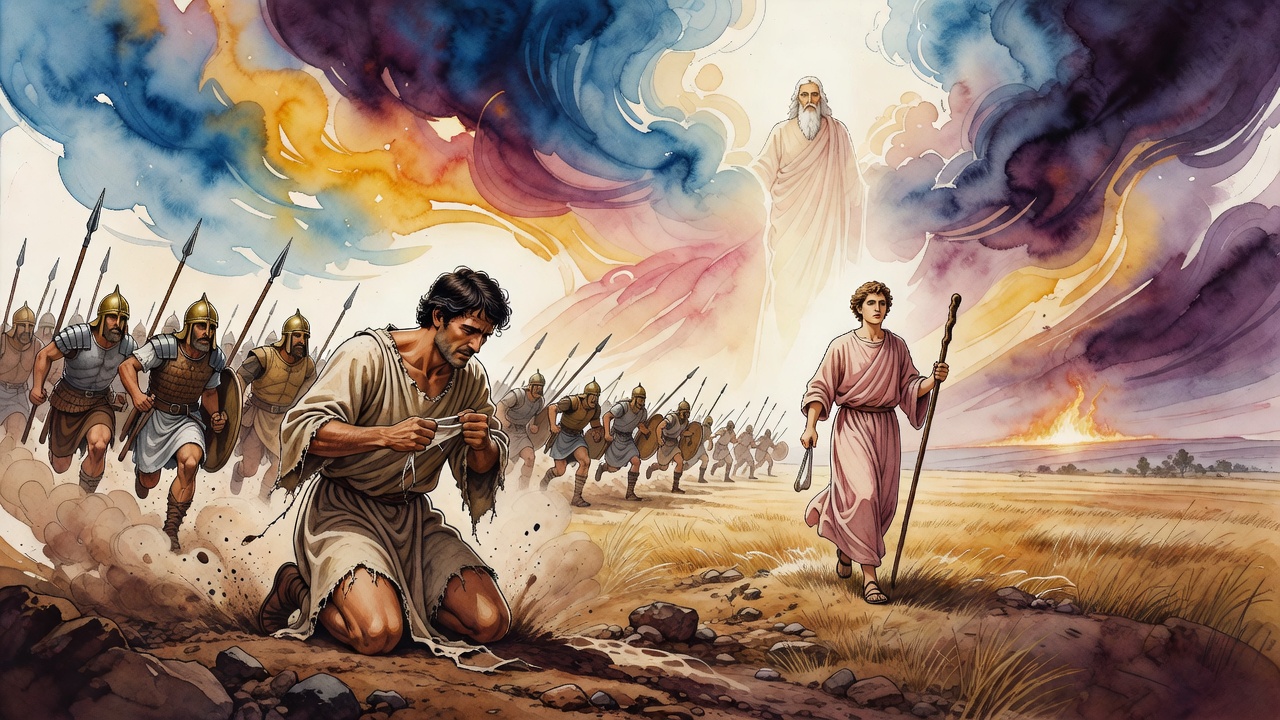
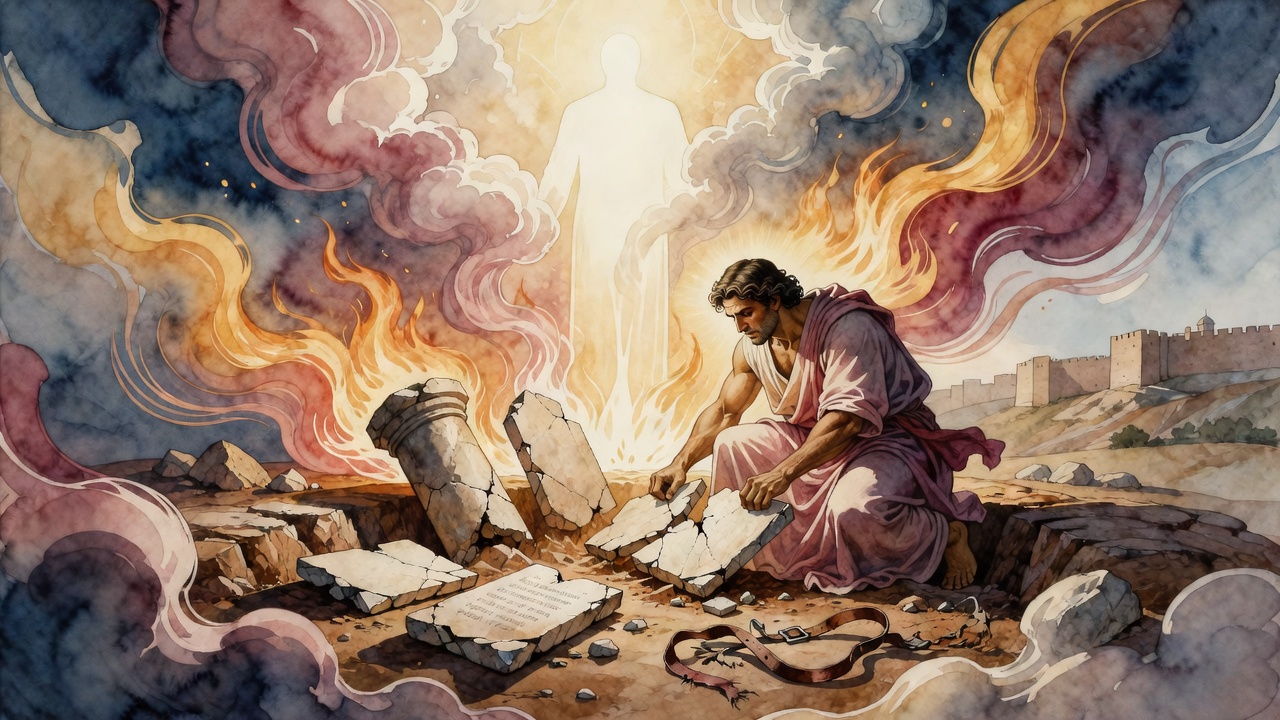
Either way, the magnitude of the event is clear. David is crushed. He hears the news, and immediately tears his clothes, covers himself in sackcloth and ashes – traditional signs of mourning and repentance – and falls on his face before the Ark of the Covenant.

He understands the gravity of his actions. He recognizes his mistake and turns to God in humility and remorse.

David’s story isn’t just about a king making a mistake. It’s about the awesome power of teshuvah, of repentance. It shows us that even when we stumble, even when our actions have significant consequences, the path back to God, the path to forgiveness, is always open.

How did David repair the damage done? That's a story for another time, but it all starts with this moment of profound regret and a willingness to turn back to the Divine.

What do you think? Does this story change how you see the potential for repentance in your own life?

Full source
Legends of the Jews 4:76Legends of the Jews

Legends of the Jews turns to David's Transgression of Abishai.

David had committed a grave sin: taking a census of the people. Now, The first reading, counting your population doesn't sound so bad. But in ancient Jewish thought, such an act could be seen as an expression of arrogance, a reliance on human strength rather than divine providence. It was like saying, "Look at how powerful I am, with all these people under my command!"

So, the prophet Gad arrives, a messenger of the Almighty, and lays out the consequences. David gets to pick his punishment.

What were the options? Famine, oppression by enemies, or… plague.

Yikes.

As Ginzberg tells us in Legends of the Jews, David felt like a sick man asked to choose between being buried next to his father or his mother. A morbid choice,. He was in a bind. What to do?

David agonized over it. "If I choose the calamities of war," he reasoned, "the people will say, 'He cares little, he has his warriors to look to.'" In other words, they'd think he wasn't suffering because he had protection. "If I choose famine," he continued, "they will say, 'He cares little, he has his riches to look to.'" Again, he'd be perceived as insulated from the people's suffering.

So, he made his choice. "I shall choose the plague," he declared, "whose scourge strikes all alike." At least this way, he thought, everyone would suffer equally, himself included. There’s a certain tragic nobility in that decision, isn't there?

But even with his intentions, the plague was devastating. Although it raged for only a brief time, it took a massive toll. And the most heartbreaking loss? The death of Abishai.

Who was Abishai? According to the Legends, he was no ordinary man. He was a pillar of piety and learning, so much so that his presence was equal to a host of seventy-five thousand! Imagine the spiritual void left by his passing.

This story leaves us with a lot to consider. The weight of leadership, the consequences of our actions, and the unpredictable nature of divine judgment. And maybe, just maybe, the importance of counting our blessings instead of simply counting heads. What do you think?

Full source
Legends of the Jews 4:66Legends of the Jews

Legends of the Jews turns to Abishai's Transgression.

The scene is set on a Friday, just as the Shabbat, the Sabbath, is about to begin. Abishai is preparing himself, getting ready to welcome the holy day. He pours water to wash, and then he sees it: drops of blood in the water. Can you imagine the shock?

The strangeness doesn't end there. A dove appears, plucking out its own feathers, moaning and wailing. Now, the dove is a powerful symbol. As Abishai himself exclaims, "The dove is the symbol of the people of Israel!" And in that moment, he understands. Something has happened to David, the king.

Abishai rushes to find the king, but David is nowhere to be found. This confirms his worst fears. He knows he has to act, and fast. He decides to search for David, using the swiftest animal available: the king's own saddle-beast.

But here's where things get interesting. Jewish law, or halakha, isn't just a set of rules; it's a framework for how to live a holy life. And one of those rules forbids a subject from using things specifically set aside for the king. It’s a matter of respect, of hierarchy.

So, what does Abishai do? He doesn't just hop on the king's animal. He understands the weight of tradition, the importance of the law. Instead, he seeks permission from the sages. Only the extreme urgency of the situation, the impending danger to the king, could justify breaking this rule.

It’s a small detail, but it speaks volumes. It shows the balance between the need for immediate action and the respect for established laws and customs. It highlights how even in moments of crisis, tradition and wisdom have their place. What would you do in that situation? Would you prioritize the law or the urgent need? And what does it say about Abishai that he understood the importance of both?

Full source