6 min read

Goliath Cursed the God of Israel Morning and Night

For forty days a giant timed his blasphemy to the exact hours of the Shema, until a shepherd's single stone finally let the prayer reach its end.

Curated by Arthur · Told by Maggid ·
Table of Contents
  1. The Body Built to Block Heaven
  2. The Silence in Saul's Camp
  3. The Shepherd Who Heard the Curse
  4. The Stone That Answered Forty Days of Blasphemy

Twice a day the valley of Elah held its breath, and twice a day a voice broke it. Goliath came down from the Philistine camp at the hour the Israelites turned toward heaven, the morning when they rose and the evening when they lay down, the two hours when their mouths shaped the words that said their God was one. He timed his coming to those hours on purpose. He did not want a soldier. He wanted the prayer.
"Hear, O Israel," the men of Saul's army began, low and ragged in the dawn.

And from across the stream the giant answered, drowning the words, hurling his own at the sky. He cursed the Name they were trying to speak. He swore by the idols hung at his neck and the gods of Ashdod and Gath that the One the Hebrews praised was nothing, a rumor, a weakness. He waited for the evening recital and he did it again. Forty days. Eighty times the sun rose or fell, and eighty times the giant stepped into the gap between Israel and its God and stood there like a wall.

The Body Built to Block Heaven

Scripture gives him four verses and then hurries to the boy with the sling. It records his height, his armor, his spear like a weaver's beam, and almost nothing else, as if the men who wrote it could not bring themselves to set down the rest. The rabbis did not flinch the way the page did. They knew what the four verses were holding back.

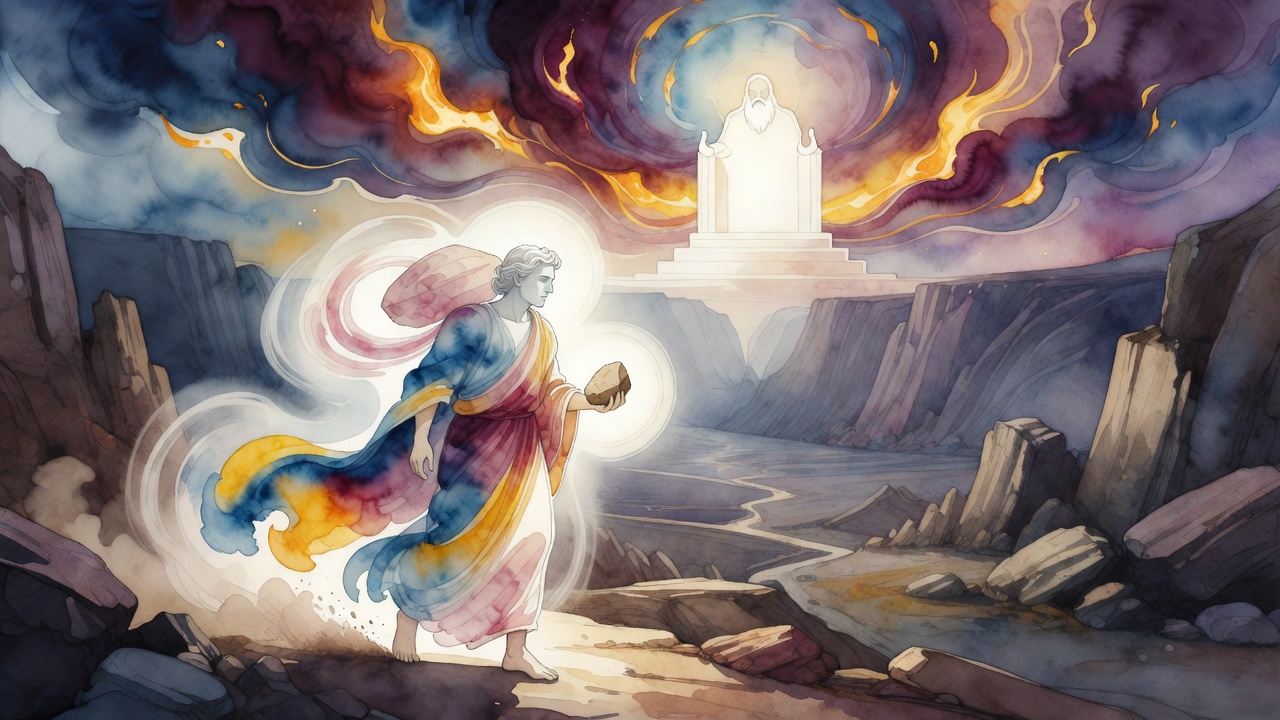
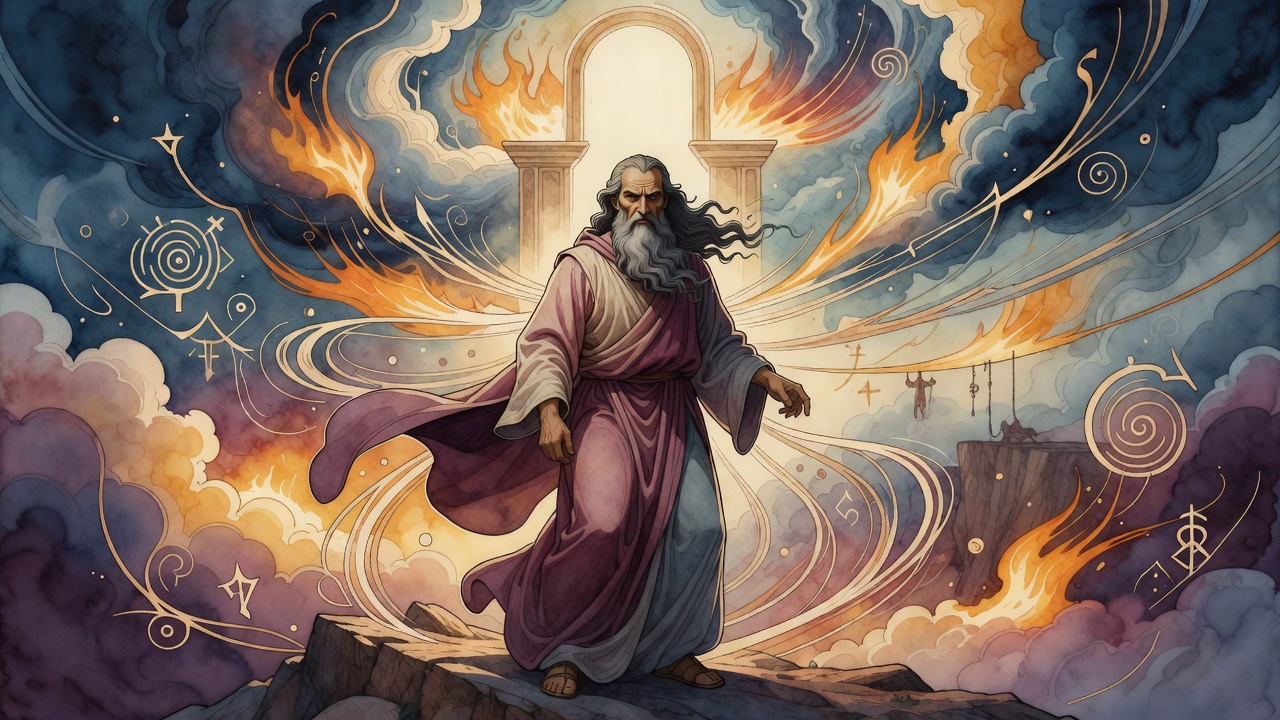
This was no mere strong man. The tradition that flowed down into the great anthologies of the legends saw in Goliath a thing assembled for one task, to obstruct. Every morning he positioned his bulk in the precise moment of Israel's worship so that the praise would die in their throats. Every evening he came back. The bronze and the iron were the least of him. The horror was the design. He had made himself a stopper jammed into the channel between the people and the Divine, and he gloried in it, and the army that should have struck him down stood frozen instead, because the dread he carried was older and larger than his shadow.

The Silence in Saul's Camp

Forty days the soldiers ate and slept under that voice. They were grown men, blooded in war, and not one of them crossed the stream. Saul, a head taller than any of them, stayed in his tent. The blasphemy had done its work. When a god is mocked at the exact hour of his praise and no hand rises to answer, the mockery starts to sound like truth. The men did not say it aloud. They did not have to. Their silence was the loudest prayer in the valley, and it said the giant was right.

That is the field a shepherd walked onto. Not a duel. A place where the holy had been shouted down twice a day for nearly six weeks and the shouting had gone unanswered. The reproach the giant heaped on Israel was not bruised pride. It was the slow public unmaking of the claim that the God of Israel was there at all.

The Shepherd Who Heard the Curse

When David came down from his father's flock with bread and cheese for his brothers, he heard the evening voice before he saw the body it came from. He had played the lyre under open sky and known the One who answered in the dark. So the curse did not land on him as fear. It landed as offense. A man stood in the open cursing his God through painted idols, and the whole army treated it as weather.

The Philistine looked at the boy and cursed him too, by every idol he carried, the way he had cursed the Name every morning for forty days. He expected the silence he always got. The valley had taught him that the God of the Hebrews did not strike.

The valley was wrong.

The Stone That Answered Forty Days of Blasphemy

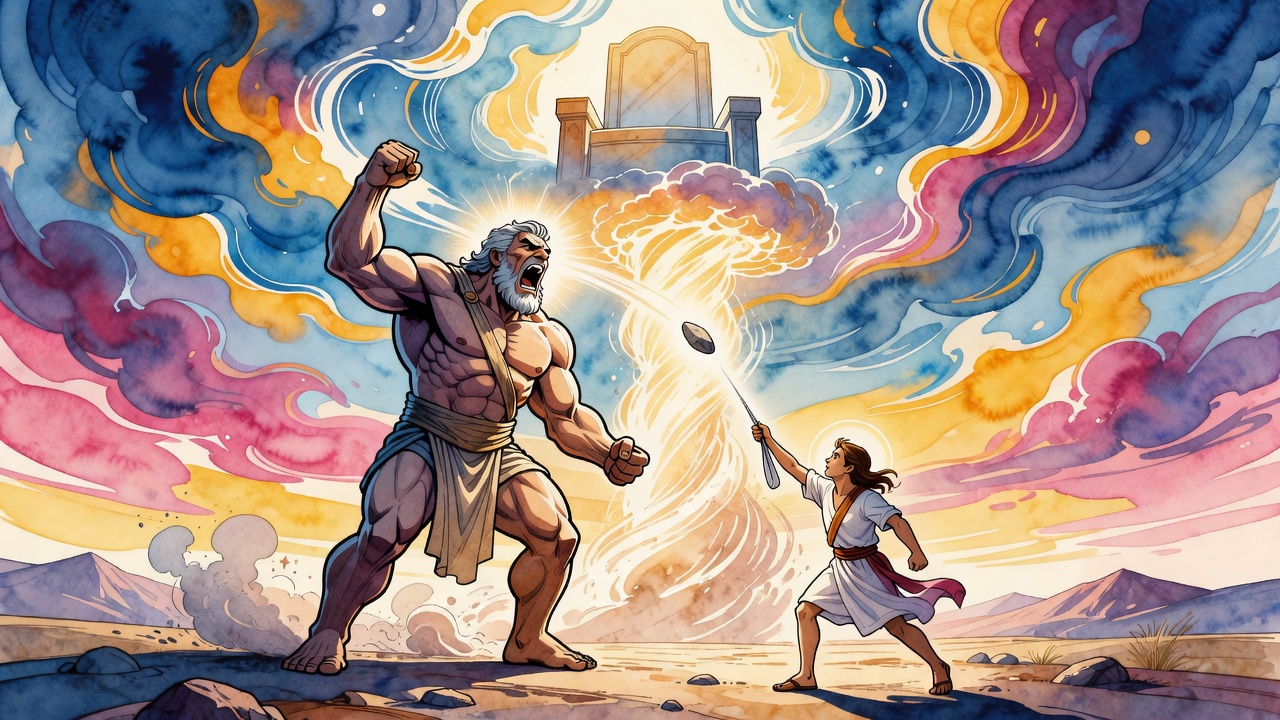
David's hand went to the sling without armor, without a sword, the way a boy's hand goes to a thing it has done ten thousand times against lions and bears in the wilderness. He called on God the Most High and the strength came into his right hand. One stone left the leather. It crossed the stream that the whole army had refused to cross. It struck the one place the bronze did not cover.

The giant who had filled the valley twice a day with the sound of his own gods fell face down into the dirt and made no sound at all. David did not own a sword. He took the giant's. He drew the enormous blade from its sheath and brought it down across the thick neck, and the head that had spat at heaven every dawn and dusk for forty days came away in a boy's two hands.

Then the silence in the camp broke the other way. The reproach that had sat on Israel since the first morning was lifted off them with the weight of the body. The next morning, when the men rose and turned toward heaven, no voice came across the stream to drown them. For the first time in forty days, the Shema reached its end.


← All myths

From the tradition

Sources

2 sources

The texts this telling draws on, in full. Open a card to read inline, or expand it for a wider, quieter read.

Legends of the Jews 4:15Legends of the Jews

Legends of the Jews turns to Everything the Bible Held Back About Goliath's Evil.

The familiar story is this: David and Goliath. Underdog versus giant. But according to rabbinic tradition, what we read in the Book of Samuel is just a tiny sliver of the whole picture. A mere fraction! Why? Because the Scriptures, as Ginzberg tells us in Legends of the Jews, intentionally hold back on elaborating on the sheer wickedness and might of this Philistine warrior. The text deliberately downplays his prowess? What are they hiding?

Well, the Rabbis weren’t shy about filling in the blanks. The Zohar, that foundational text of Jewish mysticism, paints Goliath as not just a big guy with a spear, but a symbol of something far more sinister. He wasn't just challenging the Israelite army; he was challenging GOD Himself.

It wasn't just on the battlefield. Imagine this: every morning and evening, as the Israelites prepared to recite the Shema (שְׁמַע) – that central prayer proclaiming God's oneness – Goliath would appear, taunting and disrupting their worship. He was actively trying to prevent them from connecting with the Divine. Can you picture that brazen defiance?

Morning and evening. Every single day.

Ginzberg's Legends of the Jews, drawing on sources like Midrash Rabbah, reveals a Goliath far more audacious, far more deliberately malevolent, than the one we often picture. He wasn't just some brute force obstacle for young David to overcome. He was a spiritual obstruction, a symbol of the forces that seek to silence faith and deny the presence of the Divine in the world.

So, the next time you hear the story of David and Goliath, remember there's more to it than meets the eye. It's not just a battle of strength, but a battle of wills, a clash of ideologies, and ultimately, a evidence of the enduring power of faith in the face of overwhelming opposition. What other secrets are hiding in plain sight within these ancient texts?

Full source
Psalm 151 1:10Psalm 151

The familiar story centers on David and Goliath. But have you ever stopped to think about David before Goliath? Before the crown? What was he like, this shepherd boy who would become king?

Psalm 151, a short psalm found in some versions of the Book of Psalms (though not in the Masoretic Text we commonly use), gives us a glimpse. It’s like a little behind-the-scenes peek at the making of a king. It’s considered apocryphal, meaning its authenticity is disputed and it’s not included in the standard Jewish biblical canon. But that doesn't make it any less interesting.

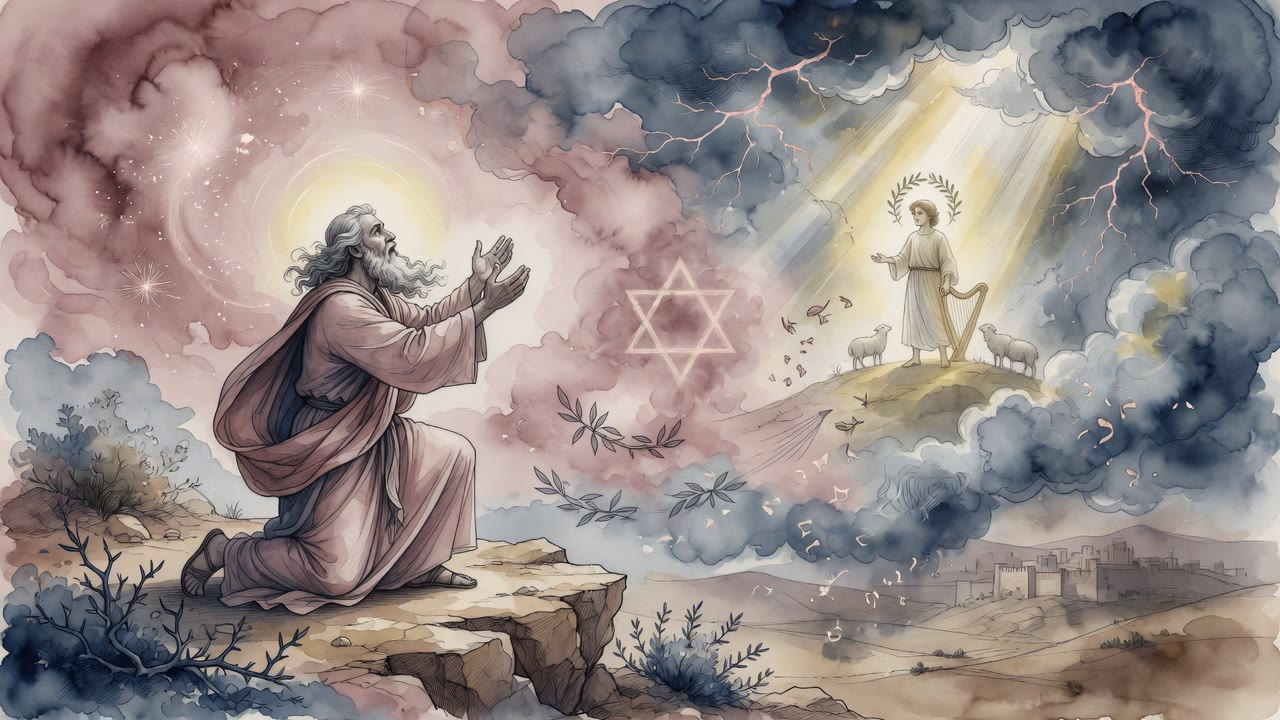
"Young I was in the midst of my brothers, and a lad in my father’s house," it begins. A young man, perhaps overshadowed by his older, stronger siblings. A "na'ar" (lad) in his father’s house. We can almost picture him, can't we? Perhaps a bit gangly, still finding his place.

What was his place? "A shepherd of my father’s flock, driving his herd in the wilderness." Not exactly a glamorous job. Out in the midbar, the wilderness, tending sheep. It's a lonely image, but it speaks to responsibility, to quiet strength, to a connection with something bigger than himself.

But David wasn’t just a shepherd. He was also a musician. "My hands performed upon a lute, my fingers worked a lyre." Imagine him, sitting under the vast, starlit sky, composing melodies, pouring his heart out through music. This wasn't just a job; it was a calling, a way to connect with the Divine. The Talmud even tells us that David’s harp would play on its own at midnight, awakening him for study! (Berakhot 3b).

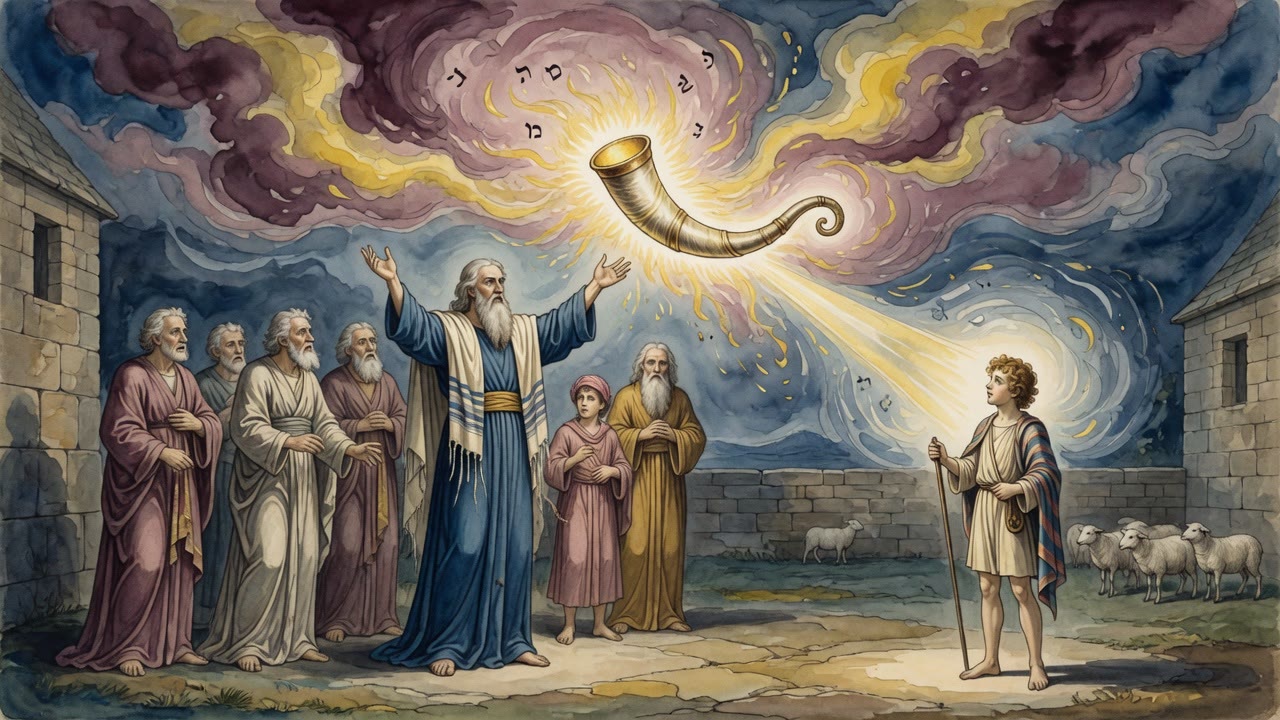
Then, the psalm takes a pivotal turn. "He sent His messenger, and took me from after my father’s flock. And He anointed me with anointing oil, and appointed me a prince of my people." This is the moment of transformation. Samuel, the prophet, arrives, guided by God, to anoint David as the future king. (1 Samuel 16). Talk about a career change! One minute you're tending sheep, the next you're being anointed as a nagid (prince) over Israel.

"My brothers are good and strong, but them Adonai did not desire." It's a blunt statement, but it highlights a crucial point: God doesn't always choose the obvious. He looks beyond outward appearances, beyond strength and stature, to the heart. As we read in (1 Samuel 16:7): "For not as man sees does God see; man sees only what is visible, but God sees into the heart."

And then, the final, dramatic act: "He took me out towards the Philistine, who cursed me through his idols. And I tore off his sword, and cut off his head, and removed reproach from the children of Israel." This, of course, is Goliath. But notice how the psalm frames it. It's not just about slaying a giant; it's about removing the "herpah" (reproach) from Israel. It’s about restoring honor, about standing up for what's right, even when the odds seem impossible. From shepherd boy to slayer of giants, from obscurity to royalty. David's journey is a evidence of the power of potential, to the idea that even the most unassuming among us can be called to greatness. It reminds us that God sees something in each of us, a spark of potential waiting to be ignited.

So, the next time you feel overlooked, remember David. Remember the shepherd boy with the lute, the one who dared to face a giant, and the one who, through faith and courage, changed the course of history. What "giant" are you being called to face? And what song is waiting to be played through your own life?

Full source