5 min read

David Paid Judah's Ancient Debt With One Stone

David entered Goliath's valley carrying Judah's old pledge, Saul's wounded honor, and a stone the earth itself helped deliver.

Curated by Arthur · Told by Maggid ·
Table of Contents
  1. Judah's Pledge Reached the Field
  2. The Boy From the Sheepfold
  3. Saul's Armor Knew Too Much
  4. The Ground Took Hold
  5. Five Stones Became One

Goliath shouted for a king, but an older promise heard him first.

\n\n

He wanted Saul. The giant had not forgotten the humiliation. In an earlier clash he had seized the holy tablets, and Saul had torn them back from his hands. Now Saul was ill, Israel was pinned by fear, and the Philistine came forward every morning and evening with his mouth full of meat and birds.

\n\n

Judah's Pledge Reached the Field

\n\n

David did not walk into the valley as a boy chasing applause. His father Jesse sent him with a family debt beating under his ribs. Long before Israel had kings, Judah had placed himself between Benjamin and ruin. When Joseph threatened to keep Benjamin in Egypt, Judah stepped forward and offered his own life in the boy's place.

\n\n

Centuries later, Saul stood in Benjamin's line, weakened before a warrior who wanted him dead. David stood in Judah's line. The old pledge had not expired. A word spoken by an ancestor had waited through graves, births, tribal banners, and the rise of monarchy until it found a shepherd with a sling.

\n\n

The Boy From the Sheepfold

\n\n

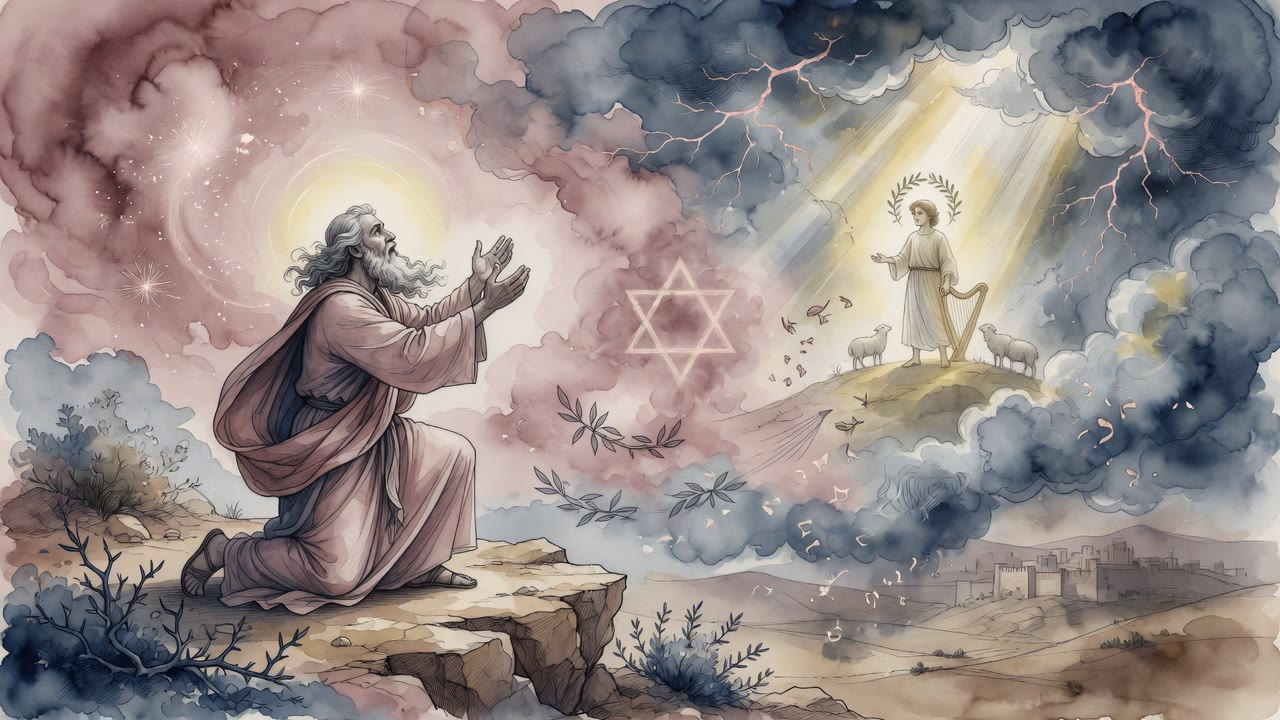
David had been young among his brothers, a lad in his father's house, driving sheep through the wilderness while stronger sons stood nearer the center of attention. His hands knew strings before they knew a crown. His fingers worked the lyre. His days smelled of wool, dust, animal breath, and lonely hills.

\n\n

The wilderness had not made him soft. Lions had come. Bears had come. David treated them like creatures that could be faced, not omens that required flight. The hand that played music also learned the sudden violence of rescue. When a lamb vanished between teeth, David did not write a song about loss. He went after it.

\n\n

That was the hand Israel needed. Not the largest hand. Not the armored hand. The hand that had pulled life back from jaws.

\n\n

Saul's Armor Knew Too Much

\n\n

Saul dressed David in royal armor, and the metal made its own announcement. It fit.

\n\n

The king was broad and powerful. David was the slender youth from the flock. The armor should have swallowed him, hung loose from his shoulders, turned him into a child hidden inside a man's shell. Instead it settled on him as if it had been waiting. Saul saw the sign and understood more than he wanted to understand. The boy was not only brave. He had been marked.

\n\n

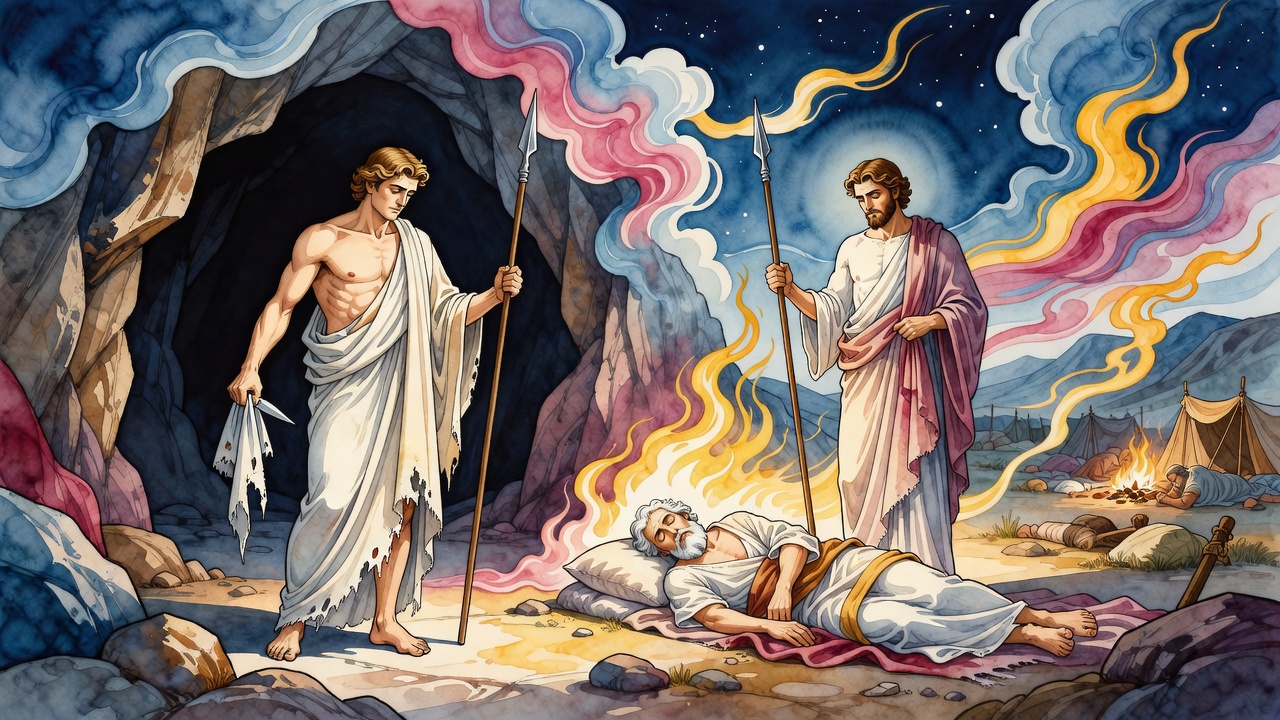
Jealousy entered before the battle began. David felt the danger in that fit. He stripped off the armor and refused to meet Goliath disguised as Saul's replacement. If he was going to stand, he would stand as himself: shepherd, son of Jesse, son of Judah, a man with no bronze between his skin and heaven.

\n\n

The Ground Took Hold

\n\n

Goliath came out roaring, morning after morning, evening after evening, turning time itself into a weapon. He called David closer and promised to feed his flesh to the birds. His body was built for distance crossed quickly, for one rush, one grip, one boy broken before Israel could breathe.

\n\n

Then the land seized him.

\n\n

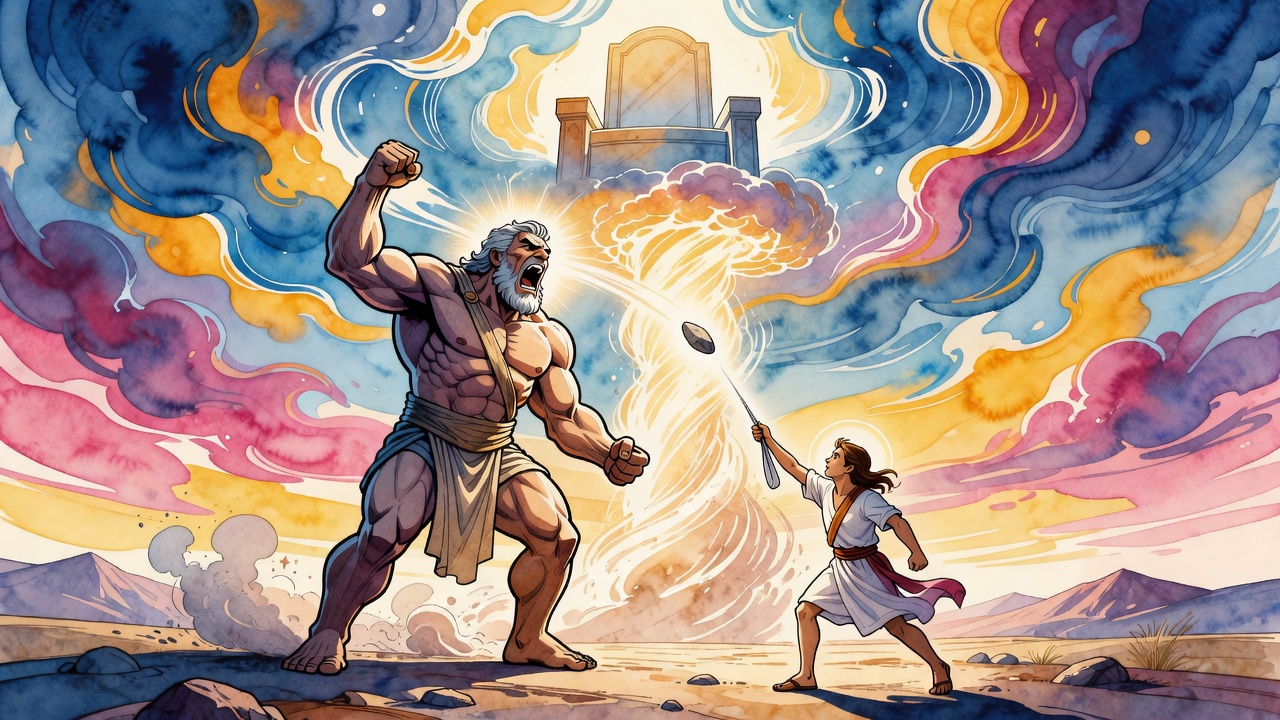
It was as if iron fastened itself around every limb, two hundred forty-eight fetters for two hundred forty-eight parts of the body. The giant said, "Come to me," because he could not come as he wished. The earth beneath his feet became a hand. His shoulders would not loose. His desire outran his body, and the delay gave David the thin slice of time a sling requires.

\n\n

Five Stones Became One

\n\n

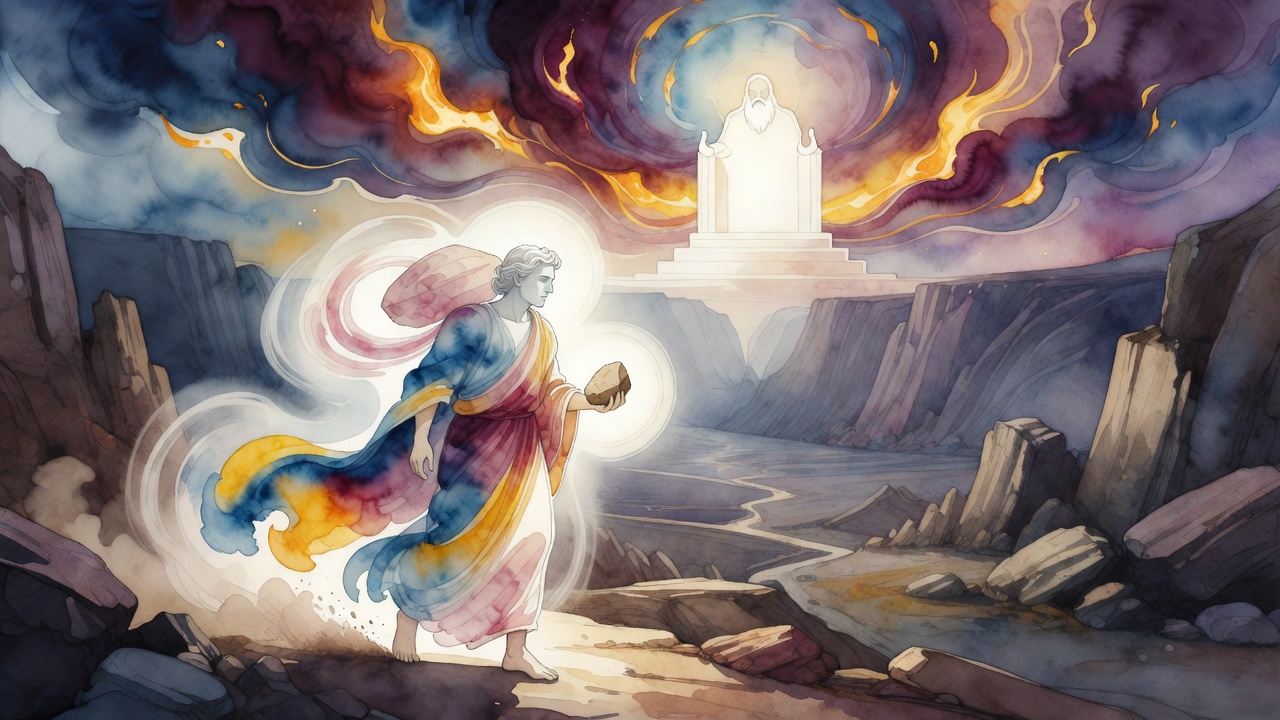
The stones came to David as if they had chosen the fight. Five pebbles entered his hand and became one. One for God. One for Abraham. One for Isaac. One for Jacob. One for Aaron, whose priestly descendants had recently fallen under the same Philistine terror. The small things gathered themselves into a single answer.

\n\n

David ran toward the line. The giant stood trapped inside his own threat. The sling moved, the stone flew, and the forehead that had towered over Israel opened to dust. David took Goliath's sword and removed the head that had cursed him. Shame crossed the field in the other direction.

\n\n

The girls would later sing of ten thousands. The crown would come later, with its weight and wounds. In the valley, before the songs, there was only an ancient promise paid in public: Judah still guarded Benjamin, the shepherd's hand still held, and the land itself had refused to let the giant take one more step.

\n\n

← All myths

From the tradition

Sources

4 sources

The texts this telling draws on, in full. Open a card to read inline, or expand it for a wider, quieter read.

Legends of the Jews 4:16Legends of the Jews

The little shepherd boy who takes down the giant. But did you ever stop to think about why David was so determined to face him? It wasn't just bravery, or youthful exuberance. According to the legends, there was much more at stake.

David’s father, Jesse, actually encouraged him to fight Goliath. But why? It wasn't just about defending Israel. It was about upholding an ancient oath. David, a descendant of Judah, felt it was his duty to protect Saul, who was from the tribe of Benjamin. According to tradition, Judah had pledged to safeguard Benjamin long ago. And as we read in Legends of the Jews, Saul was in grave danger.

Why was Goliath so fixated on Saul? Well, it all goes back to a previous battle. Goliath had managed to capture the luchot ha-brit (לוחות הברית), the holy tablets of the law – the very tablets given to Moses on Mount Sinai. But Saul, in a moment of strength, had snatched them back from the giant. That humiliation fueled Goliath's burning desire for revenge.

Saul himself, weakened by illness, couldn't face Goliath directly. He accepted David's audacious offer to fight in his stead. He even offered David his own armor. Here's where it gets interesting: when David put on Saul's armor, it seemed to miraculously fit the slender youth. Saul recognized this as a sign, perhaps even a preordained destiny. But, as human nature dictates, this miraculous transformation also stirred a bit of jealousy in Saul's heart.

David, sensing this, or perhaps simply understanding the symbolic power of his actions, decided to decline the armor. He wanted to meet Goliath not as a warrior, but as the simple shepherd he was. He chose to rely on something else entirely.

And get this: five pebbles willingly came to David. Five! But when he touched them, they miraculously fused into one single stone. Now, the legends explain that these five pebbles represented something profound. They stood for God, the three Patriarchs (Abraham, Isaac, and Jacob), and Aaron. According to Ginzberg's retelling in Legends of the Jews, the inclusion of Aaron is a poignant reminder. His descendants, Hophni and Phinehas, had recently been killed by none other than Goliath. So, in a way, this battle was about avenging them too.

Isn't it fascinating how much depth and meaning is packed into this iconic story? It’s not just about a small guy beating a big guy. It’s about fulfilling ancient promises, protecting sacred objects, and standing up for what's right, even when the odds seem impossible. It makes you wonder, what "giants" are we facing today, and what "pebbles" do we have at our disposal to overcome them?

Full source
Vayikra Rabbah 21:2Vayikra Rabbah

Rabbi Shmuel bar Naḥman starts us off by interpreting a verse about evildoers in light of the Goliath narrative. He points out how Goliath, described in Samuel as approaching "every morning and evening" (I (Samuel 17:1)6), embodies this idea of relentless evil. And when Goliath boasts, "Come to me and I will give your flesh to the birds of the heavens" (I (Samuel 17:4)4), it emphasizes the sheer brutality David faced.

Rabbi Abba bar Kahana offers a striking image: "The land took hold of him." What does that mean? It suggests that Goliath wasn't just defeated by a slingshot, but by something almost supernatural. The earth itself seemed to impede him, preventing him from reaching David before David could strike. The Etz Yosef commentary beautifully explains that this was so that David could employ his slingshot against Goliath. It's a powerful image of the world conspiring to protect the righteous.

Rabbi Tanhuma reinforces this idea with a clever textual point. He notes that Goliath says, "Come to me," not "I will come to you." The very ground, it seems, rooted him in place.

Then, Rabbi Yanai, quoting Rabbi Shimon ben Rabbi Yanai, adds another layer. He suggests that God placed "two hundred and forty-eight iron fetters" – corresponding to the 248 limbs in the human body – on Goliath. Imagine that! David, witnessing this, cries out, "Lord, do not grant the wishes of the wicked" (Psalms 140:9). The Rabbis translate this as, don't grant his desires. "Do not untie his muzzle, restrain his shoulders." (Psalms 140:9). The Hebrew word zemamo can mean both "scheme" and "muzzle," so the midrash (rabbinic interpretive commentary) interprets this as not loosening Goliath’s control.

Rabbi Yudan even suggests that Goliath lusted after David, who was described as being "with beautiful eyes and a lovely appearance" (I (Samuel 16:1)2). In response to this, David prays that God grant the desire of the righteous instead!

But the Rabbis aren’t done yet! Some suggest that God afflicted Goliath with leprosy. How do they arrive at this? They connect the phrase "The Lord will deliver you [yesagerkha] into my hand" (I (Samuel 17:4)6) with the term used for quarantine in cases of leprosy, [vehisgiro] (Leviticus 13:4). It's a fascinating example of how the Rabbis find connections and deeper meanings within the text.

Finally, the midrash concludes with David's declaration of trust in God: "If a camp besieges me, my heart will not fear... In this I will put my trust" (Psalms 27:3). Rabbi Levi interprets "In this [bezot]" as a reference to the testament Moses gave to the elders, "This is [vezot] for Judah" (Deuteronomy 33:7). This verse promises divine help against adversaries.

So, what are we left with? More than just a story of a young shepherd defeating a giant. We see a world actively participating in justice, a God who intervenes in subtle and not-so-subtle ways, and a hero who, even in the face of overwhelming odds, places his trust in something larger than himself. It makes you wonder, doesn't it? What forces are at play in our own lives, perhaps unseen, working to hold back the "giants" we face? And where can we find that same unwavering trust that David possessed?

Full source
Psalm 151 1:10Psalm 151

The familiar story centers on David and Goliath. But have you ever stopped to think about David before Goliath? Before the crown? What was he like, this shepherd boy who would become king?

Psalm 151, a short psalm found in some versions of the Book of Psalms (though not in the Masoretic Text we commonly use), gives us a glimpse. It’s like a little behind-the-scenes peek at the making of a king. It’s considered apocryphal, meaning its authenticity is disputed and it’s not included in the standard Jewish biblical canon. But that doesn't make it any less interesting.

"Young I was in the midst of my brothers, and a lad in my father’s house," it begins. A young man, perhaps overshadowed by his older, stronger siblings. A "na'ar" (lad) in his father’s house. We can almost picture him, can't we? Perhaps a bit gangly, still finding his place.

What was his place? "A shepherd of my father’s flock, driving his herd in the wilderness." Not exactly a glamorous job. Out in the midbar, the wilderness, tending sheep. It's a lonely image, but it speaks to responsibility, to quiet strength, to a connection with something bigger than himself.

But David wasn’t just a shepherd. He was also a musician. "My hands performed upon a lute, my fingers worked a lyre." Imagine him, sitting under the vast, starlit sky, composing melodies, pouring his heart out through music. This wasn't just a job; it was a calling, a way to connect with the Divine. The Talmud even tells us that David’s harp would play on its own at midnight, awakening him for study! (Berakhot 3b).

Then, the psalm takes a pivotal turn. "He sent His messenger, and took me from after my father’s flock. And He anointed me with anointing oil, and appointed me a prince of my people." This is the moment of transformation. Samuel, the prophet, arrives, guided by God, to anoint David as the future king. (1 Samuel 16). Talk about a career change! One minute you're tending sheep, the next you're being anointed as a nagid (prince) over Israel.

"My brothers are good and strong, but them Adonai did not desire." It's a blunt statement, but it highlights a crucial point: God doesn't always choose the obvious. He looks beyond outward appearances, beyond strength and stature, to the heart. As we read in (1 Samuel 16:7): "For not as man sees does God see; man sees only what is visible, but God sees into the heart."

And then, the final, dramatic act: "He took me out towards the Philistine, who cursed me through his idols. And I tore off his sword, and cut off his head, and removed reproach from the children of Israel." This, of course, is Goliath. But notice how the psalm frames it. It's not just about slaying a giant; it's about removing the "herpah" (reproach) from Israel. It’s about restoring honor, about standing up for what's right, even when the odds seem impossible. From shepherd boy to slayer of giants, from obscurity to royalty. David's journey is a evidence of the power of potential, to the idea that even the most unassuming among us can be called to greatness. It reminds us that God sees something in each of us, a spark of potential waiting to be ignited.

So, the next time you feel overlooked, remember David. Remember the shepherd boy with the lute, the one who dared to face a giant, and the one who, through faith and courage, changed the course of history. What "giant" are you being called to face? And what song is waiting to be played through your own life?

Full source
Ben Sira 47:6Ben Sira

Not just any David, but the David. The shepherd boy who became a king, the poet who penned psalms that still resonate today. Ben Sira, in chapter 47, paints a vibrant portrait of this legendary figure, and it's a picture worth dwelling on.

Ben Sira begins with a powerful comparison: "For just as the suet is the highest of the holy offering, so too David from Israel." Suet, the richest part of the animal offering, was considered sacred. To compare David to it elevates him to a position of unparalleled importance. He's not just a king; he's a chosen vessel, a conduit of the divine.

What a life he led! It wasn't all royal robes and majestic pronouncements. Ben Sira reminds us of David's humble beginnings, highlighting his extraordinary courage even as a youth. "With lions he played as with a goat, and with bears as a calf from the east." Can you imagine? This isn't just bravery; it's a kind of fearless innocence, a trust in something bigger than himself.

Then comes the iconic showdown. "In his youth he struck down the warrior, and causing him eternal pain and shame; with a flick of his hand on the sling, and he broke the majesty of Golyat." Goliath, the giant, the embodiment of overwhelming force, felled by a young shepherd with a sling and a stone. It's a story that's echoed through millennia, a evidence of the power of faith and courage against seemingly insurmountable odds.

But Ben Sira doesn't just focus on David's physical prowess. He emphasizes the source of his strength: "For he called to God the Highest, and He gave strength in his right hand; to hold back a man knowing in war, and to raise the horn of Israel." David's victory wasn't just about skill; it was about faith, about his unwavering connection to God. God is the source of his strength, his victory, his ability to "raise the horn of Israel," a symbol of power and pride for the nation.

And the people recognized it. "Thus the girls sang to him, and established him with 'ten thousand.'" This echoes the famous line after David's victory, "Saul has slain his thousands, and David his ten thousands" (1 Samuel 18:7), highlighting David's military prowess and popularity.

"When crowned in a turban he fought, and all around him subjugated enemies." Even after becoming king, David continued to lead his people in battle, solidifying his reign and expanding his kingdom. He was a warrior king, a leader who inspired loyalty and secured victory.

Ben Sira's portrayal of David isn't just a historical account; it's an inspirational narrative. It's a reminder that even the most ordinary among us can achieve extraordinary things through faith, courage, and a connection to something greater than ourselves. It makes you wonder: what "giants" are we facing in our own lives? And what "sling" – what unique gift or unwavering belief – can we use to overcome them?

Full source