5 min read

The Anointing Oil That Chose David Before Samuel Did

Samuel arrived at Jesse's house with a full horn of oil and orders to anoint the next king. The oil refused to move until David walked in.

Curated by Arthur · Told by Maggid ·
Table of Contents
  1. The Horn That Would Not Pour
  2. The Boy in the Fields
  3. What the Oil Knew
  4. The Privilege of Sitting
  5. The Battle After the Throne

The Horn That Would Not Pour

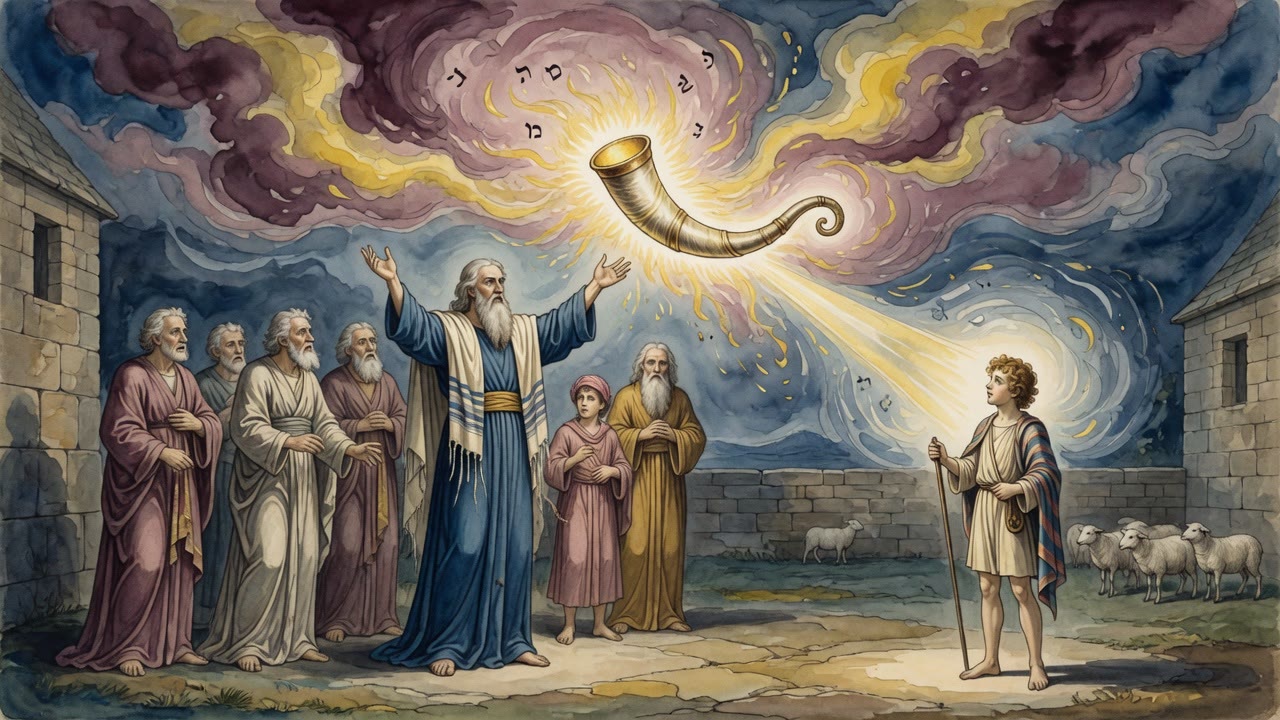
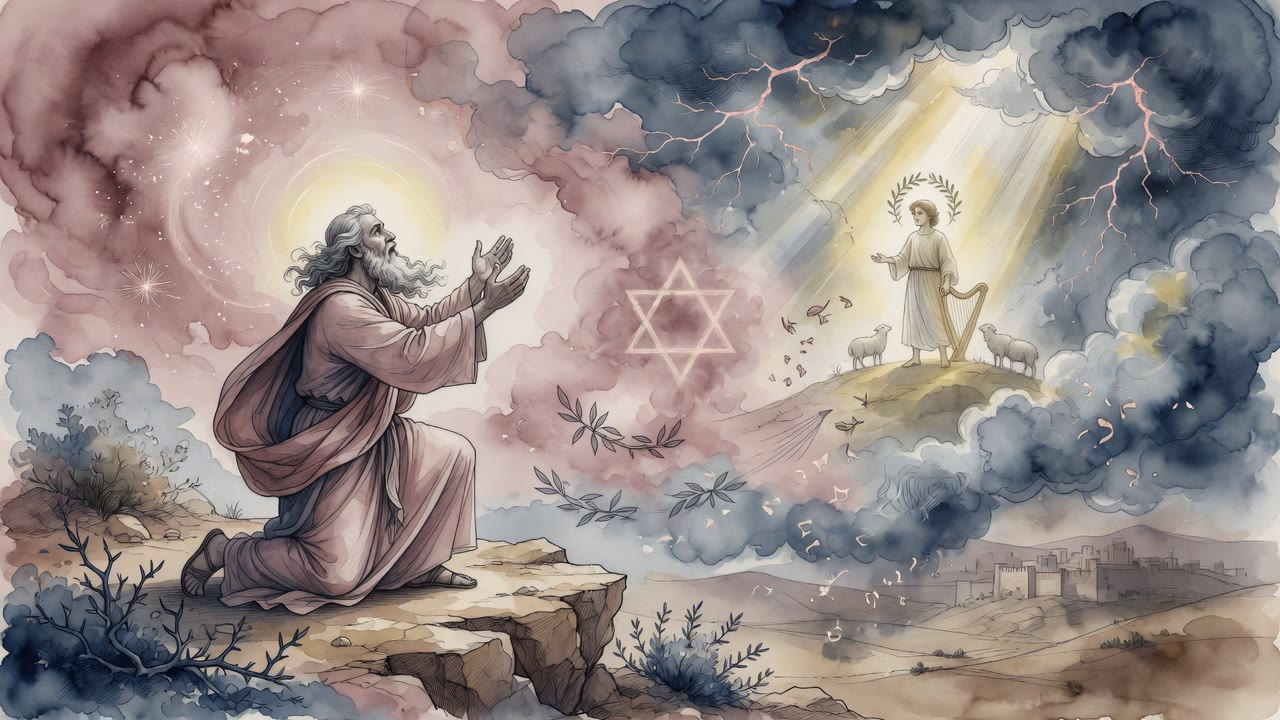
Samuel arrived at Jesse's house in Bethlehem carrying a full horn of anointing oil and a task from God: identify the next king of Israel among Jesse's sons. Jesse brought them out one at a time, starting with the oldest. These were large, impressive men, the kind of men who look like kings. Samuel raised the horn over the first son and tilted it. Nothing happened. The oil sat in the horn as though it had reached a decision of its own and was waiting for someone to catch up.

He tried the second. Then the third. Seven sons passed before him, and the oil did not move for any of them. Samuel stood in Jesse's house holding a horn full of motionless oil and asked if there were any other sons. Jesse answered almost as an afterthought: there was one more, the youngest, out in the fields with the sheep.

The Boy in the Fields

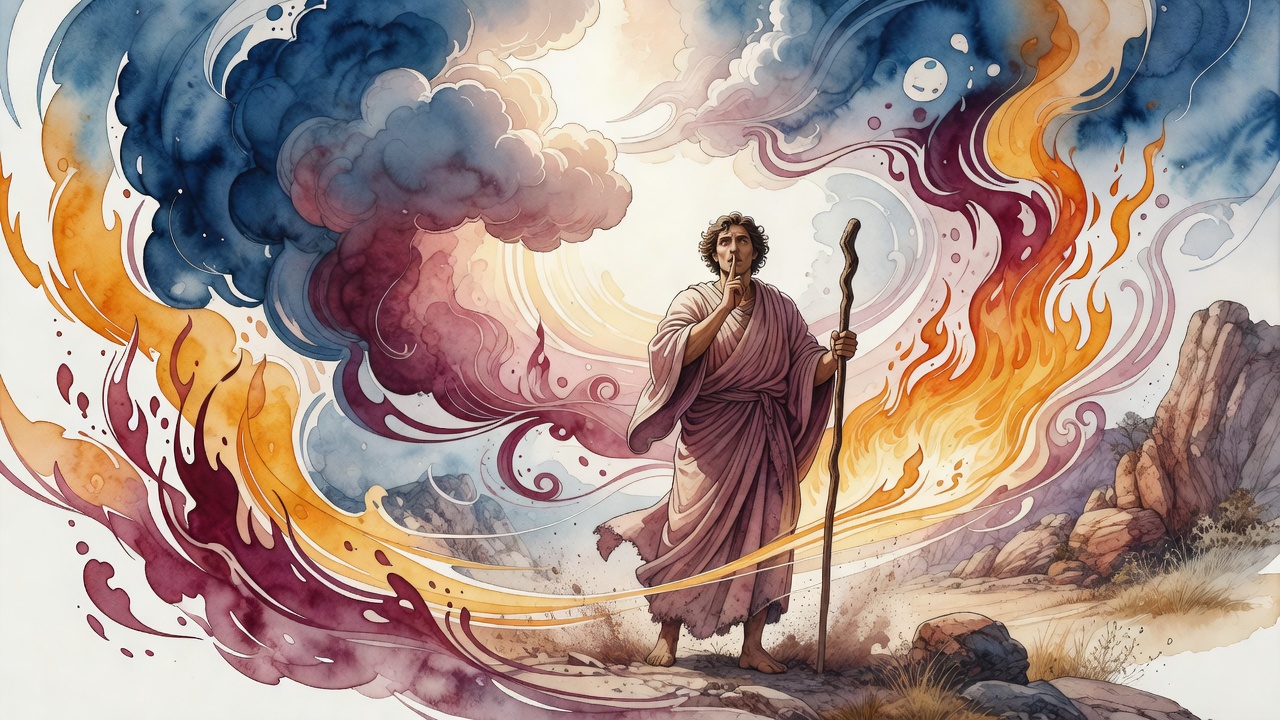
David had grown up last in a household of warriors, a shepherd among fighters. Psalm 151 remembered it in his own voice: "Young I was in the midst of my brothers, and a lad in my father's house." He was the one they did not bother to call when a prophet arrived. His absence from the lineup was not an oversight; it was a judgment.

He came in from the fields still carrying the smell of the sheep, and when he walked into the room, the anointing oil poured itself out. Not a drop at a time. Not a careful ceremony. It ran from the horn in a torrent before Samuel had completed any formal action, announcing its choice before the prophet could speak. It covered David from head to foot: his eyes, his face, his garments, his hair.

What the Oil Knew

The Midrash on Psalms tracked why David had been in the fields in the first place. While his brothers kept their Sabbath rest, David was out tending the flocks. The rabbis saw this not as deprivation but as preparation. The man who would one day sit before God as king had first to learn what it meant to be responsible for creatures who could not speak for themselves, who depended entirely on his vigilance, who scattered when frightened and needed to be gathered back without anger.

And David played music in the fields. The psalms he would later dedicate to God had their first performances in front of sheep, with no audience but the sky. He made himself a harp and sang, and his older brothers at home thought nothing of it. The anointing oil, when it finally had occasion to move, knew exactly where to go.

The Privilege of Sitting

Later traditions wrestled with one particular consequence of David's anointing: the right to sit in the Temple courtyard. Only kings of the Davidic line held that privilege, according to a teaching in Midrash Tehillim. Other kings stood. David's descendants sat. Rabbi Chiya preserved the rule and Rabbi Ami specified the designated space. When Rav Huna objected that in heaven itself there is no sitting, Daniel had described angels standing before the throne, not seated, the question deepened rather than resolved.

If even the celestial beings stood in God's presence, what earned David's dynasty the right to sit? The tradition answered with the same logic that had governed the anointing: not rank, not size, not birth order, but something demonstrated before witnesses, in this case the entire history of a people led faithfully through wilderness and war by a man who had started as a forgotten youngest son watching sheep while his brothers received a prophet's inspection.

The Battle After the Throne

The anointing did not remove David from danger. It placed him inside a different kind of danger. As king, he would eventually face questions about warfare that his shepherd years had not prepared him for, questions about destruction and restraint, about what it meant to capture rather than annihilate. The Sifrei Devarim, a legal commentary on Deuteronomy, preserved rules about the conduct of siege and battle that David's armies would have to navigate: take the city, but do not cut down its trees. Capture, but do not obliterate. There were limits built into the law, and the king who commanded armies was accountable to them.

The boy who had been anointed in his father's house before anyone thought to summon him grew into the king who had to hold those limits even when no one would have blamed him for crossing them. That was the weight inside the oil that had poured itself out on his head.


← All myths
From the tradition

Sources

4 sources

The texts this telling draws on, in full. Open a card to read inline, or expand it for a wider, quieter read.

Psalm 151 1:10Psalm 151

The familiar story centers on David and Goliath. But have you ever stopped to think about David before Goliath? Before the crown? What was he like, this shepherd boy who would become king?

Psalm 151, a short psalm found in some versions of the Book of Psalms (though not in the Masoretic Text we commonly use), gives us a glimpse. It’s like a little behind-the-scenes peek at the making of a king. It’s considered apocryphal, meaning its authenticity is disputed and it’s not included in the standard Jewish biblical canon. But that doesn't make it any less interesting.

"Young I was in the midst of my brothers, and a lad in my father’s house," it begins. A young man, perhaps overshadowed by his older, stronger siblings. A "na'ar" (lad) in his father’s house. We can almost picture him, can't we? Perhaps a bit gangly, still finding his place.

What was his place? "A shepherd of my father’s flock, driving his herd in the wilderness." Not exactly a glamorous job. Out in the midbar, the wilderness, tending sheep. It's a lonely image, but it speaks to responsibility, to quiet strength, to a connection with something bigger than himself.

But David wasn’t just a shepherd. He was also a musician. "My hands performed upon a lute, my fingers worked a lyre." Imagine him, sitting under the vast, starlit sky, composing melodies, pouring his heart out through music. This wasn't just a job; it was a calling, a way to connect with the Divine. The Talmud even tells us that David’s harp would play on its own at midnight, awakening him for study! (Berakhot 3b).

Then, the psalm takes a pivotal turn. "He sent His messenger, and took me from after my father’s flock. And He anointed me with anointing oil, and appointed me a prince of my people." This is the moment of transformation. Samuel, the prophet, arrives, guided by God, to anoint David as the future king. (1 Samuel 16). Talk about a career change! One minute you're tending sheep, the next you're being anointed as a nagid (prince) over Israel.

"My brothers are good and strong, but them Adonai did not desire." It's a blunt statement, but it highlights a crucial point: God doesn't always choose the obvious. He looks beyond outward appearances, beyond strength and stature, to the heart. As we read in (1 Samuel 16:7): "For not as man sees does God see; man sees only what is visible, but God sees into the heart."

And then, the final, dramatic act: "He took me out towards the Philistine, who cursed me through his idols. And I tore off his sword, and cut off his head, and removed reproach from the children of Israel." This, of course, is Goliath. But notice how the psalm frames it. It's not just about slaying a giant; it's about removing the "herpah" (reproach) from Israel. It’s about restoring honor, about standing up for what's right, even when the odds seem impossible. From shepherd boy to slayer of giants, from obscurity to royalty. David's journey is a evidence of the power of potential, to the idea that even the most unassuming among us can be called to greatness. It reminds us that God sees something in each of us, a spark of potential waiting to be ignited.

So, the next time you feel overlooked, remember David. Remember the shepherd boy with the lute, the one who dared to face a giant, and the one who, through faith and courage, changed the course of history. What "giant" are you being called to face? And what song is waiting to be played through your own life?

Full source
Legends of the Jews 4:11Legends of the Jews

His story is full of that kind of… knowing. Especially when it came to his anointing as king.

the prophet Samuel was sent to anoint a new king from among the sons of Jesse. He lined them up, these impressive, kingly-looking men. But the holy oil, the mishchah, just wouldn't pour. It stayed stubbornly put in the horn. According to Ginzberg's retelling in Legends of the Jews, Samuel tried and tried, but nothing happened.

Can you imagine the tension in the room? Samuel must have been sweating. What was going on?

Then came David.

And here's where things get… well, legendary. As David approached, the oil, of its own accord, began to flow. It poured itself out over him, anointing him before anyone even had a chance to react. This wasn’t just a dribble; it was a torrent, a sign so clear it couldn't be ignored.

But it gets even wilder! The drops of oil that landed on his clothes? They transformed into diamonds and pearls! Talk about a divine seal of approval. And the horn, the vessel that held the oil? After anointing David, it was still as full as before. A never-ending supply, a symbol of the endless blessings and kingship that awaited him.

Mind. Blown.

But even with such a clear sign, there was still… doubt. Amazement, even resentment. How could this… boy, this son of a… well, rumors swirled. How could he be king? Some whispered that he was the son of a slave.

And that's when Jesse's wife stepped forward and revealed a secret. She declared herself to be David's mother, silencing the whispers and setting the stage for David's rise. This revelation, this confirmation of his lineage, was crucial. As we find in Legends of the Jews, it addressed the doubts and solidified his claim to the throne.

So, what does it all mean? Maybe it's a reminder that destiny often chooses the unexpected. That greatness can come from humble beginnings. That sometimes, the signs are so clear, so undeniable, that all we can do is stand back in awe. And maybe, just maybe, it's a reminder to look beyond the surface, because you never know where you might find a king.

Full source
Midrash Tehillim 1:2Midrash Tehillim

Midrash Tehillim, a collection of rabbinic interpretations on the Book of Psalms, dives deep into that question. And it might surprise you.

One interpretation points directly to King David. We find support for this idea in the Second Book of Samuel (7:18), which says, "And King David came and sat before the Lord." Rabbi Chiya even taught that only kings from the Davidic dynasty had the privilege of sitting in the Temple courtyard. Rabbi Ami, citing Reish Lakish, specified that there was a designated place for them to sit.

Wait a minute! Rav Huna, quoting Rabbi Yishmael, throws a wrench into the works. He says that in heaven, there's no sitting! As Daniel (7:10) describes, the angels "stood before him." They don't have the ability to leap, as Ezekiel (1:7) tells us: "Their legs were straight legs." Isaiah (6:2) reiterates that the seraphim "stood above him." Zechariah (3:7) even speaks of granting someone "walking among those who stand here." So, if there's no sitting above, how can David sit before the Lord?

Rabbi Ami complicates things further by suggesting that even the kings of the House of David aren't really sitting. So, if not David, then who does this "sitting" refer to? The Midrash (rabbinic interpretive commentary) suggests the High Priest, citing 1 Samuel (1:9): "And Eli the priest sat upon a seat." But if that's the case, what about David sitting "before the Lord" in prayer?

The Midrash then makes a fascinating detour, touching upon the laws regarding Ammonites and Moabites. We learn that while the men of these nations are eternally forbidden from entering the congregation, their women are permitted immediately. David, in 2 Samuel (7:19), seems to be referencing this very law: "And this is the law of man." It's the Torah of man, not the Torah of Abraham, Isaac, and Jacob.

But the Midrash soon returns to its central theme: the parallels between Moses and David. Who are the most praiseworthy among the prophets and kings? Moses and David, of course! The Midrash draws a fascinating comparison between the two leaders. Just as Moses brought Israel out of Egypt, David freed them from the bondage of other kingdoms. Moses fought wars against Sihon and Og, while David fought "the wars of the Lord" (1 (Samuel 25:2)8). Both ruled over Israel and Judah. Moses parted the Red Sea, and David, in a sense, parted the rivers (Psalm 78:13). Both built altars and offered sacrifices.

And perhaps most significantly, Moses gave the Israelites the five books of the Torah, while David gave them the Book of Psalms, which itself is divided into five books. Moses blessed Israel with "Happy are you," and David blessed with "Happy is he."

There's a beautiful sensitivity to language here, too. The Midrash points out that even the Torah uses euphemisms when referring to unclean animals, avoiding direct language. Rabbi Yudan, quoting Rabbi Menashe, explains that instead of saying a camel is unclean, the Torah says, "because it does not chew the cud." Similarly, it describes the pig as having "a split hoof," rather than calling it unclean.

David, too, according to the Midrash, exemplifies this careful use of language. He was a "man after His own heart" (1 (Samuel 13:1)4), and just as his Maker avoids unseemly language, so did David. He could have cursed the wicked, but instead, he blessed the righteous.

So, who is the "happy man" of Psalm 1? Perhaps it's David, the king who sat before the Lord, the warrior who fought God's battles, the poet who gave us the Psalms. Or maybe it's something more. Maybe it’s about striving to emulate the best qualities of our leaders, using our words carefully, and finding happiness in righteousness. It's a question that continues to resonate, inviting us to find our own meaning within these ancient words.

Full source
Sifrei Devarim 203:7Sifrei Devarim

Jewish tradition does. It doesn't just say "go to war." It asks, "How do we go to war. justly?"

The Sifrei Devarim, a legal commentary on the Book of Deuteronomy, opens a fascinating window into this. The source unfolds one little corner of it.

" But the sages immediately ask: what does "capture" actually mean? Does it give you license to obliterate everything in your path? The answer, surprisingly, is a resounding no. "To capture it" means precisely that: to capture, not to destroy. Even in the heat of battle, there's a limitation, a boundary.

Then the text zeroes in on trees. "You shall not cut down its tree by wielding an axe against it." Okay, makes sense. Don't just go around chopping down trees. But the rabbis, masters of nuance, dig deeper. What if you don't use an axe? What if you divert a water source, slowly killing the tree? Is that okay?

Absolutely not! The text broadens the prohibition: "You shall not destroy its tree" in any manner. This isn't just about the immediate act of chopping; it's about the long-term consequences, the ecological impact. It's about recognizing the inherent value of the natural world, even in enemy territory.

But there's another layer here. The passage then veers into a discussion of timing and process, bringing up the idea of offering terms of peace. "We are hereby taught that peace is offered for two days, and a third day before the battle." It even finds textual support in the Book of Samuel: "And David Remained in Tziklag for two days" (I Samuel 30:1). War isn't meant to be a knee-jerk reaction, but a last resort after exhausting all other options.

And even the timing of sieges is considered. Gentile cities, the text says, shouldn't be besieged less than three days before the Sabbath. Why? To avoid the siege spilling over into the Sabbath, the day of rest. However, the text adds, if the siege did begin, it is not interrupted. This teaches that Jewish law is not always simple, and sometimes conflicting values must be carefully weighed.

The Sifrei Devarim then attributes this ruling, along with two others, to Shammai the Elder, a prominent sage from the first century BCE. (We also learn from him that a sea voyage is not begun fewer than three days before the Sabbath. Unless, of course, it's a short voyage.)

So, what's the takeaway? It's not just about the rules of engagement; it's about the very soul of a people. It’s about preserving life, showing restraint, and pursuing peace, even when the drums of war are beating. It's a reminder that even in the most difficult circumstances, we are called to uphold our values.

Isn't it remarkable how ancient texts can still spark such relevant conversations today? What does it mean to wage war ethically? What responsibility do we have to the environment, even in conflict? These are questions that continue to challenge us, millennia after the Sifrei Devarim was written. And perhaps, by confronting these questions, we can inch a little closer to a more just and peaceful world.

Full source