Exodus

289 texts · Page 5 of 7

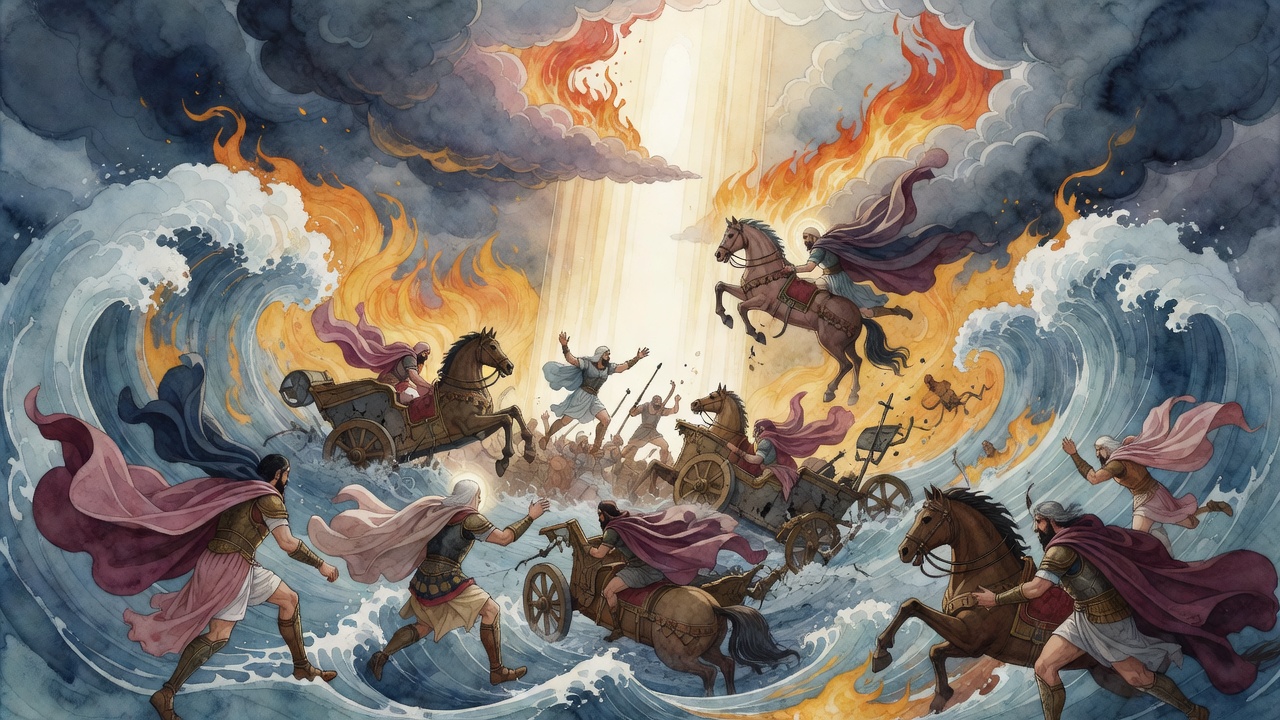
The liberation from Egypt, the parting of the sea, and the journey from slavery to Sinai that defined the Jewish people.

(Exodus 21 — 31) "Or if it gore a son, or it gore a

Mekhilta DeRabbi Yishmael Mekhilta DeRabbi Yishmael

(Exodus 21:31) "Or if it gore a son, or it gore a daughter": Why is this stated? (Ibid. 29) "and it kill a man or a woman" tells me only of adults. Whence do I derive (the same for...

(Exodus 21 — 31) "If the ox gore a man-servant or a maid-servant

Mekhilta DeRabbi Yishmael Mekhilta DeRabbi Yishmael

(Exodus 21:32) addresses the case of an ox that gores a bondservant: "If the ox gore a man-servant or a maid-servant." The Mekhilta explains that bondservants were already included...

(Exodus 21 — 33) "And if a man open a pit" — Why is this stated

Mekhilta DeRabbi Yishmael Mekhilta DeRabbi Yishmael

(Exodus 21:33) "And if a man open a pit": Why is this stated? It can be derived by reason, viz.: Since the ox is his possession and the pit is his possession, then if you have lear...

Money shall he restore to its owner' — This tells me only of money

Mekhilta DeRabbi Yishmael Mekhilta DeRabbi Yishmael

"Money shall he restore to its owner" — when someone's animal falls into another person's uncovered pit and dies, the pit-digger must pay compensation. The Torah specifies "money."...

(Exodus 21 — 37) "If a man steal an ox or a lamb" — Both the

Mekhilta DeRabbi Yishmael Mekhilta DeRabbi Yishmael

(Exodus 21:37) introduces the severe penalty for livestock theft: "If a man steal an ox or a lamb and slaughter it or sell it, he shall pay five oxen for the ox and four sheep for ...

(Exodus 22 — 1) "If the thief be found breaking in" — This

Mekhilta DeRabbi Yishmael Mekhilta DeRabbi Yishmael

(Exodus 22:1) introduces the law of the burglar: "If the thief be found breaking in." The Mekhilta clarifies what the homeowner's mental state must be. The verse describes a situat...

(Exodus 22 — 2) "If the sun shone upon him" — Now does the sun

Mekhilta DeRabbi Yishmael Mekhilta DeRabbi Yishmael

The Torah presents a puzzling phrase in (Exodus 22:2): "If the sun shone upon him." The context is a homeowner who kills a thief caught breaking in at night. During the night, the ...

(Exodus 22 — 3) "If found will be found in his hand" — in his

Mekhilta DeRabbi Yishmael Mekhilta DeRabbi Yishmael

(Exodus 22:3) says: "If found will be found in his hand." The phrase "in his hand" seems to mean the stolen object was physically held by the thief. But the Mekhilta interprets "in...

(Exodus 22 — 4) "If a man ravage a field or a vineyard, and

Mekhilta DeRabbi Yishmael Mekhilta DeRabbi Yishmael

(Exodus 22:4) "If a man ravage a field or a vineyard, and he send his beast, etc.": Why is this written? (Even) if it were not written, it would follow a fortiori, viz.: If a pit i...

(Exodus 22 — 5) "If fire go out and it find thorns … pay

Mekhilta DeRabbi Yishmael Mekhilta DeRabbi Yishmael

(Exodus 22:5) "If fire go out and it find thorns … pay shall pay he that lights the fire": Why need this be written? It is derivable a fortiori, viz. If he is liable (if the fire p...

(Exodus 22 — 6) "If a man give to his neighbor money or

Mekhilta DeRabbi Yishmael Mekhilta DeRabbi Yishmael

The Mekhilta DeRabbi Yishmael records a teaching by Rabbi Yishmael on the laws of bailment, drawn from (Exodus 22:6): "If a man give to his neighbor money or vessels to watch." Thi...

(Exodus 22 — 7) "If the thief not be found" — What is the

Mekhilta DeRabbi Yishmael Mekhilta DeRabbi Yishmael

(Exodus 22:7) "If the thief not be found": What is the intent of this? From "If the thief is found, he shall pay double," I understand that if the thief is found and he has (what t...

(Exodus 22 — 9) "If a man give to his neighbor an ass or an

Mekhilta DeRabbi Yishmael Mekhilta DeRabbi Yishmael

The Mekhilta DeRabbi Yishmael records a teaching by Rabbi Yishmael on the laws governing an unpaid bailee who is entrusted with livestock. The verse states: "If a man give to his n...

(Exodus 22 — 11) "And if it were stolen from him, he shall

Mekhilta DeRabbi Yishmael Mekhilta DeRabbi Yishmael

(Exodus 22:11) "And if it were stolen from him, he shall pay its owner": This speaks of a hired watcher, and the above (Ibid. 9-10), of a non-paid watcher. But perhaps the reverse ...

(Exodus 22 — 12) "If it were torn (by a wild beast), let him

Mekhilta DeRabbi Yishmael Mekhilta DeRabbi Yishmael

(Exodus 22:12) discusses an animal that is "torn by a wild beast" while in a guardian's care: "If it were torn, let him bring ed." But what does "ed" mean? Two rabbis disagreed. Ra...

(Exodus 22 — 13) "And if a man borrow from his neighbor"

Mekhilta DeRabbi Yishmael Mekhilta DeRabbi Yishmael

The Torah draws a sharp legal distinction between someone who watches your property and someone who borrows it. In (Exodus 22:13), the verse states: "And if a man borrow from his n...

(Exodus 22 — 15) "And if a man entice a virgin, etc

Mekhilta DeRabbi Yishmael Mekhilta DeRabbi Yishmael

(Exodus 22:15) introduces the law of seduction: "And if a man entice a virgin." The Mekhilta explains why this verse is needed when the law of the rapist is already stated in (Deut...

according to the mohar of the virgins" — What do we learn

Mekhilta DeRabbi Yishmael Mekhilta DeRabbi Yishmael

The Mekhilta DeRabbi Yishmael examines the phrase "according to the mohar of the virgins" and applies a distinctive rabbinic technique to determine the monetary amount it refers to...

(Exodus 22 — 17) "A witch you shall not allow to live" — Both

Mekhilta DeRabbi Yishmael Mekhilta DeRabbi Yishmael

The Torah declares in (Exodus 22:17): "A witch you shall not allow to live." The Mekhilta immediately clarifies the scope of this severe commandment. Despite the verse using the fe...

(Exodus 22 — 20) "And a stranger you shall not afflict and

Mekhilta DeRabbi Yishmael Mekhilta DeRabbi Yishmael

(Exodus 22:20) commands: "And a stranger you shall not afflict and you shall not oppress him." The Mekhilta identifies two distinct prohibitions within this verse. "You shall not a...

(Exodus 22 — 21) "Every widow and orphan you shall not

Mekhilta DeRabbi Yishmael Mekhilta DeRabbi Yishmael

(Exodus 22:21) commands: "Every widow and orphan you shall not afflict." The Mekhilta immediately pushes beyond the literal categories. This verse mentions only widows and orphans....

(Exodus 22 — 24) "Im you lend money to My people" — R

Mekhilta DeRabbi Yishmael Mekhilta DeRabbi Yishmael

(Exodus 22:24) begins: "Im you lend money to My people." The word "im" typically means "if" — suggesting optionality. But Rabbi Yishmael taught that this is one of the rare cases w...

Similarly, (Exodus 20 — 22) "And im ("when") an altar of

Mekhilta DeRabbi Yishmael Mekhilta DeRabbi Yishmael

The Torah states in (Exodus 20:22): "And when you make an altar of stones unto Me." The Mekhilta zeroes in on the Hebrew word "im" — which can mean either "when" or "if" — and asks...

(Exodus 22 — 25) "Im chavol (lit

Mekhilta DeRabbi Yishmael Mekhilta DeRabbi Yishmael

The Torah uses a peculiar phrase in (Exodus 22:25): "Im chavol tachbol" — literally, "if you bundle, you shall bundle." The verse appears in the context of laws about taking a garm...

(Exodus 22 — 26) "for it is his solitary covering" — This is

Mekhilta DeRabbi Yishmael Mekhilta DeRabbi Yishmael

(Exodus 22:26) "for it is his solitary covering": This is his cloak. "it is his garment for his skin"—this is his undergarment. "On what shall he lie?": to include his mat-skin. "a...

(Exodus 22 — 27) "Elokim you shall not curse" — What is the

Mekhilta DeRabbi Yishmael Mekhilta DeRabbi Yishmael

(Exodus 22:27) "Elokim you shall not curse": What is the intent of this? From (Leviticus 24:16) "One who utters blasphemously the name of the L–rd shall be put to death" we hear th...

(Exodus 22 — 28) "Your fullness and your dema (terumah) you

Mekhilta DeRabbi Yishmael Mekhilta DeRabbi Yishmael

(Exodus 22:28) "Your fullness and your dema (terumah) you shall not delay": "Your fullness"—bikkurim (first-fruits, which are taken from fully ripened grain). "you shall not delay"...

(Exodus 22 — 29) "Thus shall you do with your ox" — Just as

Mekhilta DeRabbi Yishmael Mekhilta DeRabbi Yishmael

(Exodus 22:29) commands: "Thus shall you do with your ox" — referring to the first-born of animals. The Mekhilta draws a comparison between the first-born of animals and the first-...

(Exodus 22 — 30) "And men of holiness shall you be to me" — R

Mekhilta DeRabbi Yishmael Mekhilta DeRabbi Yishmael

(Exodus 22:30) "And men of holiness shall you be to me": R. Yishmael says: When you are holy, you are Mine. Issi b. Yehudah says: When the Holy One Blessed be He originates a mitzv...

(Exodus 23 — 3) "Do not honor a poor man in his quarrel" — Why

Mekhilta DeRabbi Yishmael Mekhilta DeRabbi Yishmael

(Exodus 23:3) commands: "Do not honor a poor man in his quarrel." The Mekhilta asks why this verse is needed when (Leviticus 19:15) already says: "You shall not favor a poor man an...

(Exodus 23 — 4) "If you encounter (the ox of your foe, or his

Mekhilta DeRabbi Yishmael Mekhilta DeRabbi Yishmael

(Exodus 23:4) commands: "If you encounter the ox of your foe, or his donkey, straying, return shall you return it to him." The Mekhilta asks: does "encounter" mean literal physical...

(Exodus 23 — 5) "lying (under its burden") — and not a

Mekhilta DeRabbi Yishmael Mekhilta DeRabbi Yishmael

(Exodus 23:5) addresses the obligation to help an enemy's animal that is struggling under its burden: "If you see the donkey of your enemy lying under its burden." The Mekhilta par...

(Exodus 23 — 7) "and a clean one and a righteous one you

Mekhilta DeRabbi Yishmael Mekhilta DeRabbi Yishmael

(Exodus 23:7) says: "And a clean one and a righteous one you shall not kill." The Mekhilta applies this to a specific judicial scenario involving imprecise testimony. Suppose one w...

(Exodus 23 — 10) "Six years shall you sow your land" — R

Mekhilta DeRabbi Yishmael Mekhilta DeRabbi Yishmael

(Exodus 23:10) commands: "Six years shall you sow your land." Rabbi Eliezer taught that this verse reveals two different agricultural realities, depending on Israel's spiritual sta...

(Exodus 23 — 13) "And everything that I have spoken of to

Mekhilta DeRabbi Yishmael Mekhilta DeRabbi Yishmael

(Exodus 23:13) says: "And everything that I have spoken of to you, you shall observe." The Mekhilta asks what this general command adds to the specific Sabbath prohibition of (Exod...

(Exodus 23 — 14) "Three festivals shall you celebrate for Me

Mekhilta DeRabbi Yishmael Mekhilta DeRabbi Yishmael

(Exodus 23:14) commands: "Three festivals shall you celebrate for Me in the year." The Mekhilta asks why this verse is needed when (Exodus 23:17) already says "Three times shall ev...

(Exodus 23 — 15) "the festival of Matzoth shall you keep"

Mekhilta DeRabbi Yishmael Mekhilta DeRabbi Yishmael

The Jewish calendar is not purely lunar. It is lunisolar — adjusted periodically so that the festivals fall in their proper seasons. The Mekhilta traces this practice of calendar a...

(Exodus 23 — 16) "And the festival of the harvest (Shavuoth)

Mekhilta DeRabbi Yishmael Mekhilta DeRabbi Yishmael

(Exodus 23:16) refers to Shavuot (the Festival of Weeks)h as "the festival of the harvest, the first-fruits of your labor." The Mekhilta notes that this description appears within ...

(Exodus 23 — 19) "The first of the first-fruits of your

Mekhilta DeRabbi Yishmael Mekhilta DeRabbi Yishmael

(Exodus 23:19) commands: "The first of the first-fruits of your land you shall bring to the house of the Lord your God." The Mekhilta asks what this verse adds to (Deuteronomy 26:2...

(Exodus 23 — 19) "You shall not cook a kid in its mother's milk" — R

Mekhilta DeRabbi Yishmael Mekhilta DeRabbi Yishmael

(Exodus 23:19) prohibits: "You shall not cook a kid in its mother's milk." Rabbi Shimon asked why this prohibition is stated three times in the Torah — here, in (Exodus 34:26), and...

Guria says — "Holiness" is mentioned here (in respect to

Mekhilta DeRabbi Yishmael Mekhilta DeRabbi Yishmael

Issi ben Guria demonstrated that eating meat cooked in milk is forbidden through a verbal comparison between two passages. The word "holiness" appears in (Deuteronomy 14:21), where...

(Exodus 30 — 11) "And the L–rd spoke to Moses" — Not through

Mekhilta DeRabbi Yishmael Mekhilta DeRabbi Yishmael

The opening of Mekhilta Tractate Shabbata draws attention to the singular way God communicated with Moses. The verse states (Exodus 30:11): "And the Lord spoke to Moses." The Mekhi...

(31 — 13) "but My Sabbaths shall you keep" — What is the

Mekhilta DeRabbi Yishmael Mekhilta DeRabbi Yishmael

(Exodus 31:13) commands: "But My Sabbaths shall you keep." The Mekhilta asks what this verse adds to (Exodus 20:10): "You shall not perform any labor." If labor is already prohibit...

(Exodus 31 — 14) "for it is holy to you" — We are hereby

Mekhilta DeRabbi Yishmael Mekhilta DeRabbi Yishmael

The Torah declares about the Sabbath: "for it is holy to you" (Exodus 31:14). The Mekhilta DeRabbi Yishmael draws from this phrase a remarkable teaching about how Sabbath observanc...

(Exodus 31 — 15) "Six days will work be done

Mekhilta DeRabbi Yishmael Mekhilta DeRabbi Yishmael

(Exodus 31:15) says: "Six days will work be done." But another verse (Exodus 20:9) says: "Six days shall you work, and you shall do all of your work." One verse is passive — "work ...

What is the intent of (Exodus, Ibid

Mekhilta DeRabbi Yishmael Mekhilta DeRabbi Yishmael

What is the intent of (Exodus, Ibid. 150 "And the seventh day, a Sabbath of resting, holy to the L–rd"? From (Leviticus 23:4) "These are the festivals of the L–rd, callings of holi...

Yonathan says — What is the intent of "You shall not light a fire"

Mekhilta DeRabbi Yishmael Mekhilta DeRabbi Yishmael

Rabbi Yonathan asked: what is the purpose of specifying "You shall not light a fire" when the Torah already prohibits all labor on the Sabbath? If all thirty-nine categories of lab...

Sisera and the Dreamer

Midrash Aggadah Midrash Aggadah

Pirkei DeRabbi Eliezer, a fascinating collection of stories and elaborations on Biblical narratives, gives us a glimpse. In Chapter 42, we find a surprising dialogue between God an...