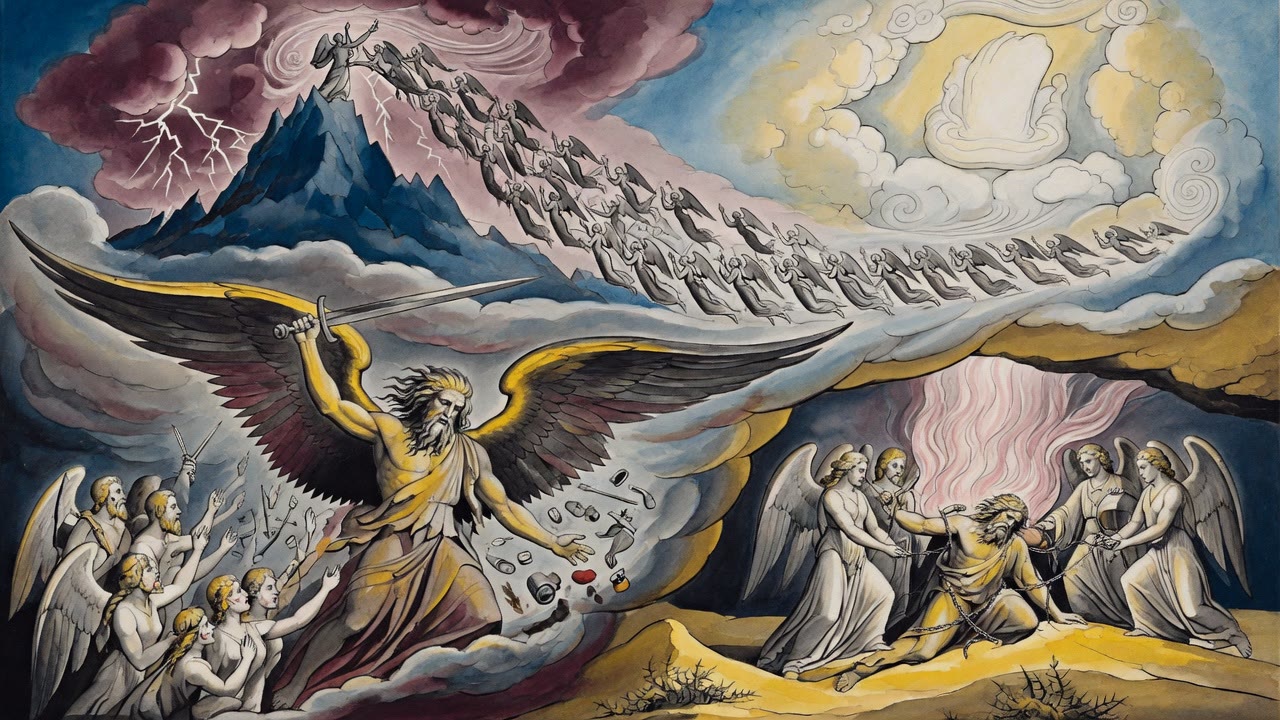
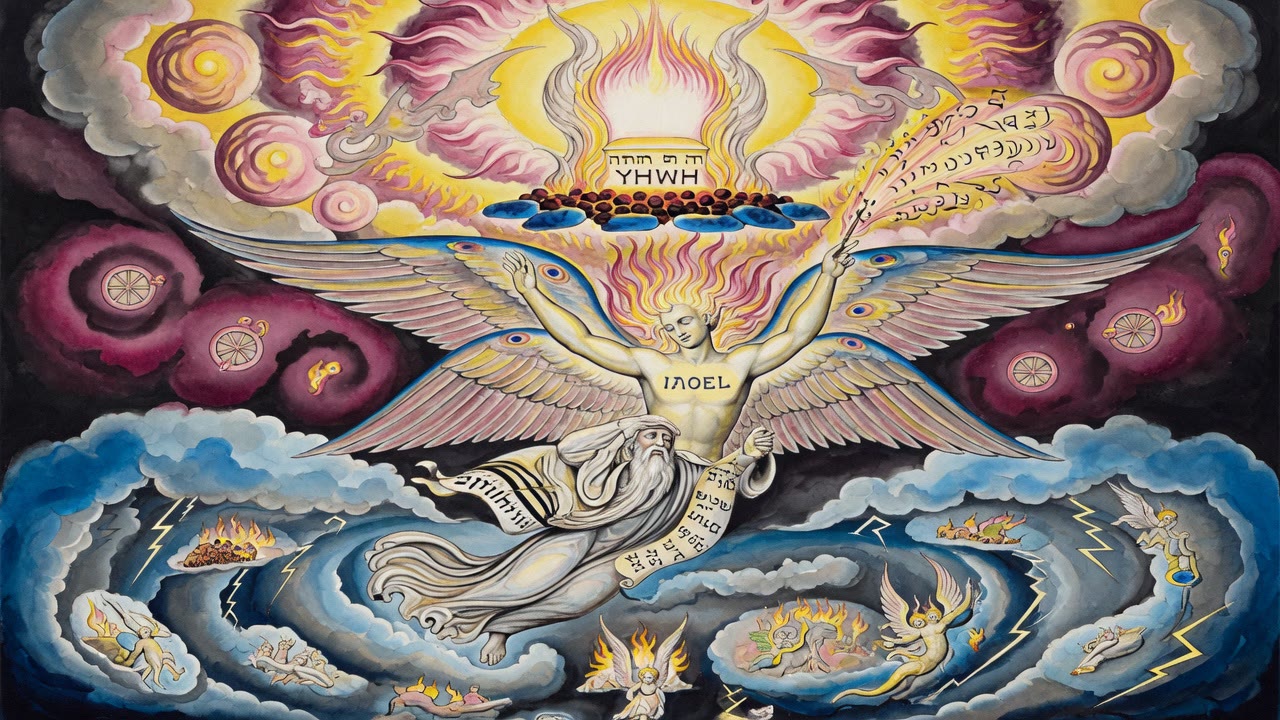
Abraham Felt His Spirit Leaving as God Drew Near
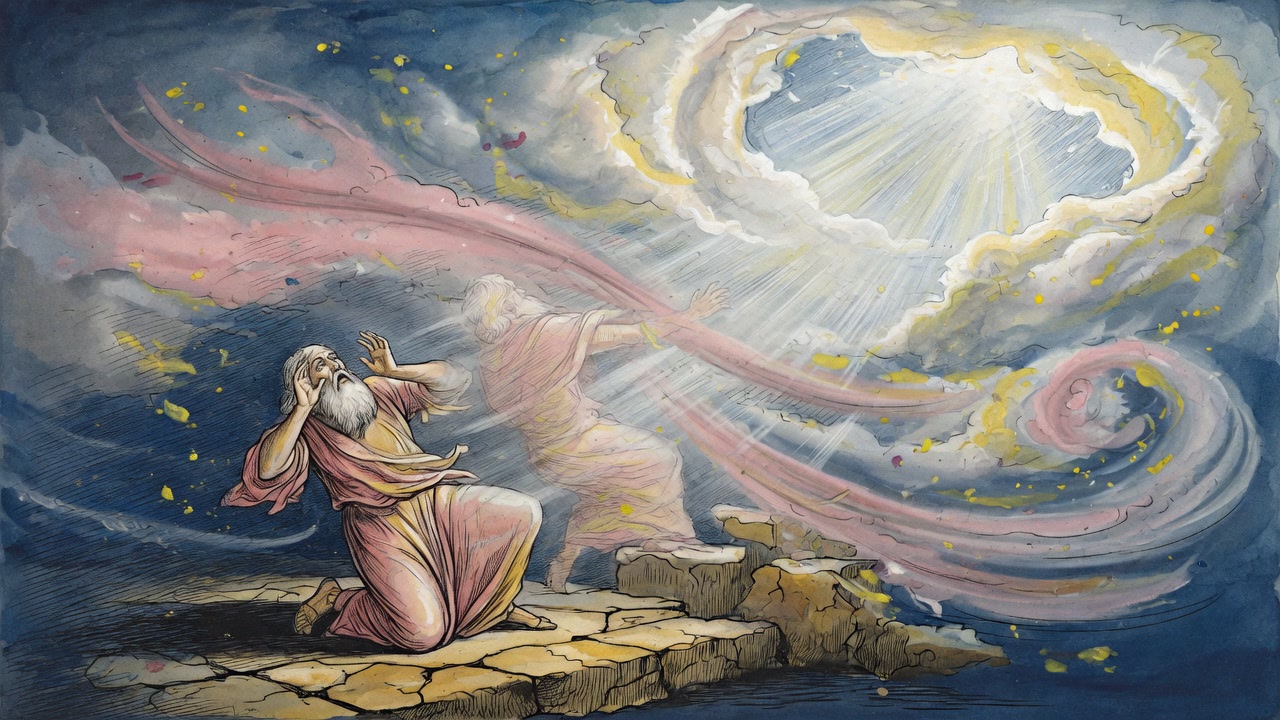
Abraham could not see. His knees were going. Iaoel held him and said the One coming loved him, and that he would not see God Himself.
Table of Contents
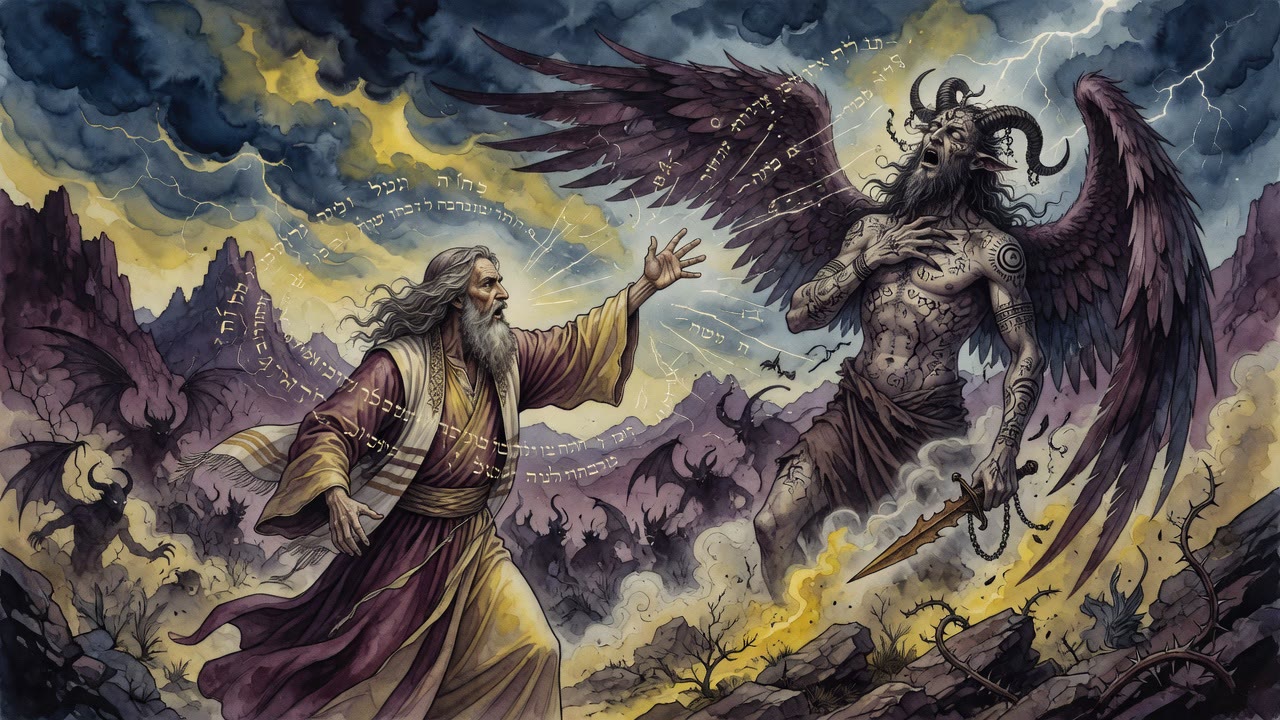
He had the words in his mouth, and he used them. Iaoel had put a sentence into Abraham and told him to spend it on Azazel.
 Click for full size
"Be the burning coal of the Furnace of the earth. Go, Azazel, into the inaccessible parts of the earth."
Abraham spoke it exactly. Azazel did not leave quietly. He kept talking, kept trying to pull Abraham into a conversation. Iaoel warned him: God has given that one power over those who answer him. However much he speaks, do not respond, so that his will may have no course in you.
Abraham shut his mouth. However much Azazel spoke, Abraham said nothing. Silence was the weapon. The voice faded. The fire around them did not cool.
His Spirit Began to Leave
Abraham turned to his guide and told him what was happening to his body.
"Why have you brought me up here? I cannot see anymore. I am already grown weak. My spirit is departing from me."
This was not a complaint. It was a report, as specific as a man describing a wound. The light was too intense. His eyes had failed. His strength was draining in some way he could feel but not stop. Something was beginning to leave his body that he could only call his spirit, not yet gone, but going.
He was not afraid of God. He was being unmade by nearness to God, which is a different thing.
The Light Adam Lost
Iaoel knew that light. Before Adam ate and was sent from the garden, a person could see by a different quality of brightness. The first-day light was not sunlight. Standing in one place, Adam could see from one end of the world to the other. He walked in it.
Then it was withdrawn. Hidden for the righteous in the world to come. Ordinary humanity was left with sun and fire and a vision that stopped at walls.
Abraham, climbing toward the Throne, had come too close to the light that had been taken back. His body was built for the diminished world after Adam's transgression. It could not hold that radiance. This was not a punishment. It was not a test. It was a post-garden body standing at the edge of the first light, and the spirit was leaving him as God drew near.
Iaoel Held Him Upright
Iaoel did not explain. He steadied Abraham first, then spoke.
"Remain by me. Fear not. He whom you see coming straight toward us with a great voice of holiness, that is the Eternal One who loves you. But Himself you cannot see."
"Do not let your spirit grow faint on account of the loud crying. I am with you, strengthening you."
What was approaching was real. It was God. God loved him. Abraham would not see God's form. Direct sight was not the gift of this hour. What he would receive was a voice, and then a looking-down: the stack of heavens peeled back, the history of his descendants, the covenant mapped across time. God would be present the way a voice is present. Everywhere, and nowhere as a face.
The Doubled Name From the Fire
The voice came first. From the midst of the fire surrounding them, a sound that shook the air with holiness. Not words yet. The approach itself, moving toward them across the gap between heaven and wherever Abraham was standing.
The fire blazed up. The heavens trembled. Abraham, already weakened, felt himself going. Then the voice called his name: "Abraham, Abraham."
The doubled call, the same form used when he was stopped over Isaac, the same form that would later catch Moses at the bush. The doubled name took Abraham as he was. Not past him. Not through him. This specific person, standing here.
Abraham answered. "Here I am." Two words. He was still present. Still able to respond. The spirit had not fully departed.
The voice told him to look down.
Look Down From the Fire
"Consider the expanses beneath the firmament on which you are now placed, and see that on no single expanse is there any other but He whom you have sought, the One who has loved you."
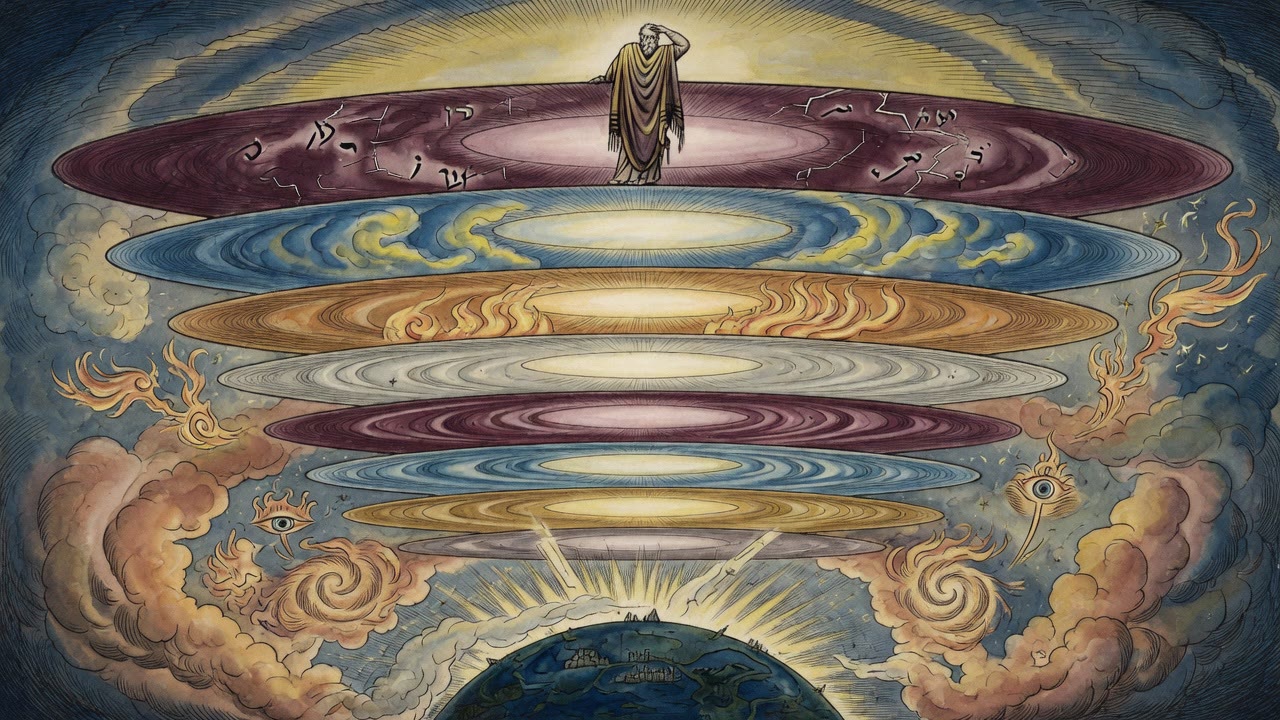
The expanses opened under his feet. He stood on the seventh firmament and saw fire widely spread, and light, and dew, and a multitude of angels, and a power of invisible glory hovering over the living creatures. No other being was there. Only God's presence, alone.
He looked down to the sixth and saw pure spirits without bodies, carrying out the commands of the fiery angels above. God commanded the sixth to be removed. On the fifth, the powers of the stars carried out their appointed commands, and the elements of the earth obeyed them.
Layer by layer the stack of heavens peeled back. Seven veils over the earth, each with its own order, each answering the one above it, all of them answering the voice from the fire. Abraham, who had been losing his spirit a moment before, was still on his feet because an angel had told him to remain, and because he had answered his name.
← All myths