Parshat Bereshit6 min read

Angels of Fire on Day One and the Sabbath Kept for Adam Alone

In Jubilees, God speaks whole orders of angels into being on day one, then keeps the first Sabbath in heaven and hands it to Adam alone.

Curated by Arthur · Told by Maggid ·
Table of Contents
  1. The First Word Fills the Heights With Ranks of Fire
  2. The Firmament Splits the Waters in Two
  3. The Waters Obey and the Dry Land Climbs Free
  4. Adam Names the Ranks and Stands Alone Among Them
  5. The Seventh Dawn and the Rest Kept in the Heights
Angels of Fire on Day One and the Sabbath Kept for Adam Alone Click for full size

The First Word Fills the Heights With Ranks of Fire

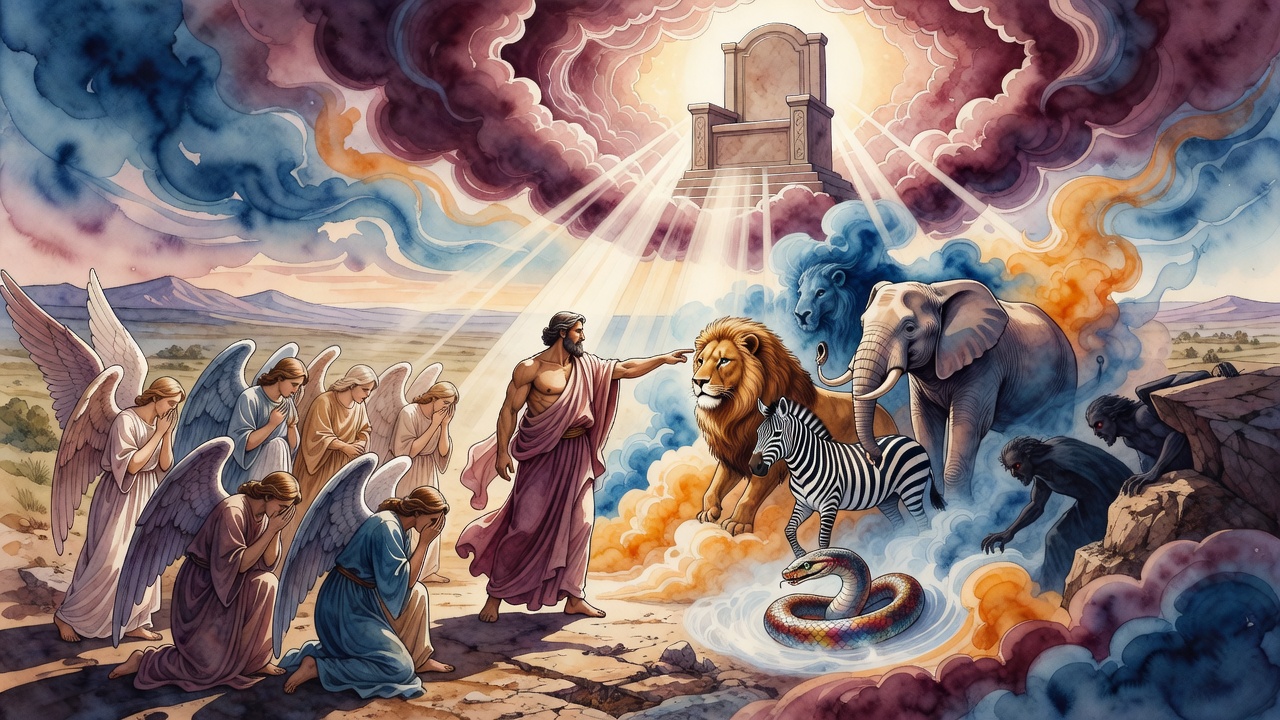
Before there was a morning to name, there was a voice, and the voice did not stop at heaven and earth. On the first day God spoke, and the waters came, and the deep spread out under a darkness that had never once been broken. Then the same breath that laid down the earth kept speaking, and the heights filled with servants.

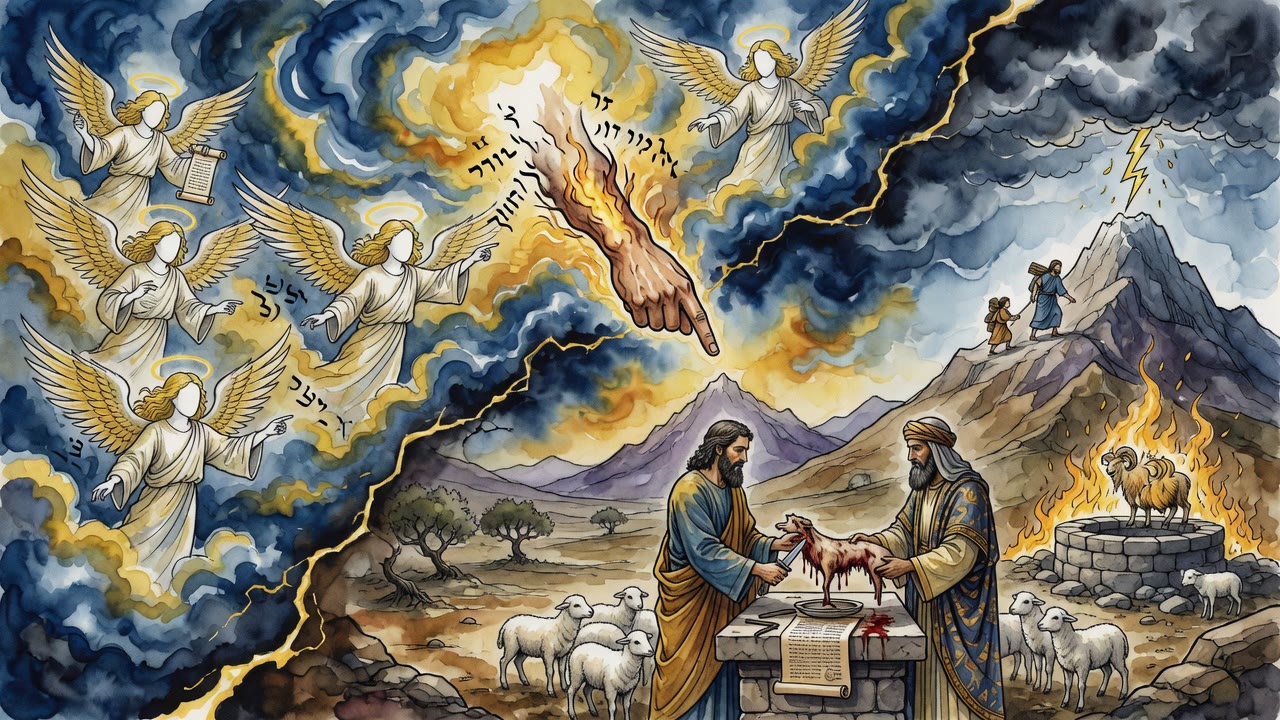
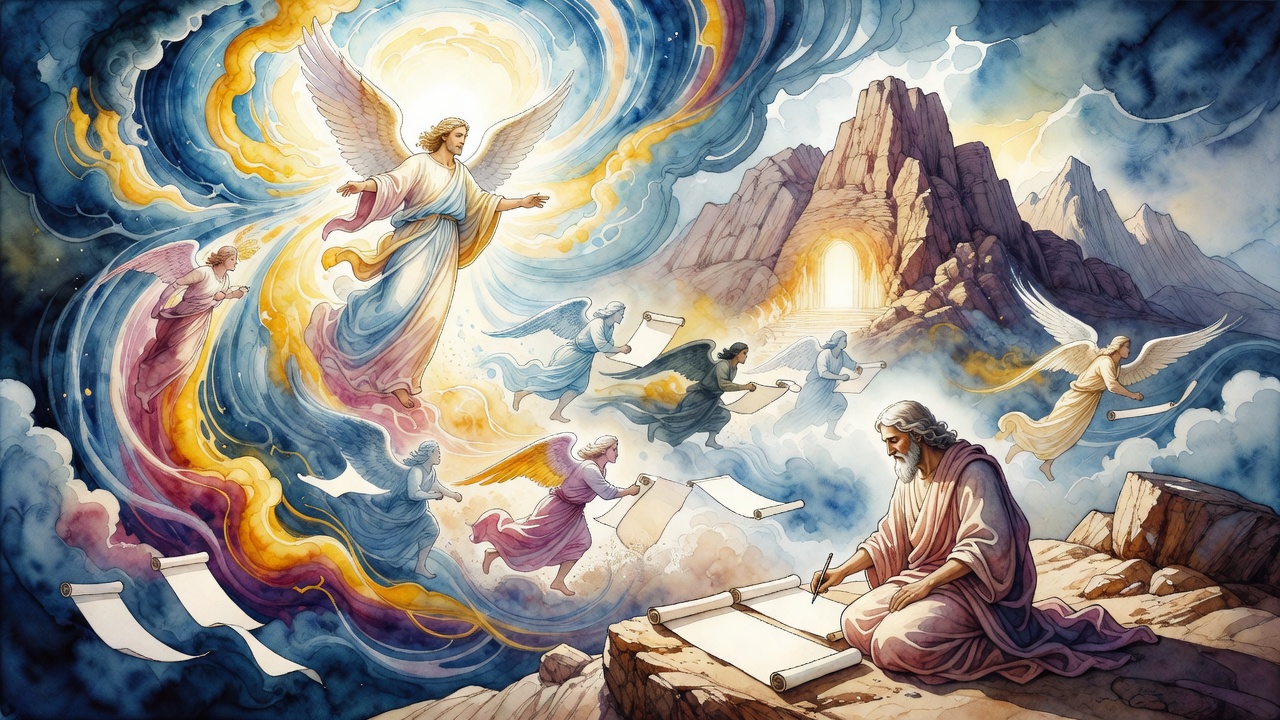
They arrived in orders, each rank to its labor. The angels of the presence, closest to the throne. The angels of sanctification, set apart for holy work. Behind them the angels of the spirit of fire, and the angels of the winds that drive the clouds across the face of the sky. Angels of the deep, of the darkness and the snow and the hail and the hoarfrost. Angels of the thunder and the lightning, of the cold and the heat, of winter and spring and the turning of the year. Every force that would ever move across the world had a servant standing ready before the world had weather.

All of this on the first day, spoken and standing, before a single plant had broken the soil.

The Firmament Splits the Waters in Two

On the second day God set one thing only in place, and it was enough to fill the day. He stretched a firmament through the middle of the waters, a vast dome dividing what had been one flood into two. Half the waters climbed above it. Half sank below and lay across the whole face of the earth. One act. One boundary hung in the deep. The day held nothing else, and needed nothing else.

The Waters Obey and the Dry Land Climbs Free

On the third day God did not reach down and haul the land up. He commanded, and the waters ran to obey. "Gather to one place," he said, and the primeval flood drew back from the face of the earth and poured out past the firmament, and the dry ground came up behind it, newborn and streaming.

Then the world filled fast. God carved out the seas, each to its own gathering place, and the rivers to their beds, and the springs into the mountains, and the dew for the fields and the lakes for the low country. He set the seed into the ground and the sprouting things and the fruit trees and the trees of the wood, and in the east he planted the garden of Eden, greener than everything around it. Four great works on that one day, and the earth that had been bare water in the morning stood heavy with growing things by dusk.

On the fourth day he hung the lights. Sun and moon and stars, fixed into the firmament of heaven to pour light on the earth below and to mark the days and the seasons and the years, so that time itself would have a face a creature could read.

Adam Names the Ranks and Stands Alone Among Them

Then the living things came, and they came in order, the way the angels had come. First the great beasts, then the cattle, then the birds filling the air. Everything that creeps and crawls upon the ground, and last the swarming life that filled the seas. Rank after rank, kind after kind, until the count of all God's works stood at two and twenty.

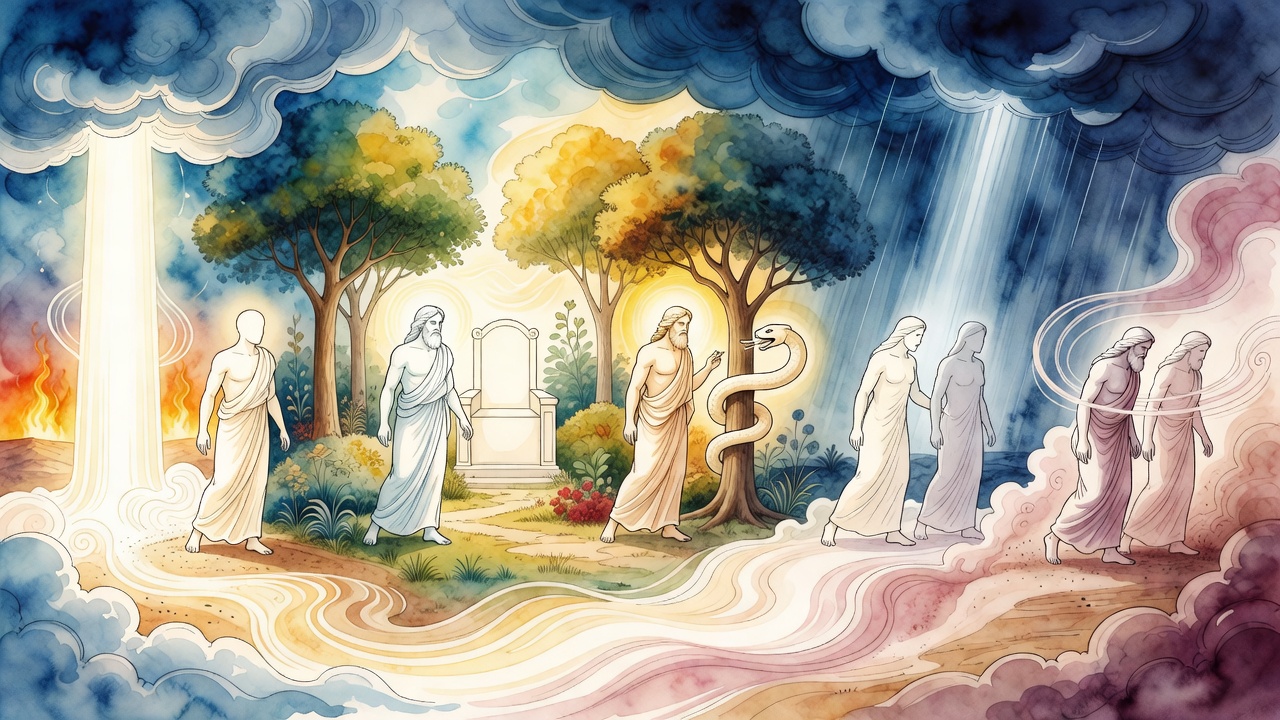
And Adam stood in the garden and watched them arrive. God brought each one before him, according to its kind and its type, and Adam gave it its name, and the name he spoke became the name it kept. He named the beasts and the birds and the creeping things, and as he named them a hollow opened in him that the naming could not fill. They came male and female, every kind of them, paired. He was one. He walked through a whole creation of couples and found no one made to match him.

God knew it before Adam spoke. "It is not good that the man should be alone," he said. "Let us make a helper fit for him." Even in a finished garden, with every creature named, something was still missing, and God said the lack out loud before he filled it.

The Seventh Dawn and the Rest Kept in the Heights

On the sixth day the work was done. Everything in the heavens and on the earth, in the seas and in the deep places, in the light and in the dark, all of it finished and standing. And on the seventh day God did not make. He rested, and he did not rest alone.

The two highest orders kept the day with him. The angels of the presence and the angels of sanctification, the ranks that had stood closest since the first morning, kept the Sabbath in the heights with their Maker, in heaven and over the earth. It was the first time creation held still on purpose.

Then God gave the day away. He blessed it and set it apart, lifted it above every other day he had made, and he handed the keeping of it down to Adam and to Adam's seed and to no other line of flesh on the earth. Adam and Eve alone were permitted to eat and drink and rest on it there in the garden, sharing the one day the angels kept above.

Before there was a Torah, before there was an Israel, before Sinai had a name, the seventh day already stood blessed, waiting for the one nation that would carry it. God had sanctified the day for himself, and he would sanctify a people the same way, out of all the peoples of the earth, the single seed that would keep the sign and be known by it forever.


← All myths

From the tradition

Sources

5 sources

The texts behind this telling. Some cards carry a translation of the source; others are our own retelling of it, and each card says which. Every card links out to the original.

Book of Jubilees 2:11Book of Jubilees

Retold in our words. Read the original at the link below.Sefaria Community Translation · CC-BY

That’s where texts like the Book of Jubilees come in. It's a fascinating ancient Jewish work, considered scripture by some, that expands on the Genesis account. to its version of creation’s second and third days.

So, Day Two. Imagine this: primordial waters, everywhere. Then, boom, God creates the firmament. That's a word we don't use every day. In this context, it's like a vast, expansive dome, placed right in the midst of the waters. According to Jubilees 2, the waters were divided. Half went up, above this new firmament, and half went down, below it, covering the face of the whole earth.

Think about the sheer scale of that! And what's striking is the simplicity with which Jubilees presents it. One powerful act, one singular creation defined Day Two. Just the firmament, dividing the waters. No more, no less.

Then comes Day Three. Now things get interesting, and perhaps a bit more familiar. God commands the waters to gather. To move away from the face of the earth, collect in one place. And wouldn’t you know it, they obey! They retreat, these primeval waters, flowing "outside of this firmament." And as the waters recede, the dry land appears.

Can you picture that? The first glimpse of solid ground, pushing its way through the receding waters. The earth, newly born.

What's interesting here is how Jubilees both echoes and expands upon the Genesis account. We see the same basic events – the separation of waters, the appearance of dry land – but with a slightly different emphasis. It highlights the commanding nature of God's voice, the immediate obedience of creation. And it really makes you consider the power and the mystery of those very first moments.

Full source
Book of Jubilees 2:15Book of Jubilees

Retold in our words. Read the original at the link below.Sefaria Community Translation · CC-BY

Those passages are easy to skim those opening chapters of Genesis, but the details… they’re breathtaking. And what if I told you there's another ancient text that expands on that cosmic blueprint? It's called the Book of Jubilees.

Jubilees, offers a more detailed account of those first six days. It's like getting a director's cut of the Genesis movie, with added scenes and behind-the-scenes commentary. So, what does it add to the story of creation?

The third day. Genesis simply states that God created land and vegetation. But Jubilees paints a much richer picture. It wasn’t just dry land appearing out of the primordial waters. No, no. According to Jubilees 2, on that very day, God created "all the seas according to their separate gathering-places, and all the rivers, and the gatherings of the waters in the mountains and on all the earth."

Think of the sheer scale! The oceans, each with its own distinct character, the rivers snaking across continents, the hidden springs bubbling in the mountains. And it doesn't stop there. The text goes on, "and all the lakes, and all the dew of the earth, and the seed which is sown, and all sprouting things, and fruit-bearing trees, and trees of the wood, and the garden of Eden, in Eden, and all (plants after their kind)." It’s a flourishing, vibrant world bursting into existence. A veritable explosion of life!

What I find especially compelling is the specific mention of the Garden of Eden. Not just vegetation in general, but that very special, sacred space. It's as if Jubilees is emphasizing the importance of this particular garden, setting the stage for the drama that will unfold there. And the text makes sure to emphasize this wasn't just some minor achievement: "These four great works God created on the third day." The text practically shouts that we pay attention!

Then comes the fourth day, and the celestial bodies take their places. Genesis tells us that God created the sun, moon, and stars to govern the day and night. Jubilees echoes this, saying, "And on the fourth day He created the sun and the moon and the stars, and set them in the firmament of the heaven, to give light upon all the earth."

The purpose is clear: illumination. Not just physical light, but perhaps also a kind of cosmic order. The sun, moon, and stars are not just objects in the sky; they are markers of time, guiding lights in the darkness.

Now, some might say, "So what? It's just more detail." But I think it’s more than that. Jubilees, in its expansion of the Genesis narrative, invites us to truly appreciate the intricate beauty and staggering scope of creation. It asks us to consider the sheer power and artistry involved in bringing our world into being.

And maybe, just maybe, it reminds us of our responsibility to care for this incredible gift we've been given. What does this detailed vision of creation spark in you?

Full source
Book of Jubilees 3:5Book of Jubilees

Retold in our words. Read the original at the link below.Sefaria Community Translation · CC-BY

Book of Jubilees turns to Adam Watches the Animals Arrive Day by Day.

First, the beasts. Then the cattle. The birds on the third day filling the skies with their songs. On the fourth day, everything that crawls and creeps upon the earth. And finally, on the fifth day, life exploded in the waters.

Adam, standing in the Garden, watching this parade of life unfold.

Here’s where it gets really interesting. Adam, according to Jubilees, had a very important job to do. He named them all. Every single one. "And Adam named them all by their respective names, and as he called them, so was their name." It wasn't just about labeling; it was about understanding the very essence of each creature, defining its place in the world. What a responsibility!

But as Adam is observing and naming, a stark reality sets in. He’s surrounded by pairs – male and female, of every kind. “And on these five days Adam saw all these, male and female, according to every kind that was on the earth, but he was alone and found no helpmeet for him.” He’s the only one. An island in a sea of couples.

You can almost feel his loneliness.

And here, the text takes a poignant turn. God notices. God sees Adam's solitude. "And the Lord said unto us: 'It is not good that the man should be alone: let us make a helpmeet for him.'"

It’s a beautiful, simple statement. "It is not good." A recognition that even in paradise, something is missing without connection, without companionship. We are, at our core, relational beings.

This moment sets the stage for the creation of Eve, but it also speaks to something deeper. And that even in the interplay of creation, our individual loneliness matters.

Full source
Book of Jubilees 2:29Book of Jubilees

Retold in our words. Read the original at the link below.Sefaria Community Translation · CC-BY

The sheer magnitude of creation, neatly organized into a divine schedule.

Our little peek into that schedule comes from the Book of Jubilees, a text shrouded in mystery and ancient wisdom. It's not part of the standard Hebrew Bible, but it offers a fascinating perspective on those early days of creation.

Specifically,

On the sixth day, God created four kinds of, well, stuff. Exactly what those four kinds were, Jubilees doesn’t specify here, but it brings the grand total to "two and twenty kinds." That’s twenty-two categories of created beings or things. A pretty comprehensive list!

And then comes the big announcement: "He finished all His work on the sixth day." Everything. In the heavens, on the earth, in the seas, even in the mysterious abysses. Light, darkness, everything! The satisfaction!

But it's what comes next that's truly special. It’s not just about finishing the job; it's about establishing a rhythm, a divine pattern. "And He gave us a great sign, the Sabbath day."

The Shabbat, the Sabbath. It's more than just a day off. It's a "great sign." A reminder. A connection. We are instructed to work for six days, mirroring the divine act of creation, and then to keep Sabbath on the seventh, abstaining from all work.

But here's where it gets really interesting. It's not just humans who are keeping Sabbath. According to Jubilees, "all the angels of the presence, and all the angels of sanctification…He hath hidden us to keep the Sabbath with Him in heaven and on earth." Two vast groups of angels. Joining in this cosmic day of rest. It elevates the Sabbath from a mere human observance to a universal principle. A shared moment of peace, reflection, and connection with the Divine.

So, what does it all mean? Well, maybe it’s a reminder that even after the most intense periods of creation, of work, of striving, there’s a need for rest. A need to pause, to reflect, and to connect with something larger than ourselves. The Sabbath, in this light, isn't just a day off, but a vital part of the cosmic order. A shared experience, linking us to the angels above and to the very act of creation itself.

Full source
Book of Jubilees 3:1Book of Jubilees

Retold in our words. Read the original at the link below.Sefaria Community Translation · CC-BY

Book of Jubilees turns to Shabbat, Adam at the Dawn of Creation.

Jubilees tells us that God permitted Adam and Eve – and them alone – to eat, drink, and keep the Sabbath right there on Earth. It wasn't just a day of rest; it was a unique privilege, a taste of something sacred. Before there was a Torah, before there were Israelites, there was Shabbat.

It goes on: The Creator of all things blessed this very day, the one He had created as a blessing, a sanctification, a glory towering above all other days. A day set apart. A day infused with divine presence.

This wasn't just a fleeting moment; it was a foundational principle. The Book of Jubilees emphasizes that this law, this testimony, was later given to the children of Israel as an everlasting law for all their generations. So, while the specific observance may have been formalized later, the essence of Shabbat, its deep spiritual meaning, was present from the dawn of creation.

But the narrative doesn't stop there. The text continues, describing how, during the second week of creation, God instructed that all the beasts, cattle, birds, and every creature that moves on land and sea be brought before Adam. Each animal was presented "according to their kinds, and according to their types."

Why this parade of creatures?

Perhaps it highlights Adam's role as steward of creation. Perhaps it emphasizes the order and structure that God established in the world. Or perhaps, it's another way of showing that Adam, in those early days, was granted a unique connection to all of creation, a connection mirrored and celebrated each week on Shabbat.

So, what does all this mean for us today? The Book of Jubilees reminds us that Shabbat isn't just a ritual; it's a connection to something ancient, something primal, something profoundly sacred. It's a weekly opportunity to reconnect with the divine spark within ourselves and within the world around us. It is a chance to eat, to drink, and to rest, just as Adam and Eve did, in the presence of the Creator.

Full source