5 min read

Adam Lived a Whole Life in His First Twelve Hours

Dust in the first hour. Every animal named by the sixth. Cain was alive and breathing an hour before the one command was ever spoken.

Curated by Arthur · Told by Maggid ·
Table of Contents
  1. Dust Gathered From the Whole World
  2. The Sixth Hour Was Names
  3. Two Went Up and Four Came Down
  4. One Command in the Ninth Hour
  5. He Ate in the Tenth
  6. Out by Sunset, and Not Destroyed
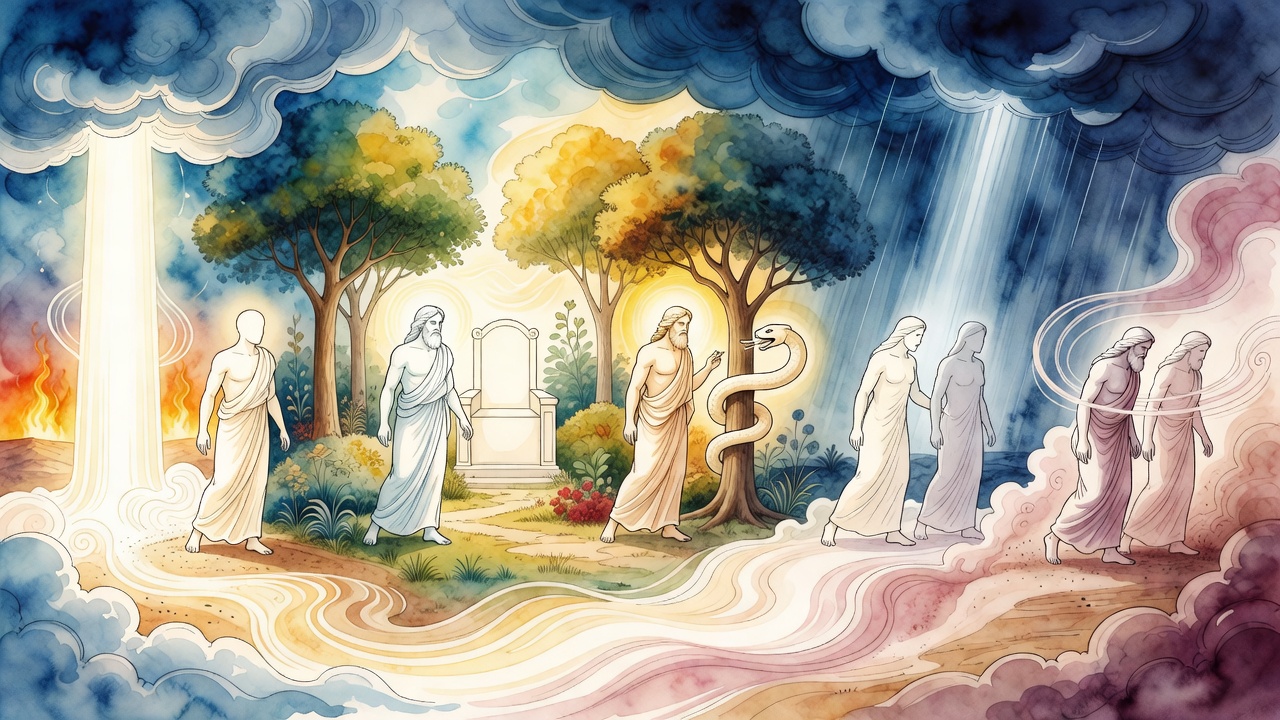
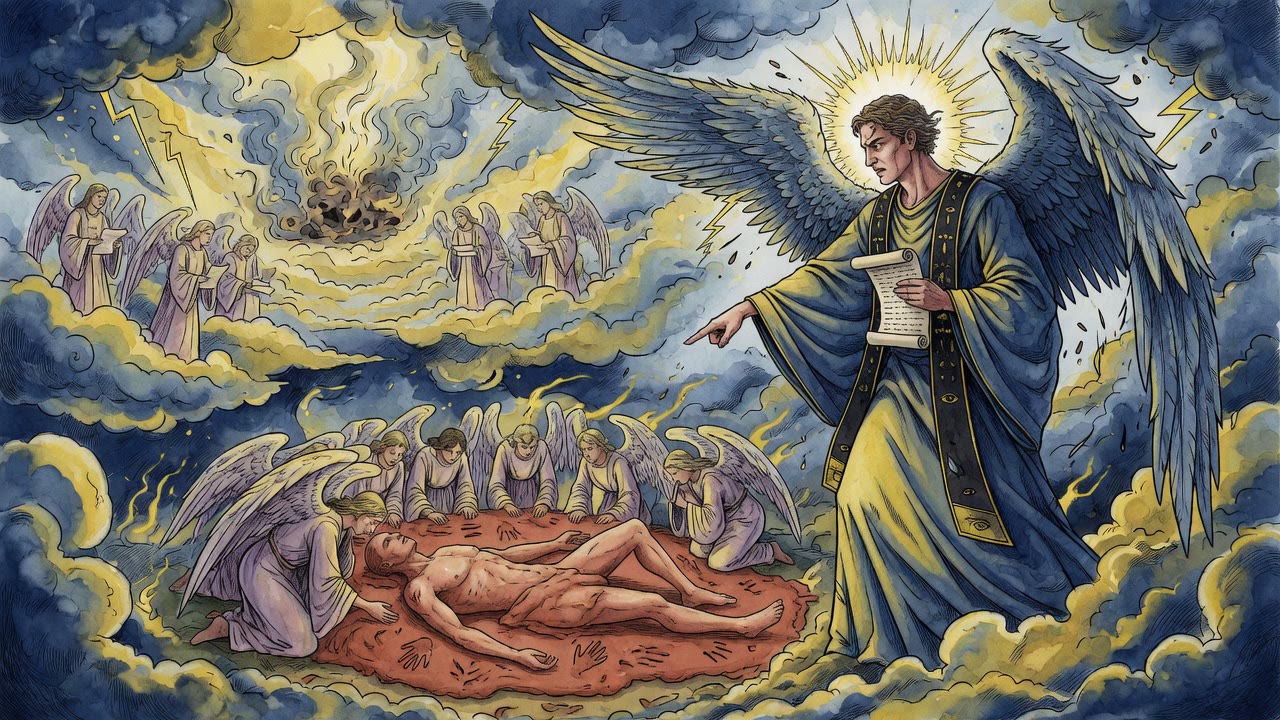
Adam Lived a Whole Life in His First Twelve Hours Click for full size

Dust Gathered From the Whole World

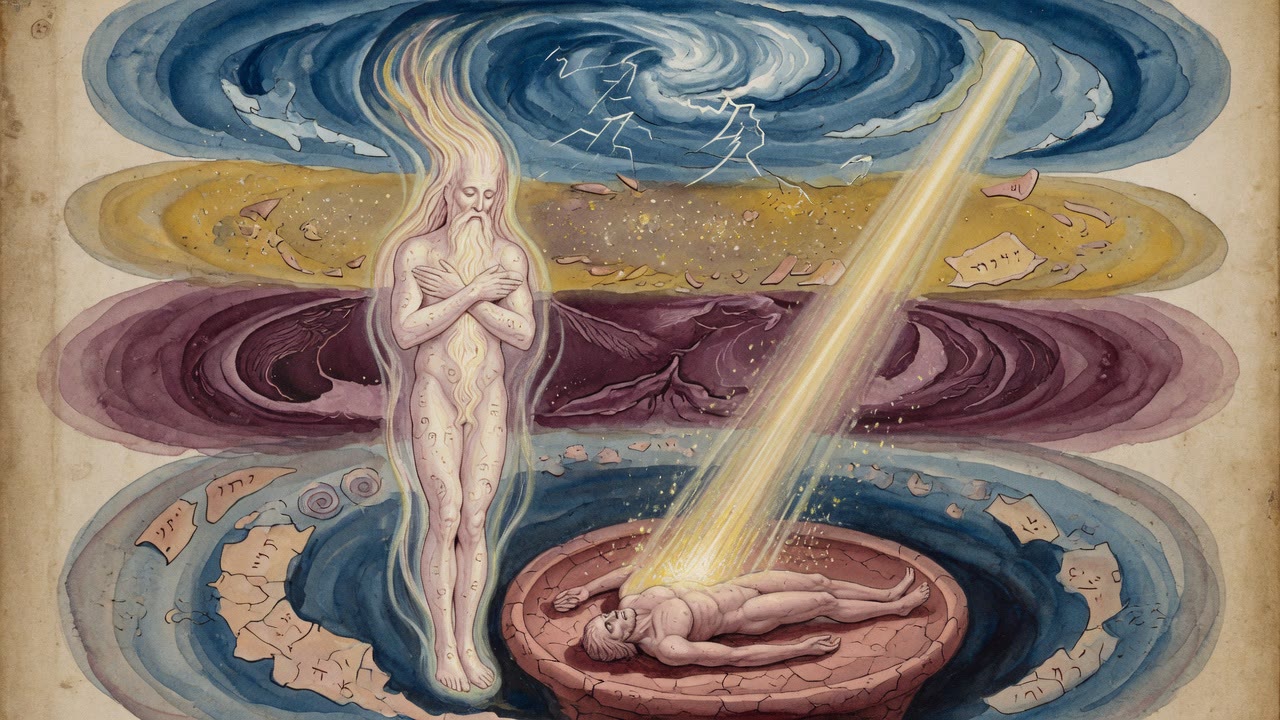
The dust was taken from everywhere, red ground and black, scraped up out of countries that had nobody in them yet, and in the first hour of the sixth day it lay in a heap on the ground.

In the second hour the heap was worked into one mass, a body with no arms and no legs and no face, and it had a name in that state. Golem. Adam lay that way while the light climbed, the first thing in the world that looked like it ought to be doing something and was not.

In the third hour the limbs came out of him, two arms, two legs, a head with the mouth already cut into it. Still nothing moved.

In the fourth hour God put a soul in him.

The whole fifth hour went to standing up. He got a hand under his shoulder and pushed against the ground he had been part of that morning, and he rose, and the ground stayed where it was.

The Sixth Hour Was Names

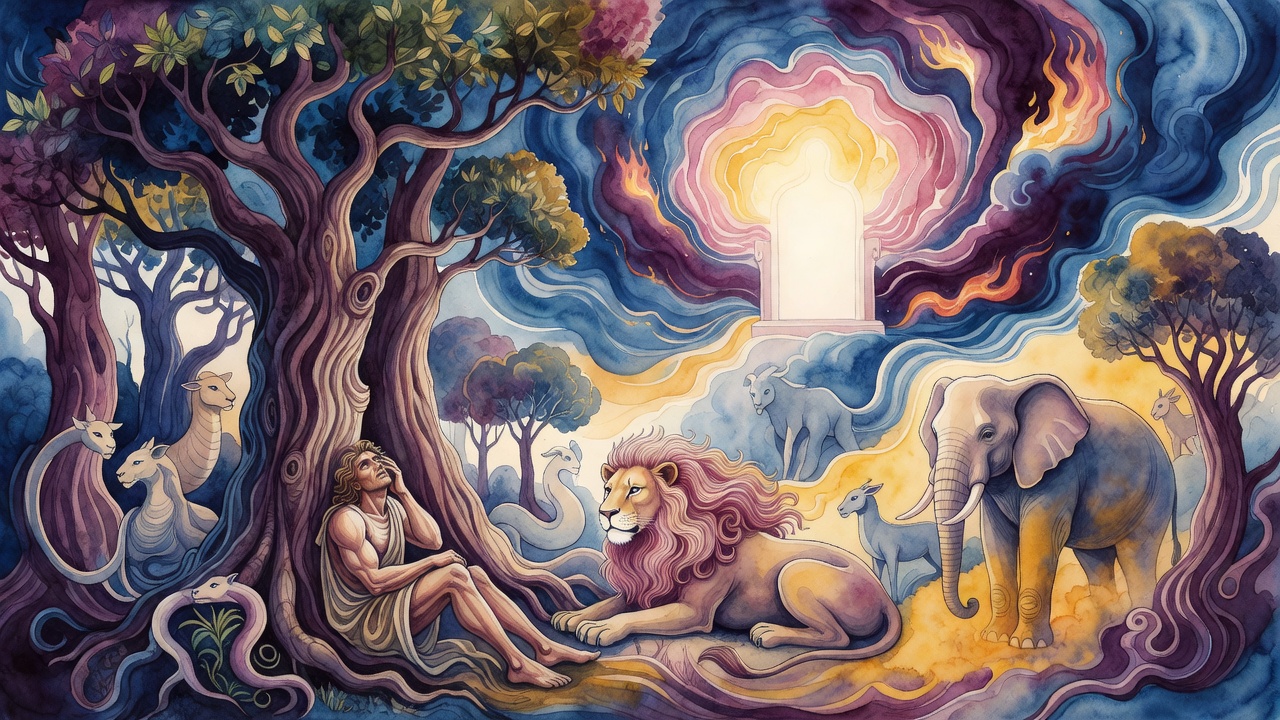
The animals came past him in a line and he gave each one a word. He did not ask anybody whether the words were right. Every creature that walked away from him walked away carrying what he had called it, and the names held.

In the seventh hour he was given a wife.

He had been alive for six hours. He could speak, he could walk, he had named every living thing on the earth, and he had not yet been told that anything in the garden was forbidden.

Two Went Up and Four Came Down

The eighth hour is the one the old count refuses to soften. Two went up to the bed. Four came down from it. A son and a daughter, born inside the garden before the day was two thirds finished.

Eve held the boy up and said, "I have gotten a man, the angel of the Lord."

She had wanted the angel. The wanting came first, before there was any child to want, and she put it in the naming and let it stand there in front of her husband. She called the boy Cain.

Nobody in the garden had been forbidden anything yet. The first murderer was already breathing.

One Command in the Ninth Hour

Then the order came, and it was short. Eat from every tree here. Not that one.

Nine hours old. A wife, two children, a language, a garden with rivers in it, and one prohibition standing in the middle of it like a stake driven into the lawn.

He Ate in the Tenth

The reach is the part worth slowing down. The hand goes out, and for a moment it is still only a hand near a branch, and the command is still unbroken, and the day could still end the way it started. Then the fingers close. Then the stem gives. Then there is juice on his chin and the taste is ordinary, which is the worst part, and the thing that cannot be undone has already been done.

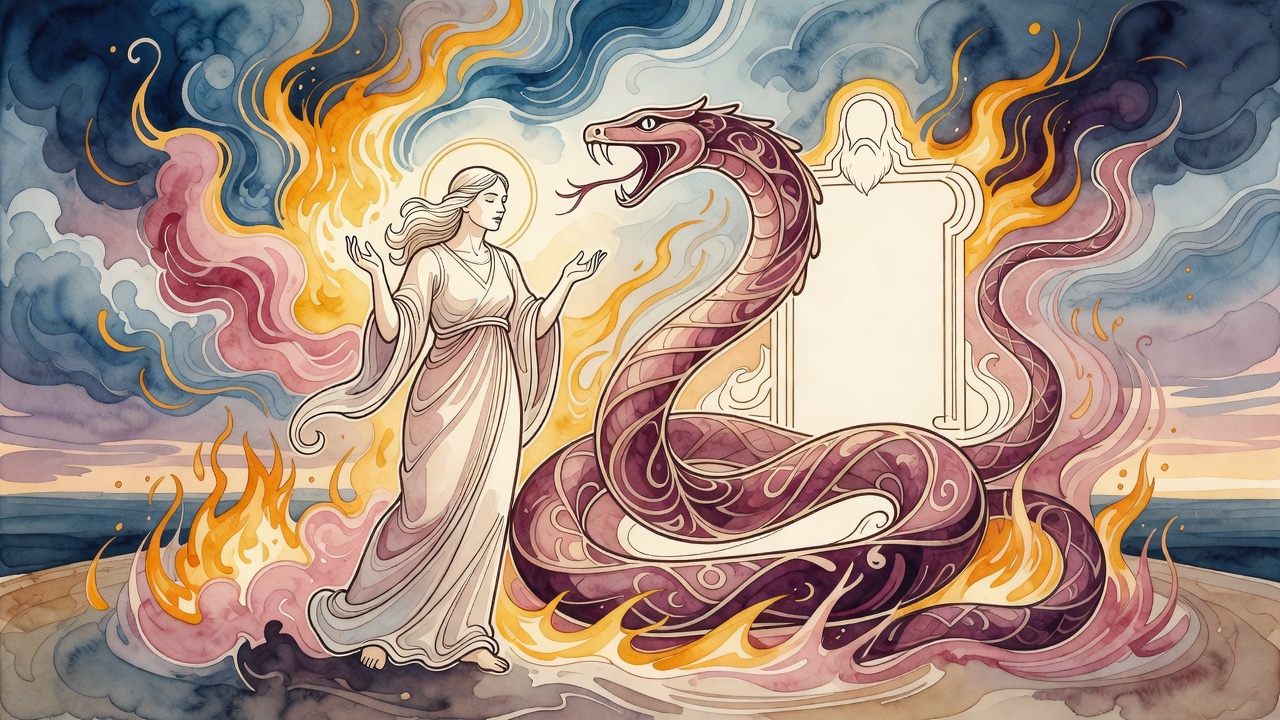
In the eleventh hour he was brought to judgment. He answered badly. He put it on his wife, and his wife put it on the serpent, and the leaves they had sewn together were coming apart while they talked.

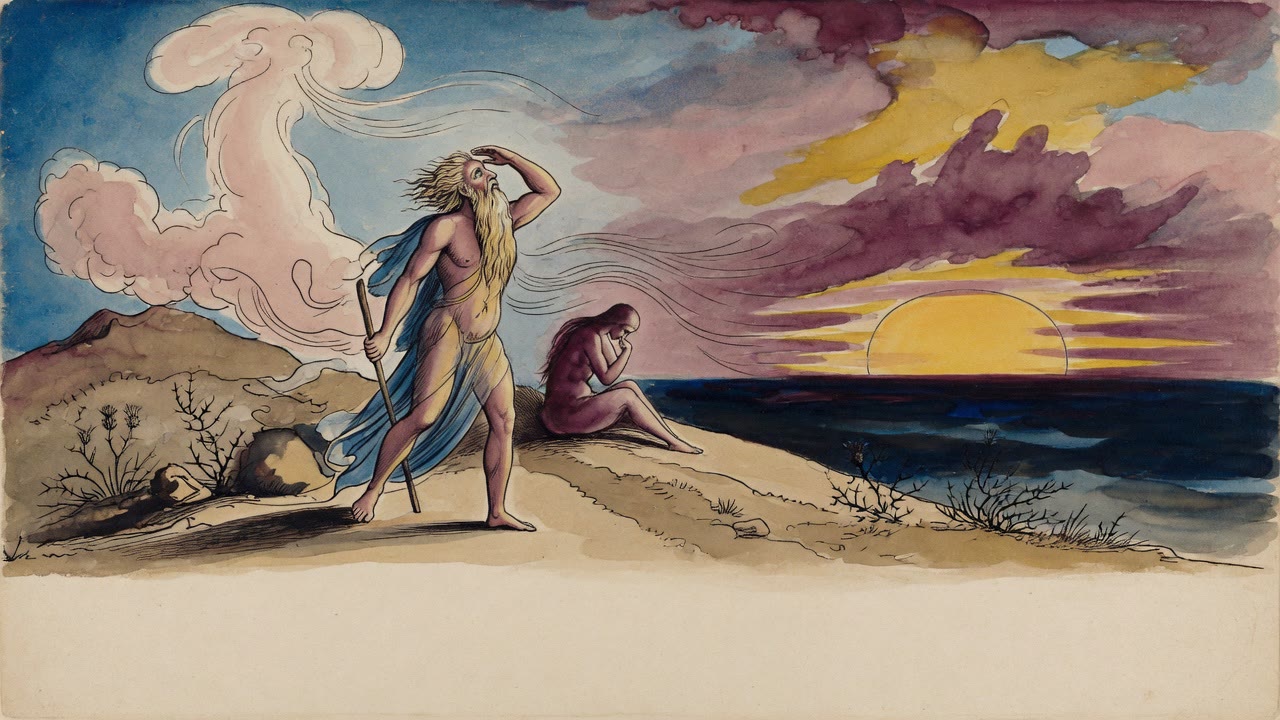
By the twelfth hour it was over. He was driven out. The gate closed behind a man who was less than one day old, and the ground outside was the same ground he had been scraped up from, except that now it would ask for sweat before it gave him anything.

Out by Sunset, and Not Destroyed

A second count of the same twelve hours ends differently, and both counts were kept. In that one he does not simply go out. He goes out acquitted, sentence served, alive.

God said to him that this would be a sign for his children. As you stood in judgment before me today and walked out of it alive, so your children will stand before me in judgment on this day of the year, and they will walk out alive too.

He had lived a whole life between one sunrise and one sunset. Dust, then a body with nothing in it, then a namer of animals, then a husband, then a father, then a defendant, then a man walking east.

Behind him the garden held its rivers and its trees and the one he had eaten from. In front of him was the field where his son would take his other son out to talk.


← All myths
From the tradition

Sources

2 sources

The texts behind this telling. Some cards carry a translation of the source; others are our own retelling of it, and each card says which. Every card links out to the original.

Targum Jonathan on Genesis 4:1Targum Jonathan

Retold in our words. Read the original at the link below.The Targum of Jonathan ben Uzziel, trans. J. W. Etheridge, London, 1862 · Public Domain

Adam knew Hava his wife, who had desired the Angel; and she conceived and bore Kain; and she said, "I have acquired a man, the Angel of the Lord."

The same Targum-style line as the conception of Cain. It does not clock twelve hours of Adam's first day.

Full source
Midrash Tehillim 12:4Midrash Tehillim

Retold in our words. Read the original at the link below.Rabbi Mike Feuer, Jerusalem Anthology · CC-BY

Midrash Tehillim, a collection of interpretations on the Book of Psalms, offers us a glimpse into that very question. Specifically, in Midrash Tehillim 12, we find a fascinating back-and-forth between two rabbis, Rabbi Yehuda and Rabbi Nechemia. They’re wrestling with verses about the fate of the righteous and the wicked. It’s a conversation that dives deep into justice, reward, and the ultimate meaning of our actions here on Earth.

Rabbi Yehuda starts us off. He sees the wicked circling the righteous in the afterlife. He draws on the prophet Isaiah (66:24), envisioning the righteous looking upon the "carcasses of the men that have transgressed" against God. In this vision, the righteous ones, having endured hardship, will finally give thanks for the trials they faced, because those trials led them to this moment of ultimate reward. As (Isaiah 12:1) says, "I will give thanks unto Thee, O LORD; for though Thou wast angry with me, Thine anger is turned away, and Thou comfortest me." Rabbi Yehuda connects this to the image of the vineyard in Psalms (80:15), seeing it as a symbol of the house of Israel, cultivated for the righteous.

Rabbi Nechemia isn't so sure about this interpretation. "How long will you interpret the verse in this manner?" he asks, challenging Rabbi Yehuda’s perspective. Instead, Rabbi Nechemia flips the image. He believes it's the wicked who will circle the righteous. He points to (Psalms 92:8), "When the wicked spring up as the grass, and when all the workers of iniquity do flourish; it is that they may be destroyed for ever." Imagine the wicked, having left Gehenna (hell), seeing the righteous basking in the glory of Gan Eden (paradise). The sight, he suggests, will diminish their very souls. He references (Psalms 112:10): "The wicked shall see it, and be vexed; he shall gnash with his teeth, and melt away."

But Rabbi Nechemia doesn’t stop there. He then paints a scene of divine reckoning. God, he says, will announce all the commandments that were belittled in this world. And that's when true shame will befall humanity. God will ask "Why were you persecuted for keeping the Sabbath? Why were you punished for eating matzah (unleavened bread)? Why were you killed for wearing tzitzit (ritual fringes)?" These are all central tenets of Jewish life.

And then comes the most poignant moment. The person will answer, quoting (Zechariah 13:6), "These are the wounds with which I was wounded in the house of my friends." But Rabbi Nechemia adds a crucial twist: "These wounds caused me to love my Father in Heaven." This is where the story becomes truly profound. It's not just about suffering; it's about finding love and devotion in the face of that suffering.

Rabbi Nechemia ends with a stark warning: "Woe to those who belittle the commandments in this world." This isn't just about following rules. It's about recognizing the profound connection between our actions and our relationship with the Divine. The Babylonian Talmud, Tractate Brachot 10a, also touches on the importance of not belittling the commandments, further emphasizing the weight of this teaching.

So, what do we take away from this ancient debate? Perhaps it's a reminder that our choices have consequences, not just in this world, but in whatever comes next. Maybe it's a call to find meaning and purpose in the midst of hardship. Or perhaps it's simply a reminder that even in the face of adversity, love and devotion can be a source of strength. It's up to each of us to decide.

Full source