5 min read

Adam Watched the Ladder of Worlds Stop Climbing

After the first bite, Adam felt the cosmic ladder of couplings freeze under his feet, and the worlds that had been climbing began to fall back into repair.

Curated by Arthur · Told by Maggid ·
Table of Contents
  1. What Coupling Was For
  2. Letters That Would Not Stay Whole
  3. The Soul That Would Be Passed
  4. Repair as Daily Weather

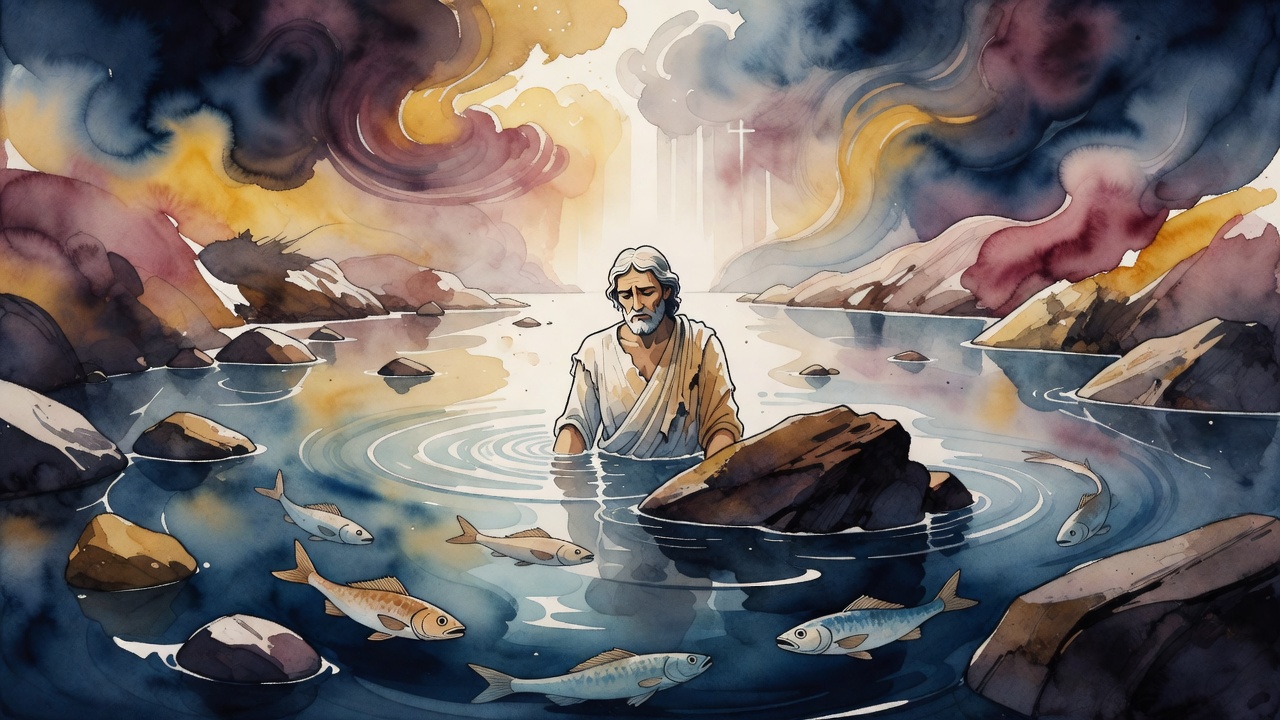
Adam still had juice on his chin when the ladder under the worlds stopped moving.

Adam Watched the Ladder of Worlds Stop Climbing Click for full size

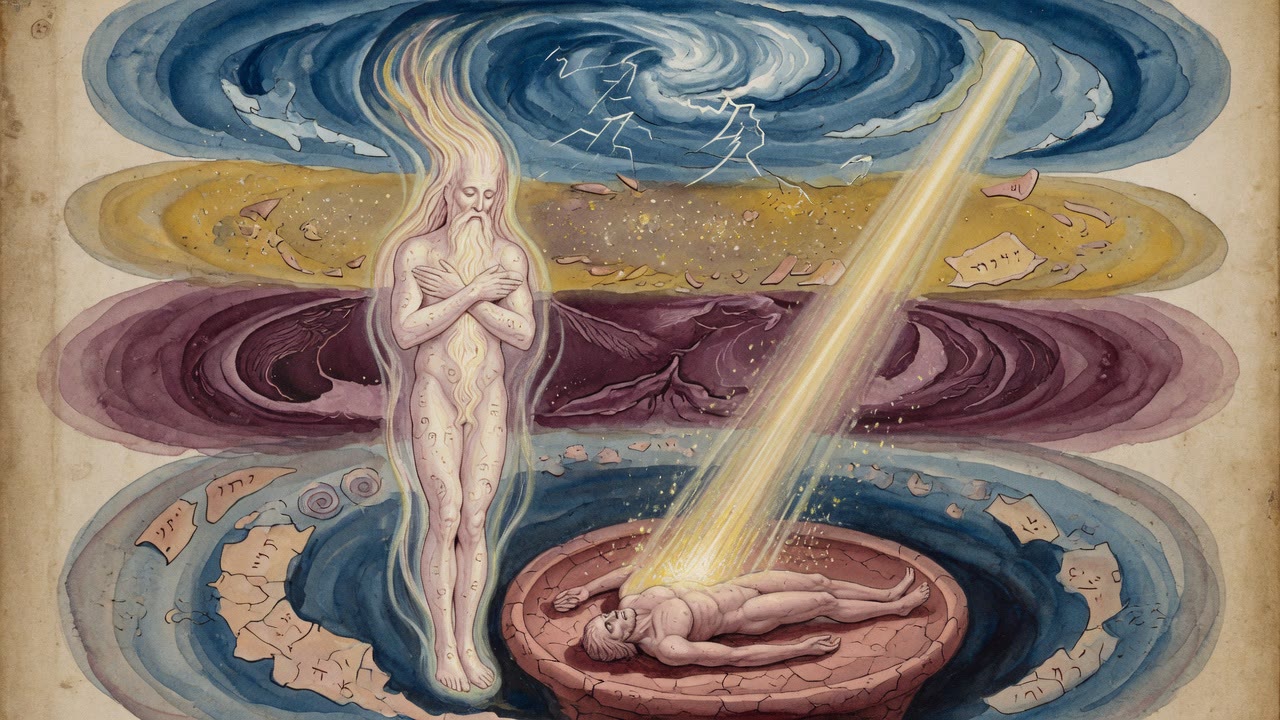
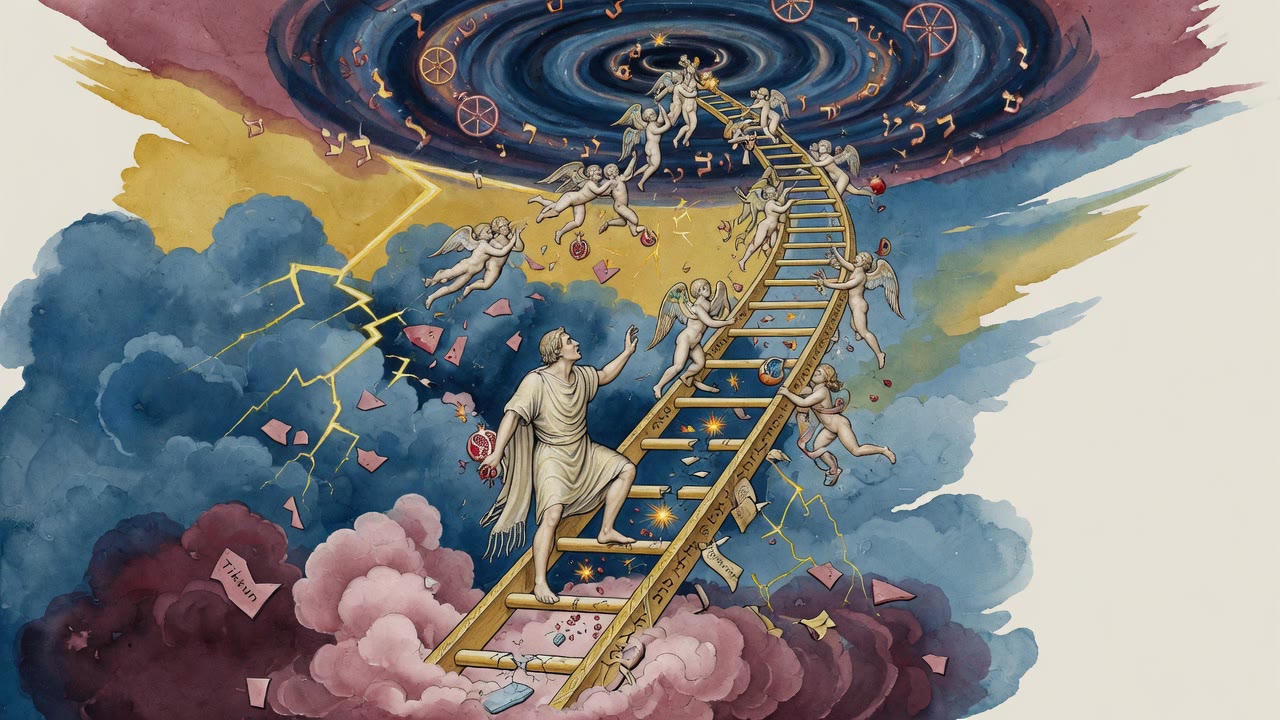
A moment earlier the rungs had been climbing. Light rose into light. Couplings of power met and made more light, and the whole structure of heaven and earth felt like a body drawing a long breath. Then his teeth closed. The fruit tore. The breath reversed.

He looked up. The ladder did not fall. It froze. Rungs that had been ascending hung mid-step, as if a dancer had been told to hold a pose forever. Below him the ground kept its green. Above him the chambers still shone. Between them, the perpetual ascent that had defined creation turned into a stalled spine.

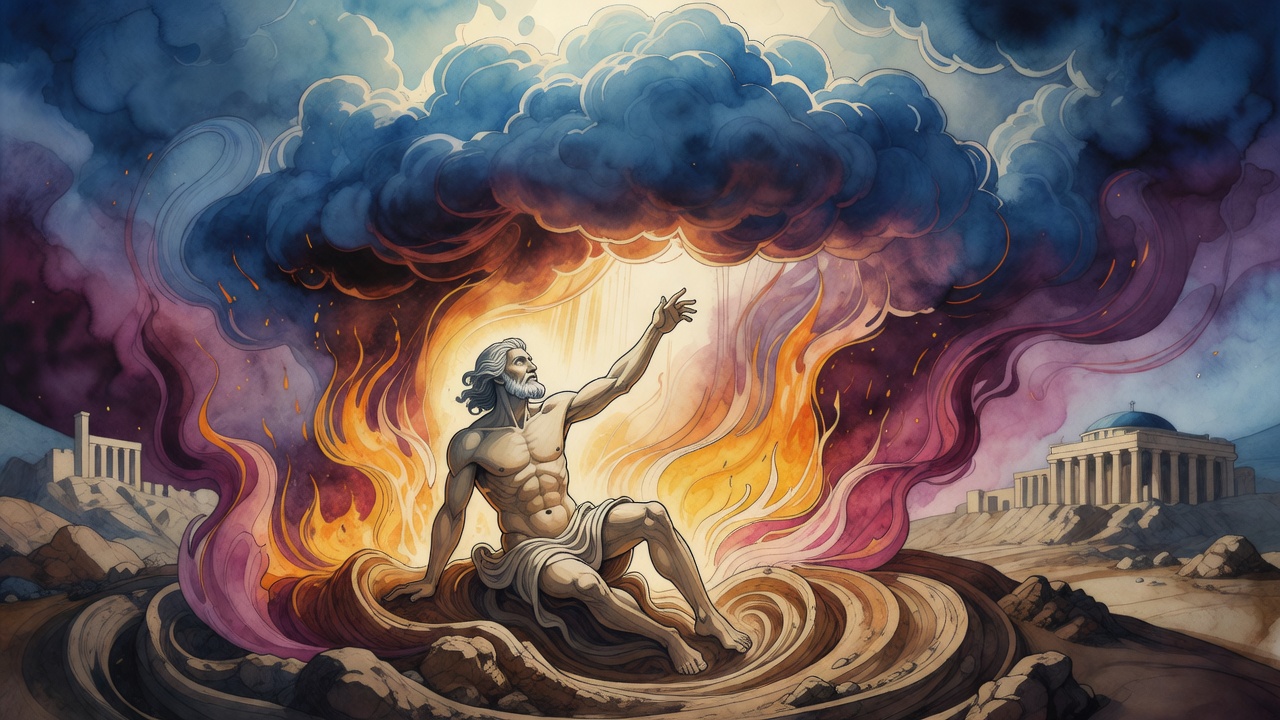
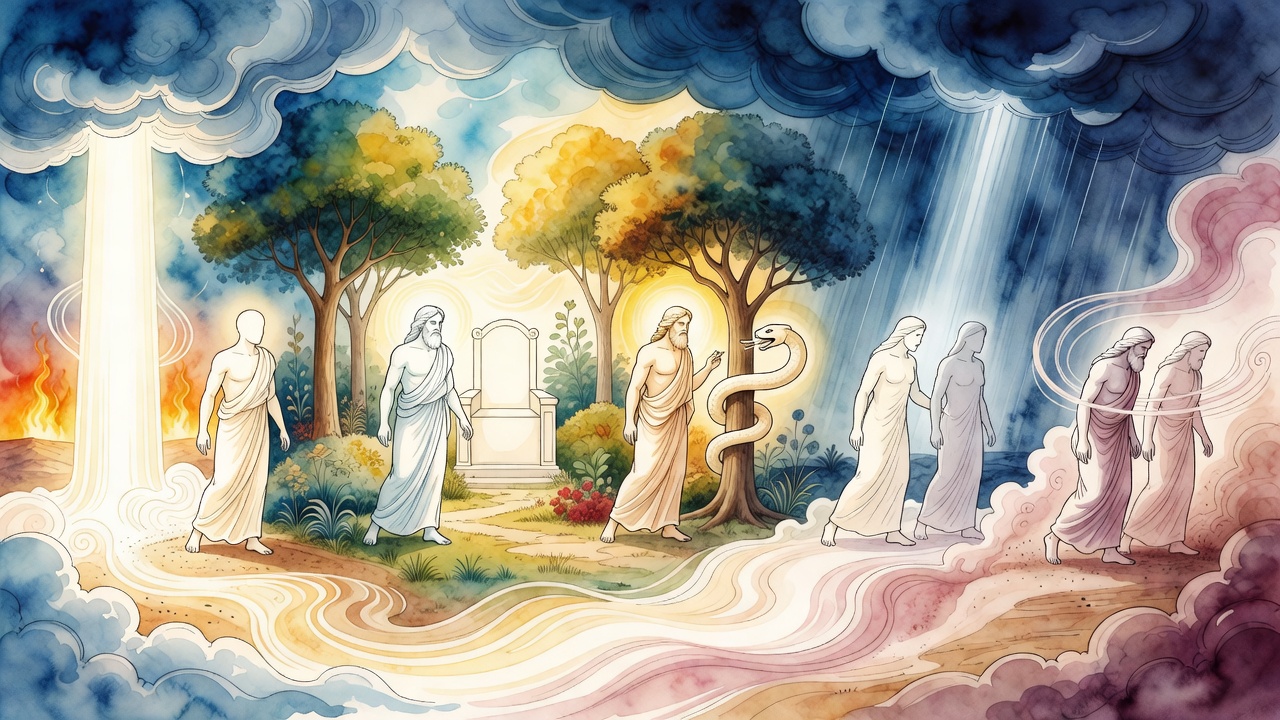
Eve said nothing. The serpent was already gone. Adam pressed both palms to the dirt and felt, for the first time, that dirt could be heavy.

What Coupling Was For

Before that bite, the worlds had not needed repair. Sacred unions of force, what the later sages would call zivug, had not been triage. They had been growth. Each joining lifted the ladder another span toward a height that had no ceiling. Attributes the worlds possessed stayed with them. Nothing had to be reclaimed because nothing had been lost.

Adam understood this the way a man understands his own pulse: without words. He had been set as the living measure of the structure. His name, later counted as forty-five, already answered the four wings of the chariot, lion and ox and eagle and the human face, the Merkavah that carries the Name through the upper rooms. He was not a tourist in Eden. He was part of the vehicle.

When he sinned, the vehicle did not crash. It lost continuous climb. Couplings that once raised new rungs now only patched broken ones. The same sacred motion remained, but its purpose bent. Repair replaced ascent. Restoration replaced novelty. The world began to spend its power mending what the first hand had torn.

Letters That Would Not Stay Whole

In the freeze Adam heard no sermon. He felt letters. The rock-of-ages Name that would one day be sung by prophets already pressed against his bones as three doubled pairs, as if heaven were trying to reassemble a number that had been his own. The four wings of the chariot still circled, but their circle felt like a guard around a wound rather than a procession of triumph.

He tried to stand as he had stood at noon, open and simple. His knees refused the old ease. Righteousness had not been removed from his design. Crookedness had been chosen, and choice left a scar the ladder could read. The worlds that had once climbed through him now climbed around the scar, carefully, as if afraid to touch it.

Eve watched his face change and asked if he was cold. He said he was counting something that would not finish counting.

The Soul That Would Be Passed

What left him that day was not only innocence. A portion of his soul, the part meant to complete the climb, tore free of the finished work and went into exile inside time. It would not vanish. It would wait for other bodies.

Ages later it would sit in David, who would sing and sin and take a census that killed, carrying the same unfinished letter-string: Adam, David, Mashiach, three names in one three-letter word. David would fail the climb again, not by fruit but by desire and by counting heads that heaven had not asked him to number. The soul would move once more, toward a messianic completion the first two bearers could not finish.

Adam did not know those names. He only felt the departure, like heat leaving a limb. He understood that repair would now be the work of centuries, and that his own breath was the first unfinished installment.

Repair as Daily Weather

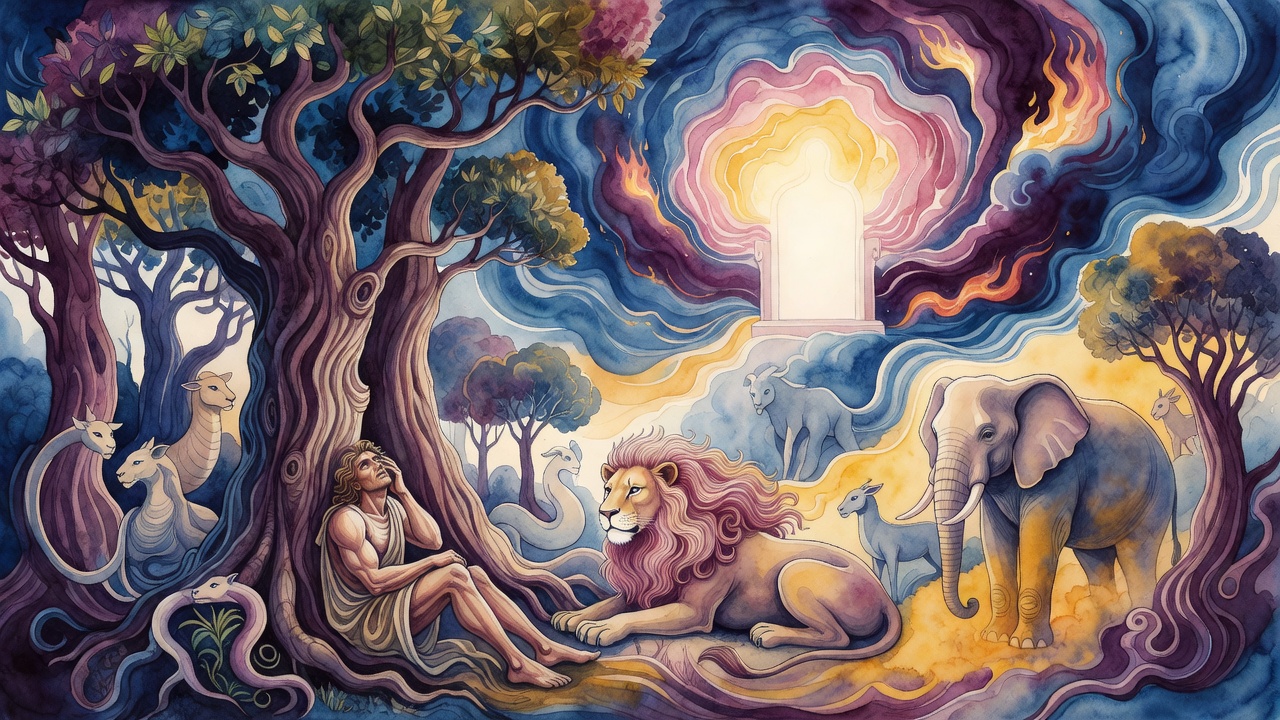
Evening came to Eden with a new grammar. Wind still moved. Animals still found their names in his mouth, but the names tasted of distance. When he reached for Eve, the joining of their bodies was still holy and still human, yet above them the cosmic couplings had changed job. They no longer raised the worlds for free. They paid down a debt.

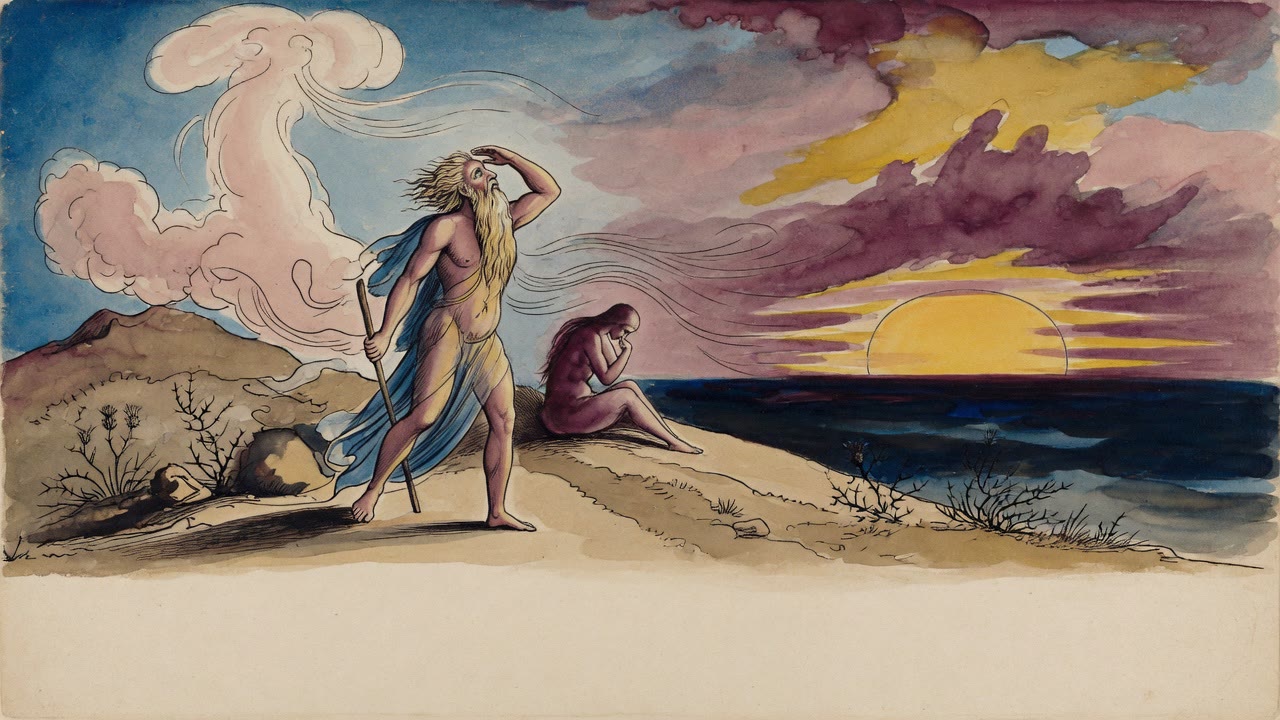
He walked to the edge of the garden while the gate was still a gate and not yet a sword. He looked back once. The ladder hung, immobile, bright as bone. He did not ask to be forgiven in a sentence. He asked, without words, whether anything would ever climb again without first kneeling to mend.

No voice answered him in the old easy way. A thinner voice, almost like a future psalm, said that tears would still open rooms when every other gate was shut. He did not yet know the prophet who would shout that line outside locked chambers. He only wiped his face and found it wet, and for a moment the freeze above him seemed to tick, one almost-rung, as if grief itself had become a mechanism of ascent.

Then the tick stopped. The ladder held. Adam left the green place carrying a soul that would outlive his grave and a knowledge that every later marriage of forces in heaven would labor first to restore what his mouth had cost the world.

Behind him, the four wings kept their circuit. Ahead of him, thorns already knew his name.


← All myths
From the tradition

Sources

3 sources

The texts behind this telling. Some cards carry a translation of the source; others are our own retelling of it, and each card says which. Every card links out to the original.

Kalach Pitchei Chokhmah 138:20Kalach Pitchei Chokhmah

Retold in our words. Read the original at the link below.138 Openings of Wisdom, trans. Rabbi Avraham Greenbaum, Azamra Institute (2005) · CC-BY

Jewish mystical thought, particularly within the Kabbalah, grapples with this very question. It speaks of a profound cosmic dance, a constant interplay of energies, and the tragic disruption caused by human failing.

Specifically, texts like Kalach Pitchei Chokhmah (Wisdom) describe a world in perpetual ascent. Imagine a ladder stretching infinitely upwards, each rung representing a higher level of spiritual understanding and connection. This ascent is fueled by what's called "Coupling" (Zivug in Hebrew). This isn’t just a romantic notion; it's a cosmic principle, a sacred union that generates new light and elevates all of creation.

The text suggests that if Adam hadn't sinned… if the original harmony hadn't been shattered… this Coupling would have been a seamless, uninterrupted climb towards ever-greater heights. The world would be in a state of continuous repair, constantly elevated through renewal!

But, as we know, that’s not the reality we inhabit. The text emphasizes that because of Adam's sin, and subsequent transgressions, the world is damaged. Attributes that the worlds once possessed have been lost. This damage necessitated repair.

So, what’s the purpose of Coupling now? According to Kalach Pitchei Chokhmah, our current Couplings serve primarily to restore what was lost due to sin. It's a cosmic effort to mend the broken pieces, to reclaim the levels that were forfeited. Only after this restoration is complete can we even begin to contemplate ascending to those unimaginable heights that would have been ours from the start.

The daily actions we take, the choices we make, all contribute to this ongoing process of restoration or, heaven forbid, further damage. Each mitzvah (good deed) is a brick in the rebuilding, each transgression… well, you get the idea.

This perspective reframes our understanding of spiritual practice. It's not just about personal enlightenment; it's about participating in a grand cosmic repair project, a tikkun (spiritual repair) olam (repairing the world) on the most profound scale imaginable.

Perhaps it's a call to greater awareness, a reminder that our actions have cosmic consequences. Or maybe, it’s an invitation to approach our own spiritual journeys with a renewed sense of purpose, knowing that we are not just striving for personal growth, but actively contributing to the restoration of a broken world, paving the way for that unimaginable ascent.

Full source
Tikkunei Zohar 102:14Tikkunei Zohar

Retold in our words. Read the original at the link below.Sefaria-hosted English translation · CC-BY

It all starts with a verse from Isaiah (26:4): "... YaQ YQV”Q the rock of ages..." Now, the Tikkunei (spiritual repair) Zohar isn't just interested in the plain meaning. It's after the spark hidden within the words themselves. It notices something remarkable: Y-Q, Y-Q, Y-Q. Then, it connects this to ADaM, the first human, whose numerical value, gematria, is 45.

What does it mean? That's where it gets interesting.

The text goes on: Four wings – lion, ox, eagle – representing the Divine Chariot, the Merkavah (the Divine Chariot). Intriguingly, this also relates to Y-H, Y-H, Y-H, which also equals ADaM, or 45. Think of it: these seemingly disparate images – the letters of God's name, the first human, the celestial chariot – all linked together through numerical value and mystical association. It's like the Kabbalists are saying: there’s a hidden unity underlying all of creation.

Then the text shifts slightly. We move to Y”Q YQV”Q. Y”Q YQV”Q. Y”Q. Then we have Y-H-V-H Y-H-V-H Y-H-V-H, the most holy name of God.

According to the Tikkunei Zohar, YQV”Q is above them all. It's connected to Ḥokhmah and Binah (Wisdom and Understanding), two of the Sefirot, the emanations of God's divine energy. And it points to Keter, the highest of the Sefirot. This then is linked to the verse in Exodus (3:14) where God says EQYeQ asher EQYeQ, "I will be that which I will be.” The names are stacked, one upon another, in an infinite hierarchy.

But it doesn't stop there. The text references (Isaiah 6:2), describing the Seraphim, angelic beings, standing above God, each with six wings. The Tikkunei Zohar sees this as a reference to A-V-G-Y-T-Tz, a powerful name of God formed from various verses.

Why six wings? The text gives us a fascinating interpretation. "With two it covers its face – for Israel, so that their enemies cannot see them." The angels are shielding the Jewish people from harm. "And with two it covers its feet – so that ‘the deed of the calf’ be not mentioned." This is a reference to the Golden Calf incident, a moment of profound betrayal in the desert. The angels are covering their feet, symbolically obscuring this shameful episode. The Midrash (rabbinic interpretive commentary) Tanhuma, Emor Ch. 16, also picks up on this idea.

"And with two it will fly – from exile." Even in the darkest of times, there is always hope for redemption, for a return to God. It is then said in (Exodus 19:4), "… and I raised you upon eagles’ wings, and I brought you to Me."

What does it all mean? It's a multilayered exploration of God's name, the creation of humanity, and the ongoing relationship between the Divine and the world. It’s a reminder that even in moments of darkness, even when we feel hidden or ashamed, there is always the possibility of being carried, like eagles, towards something greater. It's a complex, poetic, and ultimately hopeful vision of the universe. A reminder that even the smallest details can hold profound meaning, if we know how to look.

Full source
Nishmat Chaim, fol. 152Hebraic Literature (1901)

Retold in our words. Read the original at the link below.Project Gutenberg eBook #14368, Hebraic Literature · PD-US-pre-1929

The Kabbalists, the sages of truth, as the tradition calls them, noticed something about the Hebrew letters of Adam.

The word אדם spells three names. Aleph for Adam. Dalet for David. Mem for Mashiach, the Messiah. The letters of the first human contained, in miniature, the arc of every human soul.

The Nishmat Chaim of Rabbi Menasseh ben Israel (first published 1652 CE in Amsterdam) explains the legend behind the letters. When Adam sinned in Eden, his soul did not vanish. It was passed on. It entered David, who was born to bear it forward. David himself sinned, with Bathsheba, with the census. And the soul that had failed in Eden failed again in Jerusalem. So it was sent forward once more, to the Messiah, who would redeem what the first two could not complete.

The Kabbalists pointed to the prophets for confirmation. Jeremiah writes: they shall serve the Lord their God, and David their king, whom I will raise up to them (Jeremiah 30:9). Ezekiel repeats: my servant David shall be their king for ever (Ezekiel 37:25). Hosea adds: they shall seek the Lord their God, and David their king (Hosea 3:5).

The prophets keep promising a David who is also still coming. The Kabbalists read these verses not as doublets but as a single soul making its third attempt.

Adam's fall. David's fall. The Messiah's rise. Three lives, one unbroken thread of repair.

Full source