5 min read

Bar Kappara Laughed the Wedding Tables Open

At Rabbi Judah's son's feast, Bar Kappara told riddles until wine spilled by the barrel. He said he was teaching Torah through joy.

Curated by Arthur · Told by Maggid ·
Table of Contents
  1. The Guest Who Would Not Sit Quiet
  2. What Laughter Is Allowed to Carry
  3. Unseen Seen, Mute Speaking
  4. Rabban Gamliel on the Road
  5. The Floor After the Feast
Bar Kappara Laughed the Wedding Tables Open Click for full size

The Guest Who Would Not Sit Quiet

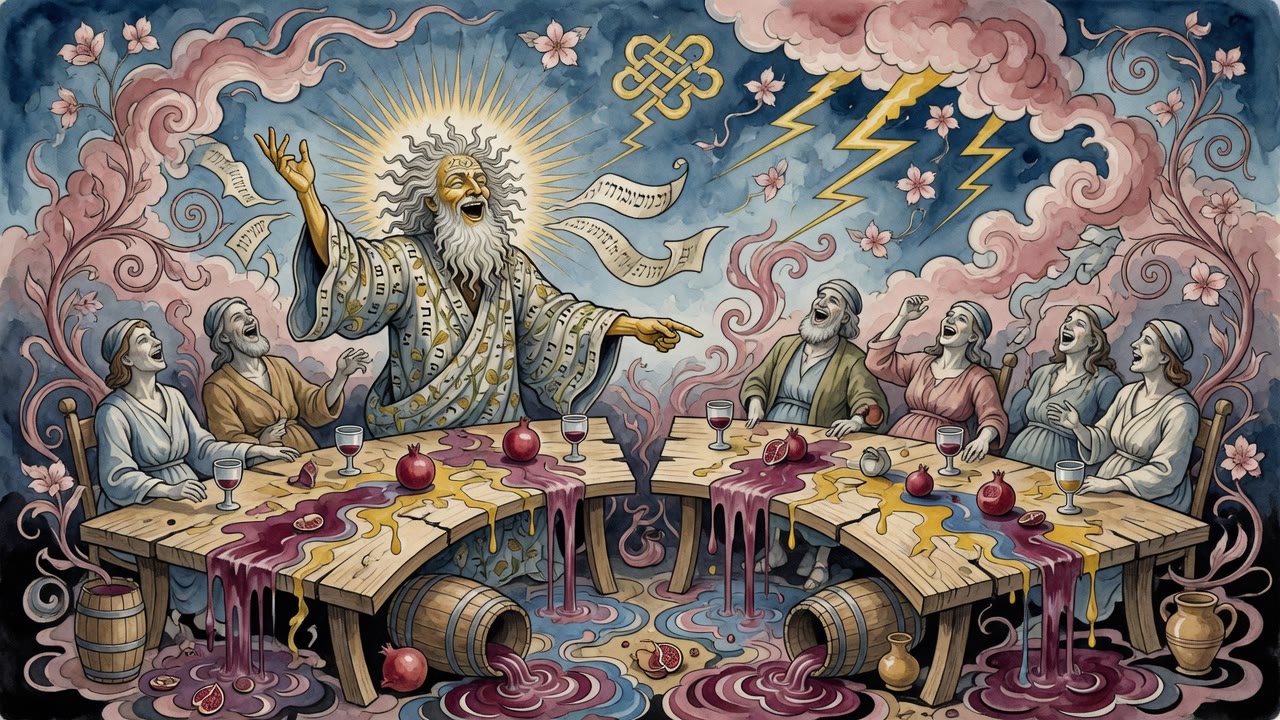
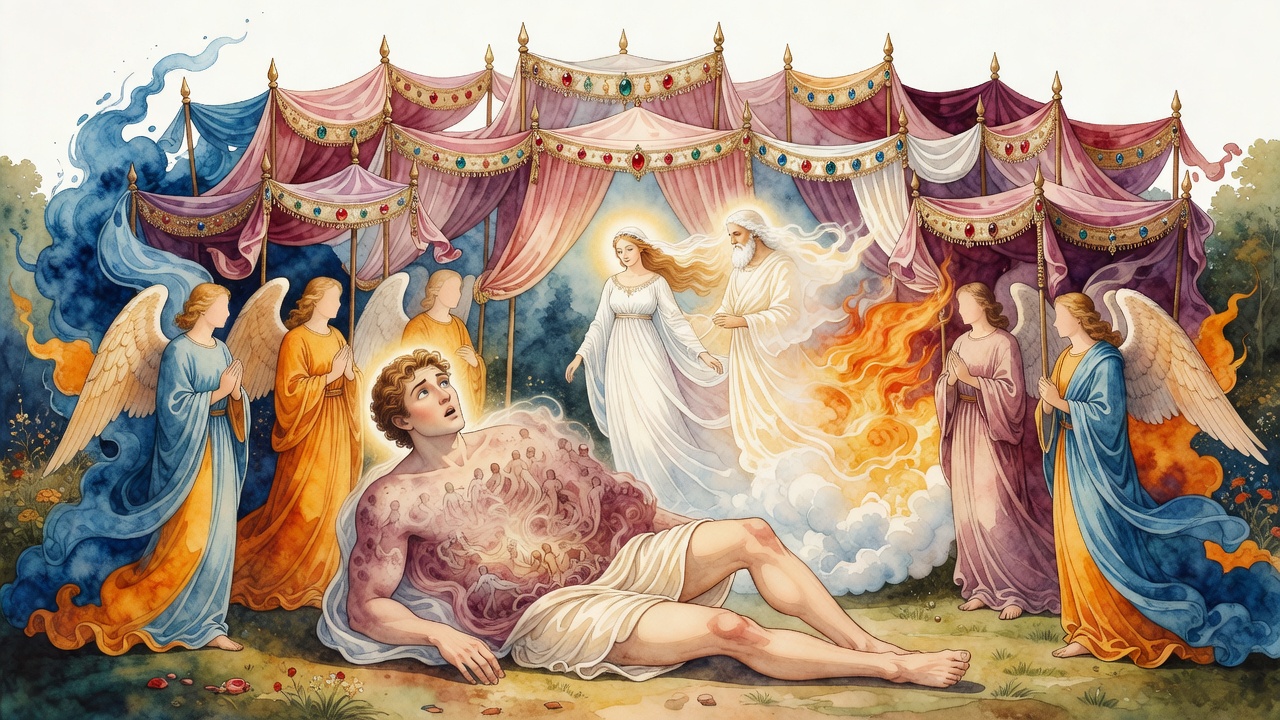
Bar Kappara arrived at the wedding feast of Rabbi Judah HaNasi's son with learning in his bones and mischief already loaded on his tongue. Courses came out. Wine went around. He answered each pour with a parable or a riddle sharp enough to split dignity without breaking it. Guests laughed until they could not hold their cups. Wine ran. The count later said three hundred barrels' worth had been wasted on joy.

Rabbi Judah's wife was not amused. Expense has a voice at a wedding, and hers said this man was making a mockery of their son's night. Rabbi Judah asked why the uproar. Bar Kappara answered without apology. He was teaching Torah through laughter. Inside every joke sat a real ruling or a real fear or a real comfort. Some tables only open when the brow unfurrows.

What Laughter Is Allowed to Carry

The sages kept the story because it refuses a false split between solemnity and wisdom. Not every teaching needs a furrowed brow. A lesson that makes people laugh is a lesson they will carry out the door. Bar Kappara was not a clown hired to insult the Nasi's house. He was a scholar who knew that joy is also a vessel, and that a wedding is already half a sermon about covenant if anyone has ears left after the music.

Still, the spilled wine is not nothing. Joy that costs another person's property without care is not pure. The tale holds both edges. Teach through delight. Do not pretend delight is free of responsibility. The same man who could open mouths with riddles could also be asked why the floor was sticky with someone else's vintage.

Unseen Seen, Mute Speaking

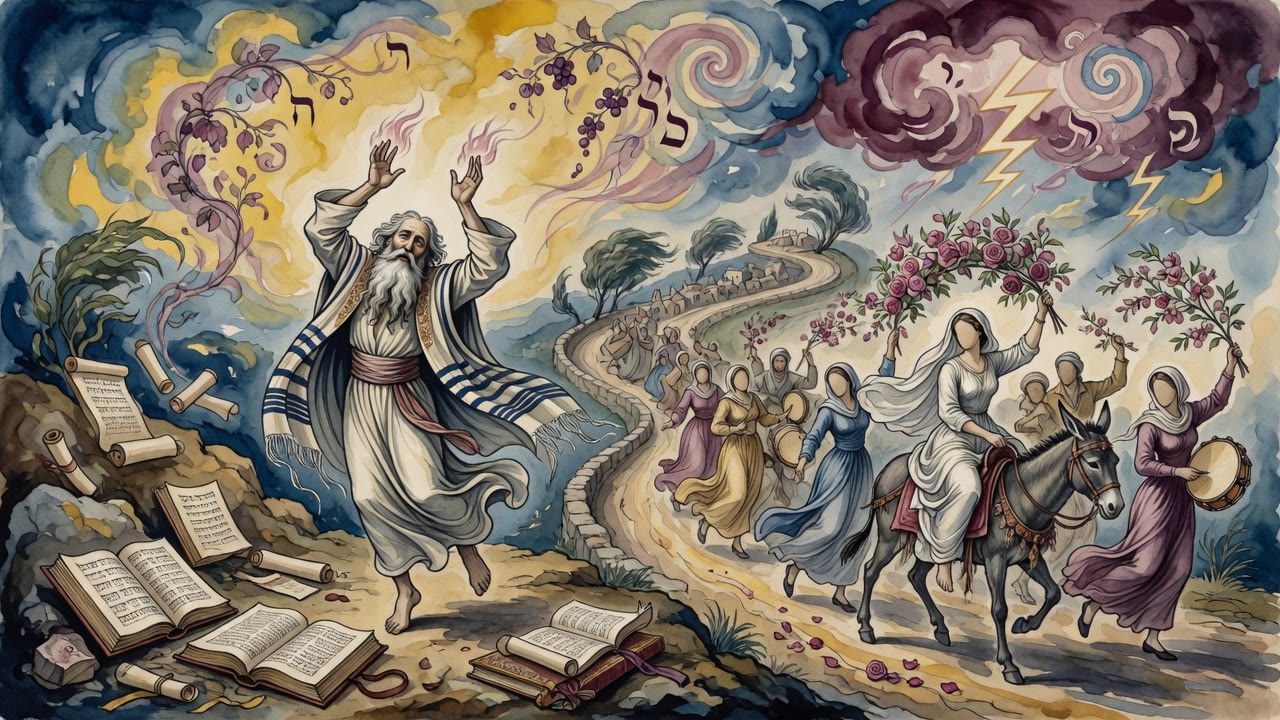
Elsewhere Bar Kappara taught that the Holy One overturns the fixed orders of nature. At Sinai, "all the people saw the voices" (Exodus 20:15). Voices are for ears, yet Israel beheld them. At Shechem, Joshua set up a stone and said it had heard the words of the Lord (Joshua 24:27). A mute rock became a witness. On the road, the Lord opened the mouth of Balaam's donkey, and a speechless beast rebuked its master (Numbers 22:28). Nothing is too silent, too deaf, or too senseless for God to bend toward purpose.

Read that teaching back into the wedding and the spilled cups change key. A room full of scholars can become deaf to Torah if the only allowed tone is severity. Bar Kappara forced speech out of a feast that might have stayed polite and empty. He made a deaf party hear. He made a mute celebration say something true. Whether every barrel needed to fall is a separate question. The claim underneath stands. God is not limited to the channels we approve in advance.

Rabban Gamliel on the Road

Vayikra Rabbah sends another master down a different road. Rabban Gamliel travels from Akko to Keziv with Tavi ahead and Rabbi Ilai behind. They find a loaf on the path near a gentile. Gamliel tells the man, calling him by name, to take the bread. Rabbi Ilai later learns the man had never greeted the Nasi, yet the name was right. Ruach hakodesh, a holy spirit of insight, can ride even a travel day. Then in Keziv, after food and drink, a man asks to have a vow dissolved. Gamliel asks whether he has drunk a quarter-log of Italian wine. When the answer is yes, he will not rule until the wine's weight lifts. Laughter and wine are not the same, but both alter a room. One sage uses joy to teach. Another refuses to teach while joy's cousin, drink, still clouds the bench.

Between Bar Kappara and Gamliel the tradition draws a sober line through celebration. Joy may open Torah. Wine may close judgment. Know which office you hold in the hour you hold it.

The Floor After the Feast

When the last riddle ended, the house still smelled of grapes and heat. Rabbi Judah's household had a mess to clean and a story that would outlive the stain. Bar Kappara left behind a claim the later books would not throw away. Torah can enter through the widest smile. It can also demand, on another day, that a judge wait until his head is clear. The Holy One who makes stones hear and donkeys speak can use a wedding guest's wit. He can also ask that wit to remember other people's barrels.

So the feast stands in memory as a quarrel worth keeping. A mother counts cost. A scholar counts souls reached. A Nasi stands between them. And somewhere offstage, Sinai still hums with voices that were seen, proving that the ordinary rules of sense are not the outer wall of revelation.


← All myths
From the tradition

Sources

3 sources

The texts behind this telling. Some cards carry a translation of the source; others are our own retelling of it, and each card says which. Every card links out to the original.

Exempla of the Rabbis, No. 212Exempla of the Rabbis (Gaster, 1924)

Retold in our words. Read the original at the link below.The Exempla of the Rabbis, Moses Gaster (1924) · Public Domain

Bar Kappara was known for his wit, his learning, and his ability to make even the most solemn occasions lively. The Talmud (Nedarim 50b-51a) records what happened when he was invited as a guest to the wedding feast of Rabbi Judah HaNasi's son.

Bar Kappara arrived and immediately began telling humorous parables and riddles. He was so entertaining that the other guests were helpless with laughter. Every time a new course of wine was served, Bar Kappara launched into another story, and the guests laughed so hard that the wine spilled.

Rabbi Judah's wife was not amused. The wine was expensive, and Bar Kappara's comedy was causing it to be wasted, three hundred barrels' worth, according to one account. She complained to her husband: "This man is making a mockery of your son's wedding!"

Rabbi Judah spoke to Bar Kappara: "Why do you cause such uproar?" Bar Kappara answered: "I am teaching Torah through laughter." And, embedded in every joke and every riddle was a genuine teaching. He was not wasting the evening, he was using the only method some guests would actually absorb: humor.

The sages preserved this story as a lesson about the relationship between joy and wisdom. Not all teaching must be solemn. Not all Torah must be delivered with furrowed brows. Sometimes the deepest truths enter through the widest smiles. Bar Kappara understood what many scholars forget: a lesson that makes people laugh is a lesson they will never forget.

Full source
Midrash Shmuel 9:4Midrash Shmuel

Translation of the source text.Midrash Shmuel, Krakow 1893, Public Domain, on Sefaria · CC-BY-SA

Bar Kappara said: The Holy One, blessed be He, made that which is not seen seen, and that which does not hear hear, and that which does not speak speak.

That which is not seen [was made] seen, from where [do we know this]? "And all the people saw the voices and the torches" (Exodus 20:15).

That which does not hear [was made to] hear, from where [do we know this]? "Behold, this stone shall be a witness against us, for it has heard all the words of the LORD" (Joshua 24:27).

And that which does not speak [was made to] speak, from where [do we know this]? "And the LORD opened the mouth of the donkey," etc. (Numbers 22:28).

Full source
Vayikra Rabbah 37:3Vayikra Rabbah

Retold in our words. Read the original at the link below.The Sefaria Midrash Rabbah, 2022 · CC-BY

Our story begins with a loaf of bread on the road, and it takes us on a journey filled with divine insight, legal intricacies, and a little bit of wine!

The tale, found in Vayikra Rabbah 37, follows Rabban Gamliel as he travels from Akko to Keziv. His servant, Tavi, walks ahead, and Rabbi Ilai follows behind. They encounter a loaf of bread lying on the road, near a non-Jew. Rabban Gamliel instructs the gentile, "Mabegai, take the loaf."

Rabbi Ilai, curious, asks the man his name. "Mabegai," he replies. Rabbi Ilai presses further: "Have you ever greeted Rabban Gamliel?" The answer is no. "Where are you from?" "From these towns of huts."

From this brief encounter, we learn several things. First, that leavened bread – chametz – belonging to a gentile is permitted after Passover. Second, that Rabban Gamliel, through a touch of ruach (spirit) hakodesh, a divine spirit, knew the gentile's name was Mabegai. And third, a lesson in basic respect: one shouldn't simply pass by food left on the ground. the prevailing thought was that you should pick it up.

However, Rabbi Yaakov bar Zavdi, in the name of Rabbi Abbahu, adds a layer of caution: initially, yes, one should pick up the food. But in their time, one might pass it by due to concerns about sorcery. Someone might have intentionally left it there with harmful intentions for whoever picked it up.

The group then arrives in Keziv. After eating and drinking, a man approaches Rabban Gamliel, seeking to have a vow dissolved. Rabban Gamliel turns to Rabbi Ilai, asking, "Do you think I drank a quarter-log of Italian wine?" A log being a liquid measure in Jewish law. Rabbi Ilai confirms he did. Rabban Gamliel then tells the man, "Stroll with us until the effects of my wine wear off."

They walk until they reach the Promontory of Tyre. There, Rabban Gamliel dismounts his donkey, wraps himself in his tallit (prayer shawl), and sits down. This moment teaches us several things: that a quarter-log of wine can indeed cause drunkenness, that a journey can help sober one up, and, crucially, that one shouldn't issue a halakhic (legal) ruling while intoxicated.

And from Rabban Gamliel's actions, we further learn that one cannot dissolve a vow while intoxicated, while riding, or while standing. It must be done while seated and properly attired in a prayer shawl. The setting matters; sobriety and respect are essential for such serious matters.

So, what "opening" – what legal loophole, if you will – did Rabban Gamliel suggest to the man seeking to dissolve his vow? In the laws of vows, an "opening" refers to an unforeseen negative consequence of the vow, one that wasn't realized at the time it was made. The existence of such a consequence can provide grounds for annulling the vow.

Rabbi Yochanan offers an interpretation, drawing on (Proverbs 12:18): "There is one who expresses like stabbings of a sword, but the tongue of the wise is a cure." He explains that one who carelessly makes vows deserves to be "stabbed with a sword" – metaphorically speaking, of course! The remedy? To seek out wise sages who can dissolve the vow. Rabban Gamliel, it's suggested, was probing whether the man understood the gravity of making vows. If he didn't, Rabban Gamliel would be willing to annul it. This emphasizes the importance of understanding what you're committing to, as echoed in Moses' caution to Israel: "If a man articulates a vow." The text equates vows with valuations, implying we should exercise similar caution with both.

This story, seemingly simple on the surface, reveals layers of wisdom about Jewish law, human nature, and the importance of acting with awareness and intention.

Full source