6 min read

A Snake Bit the Groom in the Wedding Attic

In Kavul a father sent his son for wine mid-feast. The attic held a snake. Guests finished the meal, then changed wedding blessings into burial.

Curated by Arthur · Told by Maggid ·
Table of Contents
  1. Wine from the Upper Room
  2. The Father Who Waited
  3. When Tranquility Asks Too Much
  4. Leaders and the Chain of Shame
  5. What the Guests Carried Home
A Snake Bit the Groom in the Wedding Attic Click for full size

Wine from the Upper Room

The wedding in Kavul filled the house with noise fit for a Wednesday night, the day the old law favored for bringing a bride under the canopy. A leading man of the town was marrying off his son. Cups moved. Meat was cut. Guests blessed the pair with the bright formulas of joy. The bride's face was covered. The groom's friends stamped the floor in time with a song that had already survived three wars and two famines. Outside, the street smelled of oil lamps and dust cooling after heat.

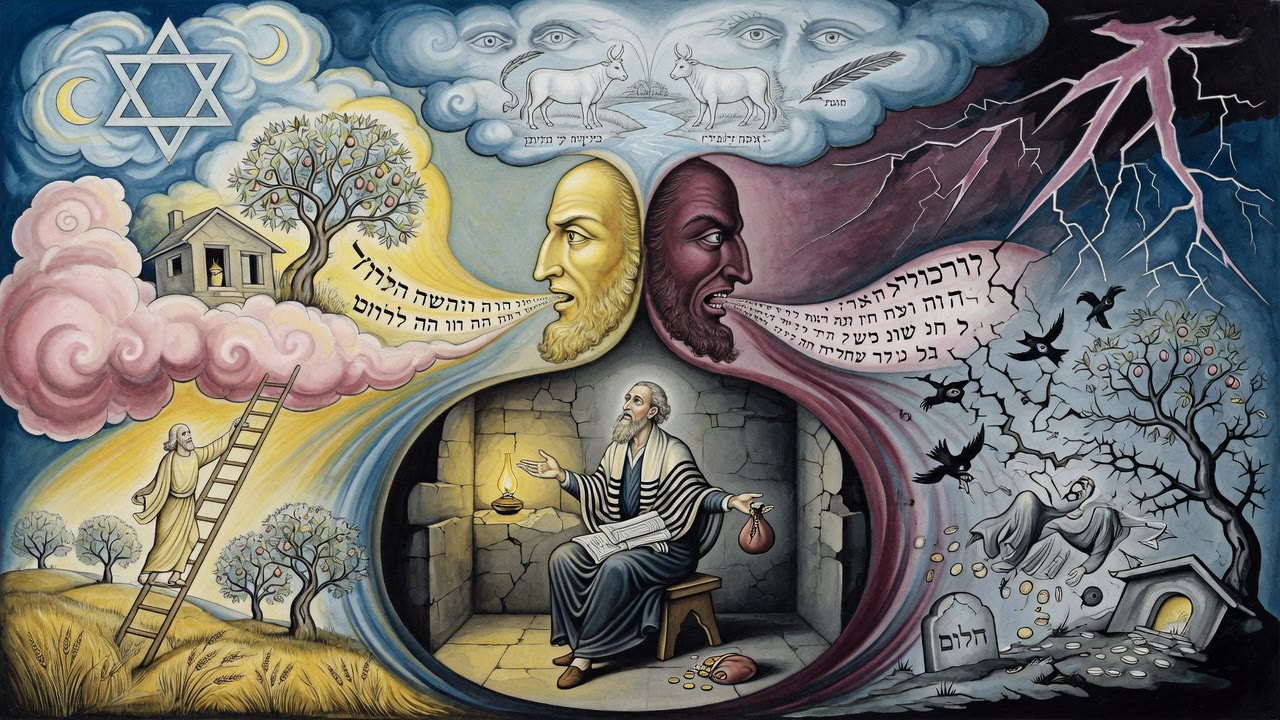
The father, proud enough to shine, sent the groom upstairs for a barrel of wine. A simple errand. The son climbed the narrow steps with a joke still unfinished on his lips. In the attic, among the stored vessels, a snake struck. He died at once. No cry carried down through the boards. The feast below did not know. Laughter kept its shape for a little longer, the way a house keeps heat after the fire is out.

The Father Who Waited

The father waited for the sound of feet. He waited for the scrape of wood on wood. When neither came, he climbed himself. He found his son among the barrels, still, the wine unopened, the snake already gone into the dark between the beams. He did not scream down the stairs. He closed the boy's eyes with two fingers, wiped his hand on his robe, and went back to the table. He let the guests finish what they had come to do. Bread still broke. Someone still told a joke that landed wrong and no one noticed why.

Only then did he stand and speak. "My masters," he said, "did you not come to recite the blessing of the bridegrooms for my son? Recite over him the blessing of the mourners. Did you not come to bring my son into his wedding canopy? Come and bring him into his grave." The room changed temperature. Rabbi Zakkai of Kavul later set the scene under the verse, of laughter I said it is confounded, and of joy, what does it accomplish (Ecclesiastes 2:2). Joy mixed with mourning is joy diluted, like silver turned to dross. The word for confounded is the word for mixed, for watered wine, for a festival that has already begun to taste of ash.

When Tranquility Asks Too Much

Jacob once sought a quiet stretch of years after the long roads of Esau and Laban. The Accuser, in the sages' telling, objected before the throne. Why should the righteous take ease in this world when the World to Come already holds their reward? Turmoil arrived as Joseph vanished into Egypt, a coat torn, a father who would not be comforted. Jacob's life is read against Job's line: I was not tranquil, was not silent, and I did not rest, but turmoil came (Job 3:26). Not tranquil from Esau. Not silent from Laban. No rest from Dinah's wound. Then the last turmoil of the missing son.

The wedding house in Kavul is a smaller map of the same law. A father asked one clean night of honor. Heaven did not owe him that night. The guests had come for canopy blessings and left as a burial party. Honor can turn in a single climb of stairs. The midrash does not say the father sinned by wanting joy. It says joy is not a wall. It is a table that can be cleared for a different meal without anyone's permission.

Leaders and the Chain of Shame

Elsewhere the sages watch honor reverse for another reason. As they increased, so they sinned, and honor became shame (Hosea 4:7). When a leader bends a rule, the head of court softens, the judges soften, and the people stop forbidding what was once forbidden. A man goes to complain of a stolen garment and finds it spread on the judge's bed. A kettle taken from a neighbor sits on a stove that should have been clean. Increase of power, land, silver, even children, can amplify the capacity for wrong until the blessing itself becomes the trap.

In Kavul the shame was not corruption. It was timing. The house had been loud with increase, full tables, fine wine, a son under the canopy, and then the upper room answered with a fang. The town learned that joy is not a fortress. It is a lamp that can be knocked over while people are still singing. Leaders who rot from above teach one lesson. An attic that kills without warning teaches another. Both leave a room that must change its words mid-sentence.

What the Guests Carried Home

They finished the meal because the father asked them to. Then they changed their mouths. Bridegroom formulas became mourners' formulas. The canopy route became the grave path. No one argued theology at the door. The body was enough. Women who had come with sweets for the bride stood with empty hands. Men who had come to dance walked behind a bier.

The confounded laughter of Ecclesiastes is not a ban on feasts. It is the memory that a barrel of wine can wait one room above a celebration and hold a snake. Jacob's restlessness and Kavul's wedding share one hard mercy: the story does not pretend the righteous buy quiet with merit alone. Sometimes the only strength left is to stand before guests and tell the truth of the attic before the cups go cold. Kavul slept badly that week. The midrash kept the father's sentence so later rooms would know how fast a blessing can be rewritten.


← All myths

From the tradition

Sources

3 sources

The texts behind this telling. Some cards carry a translation of the source; others are our own retelling of it, and each card says which. Every card links out to the original.

Vayikra Rabbah 20:3Vayikra Rabbah

Retold in our words. Read the original at the link below.The Sefaria Midrash Rabbah, 2022 · CC-BY

Like you're celebrating a joyous occasion, and then...bam! Tragedy strikes.

Rabbi Abba bar Kahana opens with a question that really hits home: “Of laughter, I said it is confounded, [and of joy, what does it accomplish?]” (Ecclesiastes 2:2). He's getting at something deep here. If laughter is all mixed up with mourning, what good is joy? What good is it if it can be snatched away in an instant? The word meholal, which is translated as "confounded," really means mixed or diluted, like we see in (Isaiah 1:22). It's like your happiness is tainted. To illustrate this, the Midrash (rabbinic interpretive commentary) brings us a story from Kavul. It's a wedding. A joyous occasion. One of the prominent leaders of Kavul is marrying off his son. This wasn't just any celebration; weddings were a big deal, traditionally held on Wednesdays (as we see in Mishna Ketubot 1:1), a day deemed especially auspicious. He invites all his guests, they’re eating, drinking, making merry. The father, beaming with pride, asks his son to go up to the attic and bring down a barrel of wine.

Simple enough. The son goes up to the attic… and is bitten by a snake. He dies instantly. The father waits, growing impatient. Where is his son? He goes up to check and finds him lying there, lifeless, among the barrels.

But he doesn't immediately break down in front of his guests. He waits. He lets them finish their feast. Then, with a heavy heart, he addresses them. “My masters,” he says, his voice probably thick with grief, “did you not come to recite the blessing of the bridegrooms for my son? Recite over him the blessing of the mourners. Did you not come to bring my son into his wedding canopy? Come and bring him into his grave.”

Rabbi Zakkai of Kavul concludes with the same haunting words: “Of laughter, I said it is confounded.”

How easily joy can turn to sorrow. How even in our happiest moments, there's always a shadow lurking. It's not about avoiding joy, of course. It's about acknowledging the complexity of existence, the bittersweet dance between laughter and tears. This story invites us to consider the nature of happiness, the ever-present possibility of tragedy, and how we find meaning even when life seems to be at its most unfair.

Full source
Bereshit Rabbah 84:3Bereshit Rabbah

Retold in our words. Read the original at the link below.The Sefaria Midrash Rabbah, 2022 · CC-BY

Antoninos, a Roman emperor known for his dialogues with Rabbi Yehuda HaNasi (the compiler of the Mishnah (the earliest code of rabbinic law)), poses a question about this verse.

Rabbi Yehuda responds with a rather intriguing hypothetical situation. Imagine, he says, a person sentenced to one hundred lashes. Now Sounds like a fair trade. But Rabbi Yehuda explains the inherent injustice: if the person is strong enough to withstand all the lashes and collect the money, then the punishment becomes a mockery. It's all about the money, not about justice or atonement. But if the person can’t endure the pain and dies, then they suffer for nothing, gaining neither the dinarim nor any sense of justice. This, says Rabbi Yehuda, is a form of mocking "the undoing of the innocent."

The interpretation doesn't stop there. Rav Aḥa adds another layer, suggesting that even the pursuit of tranquility by the righteous can attract unwanted attention. He argues that when righteous people seek to live peacefully in this world, the satan – the accuser – steps in. The accuser questions whether the reward awaiting them in the World to Come isn't enough. Why, the accuser asks, do they also need peace and comfort in this world?

To illustrate this point, Rav Aḥa brings up the story of Jacob, our patriarch. Because Jacob sought tranquility, he was confronted with the ordeal of Joseph's disappearance. As The familiar version gives us, Jacob’s favorite son, Joseph, was sold into slavery in Egypt, causing Jacob immense grief.

The passage then quotes Jacob himself from the Book of Job: "I was not tranquil, was not silent, and I did not rest, but turmoil came" (Job 3:26). The rabbis interpret each phrase as referring to different periods of suffering in Jacob's life. "I was not tranquil" – from Esau, his twin brother. "Was not silent" – from Laban, his deceitful father-in-law. "And I did not rest" – from Dina, his daughter, and the tragedy that befell her. And finally, "But turmoil came" – the ultimate turmoil of Joseph's disappearance.

It's a complex and perhaps challenging idea. Are we to believe that seeking peace and comfort is somehow wrong, or that it invites divine scrutiny? Perhaps the message is more nuanced. Maybe it's a reminder that life is inherently filled with challenges, and even the most righteous among us are not immune to suffering. It could also be a commentary on the importance of perspective; that true tranquility comes not from the absence of hardship, but from how we navigate it.

The rabbis are not saying we shouldn't strive for peace. But perhaps they are reminding us that true righteousness isn't just about avoiding hardship; it's about how we respond to it, and how we maintain our faith and integrity even in the face of turmoil. It's a reminder that even in our moments of apparent tranquility, we should remain vigilant and compassionate, aware of the suffering in the world and ready to act with kindness and justice. Because, ultimately, it's not about avoiding the lashes, but about how we endure them, and what we learn from the experience.

Full source
Devarim Rabbah 2:19Devarim Rabbah

Retold in our words. Read the original at the link below.The Sefaria Midrash Rabbah, 2022 · CC-BY

The book of Devarim Rabbah, a collection of rabbinic teachings on the book of Deuteronomy, tackles this very question, and the answers might surprise you.

It all starts with a verse from Hosea (4:7): “As they increased, so they sinned against Me; I will change their honor into shame.” But what does "as they increased" really mean?

Rabbi Shmuel bar Naḥmani offers a powerful interpretation: It's about leadership. "Everything that the prominent individuals perform," he says, "the generation performs." He reads the Hebrew word for "increased" (kerubam) as connected to "leader" (kerabam). It’s like saying, “like their leader, so goes the people.”: If the Nasi, the leader, bends the rules, what message does that send?

Devarim Rabbah illustrates this with a stark example. Imagine the Nasi permits something, but the head of the court prohibits it. The head of the court might hesitate, thinking, "If the Nasi permits it, should I prohibit it?" Then the judges might think, "If the head of the court permits it, should we prohibit it?" And finally, the people say, "If the judges permit it, should we prohibit it?" Who set this whole chain reaction in motion? The Nasi, the leader, who compromised in the first place. The buck, as they say, stops at the top.

Rabbi Simlai paints another vivid picture, focusing on hypocrisy. He references (Hosea 2:7): "For their mother committed harlotry; she who conceived them acted shamefully" This, Rabbi Simlai says, is about those who "put their own words to shame before the masses." A sage stands up and preaches, "Do not lend with interest!" – and then goes home and does exactly that. He warns, "Do not rob!" – while secretly lining his own pockets. "Do not steal!", while taking what isn't his.

Rabbi Berekhya drives the point home with two unsettling stories. In one, a man goes to the judge to complain about his stolen garment, only to find it spread out on the judge's bed. In the second, a stolen kettle turns up on the judge's stove! These are shocking images of corruption within the very system designed to uphold justice. This is what it means, says Devarim Rabbah, when "as they increased, so they sinned against Me."

But there's more to it than just leadership. Rabbi Tanhuma expands on the verse with a series of "another matter" interpretations. "The more lands I provided for them," says God, "the more they sinned against Me." He finds this idea alluded to in (Hosea 12:12): "Their altars too will be as heaps on the furrows of the field." The people used the bounty of the land to build altars to false gods.

Similarly, "The more I increased their wealth, the more they sinned against Me," as (Hosea 8:4) tells us: "Their silver and gold they made into idols for themselves." And "The more I increased their kings, the more they sinned against Me," because "All their kings have fallen; no one among them calls to Me" (Hosea 7:7). Even an increase in children led to more sin, as the verse states, "When you will beget children..." (implied: they will turn away).

What's the takeaway from all of this? It's a sobering reminder that increase – whether in power, wealth, land, or even population – doesn't automatically lead to good. It can, in fact, amplify our capacity for wrongdoing. The responsibility lies with each individual, especially those in positions of influence, to act with integrity and guide the community towards righteousness. Otherwise, the very things meant to be blessings can become the source of our downfall.

Full source