Parshat Bereshit6 min read

Adam Chose the Road of Death and the Sword Turned Every Way

Pappias hears flattery in "like one of Us." Akiva hears a wound. Adam stood between two roads and let immortal water slip through his hand.

Curated by Arthur · Told by Maggid ·
Table of Contents
  1. The Fork in the First Garden
  2. The Sword That Turned Every Way
  3. The Door He Did Not See Close Behind Him
  4. An Opening Left in the Wall

Two old men stood over a single verse and could not agree on what it meant. Rabbi Pappias read it the way a courtier reads a king. "Behold, the man has become like one of Us," he said, and he meant it as praise. Adam had risen. Adam had climbed to the rank of the ministering angels, those burning servants who never tire and never die. He had eaten, and the eating had lifted him.
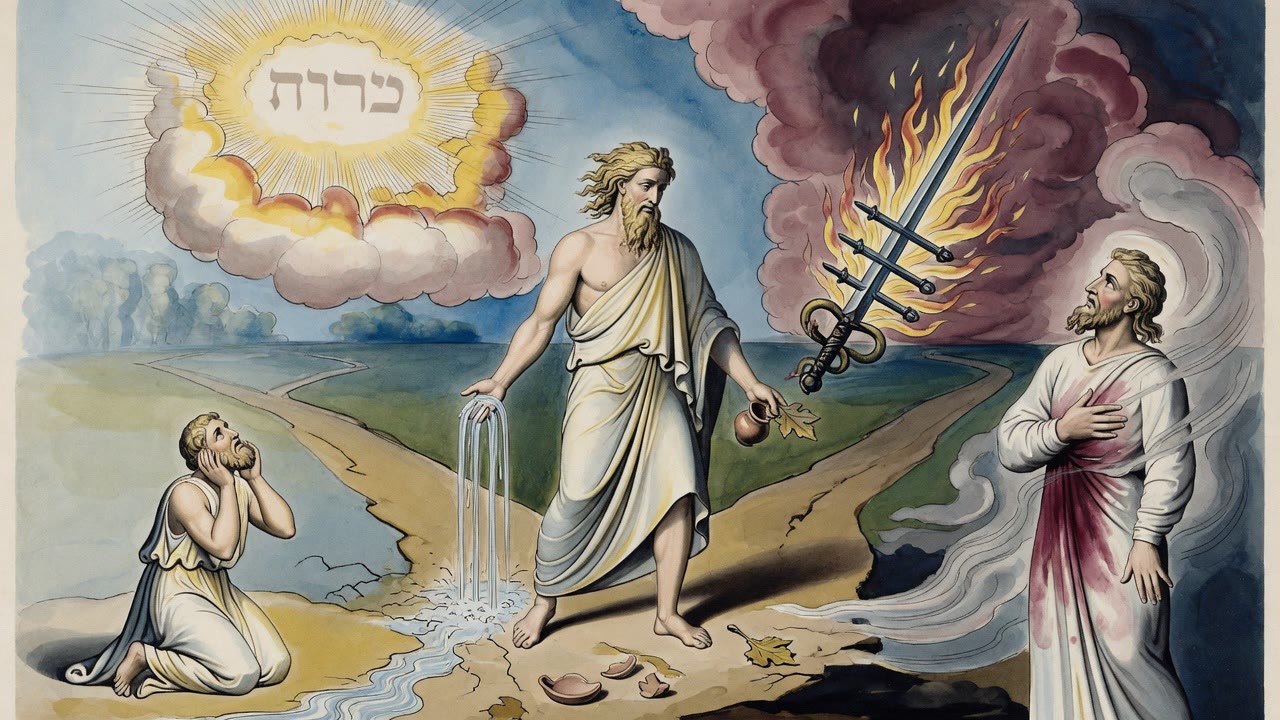
"Enough, Pappias." Rabbi Akiva cut him off before the flattery could finish. Enough. The man had not climbed. The man had been standing at a place where two roads opened, and he had chosen the worse one.

The Fork in the First Garden

This was what Akiva saw when he looked at the beginning. Before Adam there was a parting of ways, laid out by the Holy One like two paths cut through one field. One road ran with the angels. The other ran with the beasts that perish. The first road was life. The second was death. And the man, set down exactly where the roads divided, with the whole weight of the choice resting on him, abandoned the way of life and took the way of death for himself.

So the verse was no compliment. "Like one of Us" was a wound dressed as honor. When Adam stood alone, before the rib was taken, before the woman, he was simple and whole, "like one," undivided. Then the rib went out from him, and good and evil came into him together, and he could no longer be one thing. He had become a creature who knew both roads and walked the wrong one.

The Sword That Turned Every Way

What he lost was not a garden of pleasant trees. It was the spring.

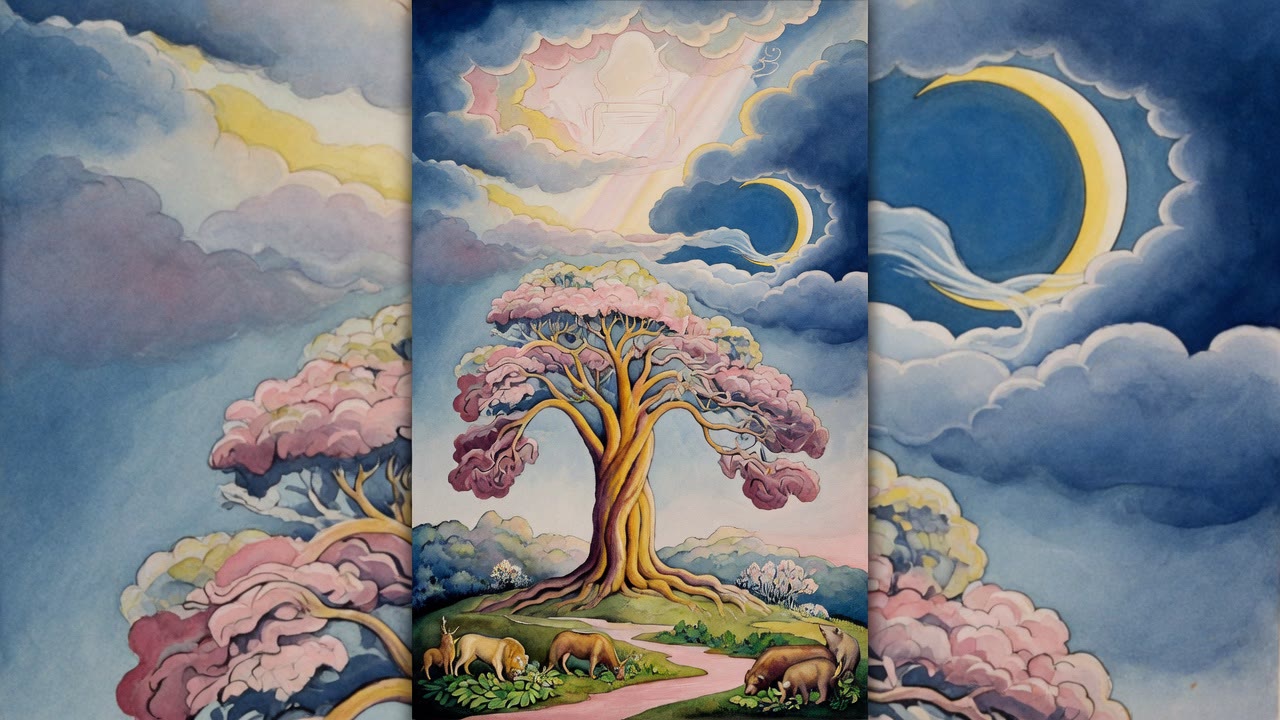
For under one tree in that place a fountain rose, and the water in it was living water, mayim chayyim, the kind that does not run dry and does not let the drinker die. It split into four streams and ran under the Throne of Glory and looped the whole of Paradise, and where the righteous would one day sit there were four more rivers, one of honey, one of milk, one of wine, one of pure balsam that healed whatever it touched. At the center of it all stood the Etz Chayyim, the Tree of Life. A hand could have reached it. A mouth could have eaten and gone on forever.

That was the danger. A man who had already chosen death, left loose in the garden, might still stretch out his hand and take from the Tree of Life and live forever in his wrongness. So the gate had to close. "And He drove out the man." The word for driving out is hard, the same root used when a man hands his wife the writ that ends a marriage, and that is what it was. God divorced him from Eden and sent him out the eastern way, the way the wind itself moves, the way that would later carry Cain into the land of Nod and carry the killer to the cities of refuge.

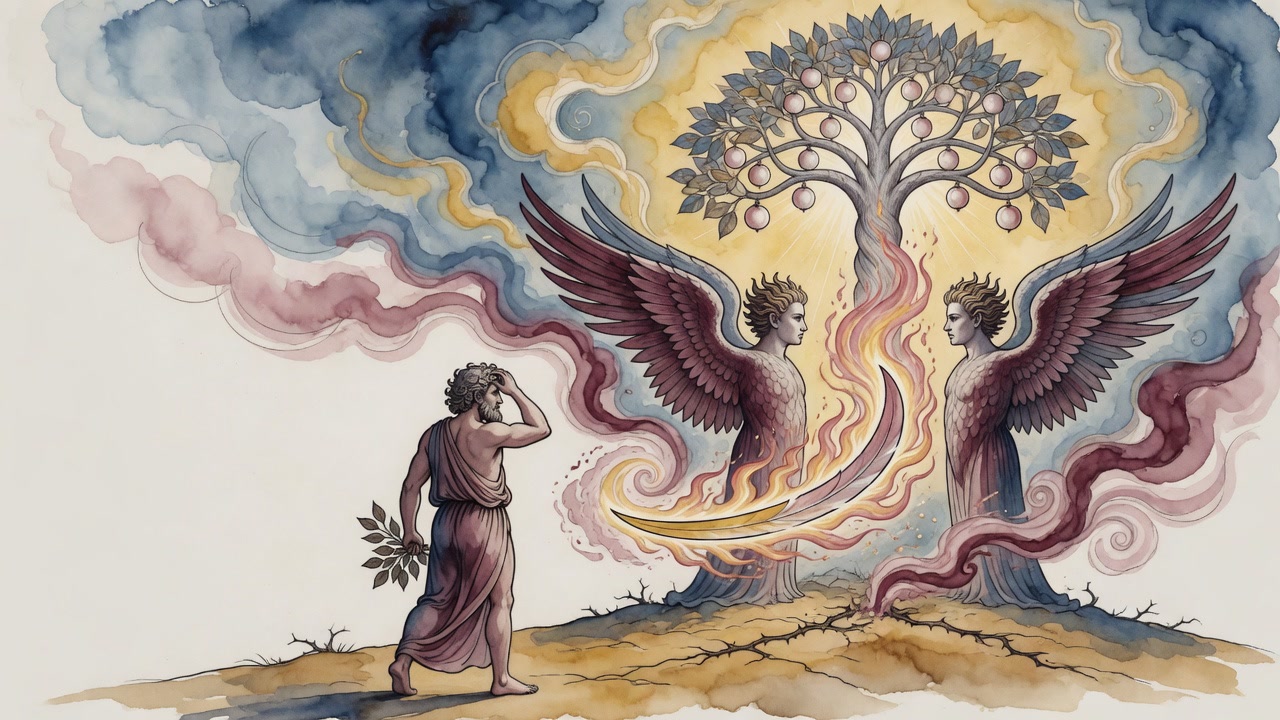
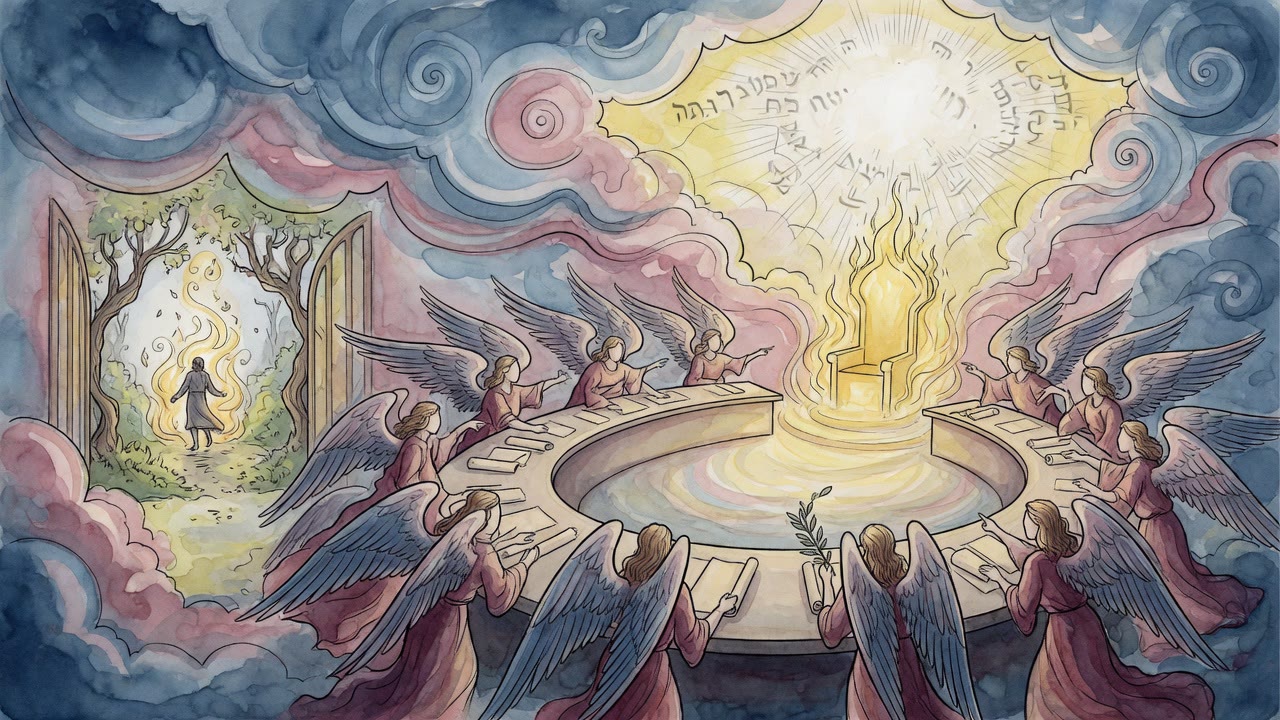
At the threshold He set the cherubim, who had been made before everything else, older than the work of creation, ready for exactly this watch. And He set the flame: a sword of fire that turned every way at once so that no angle of approach was safe. The old men called that fire by its true name. It was Gehinnom, the burning, stationed at the road back to the tree so the road could not be walked.

The Door He Did Not See Close Behind Him

Generations later another man stood where the immortal water ran, and he was let in to look.

Moses came to the edge of the reward at the end of his life and saw what Adam had forfeited. He saw the spring of living water rising under the Tree of Life. He saw it divide into four and pour under the Throne. He saw the river of honey and the river of milk, the river of wine and the river of balsam, all of it kept for those who had kept the way. The sweetness of it, the smell of it, the sheer waste of abundance broke something open in him, and he cried out, "Oh, how great is Thy goodness, which Thou hast laid up for them that fear Thee." Then his glimpse was over, and Moses turned and went back down to the earth and to his death, the way every son of Adam goes.

That was the difference between the two men at the tree. Moses was shown the water and could not stay. Adam had stood in the water and let it go.

An Opening Left in the Wall

And yet the same hand that drove him out left a crack in the verdict.

"And now," the verse said, and the rabbis heard a hinge in those two small words. The same "and now" begins the great call in Deuteronomy, "And now, Israel, what does the LORD your God ask of you." It is the word that opens the door of repentance. God had made Adam with two measures held together, the measure of justice and the measure of mercy, and when He banished him He used the gentler hand. He sent him from the garden in this world. He did not, one voice insisted, send him from it forever. When the man made in God's likeness wakes at the end, that decree will be lifted, and he will be set right.

So the flaming sword turns at the gate to this day, guarding the road to the tree. But a road that is guarded is a road that still exists. Adam reached once, in a single hour, and could not hold even that hour. His children stand outside the wall, watching the fruit of the first three years they may not eat, learning the patience he never had, waiting for the gate.


← All myths
From the tradition

Sources

2 sources

The texts this telling draws on, in full. Open a card to read inline, or expand it for a wider, quieter read.

Yalkut Shimoni on Torah 34:7Yalkut Shimoni on Torah

Rabbi Pappias expounded, "Behold, the man has become like one of Us" (Genesis 3:22) to mean like one of the ministering angels. Rabbi Akiva said to him: Enough, Pappias! Rather, the Holy One, blessed be He, set before him two ways, and he abandoned the way of life and chose for himself the way of death. Rabbi Yehudah son of Rabbi Simon said: like the Unique One of the world, as it is said, "the LORD our God, the LORD is One" (Deuteronomy 6:4). The rabbis say: like Gabriel, as it is said, "and behold, one man clothed in linen" (Daniel 10:5). Resh Lakish said: like Jonah; just as that one flees, so this one flees.

"And He drove out the man" (Genesis 3:24). This teaches that the Holy One, blessed be He, gave him a divorce like a woman. "And He stationed east of the Garden of Eden the cherubim": this teaches that the cherubim preceded all the work of creation. "And the flaming sword": this is Gehinnom. "To guard the way": this is the way of the world [proper conduct]; it teaches that proper conduct preceded the tree of life. And "tree" means nothing other than Torah, as it is said, "it is a tree of life" (Proverbs 3:18).

Just as that one [Elijah] did not have his honor lodge with him, so this one did not have his honor lodge with him. Rabbi Berekhyah said: like Elijah; just as that one did not taste the taste of death, so this one was not fit to taste the taste of death. As long as Adam was alone he was "like one"; once his rib was taken from him he came to the knowledge of good and evil. "And now" (Genesis 3:22): this teaches that the LORD opened for him an opening of repentance, as you say, "And now, Israel, what does the LORD your God ask of you" (Deuteronomy 10:12).

"And He sent him forth." Rabbi Yehudah says: the sending forth from the Garden of Eden was in this world and in the world to come. Rabbi Nehemiah objected and said: He sent him from the Garden of Eden in this world but did not send him in the world to come. And this supports Rabbi Nehemiah: "As for me, in righteousness I shall behold Your face; I shall be satisfied, when I awake, with Your likeness" (Psalms 17:15) - when the one created in Your likeness awakes, at that hour I will declare him righteous, freeing him from that decree.

"And the LORD God sent him forth." When He created him, He created him with the attribute of mercy and the attribute of justice, and when He banished him, He banished him with the attribute of mercy. "Behold, the man" - he could not stand by Your command even for a single hour, yet behold, his children wait for the fruit of the first three years, as it is said, "three years it shall be forbidden to you, it shall not be eaten" (Leviticus 19:23).

"And He drove out the man." This is like a king who had three friends and would do nothing without their counsel. Once the king wished to do something without their counsel. He took the first and banished him, sending him outside his palace. The second he imprisoned and placed a guard over him. The third, who was especially dear to him, he said: I will do nothing without his counsel. So with Adam the first man, "And He drove out the man"; with Noah, "and the LORD shut him in" (Genesis 7:16); with Abraham, who was especially dear to Him, He said, I will do nothing without his counsel, as it is said, "And the LORD said, Shall I hide from Abraham" (Genesis 18:17).

"And He drove out" [vaygaresh]. He showed him the destruction of the Temple, as you say, "He has broken my teeth with gravel" [vayagres] (Lamentations 3:16). To the expelled-area of the Garden of Eden He banished him, and set guards over him to keep watch over him. "East" [from the east]. Rav said: in every place the eastern wind takes in. It took in Cain: "and he dwelt in the land of Nod, east of Eden" (Genesis 4:16). The murderer: "then Moses set apart three cities... toward the rising of the sun" (Deuteronomy 4:41).

Full source
Legends of the Jews 4:191Legends of the Jews

Moses stood on the threshold of the ultimate reward and saw the Tree of Life.

So, what did Moses see? First, he saw a spring – a spring of living water. Not just any water, but chayyim mayim – water of life – bubbling up from beneath the Etz Chayyim, the Tree of Life itself! This wasn't just one stream, though. It divided into four, flowing under the very Throne of Glory, and from there, encircling the entire expanse of Paradise. A source of endless blessings, nourishing everything.

The vision didn't stop there. He saw four rivers flowing under the thrones of the righteous – the tzaddikim (a righteous person) (the righteous). And these weren't rivers of water.. oh no. The first was a river of honey, thick and sweet. The second, a river of milk, creamy and pure. The third, a river of wine, rich and intoxicating. And the fourth? A river of pure balsam, fragrant and healing. Four rivers, each representing a different kind of delight and sustenance, reserved for those who lived righteous lives.

The sights, the smells, the sheer abundance of it all. It must have been overwhelming.

No wonder, then, that beholding all this, Moses was filled with such joy. He exclaimed, "Oh, how great is Thy goodness, which Thou hast laid up for them that fear Thee, which Thou hast wrought for them that put their trust in Thee, before the sons of men!" A sentiment echoing the words of Tehillim, (Psalms 31:20). A simple, heartfelt expression of awe and gratitude.

And then, his glimpse complete, Moses left Paradise, and returned to the earth.

What does this vision tell us? Is it a literal description, or a metaphor? Perhaps it's both. Maybe it's a reminder that the reward for a life well-lived isn't just about pleasure, but about a deeper connection to the source of all goodness. Maybe it's about recognizing the blessings we already have, the sweetness, nourishment, joy, and healing that surround us every day.

What do you think? What does Gan Eden (the Garden of Eden, paradise) look like in your mind's eye? And how can we bring a little bit of that paradise into our lives, right here, right now?

Full source