Parshat Bereshit4 min read

Adam Asked the Angels for Spices When He Left Eden

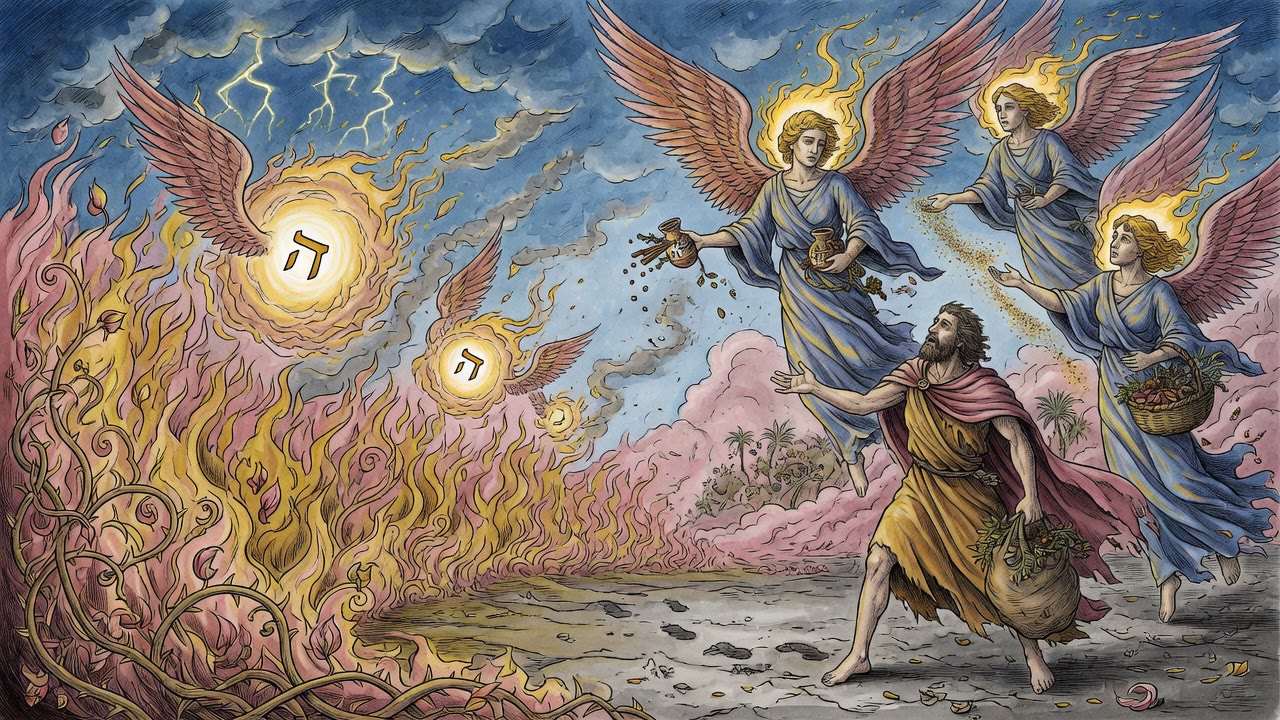
Driven from the Garden in the twelfth hour, Adam wept and begged the angels for one thing before the gates closed: spices, so he could still pray.

Curated by Arthur · Told by Maggid ·
Table of Contents
  1. The Twelfth Hour
  2. What He Asked For
  3. Two Timetables for One Couple
  4. What Teshuvah Did for Adam

The Twelfth Hour

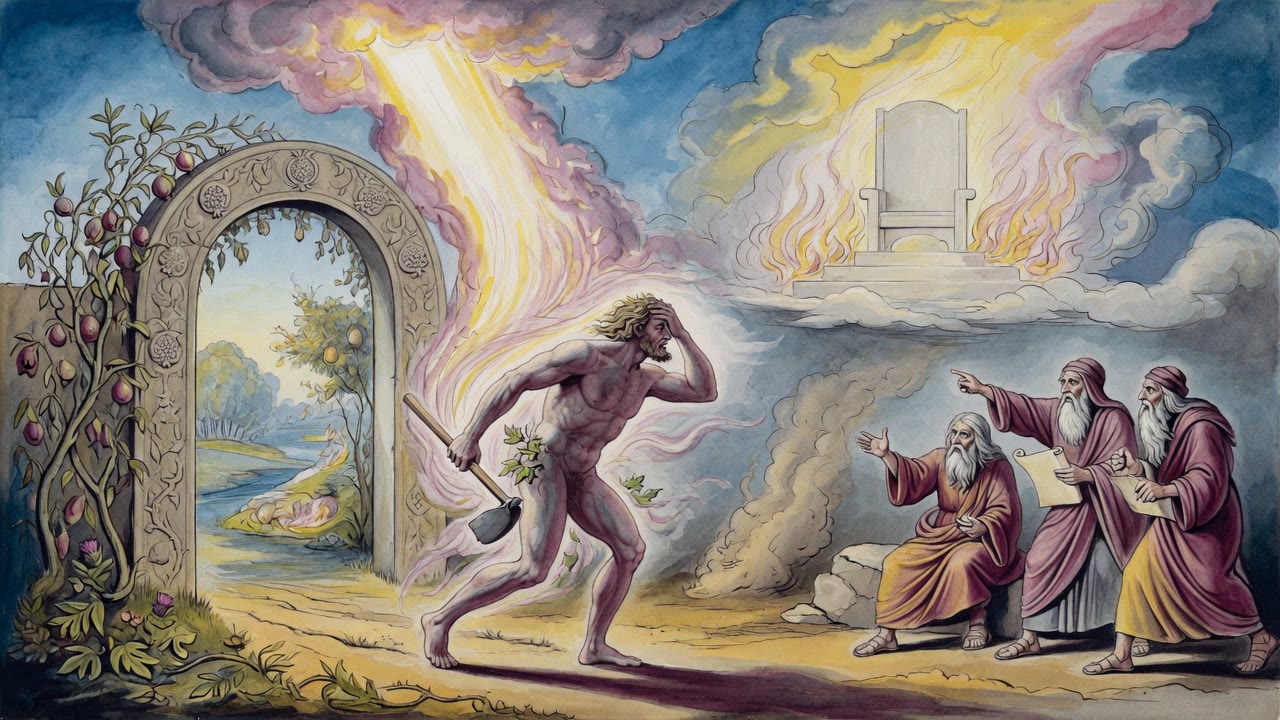
Adam entered the Garden in the eighth hour of the sixth day of creation. By the twelfth, the gates had closed behind him. Four hours, measured not in human years but in divine time, each hour containing what a human age might hold, and then the cherubim and the flaming sword and the eastern gate sealed against his return.

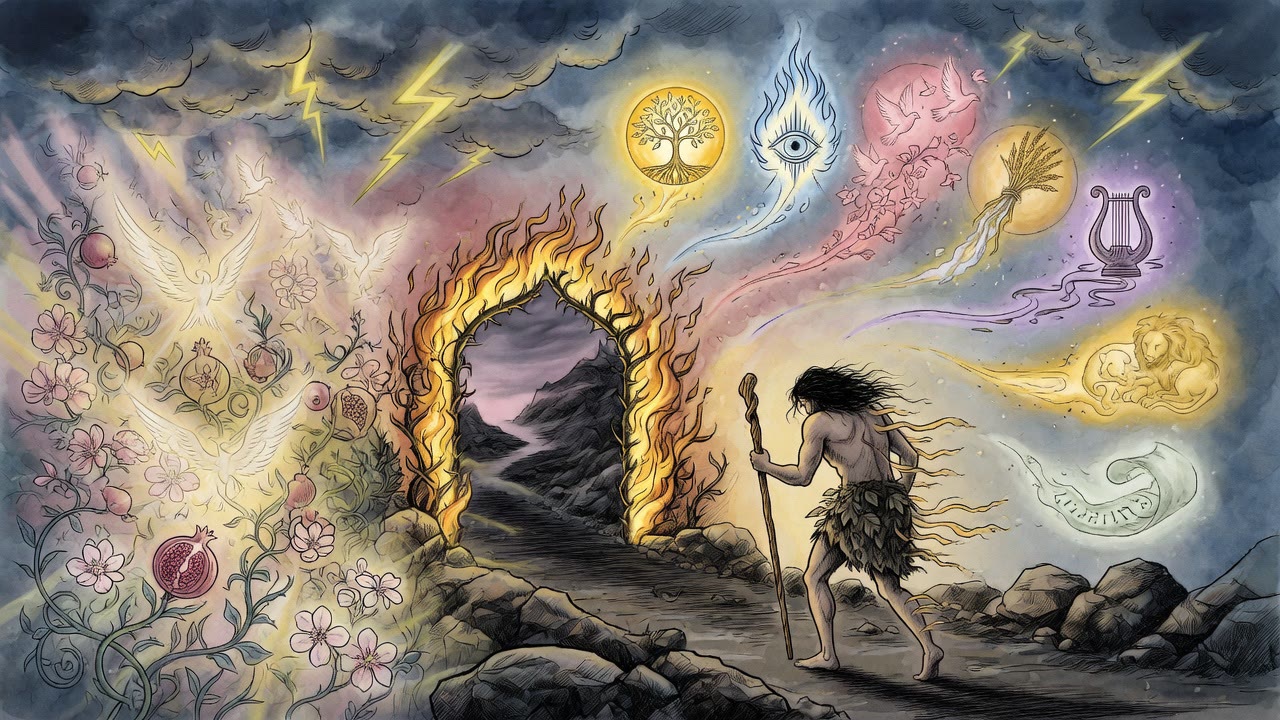
He stood outside and wept. The Garden was still there, still visible from where he stood, still producing the fragrance and light that he had lived inside for those four hours. He could smell it. He had been made in it, shaped for it, and now he was in the world outside it, which was cold by comparison, bare, functional rather than beautiful, a place for labor rather than for dwelling with God.

What He Asked For

Before the angels withdrew, Adam made one request. Not to be allowed back in. Not for the sentence to be reduced. He asked for spices, sweet-smelling herbs from paradise, to take with him into the world outside. He knew he would be praying from that world for the rest of his life, and he wanted something from the Garden to hold when he prayed. Something that still carried the scent of where he had been.

The angels gave him the spices. They let him take the fragrance of paradise into exile because the request was not defiance. It was continuity. Adam understood from the first hour outside the Garden that prayer was what would have to substitute for direct proximity to God, and he was already thinking about how to do it right. The spices were not comfort. They were ritual equipment.

Two Timetables for One Couple

The Book of Jubilees, working through the Genesis narrative with the precision of a legal document, added a detail that the Torah leaves out: Adam and Eve did not enter the Garden on the same day they were created. Adam was introduced to the Garden forty days after his creation. Eve entered eighty days after hers. The forty-day gap between a male birth and the purification period that allowed entry into sacred precincts, and the eighty-day gap for a female birth, were already present in creation itself. The laws of purity that would govern the sanctuary in the wilderness had their template in the original human story.

They were driven out together, but they had entered on different days, and that asymmetry was not accidental. The creation story was already encoding the structure of sacred law. Eden was not just a garden. It was a prototype of the holy of holies, and entry into it had always required preparation.

What Teshuvah Did for Adam

Outside the Garden, Adam turned back toward God. The tradition calls this the invention of teshuvah, the first act of return, the first time a creature who had broken something between itself and God tried to repair it. God accepted the repentance. The Tikkunei Zohar reads this moment as cosmically significant: Adam had not merely committed a sin. He had introduced the possibility of disconnection into a world that had been entirely unified. His return, his act of turning back, introduced the possibility of repair. The world that had been damaged now had a mechanism for its own restoration.

The seven gifts he had lost, celestial light, height, radiance, abundant fruit, full sun and moon, unending life, direct presence of the Shekhinah, were not returned to him as a reward for his teshuvah. They were deferred. Set aside. Catalogued for a future restoration that would come when the world was ready to hold them again. Adam died knowing what had been lost and that it would come back, but not through him.


← All myths
From the tradition

Sources

5 sources

The texts this telling draws on, in full. Open a card to read inline, or expand it for a wider, quieter read.

Book of Jubilees 3:13Book of Jubilees

This ancient Jewish text, considered scripture by some but not included in the Hebrew Bible as we know it, offers a fascinatingly detailed retelling of the stories in Genesis. And within its pages, we find some intriguing explanations for things we might otherwise overlook.

So, The familiar story centers on Adam and Eve. But did you know that the Book of Jubilees specifies a timetable for their early days?

It starts with a familiar phrase, echoing the core principle of marriage: "Therefore shall man and wife be one, and therefore shall a man leave his father and his mother, and cleave unto his wife, and they shall be one flesh." This sets the stage for understanding the relationship between Adam and Eve as a foundational archetype.

The text continues, "In the first week was Adam created, and the rib--his wife: in the second week He showed her unto him." Already, there's a sense of careful timing, a deliberate unfolding of creation. But here's where it gets really interesting.

The Book of Jubilees then explains, "and for this reason the commandment was given to keep in their defilement, for a male seven days, and for a female twice seven days." What's this about? This refers to the laws of ritual purity after childbirth. According to Leviticus, a woman who gives birth is considered ritually impure – tamei in Hebrew – for a period of time. The length of this period differs depending on whether she gives birth to a son or a daughter.

The Book of Jubilees connects this practice directly back to the creation of Adam and Eve! It suggests that the differing lengths of impurity are rooted in the very beginnings of humanity.

Finally, we get to the timetable: "And after Adam had completed forty days in the land where he had been created, we brought him into the Garden of Eden to till and keep it, but his wife they brought in on the eightieth day, and after this she entered into the Garden of Eden."

Forty days for Adam. Eighty days for Eve. Why?

The Book of Jubilees doesn't explicitly tell us why, but the implication is powerful. It links the laws of ritual purity to the very creation narrative, suggesting a deep and enduring connection between our origins and our understanding of purity and impurity. It also, perhaps, suggests something about the differing experiences of men and women, even from the very start.

It's a small detail, perhaps. But it's details like these that open up new avenues for understanding the richness and complexity of Jewish tradition. They invite us to look beyond the familiar and to consider the hidden meanings that might be waiting to be discovered. What does it mean that Adam entered the Garden before Eve? What does the number 40 represent in Jewish tradition, and how does it contrast with 80? These are the types of questions that make studying these ancient texts so fascinating, and keeps us digging deeper for the answers.

Full source
Legends of the Jews 2:72Legends of the Jews

All that splendor, all that divine closeness… gone. But the story doesn't end there.

The Ginzberg's says retelling in Legends of the Jews, as Adam realized the gravity of his situation, he began to weep. He pleaded with the angels for one small mercy: to take sweet-scented spices from Paradise with him. He hoped that even outside the Garden, he could still offer gifts to God and that his prayers would still be heard. Even in the face of such profound loss, Adam's first thought was to maintain a connection with the Divine.

The angels, moved by his remorse, approached God. "King unto everlasting," they said, "command Thou us to give Adam sweet-scented spices of Paradise." And God, in his infinite mercy, granted their request.

So, Adam gathered saffron, nard, calamus, and cinnamon, precious aromas of Paradise. He also collected all sorts of seeds, a practical provision for sustenance in the world outside. Laden with these gifts, Adam and Eve left Paradise and stepped onto the earth.

Now, here’s a truly striking detail: their time in Paradise was incredibly brief. A mere few hours. The story, pieced together from various Midrashim (rabbinic interpretive commentary) (interpretive stories), unfolds with almost cinematic precision:

In the first hour of the sixth day of Creation, God conceived the idea of creating humanity. The second hour was spent in counsel with the angels. In the third, He gathered the dust to form Adam’s body. The fourth hour saw Adam taking shape. In the fifth, he was clothed with skin. By the sixth hour, the soulless form was complete, capable of standing upright. In the seventh, a soul was breathed into him. In the eighth, Adam was led into Paradise. The ninth hour brought the Divine command prohibiting the fruit of the Tree of Knowledge. In the tenth, he transgressed that command. The eleventh hour was his judgment. And in the twelfth hour of the day, as atonement for his sin, he was cast out.

Just like that, from conception to expulsion, all within a single day. It's a powerful reminder of the speed with which fortunes can change, and the lasting consequences of our choices. Doesn't it make you wonder about the weight of those spices and seeds Adam carried? They were a link to a lost world, a symbol of hope, and a burden of responsibility, all at once.

Full source
Book of Jubilees 3:41Book of Jubilees

The familiar story is this: the forbidden fruit, the serpent, the expulsion. But what were those first moments like outside of paradise?

The Book of Jubilees, a fascinating text considered canonical by some but excluded from the standard Hebrew Bible, fills in some intriguing details. It paints a vivid picture of their initial struggle. Remember that curse? "Thorns and thistles shall it bring forth to thee, and thou shalt eat thy bread in the sweat of thy face, till thou returnest to the earth from whence thou wast taken; for earth thou art, and unto earth shalt thou return." It wasn’t just a metaphor. It was their new reality.

The sheer shock. One moment, blissful ease; the next, a harsh, unforgiving world of toil and hardship.

Then, there's the poignant image of God making them "coats of skin" and clothing them before sending them out. A final act of compassion, perhaps? A recognition of their vulnerability in this new, hostile environment? It's a powerful visual: divine hands crafting garments for the exiled couple. It speaks volumes, doesn't it?

But here's where it gets even more interesting. The Book of Jubilees goes on to describe Adam's actions on that very first day after leaving Eden. He offered a sacrifice, a "sweet savour," consisting of frankincense, galbanum, stacte, and spices, in the morning with the rising of the sun. He did this, the text specifies, "from the day when he covered his shame." Freshly banished, burdened by guilt and the weight of his actions, Adam turns to offering. Was it an act of repentance? A plea for forgiveness? Or simply a desperate attempt to reconnect with the divine in a world that suddenly felt so distant from God? The text doesn’t explicitly say, but the image is incredibly evocative.

It makes you wonder about the nature of repentance itself. Is it something we do out of fear? Out of a genuine desire for atonement? Or perhaps a combination of both? And what does it mean to "cover our shame"? Is it about hiding from God, or about finding a way to move forward, acknowledging our mistakes, and striving to do better?

The story of Adam and Eve, even in these added details, remains a story of profound human struggle and the enduring search for meaning in a world marked by both beauty and hardship. It’s a reminder that even in the wake of our greatest failures, there's always the possibility of a new beginning, a new dawn, and perhaps, even a chance at redemption.

Full source
Legends of the Jews 2:85Legends of the Jews

It wasn't just the companionship of God, or a life free from toil. According to tradition, he lost seven precious gifts – treasures that will only be restored in the Messianic Age.

One of these was the celestial light. Imagine a light so pure, so radiant, it surpasses anything we can comprehend today. But there were others. The Zohar, that foundational text of Jewish mysticism, mentions the resplendence of Adam's face, a divine glow reflecting his proximity to God. He also lost eternal life, his towering stature (a sign of his spiritual perfection, perhaps?), and the abundance of fruits from the soil and the trees. And finally, he lost the original luminaries of the sky – the sun and the moon. In that original state, the moon shone as brightly as the sun, and the sun itself possessed a sevenfold intensity (Legends of the Jews). Quite a downgrade. So, what happened after the expulsion? Imagine the scene: Adam and Eve, utterly bereft, build themselves a simple hut. For seven long days, they sit there, consumed by grief and remorse. Can you feel their despair?

Then, hunger sets in. They venture out, desperately seeking sustenance. For another seven days, Adam searches high and low, hoping to find some remnant of the delicacies they enjoyed in Paradise. But it's no use. Nothing compares.

Eve, in her anguish, suggests a drastic solution: "My lord, if it please thee, slay me. Mayhap God will then take thee back into Paradise, for the Lord God became wroth with thee only on account of me." (Legends of the Jews). Think about the weight of that statement! She believes she is the sole cause of their downfall.

But Adam, horrified, rejects her plea. They continue their desperate search. Nine more days pass, and still, they find nothing even remotely resembling their former food. All they see is food fit for cattle, for beasts. Imagine the humiliation, the stark contrast to the divine bounty they once knew.

Finally, Adam proposes a solution: penance. "Let us do penance," he says, "mayhap the Lord God will forgive us and have pity on us, and give us something to sustain our life." (Legends of the Jews). He understands that atonement is the only path forward.

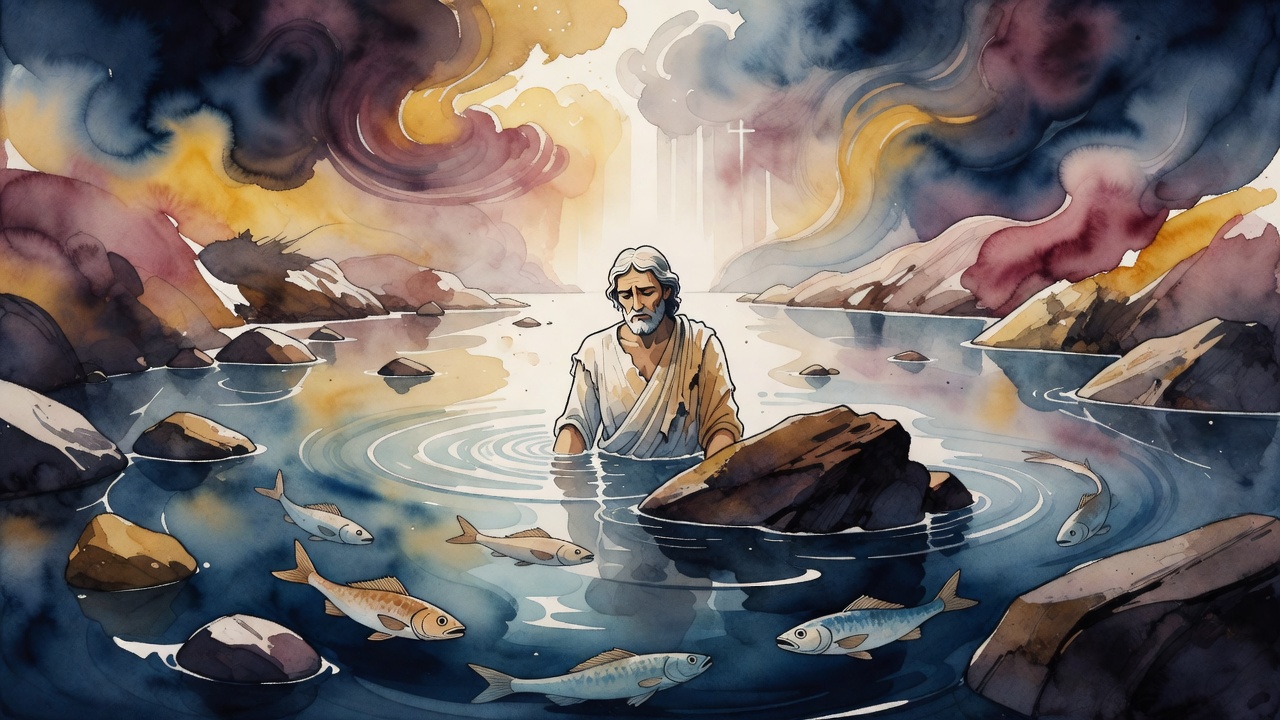
But knowing Eve isn't strong enough for the intense physical mortification he has in mind for himself, he prescribes a different penance for her. "Arise," he tells her, "and go to the Tigris. Take a stone and stand upon it in the deepest part of the river, where the water will reach as high as thy neck. And let no speech issue forth from thy mouth, for we are unworthy to supplicate God, our lips are unclean by reason of the forbidden fruit of the tree. Remain in the water for thirty-seven days." (Legends of the Jews).

Imagine Eve, standing silently in the cold river for over a month, a symbol of repentance and humility. It's a powerful image, isn't it? A evidence of their longing to return to God's grace. And it makes you wonder: what penance are we willing to undertake to reconnect with the divine?

Full source
Tikkunei Zohar 83:3Tikkunei Zohar

Being utterly lost. Disconnected. Adrift. That's the picture the Tikkunei (spiritual repair) Zohar, a profound work of Kabbalah, paints for us of Adam after his transgression. Scary thought, isn't it?

The Tikkunei Zohar, specifically in Tikkun 83, dives into this idea of being utterly lost, and what saves us from it. It all hinges on teshuvah (תשובה) – repentance, return. But not just any kind of repentance.

The verse reads, "And if not that ‘Repentance’ – te-shuvah had stood by him, Adam, and had become exiled with him, he would have become lost from everything." Repentance isn't just something we do. It's something that accompanies us, even into exile. It's a constant possibility, a lifeline thrown into the darkness. The Tikkunei Zohar suggests that without this constant possibility of return, Adam would have been completely and irrevocably lost.

This leads into a fascinating interpretation of (Psalm 130:3), "If You preserve sins, YaQ, Y”Y ‘who’ will stand?" The Tikkunei Zohar doesn't read this literally. Instead, it connects the "who" (MiY) to Binah (Understanding) – one of the Sefirot (the divine emanations), often associated with understanding and the Divine Mother. So, the question isn't just "who will stand?" but "Binah will stand, surely!"

What does this mean? That even in the face of sin, even when it feels like everything is crumbling, Divine Understanding, the nurturing aspect of the Divine, remains. It's a powerful message of hope.

And then we get to (Isaiah 50:1): "..and through your sins, your ‘mother’ was sent-away." This is a heartbreaking image. Who is this "mother"? The text connects it to the Shekhinah (שכינה), the Divine Presence, particularly the Lower Shekhinah, which is often seen as dwelling among us in the physical world. The verse then references (Deuteronomy 22:7), "You shall surely send-away – ‘ET’ – the mother.."

The word "et" (את) is a direct-object signifier in Hebrew, usually untranslated. But here, the Tikkunei Zohar sees deeper meaning. It says that "et" comes to include the Lower Shekhinah with Her. The sins of humanity, it suggests, have caused a separation, an exile, even for the Divine Presence that dwells among us.

So, what are we left with? A picture of a world fractured by sin, where even the Divine Presence feels distant. But also, a powerful reminder that teshuvah is always possible. That even in exile, even in the darkest of times, the possibility of return, of reconnecting with the Divine, remains. And that Binah, Divine Understanding, and the Shekhinah, the Divine Presence, are somehow intertwined with our actions, our choices, and our capacity for repentance. It's a weighty thought, isn't it? It makes you wonder about the ripple effects of our choices, and the enduring power of a sincere return.

Full source