5 min read

Bath Kol Names the Month That Holds Spring

Judges sit in a circle, hands spread toward heaven, until a Bath Kol declares the month, so Passover stays in spring and leaven keeps its hours.

Curated by Arthur · Told by Maggid ·
Table of Contents
  1. Why the Circle Needed Heaven
  2. Matzot Must Meet Aviv
  3. Leaven Before, During, and After
  4. The Night the Month Landed

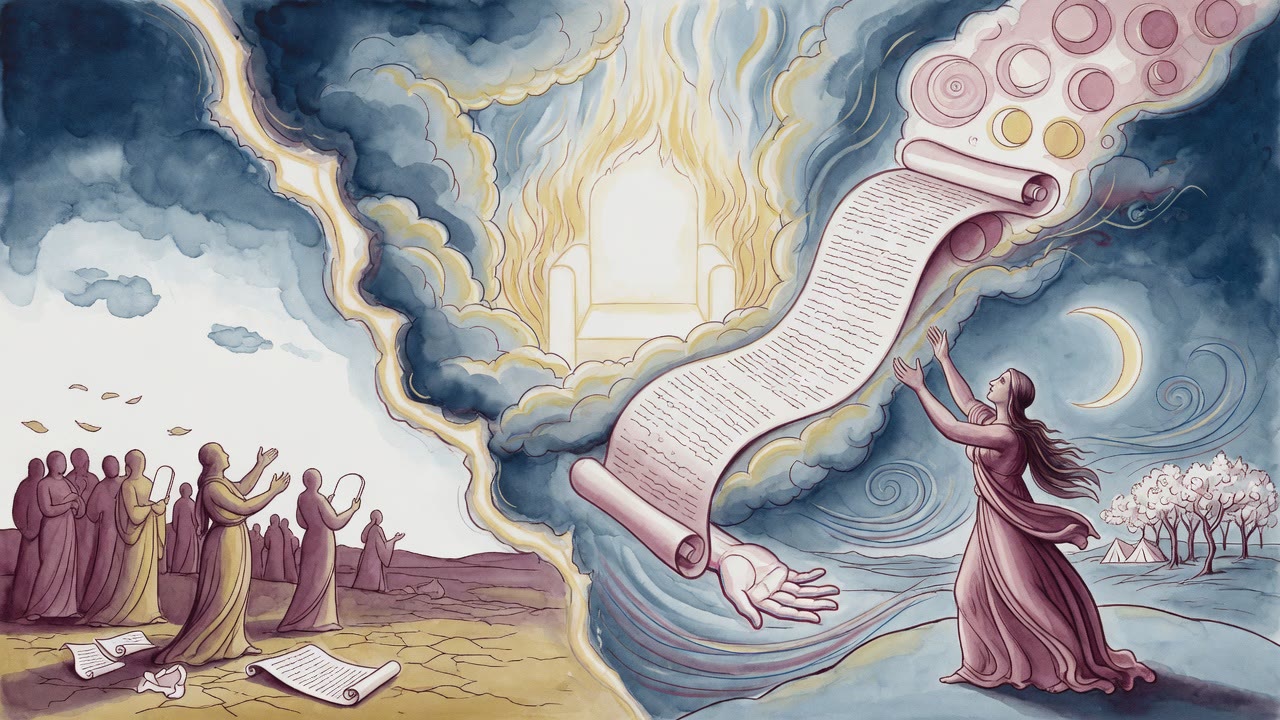
Ten men sat in a circle on the court floor with a Torah scroll before them. The greatest sat first. The least sat last. Eyes dropped toward the earth. Hands rose and spread toward their Father in heaven. The chief of the assembly proclaimed the Name. Then a Bath Kol (בת קול), a heavenly voice, spoke the words that set time itself: "This month shall be unto you" (Exodus 12:2).
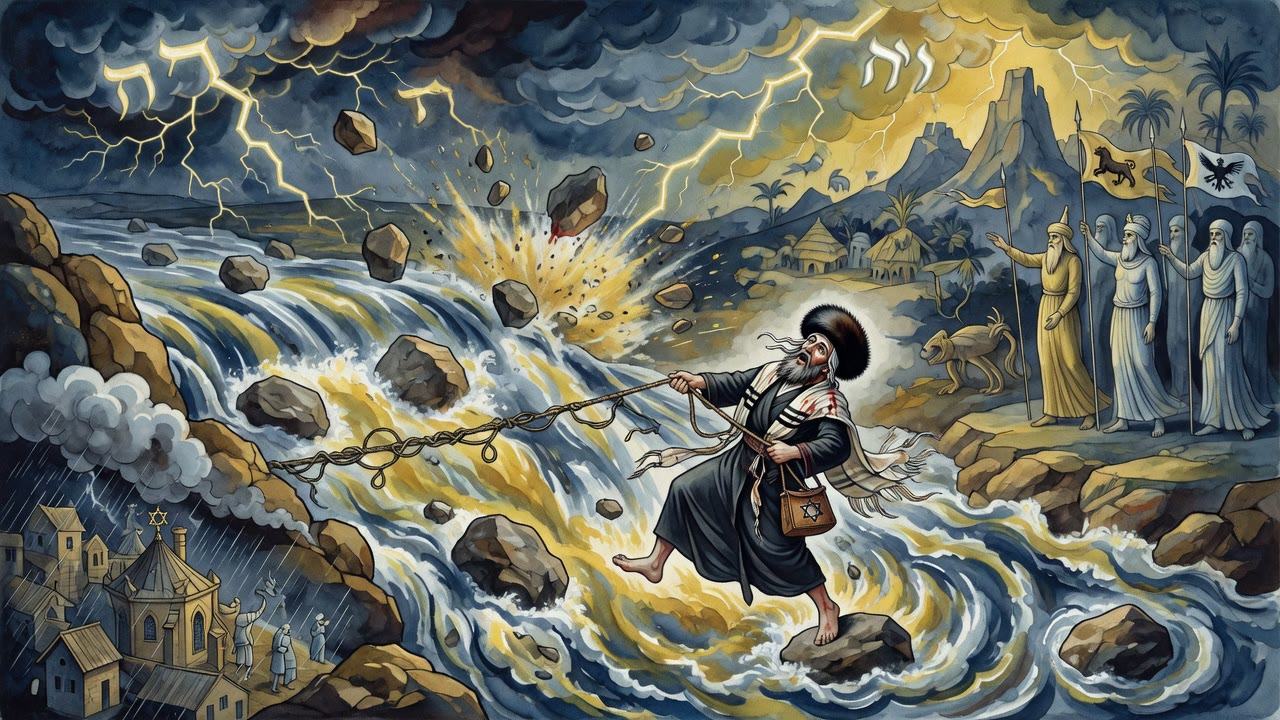
Bath Kol Names the Month That Holds Spring Click for full size

Why the Circle Needed Heaven

Intercalation, the adding of a month so the festivals keep their seasons, is not a private calculation whispered in a back room. Pirkei DeRabbi Eliezer places it in a congregation. Rabbi Eliezer requires ten. If the number thins, the scroll itself joins the seating so the court still has weight. The body language is all humility: gaze down, hands open, no swagger of astronomers who think the sky is theirs alone.

They are asking for a month that will keep Passover in spring and Sukkot (the harvest festival of booths) in fall. Without that adjustment the lunar year drifts. Matzah would wander into the wrong weather. The voice from heaven does not invent the calendar. It confirms the partnership of a human court with the God who said the month belongs "unto you."

Matzot Must Meet Aviv

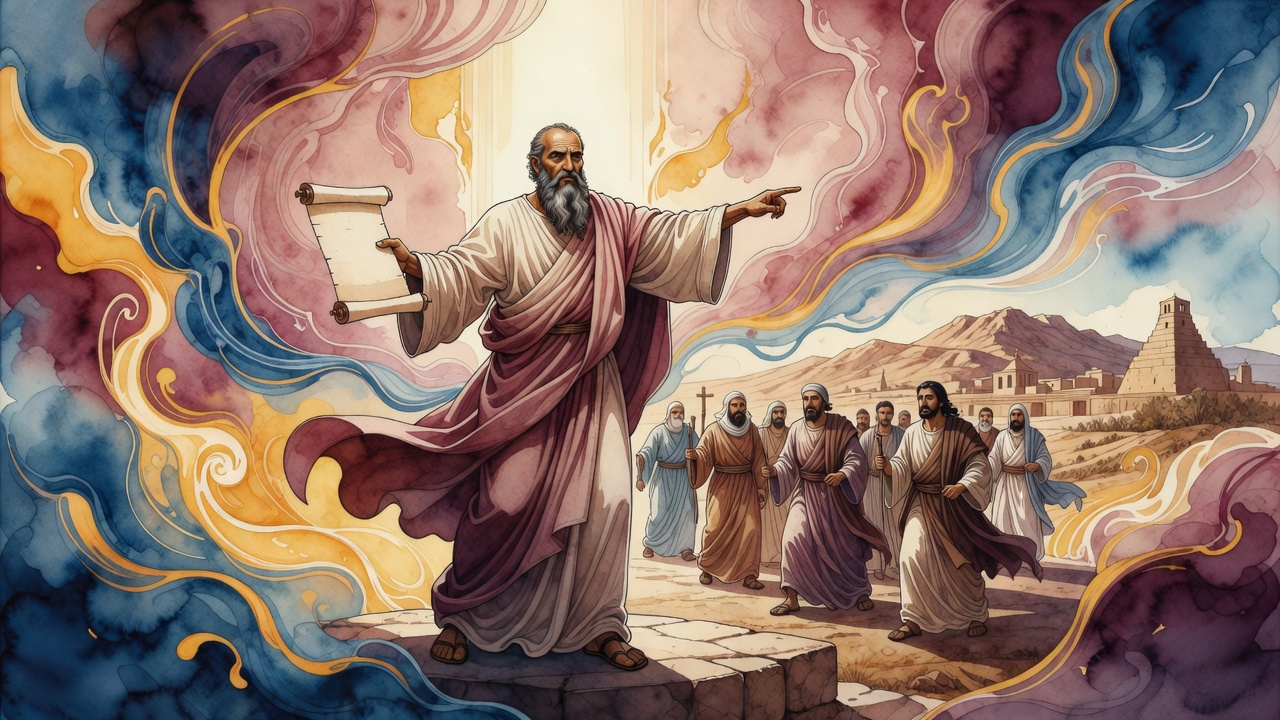
"The festival of Matzot shall you keep" (Exodus 23:15). Rabbi Yehudah ben Betheira heard inside the command a demand for timing: at the appointed time in the month of aviv, when grain begins to ripen. Years are intercalated so Pesach falls only then. Spring is not a decoration on the holiday. It is part of the law's body. A people freed from Egypt must taste freedom when the land itself is waking.

So the circle in the courtyard is fighting drift. Every added month is a fence around the taste of matzah in its proper air.

Leaven Before, During, and After

While the court sets the month, households set the hours of bread. Rabbi Yehudah reads the ban on chametz as stretching before its time, during its time, and after, so that eating leaven can carry a negative command and karet across more than one window. Rabbi Shimon refuses to let the prohibition float loose. In his reading, the ban bites inside its proper span with a different force than outside it.

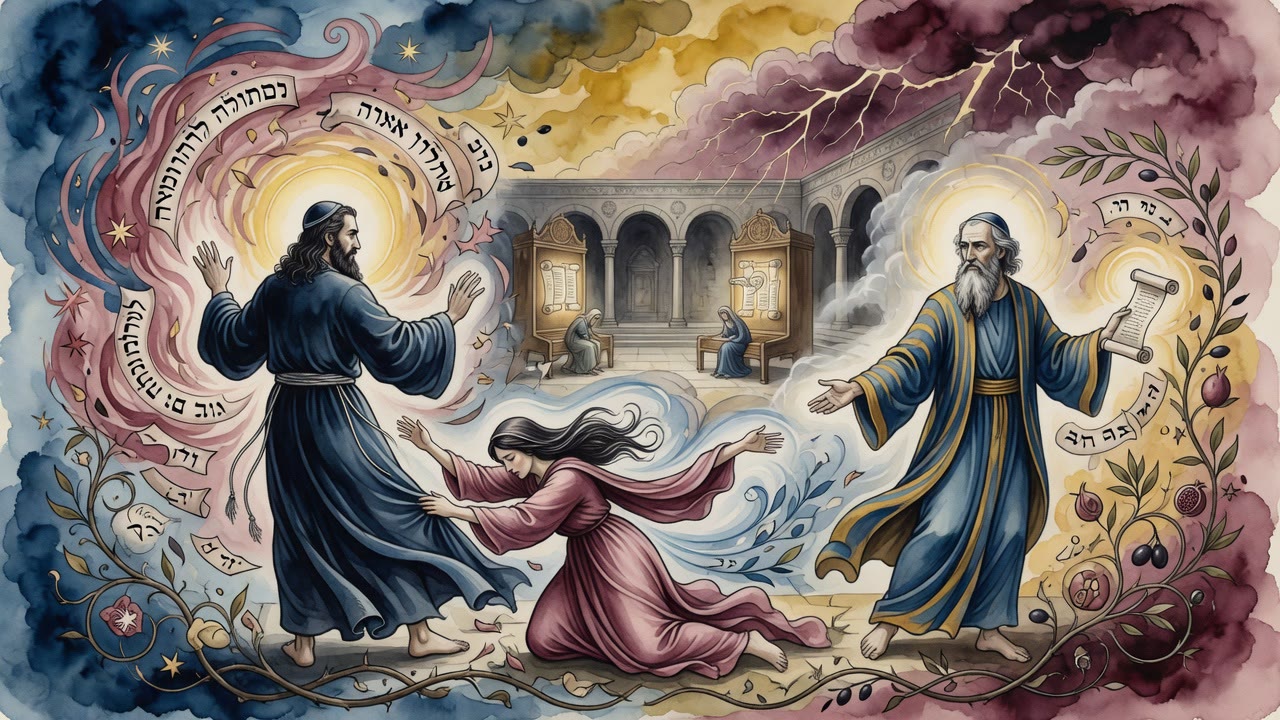
The argument is technical on the page and tense in the kitchen. Dough rises while the sun moves. A crumb under a chest becomes a legal person. Midnight approaches. The same God who sends a Bath Kol for the month also cares whether a family clears the house on time. Cosmic voice and kitchen broom share one calendar of holiness.

The Night the Month Landed

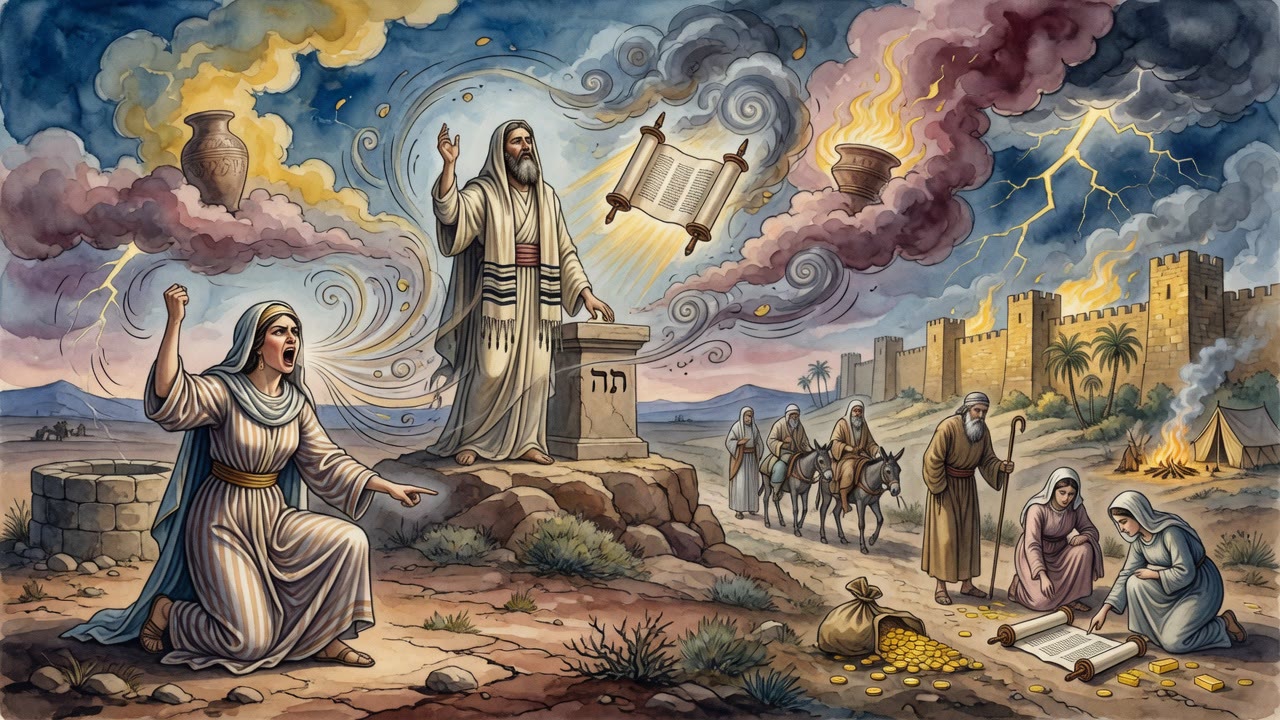
When the heavenly words fell into the circle, the least of the ten felt his shoulders drop. The greatest rose first. Outside, farmers still watched barley. Inside, scribes prepared to announce the month to the towns. Children would later ask why this night is different. The answer begins months earlier, in a courtyard where men looked at dirt and opened their hands until heaven named the moon.

Passover would arrive in aviv. Matzah would meet ripe grain. Leaven would meet its counted hours. The Bath Kol did not bake the bread. It kept the bread's season from sliding off the year.

Before the ten entered the circle, messengers had brought reports of barley in the fields and of lambs ready for the rite. Human eyes did the measuring. Heaven's voice did the sealing. That order matters. The Bath Kol does not replace witnesses. It answers a court that has already lowered its gaze and opened its hands. Pride would have looked up first. This court looked down, then reached up, then heard.

In a town two days' walk away, a woman had already begun to plan the search for leaven. She did not yet know which moon would be named, but she knew the fight between Rabbi Yehudah and Rabbi Shimon would land in her bowl. Hours before the festival, hours inside it, hours after: different weights of prohibition in different mouths. She swept anyway, early. Fear of crumbs is one face of love for the season the court just protected.

Children asked why the old men sat on the floor with a scroll. An uncle said, so Passover will not freeze in the wrong month. The child did not understand intercalation. The child understood matzah in spring air, and that was enough. The festival of Matzot keeps a people tied to aviv, to ripening, to a freedom that has a weather. Without the circle and the voice, the weather would slip, and with it the story's body.

When the announcement left the courtyard, runners carried the month to outlying towns. A delay could still confuse the distant. The system was never perfect in a world of slow roads. Still the ideal stood: heaven and court, barley and moon, matzah and aviv, leaven and counted hours, all braided so a freed people would not lose the season of their freedom.


← All myths
From the tradition

Sources

3 sources

The texts behind this telling. Some cards carry a translation of the source; others are our own retelling of it, and each card says which. Every card links out to the original.

Pirkei DeRabbi Eliezer 8:6Pirkei DeRabbi Eliezer

Retold in our words. Read the original at the link below.Pirke de Rabbi Eliezer, trans. Rabbi Gerald Friedlander, London (1916) · CC-BY

Our ancestors grappled with this too. And the way they dealt with it, according to ancient texts, is pretty darn fascinating.

Think of it like a cosmic tune-up, making sure Passover stays in the spring and Sukkot (the Festival of Tabernacles) in the fall. But how did they actually do it?

The Pirkei DeRabbi Eliezer, a fascinating early medieval text, gives us a glimpse. It describes the scene: a group of learned men gathered to make this crucial decision. Now, opinions differed on exactly how many were needed. Rabbi Eliezer himself, known for his strong opinions, insisted on ten, drawing on the verse from (Psalm 82:1): "God standeth in the congregation of God." Ten representing a minyan, a quorum, a sacred community.

What if they couldn't muster ten? What if the community was diminished? Here's where it gets really interesting. They would place a Sefer Torah, a Torah scroll, before them. The scroll itself becoming a symbolic member, filling the gap, reminding them of the divine presence even in their reduced numbers.

Imagine this: They're seated in a circle in the courtroom, the most respected scholar at the head, the least experienced at the end. Their gaze is lowered, perhaps in humility, perhaps in deep concentration. They stand, raise their hands towards heaven, and the leader of the assembly proclaims God’s name.

Then, a Bath Kol.

A Bath Kol (בַּת קוֹל) literally means "daughter of a voice." It's described as a divine echo, a heavenly pronouncement. Not quite prophecy, but a clear indication of God's will. In this case, the Bath Kol speaks the words from (Exodus 12:1-2): "And the Lord spake unto Moses and Aaron… saying, This month shall be unto you."

So, the decision to intercalate – to add that extra month – wasn't just a mathematical calculation or an astronomical observation. It was a spiritual event, a moment of connection to the divine. A reminder that even the calendar, something we often take for granted, is touched by the hand of God. the next time you flip through your calendar. That seemingly mundane system of days and months is rooted in a deep, ancient tradition, a striving to align ourselves not just with the earth's orbit, but with something far greater. How often do we stop, lower our gaze, and listen for the Bath Kol

Full source
Mekhilta Tractate Kaspa 4:10Mekhilta DeRabbi Yishmael

Retold in our words. Read the original at the link below.Mechilta, translated by Rabbi Shraga Silverstein · CC-BY

The Jewish calendar is not purely lunar. It is lunisolar, adjusted periodically so that the festivals fall in their proper seasons. The Mekhilta traces this practice of calendar adjustment all the way back to a single verse in (Exodus 23:15): "The festival of Matzot shall you keep."

Rabbi Yehudah ben Betheira zeroed in on the key phrase: "as I commanded you, at the appointed time in the month of Aviv." The month of Aviv is springtime, the season when barley begins to ripen in the Land of Israel. The Torah does not merely say to observe Passover. It says to observe Passover in the month of Aviv. The festival must coincide with spring.

A purely lunar calendar drifts about eleven days each year relative to the solar seasons. Left uncorrected, Passover would eventually fall in winter, then autumn, then summer, cycling through every season over the course of roughly thirty-three years. The Torah's insistence that Passover occur in Aviv makes this unacceptable.

The solution is intercalation, the periodic addition of an extra month to the year. When the rabbinical court determined that Passover would otherwise fall too early, before the barley had begun to ripen, they added a second month of Adar, pushing the entire calendar forward and ensuring that Passover landed in spring.

Rabbi Yehudah ben Betheira derived this entire system from the Torah's precise language. The phrase "at the appointed time in the month of Aviv" is not a poetic description of the season. It is a binding legal requirement that compels the court to intervene in the calendar itself whenever nature and the lunar cycle fall out of alignment. One verse, and from it, the entire Jewish calendar takes its shape.

Full source
Yalkut Shimoni on Torah 202:3Yalkut Shimoni on Torah

Translation of the source text.Torat Emet (Yalkut Shimoni) · CC-BY-NC

It was taught: Leaven, whether before its time or after its time, one transgresses concerning it a negative commandment and incurs karet; these are the words of Rabbi Yehudah. Rabbi Shimon says: With leaven before its time, one transgresses nothing at all concerning it. Within its time, one transgresses a negative commandment and incurs karet. Rabbi Yose the Galilean says: Wonder at yourself: how can leaven be forbidden for benefit all seven days? And from where is it derived that one who eats leaven from the sixth hour and onward is under a negative commandment? As it is said, "You shall eat no leavened bread with it" (Deuteronomy 16:3); these are the words of Rabbi Yehudah. Rabbi Shimon said to him: Is it possible to say this? It has already been said, "You shall eat no leavened bread with it; seven days you shall eat unleavened bread with it" (Deuteronomy 16:3). At the time when there is the positive command, "Arise and eat matzah," there is the prohibition, "Do not eat leaven." At the time when there is no positive command, "Arise and eat matzah," there is no prohibition, "Do not eat leaven."

What is Rabbi Yehudah's reason? Three verses are written: "And no leaven shall be eaten" (Exodus 13:3); "You shall eat nothing leavened" (Exodus 12:20); and "You shall eat no leavened bread with it" (Deuteronomy 16:3). One is for before its time, one is within its time, and one is after its time. And Rabbi Shimon needs "leavened thing" for that which was taught: From "leavened thing" I know only what became leavened on its own. From where do I know what became leavened because of another thing? Scripture therefore teaches, "any leavened thing." He needs "and no leaven shall be eaten" for that which was taught: Rabbi Yose the Galilean says: From where do we know that for the Passover in Egypt, its leaven prohibition applied only one day? Scripture therefore teaches, "and no leaven shall be eaten," and adjacent to it, "Today you are going out" (Exodus 13:3-4). And Rabbi Yehudah, from where does he derive what became leavened because of another thing? From the fact that the Merciful One expressed it in the language of "leavened thing." From where does he derive the Passover in Egypt? From "Today you are going out." And if you say: he does not expound juxtapositions.

But according to Rabbi Yehudah, Rabbi Shimon spoke well to him. He would say to him: That "with it" comes to establish it as an obligation. And the other derives that from "In the evening you shall eat matzot" (Exodus 12:18). And the other needs that verse for one who is impure or on a distant road, for it might enter your mind to say: since he does not eat the Passover offering, he should also not eat matzah and bitter herbs. And Rabbi Shimon says: he is no worse than an uncircumcised man or a foreign-born person, for it is written, "he shall not eat of it" (Exodus 12:48); of it he may not eat, but he may eat matzah and bitter herbs. And Rabbi Yehudah says: Scripture wrote this with this case and wrote that with that case. Rava said: Matzah at the present time is required by Torah law; bitter herbs are required by rabbinic law. What is different about bitter herbs? For it is written, "with matzot and bitter herbs they shall eat it" (Numbers 9:11): when there is a Passover offering, yes; when there is no Passover offering, no. But with matzah too, is it not written, "with matzot and bitter herbs they shall eat it": when there is a Passover offering, yes; when there is no Passover offering, no? The verse returned and repeated it: "In the evening you shall eat matzot" (Exodus 12:18). And Rav Acha bar Yaakov said: both this and that are rabbinic. But is it not written, "In the evening you shall eat matzot"? He needs that verse for one who is impure or who was on a distant road, and so on. The priests fulfill their obligation with challah, the priestly dough portion. This is obvious. What might you have said? That we require matzah equally available to every person. It therefore teaches us by repeating "matzot, matzot," including additional cases.

Full source