Parshat Emor7 min read

Binah Appointed Satan Plaintiff and God Filed His Own Suit

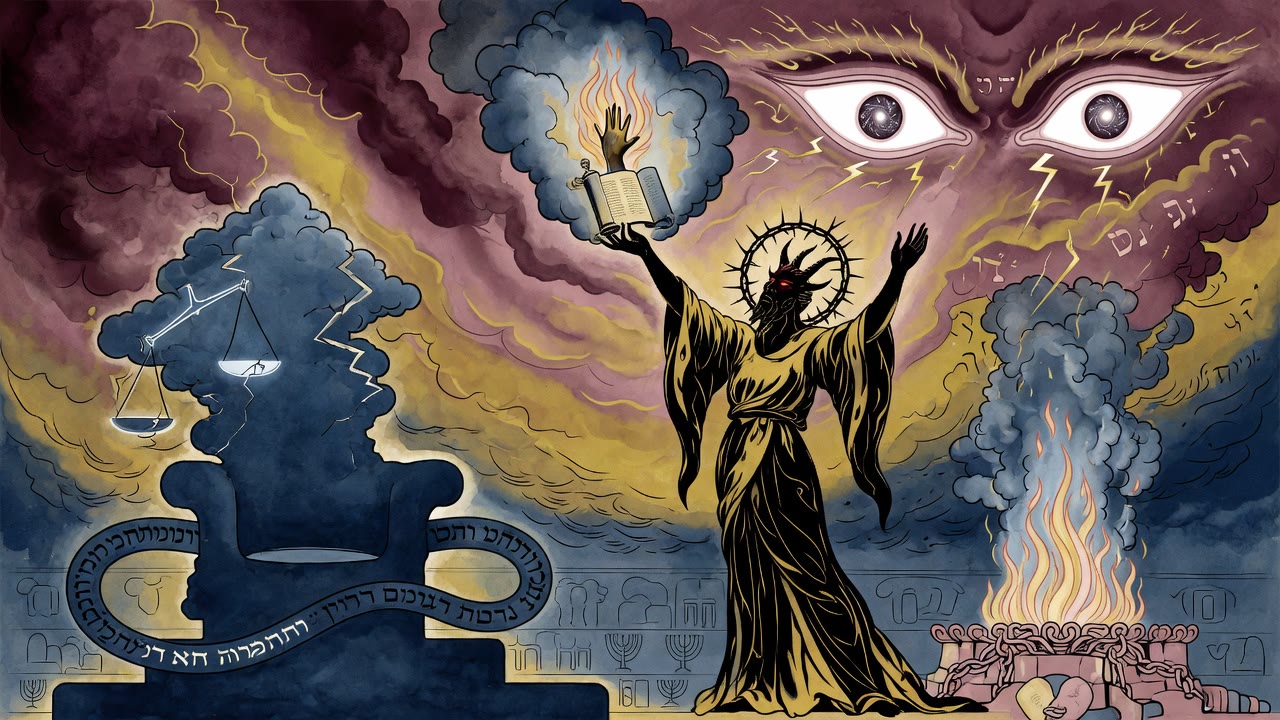
Understanding knew the truth already and still refused to rule, so Satan was sworn in as plaintiff and the eyes of God entered as witnesses.

Curated by Arthur · Told by Maggid ·
Table of Contents
  1. The Bench That Would Not Rule Without a Plaintiff
  2. Satan Sworn In and the Eyes Entered on the Roll
  3. The Man Who Waited for the Dark
  4. The Angels Came Asking for the Date
  5. Midnight Came by Vote of the Council
  6. Three Times the Judge Filed Against His Own
Binah Appointed Satan Plaintiff and God Filed His Own Suit Click for full size

The Bench That Would Not Rule Without a Plaintiff

The court of the rakia (רקיע), the firmament, opens the way a king's court opens on earth. A roll. A docket. An order of speaking nobody skips. At the head of the hall sits Binah (בינה), Understanding, who knows every answer the session will produce and will not say one of them aloud.

"Bring Me a plaintiff," Binah said. "Then bring Me witnesses."

Angels at the rail shifted where they stood. Understanding needs no informant. The hall itself had been laid out by that same Understanding. But nothing moved in that room on knowledge alone. Someone had to file the charge. Someone else had to stand and prove it. Truth came in through the door like everybody else or it did not come in.

Satan Sworn In and the Eyes Entered on the Roll

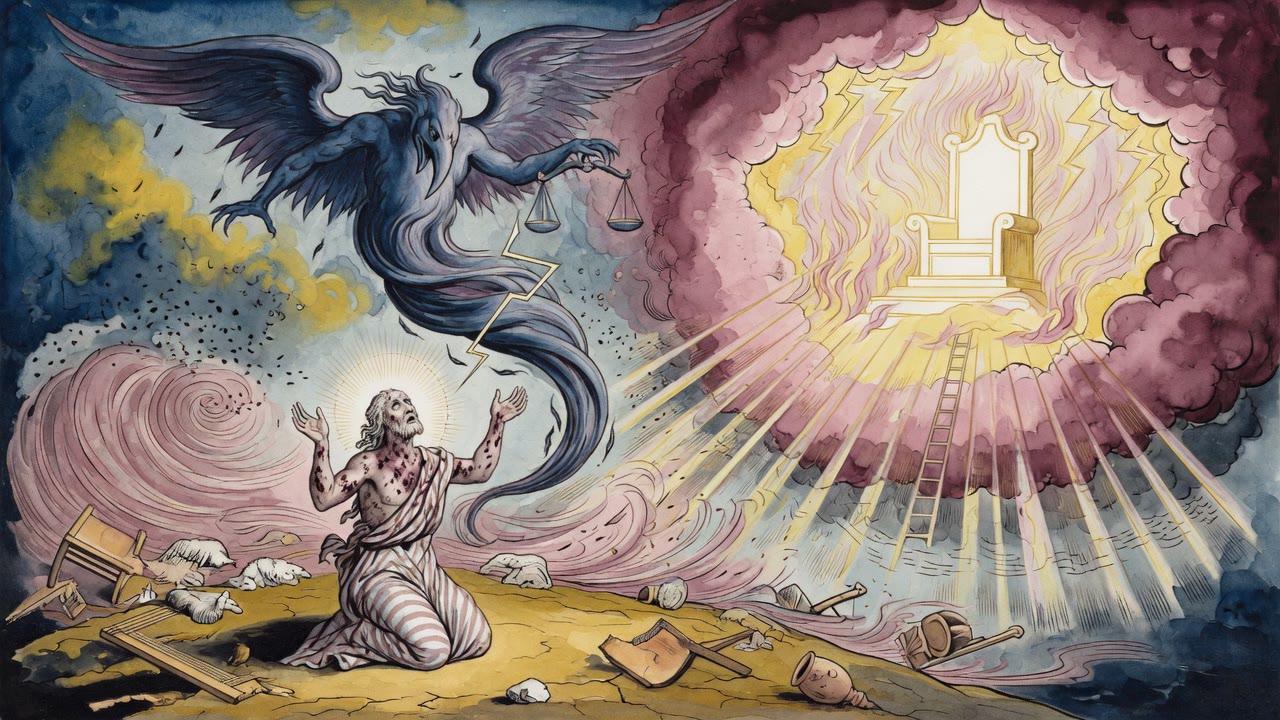
The one they call Satan came up the aisle and took the plaintiff's place without arguing. He is not the court's enemy. He is its officer, the accuser who carries the charge sheet up from below and reads out what is on it in a level voice. Binah put the case against the human race in his hands and told him to open it.

Then the witnesses were entered, and they were the eyes of God, which range over the hidden and the open alike, over the theft at noon in the market and the thing done at three in the morning behind a bolted door. In that court the timbers of a house are competent to testify. A man sins alone in a sealed room and the beams over his head take the stand.

The Man Who Waited for the Dark

The adulterer had done his arithmetic. He waited for night and recited the usual calculation. "No eye will behold me. Not an eye below and not an eye above." Others said it out loud, deep in their planning, and the words went onto the record: "Who sees us, and who knows of us?" God is at the apex of heaven, they said. Look how high the stars are. Clouds cover for Him and He does not look down.

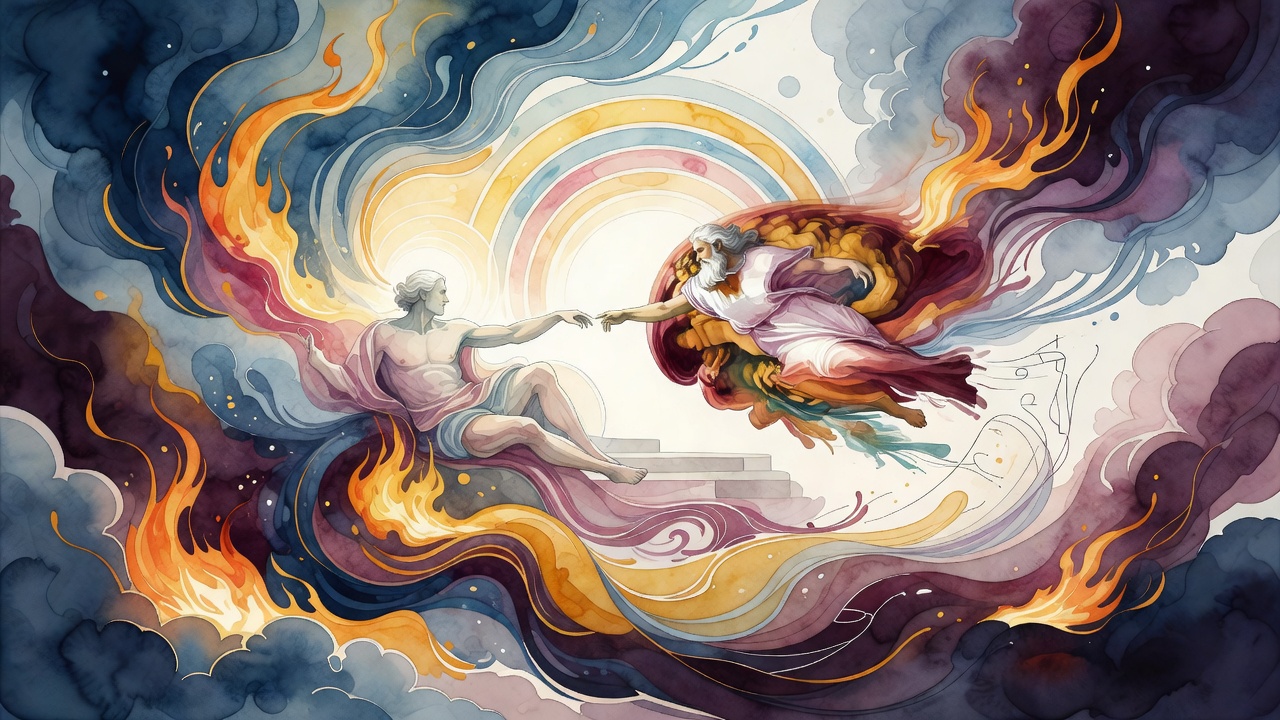
The court answered with the strangest sentence in its books. God, who dwells in secret, took the man's face and set it on the child.

The boy was born into a house where nobody suspected anything, and the face that came up out of that cradle belonged to a man four streets over. Forty days the shaping goes on inside her, and after that the divine hand is left over half-finished work. A painter was once commissioned for the king's portrait, and before the face was done the king died and another took the throne, and the painter stood there with a loaded brush and no idea whose likeness to finish. The Shekhinah (the Divine Presence), the Presence, works under that pressure.

They hid their valuables from the chief architect of the province, who had drawn the plans for every hiding place in it. "Is it from Me that you are hiding yourselves?" God said. "Is it not I who made the hearts?" He had built them chamber inside chamber, cavity upon cavity, heart and kidney, and into those chambers they packed the one lie the court hears most, that He does not see.

The Angels Came Asking for the Date

The ministering angels pressed in at the rail. A session needs a date.

"When is Rosh Hashanah?" they asked. "When is Yom Kippur?"

The Holy One turned it back on them. "Why are you asking Me? Come, I and you together, and we will go down to the court below."

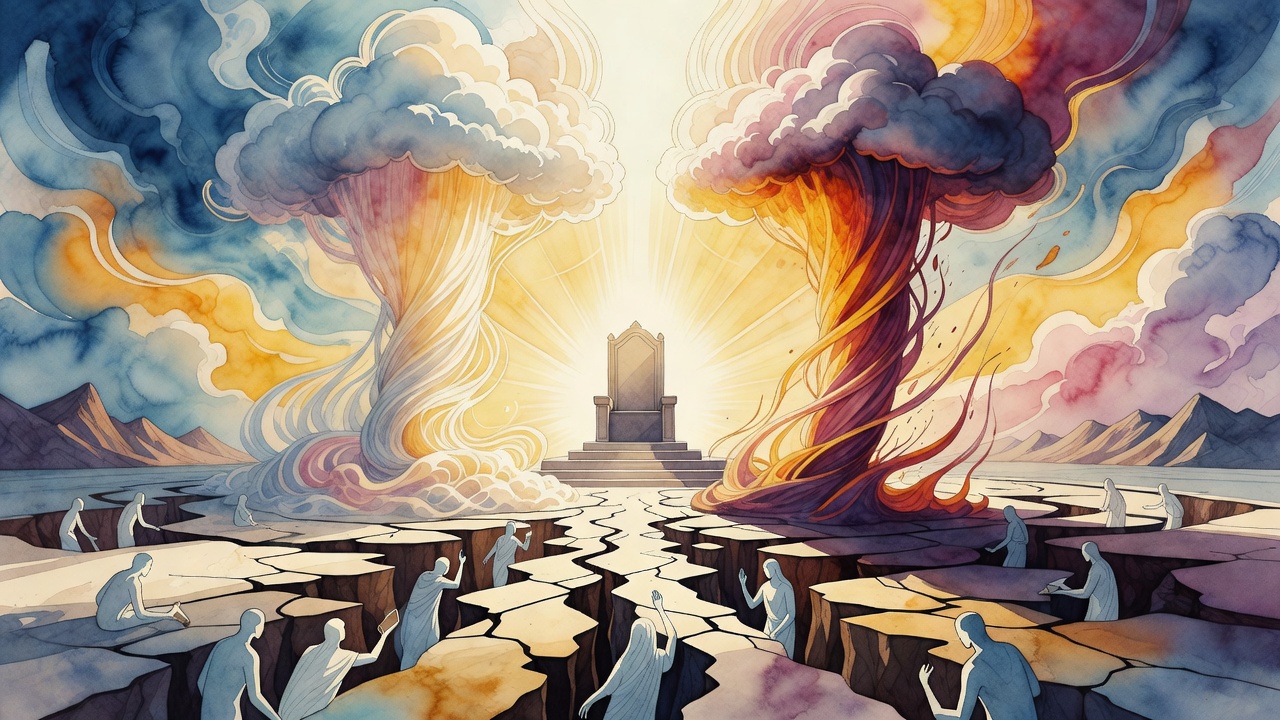
So the whole entourage went down. The judge, the officers, the plaintiff with his file, all of them outside a room where men with a calendar and two witnesses settled which day the year would be weighed. Before Sinai the times had been His alone, the appointed times of the Lord. After Sinai the wording changed toward the defendants: that you shall proclaim them. The accused now fix the date of their own trial, and heaven waits on the announcement.

Midnight Came by Vote of the Council

One session ran late over Egypt.

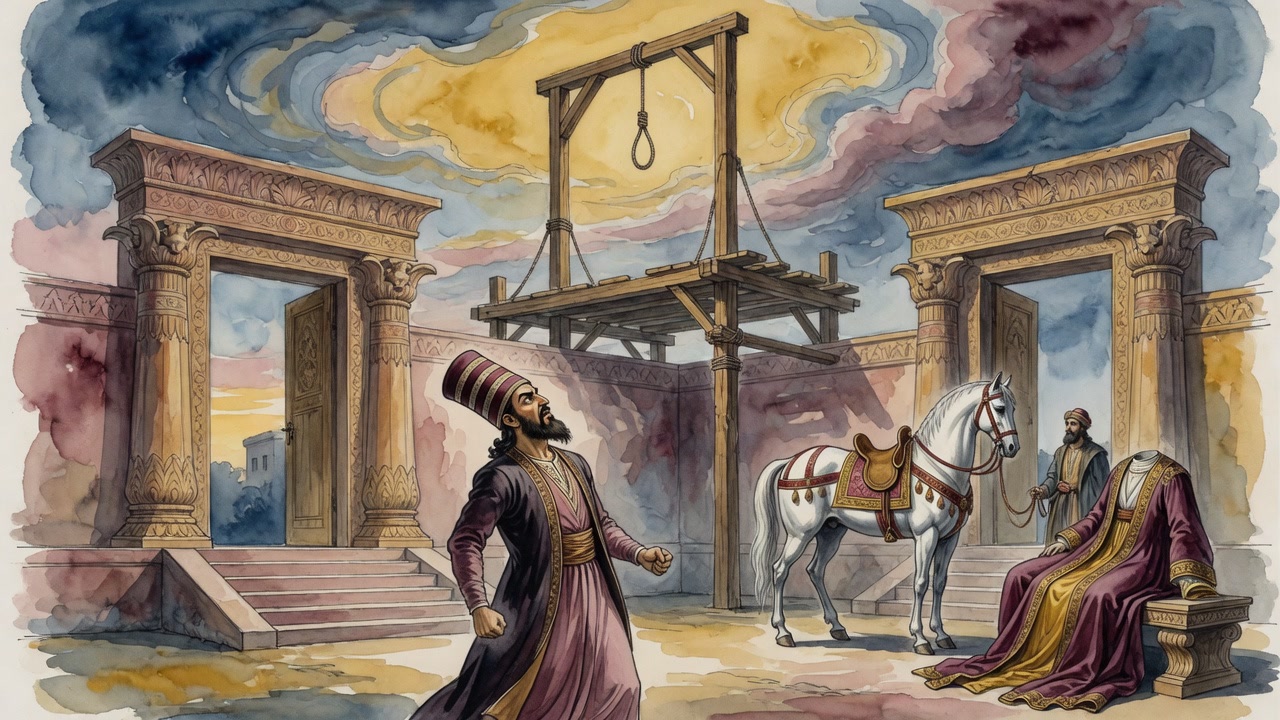
When the record says the Lord struck, He had not sat alone. He sat above the council in judgment, they took up the case of the firstborn of Egypt, and the decree left the court on high with an hour attached.

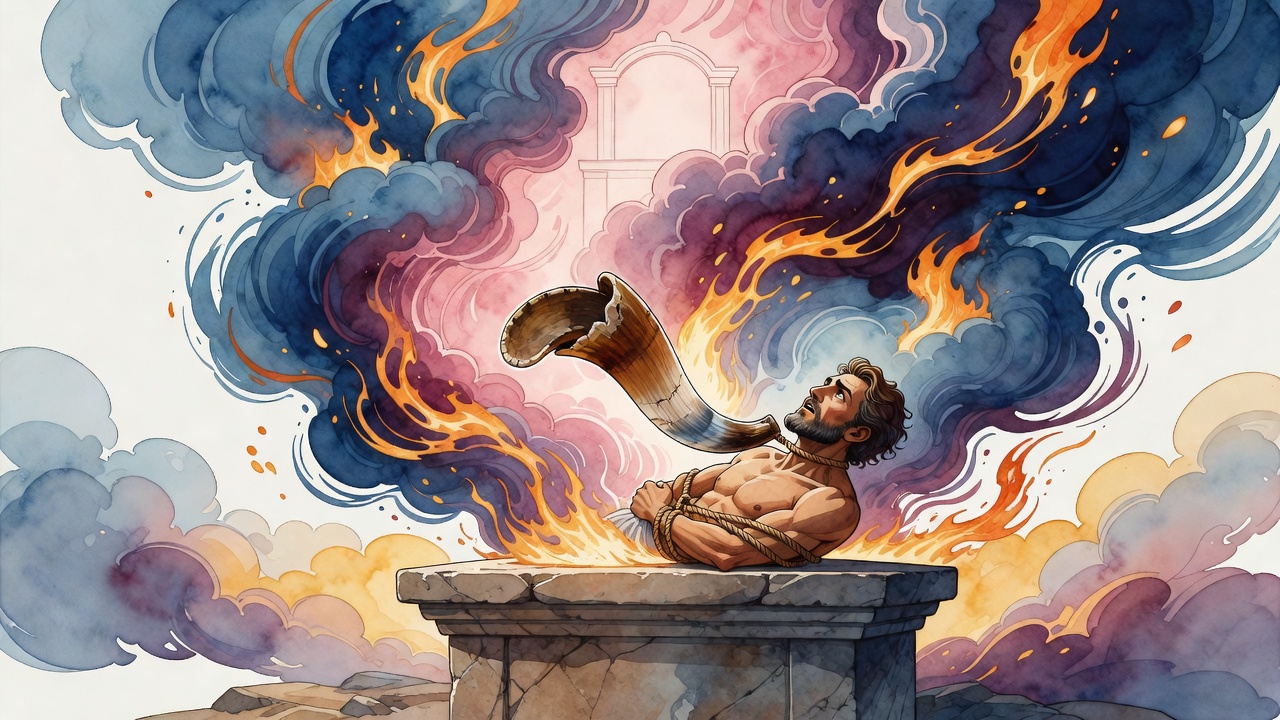
Then midnight arrived, and it arrived exactly, and from the throne room to the millstone there was a body in every house that had been a son.

Three Times the Judge Filed Against His Own

He sued Israel three times, and each time the nations of the world filled the gallery.

"Come now, and let us reason together," He said the first time. The gallery elbowed one another. "How can these argue a case against their own Creator? Now He finishes them." The Holy One saw them enjoying it and turned the whole suit over in His hand. "Though your sins be as scarlet, they shall be as white as snow." The nations sat with their mouths open. "Is that a reply? Is that a rebuke? He came in here to amuse Himself with His children."

The second time He called the mountains in to hear the suit, and the gallery settled back, certain of a burning. He opened by reminding Israel what Balak king of Moab had plotted against them, and the indictment turned into a defense while they watched.

The third time the writ named Judah, and the punishment of Jacob according to his ways, and the gallery leaned forward. The evidence He produced was that Jacob, in the womb, had grabbed his brother by the heel.

A woman once brought a complaint against her son before a judge. She sat in the back while the docket ran and the sentences came down all morning. If she named what her boy had done, this judge would hang him. So she let every other case go first. When the hall emptied he asked what the offense was. "When he was in my belly," she said, "he kicked me." The judge waited. "And has he done anything to you since?" "No." "Then go home. That is no offense at all."

"Testify against Me," He had told them at the start, "and take a reward for it." The gallery emptied. Satan stayed on his feet at the plaintiff's table with the charge sheet still open, and nobody told him to sit down.


← All myths
From the tradition

Sources

5 sources

The texts behind this telling. Some cards carry a translation of the source; others are our own retelling of it, and each card says which. Every card links out to the original.

Sefer HaKanah 45:6Sefer HaKanah

Retold in our words. Read the original at the link below.Sefaria Community Translation · CC-BY

This ancient text, the Sefer HaKanah, offers a glimpse into the inner workings of the divine. It tells us that Binah (Understanding), often translated as "understanding" or "intelligence," plays a crucial role. But what exactly is Binah in this context? Well, it’s not just simple comprehension. Think of it more like the divine blueprint, the way God organizes and understands all things.

The Sefer HaKanah reveals something fascinating: the celestial court, the "kingship of the firmament" – that rakia, that expansive dome we sometimes call the heavens – mirrors the way earthly governments are run. There’s order, there’s process, there’s even something resembling a legal system.

Here's the kicker: even though Binah, this divine understanding, knows the absolute truth, it doesn't just hand down judgments willy-nilly. It requires a plaintiff and witnesses! It's a system designed with checks and balances, a cosmic pursuit of justice. So who fills those roles?

In Sefer HaKanah, Binah actually appoints a litigator, a plaintiff, and this is where it gets interesting… it's Satan. Yes, that Satan. Now, before you jump to conclusions about divine malevolence, remember that in this context, Satan isn't necessarily the embodiment of pure evil. Instead, he serves as the "accuser," the one who brings forth the case against humanity. He's the cosmic prosecuting attorney, if you will.

And the witnesses? "The eyes of Hashem," the verse says, which see and watch over the hidden and visible actions of people. These aren’t literal eyeballs floating in the sky, of course. Think of them as the all-encompassing awareness of God, observing everything. The text is suggesting that Binah here refers to God's ideation, as distinct from God's eyes, meaning vision.

This reminds me of something the Chazal, our Sages, said: "If someone is to commit an aveira," a transgression, "in secret, the beams of his house testify against him. Even the inanimate objects around us seem to hold a memory of our actions, echoing the watchful "eyes of Hashem." It’s all connected.

The Sefer HaKanah concludes this section with an enigmatic phrase: "The beams of the crown and strengthening." The Hebrew here is a bit unclear, but the overall picture is anything but: a complex, divinely orchestrated system of judgment where even the accuser has a role to play and nothing escapes the Divine gaze.

So, what does this all mean for us? Perhaps it's a reminder that our actions, even those done in secret, have cosmic consequences. Maybe it’s an invitation to live with greater awareness, knowing that we are always, in a sense, being watched. Or perhaps it’s simply a glimpse into the awe-inspiring complexity of the universe, a reminder that there is always more to learn, more to understand, and more to contemplate within the vastness of Jewish wisdom.

Full source
Devarim Rabbah 2:14Devarim Rabbah

Retold in our words. Read the original at the link below.The Sefaria Midrash Rabbah, 2022 · CC-BY

A quote from Deuteronomy, saying God is "near it." But who is "it"? The verse itself speaks of a nation that has God near to it. Devarim Rabbah, in its characteristic fashion, finds something deeper there.

Rabbi Yoḥanan offers a stunning image. He says that when the ministering angels gather before the Holy One, Baruch Hu (blessed be He), and ask, "When is Rosh Hashanah (the Jewish New Year)? When is Yom Kippur (the Day of Atonement)?". God turns the question around!

"Why are you asking Me?" God replies, according to Rabbi Yoḥanan. "Let us, I and you, go to the earthly court."

Wait, what earthly court? What's going on here?

The Midrash (rabbinic interpretive commentary) finds support for this idea in that very verse: “That has God near [kerovim] it.” The text emphasizes that it doesn't say God is near to the nation, but rather the nation has God near it. It's not written, "Who has a nation near [Him]," but rather, "That has God near it." The Midrash interprets this to mean that God and His entire entourage are close to Israel.

The implication, according to this reading, is that, to a certain extent, Israel is primary. But how can that be? How can mortals determine the holy days?

Rabbi Yoḥanan continues, offering an explanation. The Holy One, blessed be He, says, "Until you became My nation – 'the appointed times of the Lord' (Leviticus 23:2)." This refers to the period before the giving of the Torah, when God alone determined the calendar. "From then on," God continues, "'that you shall proclaim them' (Leviticus 23:2)."

In other words, once the covenant was established, the responsibility for proclaiming the holy days – for determining the calendar – shifted, at least in part, to Israel.

It suggests that human agency, our choices and actions here on Earth, actually influence the divine realm. It means that the Jewish calendar, and by extension the Jewish experience of time, is a partnership between God and humanity.

We are active participants in shaping it, in interpreting it, and in living it out in the world. We have a role to play, not just in observing the holidays, but in understanding their meaning and making them relevant to our lives. It's a weighty responsibility, but also an incredible privilege.

Full source
Bamidbar Rabbah 9:1Bamidbar Rabbah

Retold in our words. Read the original at the link below.The Sefaria Midrash Rabbah, 2022 · CC-BY

A fascinating, and frankly, a little unsettling, passage from Bamidbar Rabbah 9 that tackles this very idea, exploring the consequences of hidden sins, specifically adultery, and how, according to Jewish tradition, nothing truly escapes divine notice.

The passage begins with a verse from Numbers (5:12) about a wife who "strays and commits a trespass" against her husband. But it quickly pivots to Deuteronomy (32:18): "You neglected the Rock that begot you…" The connection? Bamidbar Rabbah sees adultery as a form of neglecting God, a turning away from the source of creation.

Why? Because, as the text goes on to explain, based on verses from Job, Proverbs, and Isaiah, adulterers believe they are acting in secret, cloaked in darkness, hidden from prying eyes. They think, "Who sees us? Who knows of us?" (Isaiah 29:15). They convince themselves that because their actions are concealed, God is unaware.

Here’s where it gets really interesting. Quoting (Job 22:12-15), the text challenges this notion: "Is God not at the apex of heaven? See the height of the stars, how lofty they are. You say: What does God know?… Clouds obscure for Him and He does not see…" It’s a direct rebuke to the idea that God's vision is somehow limited.

And then comes a truly striking image. The passage quotes (Job 24:15), "The eye of the adulterer awaits the night, saying: No eye will behold me – neither an eye below nor an eye above. What is, 'and he masks [yasim] his face [panim] clandestinely [veseter]?'" The text interprets this to mean that God, who dwells in secret (seter), will place (yasim) the face (panim) of the adulterer on the child born from the adulterous union. In other words, God will reveal their sin to the world. The ultimate act of secrecy, the adulterous act itself, is paradoxically made public. The shame, the hidden deed, becomes visible for all to see. The text calls adultery zima, lewdness, because the guilty parties deny it, but the evidence is undeniable. Even if the woman is already pregnant by her husband, and then commits adultery, God can alter the child's features to resemble the adulterer. This isn't just about physical resemblance; it's about exposing the hidden truth.

Rabbi Yitzchak adds another layer, arguing that adultery weakens the power of the Shekhinah, the Divine Presence. He explains that God shapes the fetus within forty days of conception. But if adultery occurs after that, God is, metaphorically speaking, left wondering whose features to imprint on the child. It's as if the adulterer is causing a divine dilemma, a weakening of God's creative act.

Rabbi Abbahu uses a powerful analogy: a painter commissioned to paint the king's portrait. Before the face is finished, the king dies and another takes his place. The painter is left bewildered, unsure whose likeness to complete. Similarly, the adulterer mixes the "paints," confusing the divine artist and forcing a transformation of the child's features. This echoes (Hosea 4:5): "Cursing, lying, murder, theft, and adultery have broken out, and blood touches blood."

The passage concludes with an analogy to a chief architect of a province. The residents try to hide their valuables from him, forgetting that he designed the very hiding places they use. Similarly, God says to the adulterers, "Is it from Me that you are hiding yourselves? Is it not I who created the hearts?" (Jeremiah 17:10). We forget that God probes the heart and examines the kidneys, the innermost parts of our being. To forget this, to believe we can truly hide our actions, is to neglect the very source of our being, our meḥolelekha, our Originator. God created us, crafted us cavity upon cavity (meḥilim meḥilim) – these being our hearts and kidneys – yet we lie, claiming God doesn’t see or know.

So, what are we left with? A stark reminder that our actions, even those performed in the deepest secrecy, have consequences. Not just in this world, but, according to this ancient text, on a cosmic scale. It's a call to remember that we are always seen, always known, and that true integrity lies not in avoiding detection, but in living a life worthy of the One who created us.

Full source
Midrash Tanchuma Buber, Bo 17:3Midrash Tanchuma Buber, Bo

Translation of the source text.Midrash Tanchuma (Buber), Public Domain, on Sefaria · CC-BY-SA

(Exodus 12:29:) "And it came to pass at midnight, that the LORD (literally: and the LORD) smote all the firstborn in the land of Egypt." Rabbi Eleazar ben Padat said: Wherever it is stated "and the LORD," it means He and His council. The Holy One, blessed be He, sat over them in judgment, and the court on high decreed that the firstborn of Egypt should be smitten. Therefore (Scripture says): "And it came to pass at midnight," and so forth.

Full source
Midrash Tanchuma Buber, Emor 13:1Midrash Tanchuma Buber, Emor

Translation of the source text.Midrash Tanchuma (Buber), Public Domain, on Sefaria · CC-BY-SA

[Another interpretation of "A bull or a sheep." This text is connected] to (Micah 6:3): "My people, what have I done to you, and how have I wearied you? Testify against Me." Rabbi Aha said: Testify against Me and receive a reward; "you shall not testify against your neighbor falsely" (Exodus 20:13), and you will receive a verdict and a reckoning.

Rabbi Samuel bar Nahman said: On three occasions the Holy One, blessed be He, came to dispute with Israel, and the nations of the world rejoiced and said: How can these be able to dispute with their Creator? Now He is destroying them. At that hour when He said to them, "Come now, and let us reason together" (Isaiah 1:18), they rejoiced and said: Now He is destroying them. When the Holy One, blessed be He, saw that they were rejoicing, He turned it for them to the good. He said, "Though your sins be as scarlet, they shall be as white as snow" (ibid.). When the nations of the world heard this, they were astonished and said: Is this a reply, and is this a rebuke? They said: He has come only to amuse Himself with His children.

The second, when He said to them, "Hear, O mountains, the lawsuit of the Lord, [for the Lord has a lawsuit with His people, and He will dispute with Israel]" (Micah 6:2), the nations of the world rejoiced and said: Now He is destroying them. When the Holy One, blessed be He, saw this, He turned it for them to the good and said, "My people, remember now what Balak king of Moab plotted... With what shall I come before the Lord?" (ibid. 6:5-6). The nations of the world were astonished and said: Is this a reply, and is this a rebuke? He has come only to amuse Himself with His children.

The third, when He said, "And the Lord has a lawsuit with Judah, [and will punish Jacob according to his ways]" (Hosea 12:3). The nations of the world said: Now the Holy One, blessed be He, is destroying them. When the Holy One, blessed be He, saw this, He turned it for them to the good: "In the womb he grasped his brother by the heel" (ibid. 12:4).

A parable: This is like a woman who was lodging a complaint about her son before a judge. When she saw that the judge was sentencing the people to execution, [she said]: If I make known my son's offense, he will order him to be put to death. What did she do? She delayed [until] he had finished his cases. He said to her: What is your son's offense? She said to him: When he was in my belly, he kicked me. He said to her: And has he done anything to you now? She said: No. He said to her: Go, this is no offense at all. The nations of the world were astonished [and said]: Is this a reply, and is this a rebuke? He has come only to amuse Himself with His children.

Full source