5 min read

Haman Built the Gallows and Hanged on It Himself

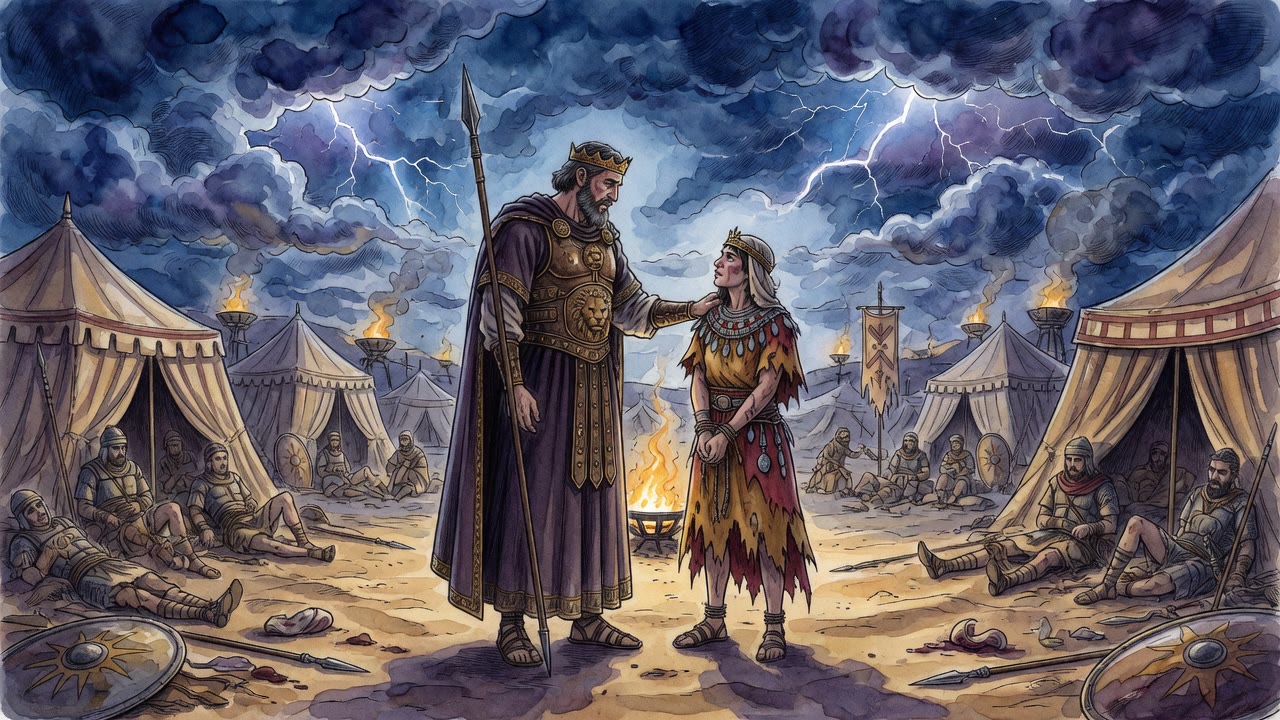
Haman arrived at the palace before dawn to ask for Mordechai's death. He left with orders to lead Mordechai through the streets in the king's own robes.

Curated by Arthur · Told by Maggid ·
Table of Contents
  1. Before Dawn
  2. The Conversation He Walked Into
  3. What the Angels Saw
  4. Esther's Timing
  5. The Gallows Already Built

Before Dawn

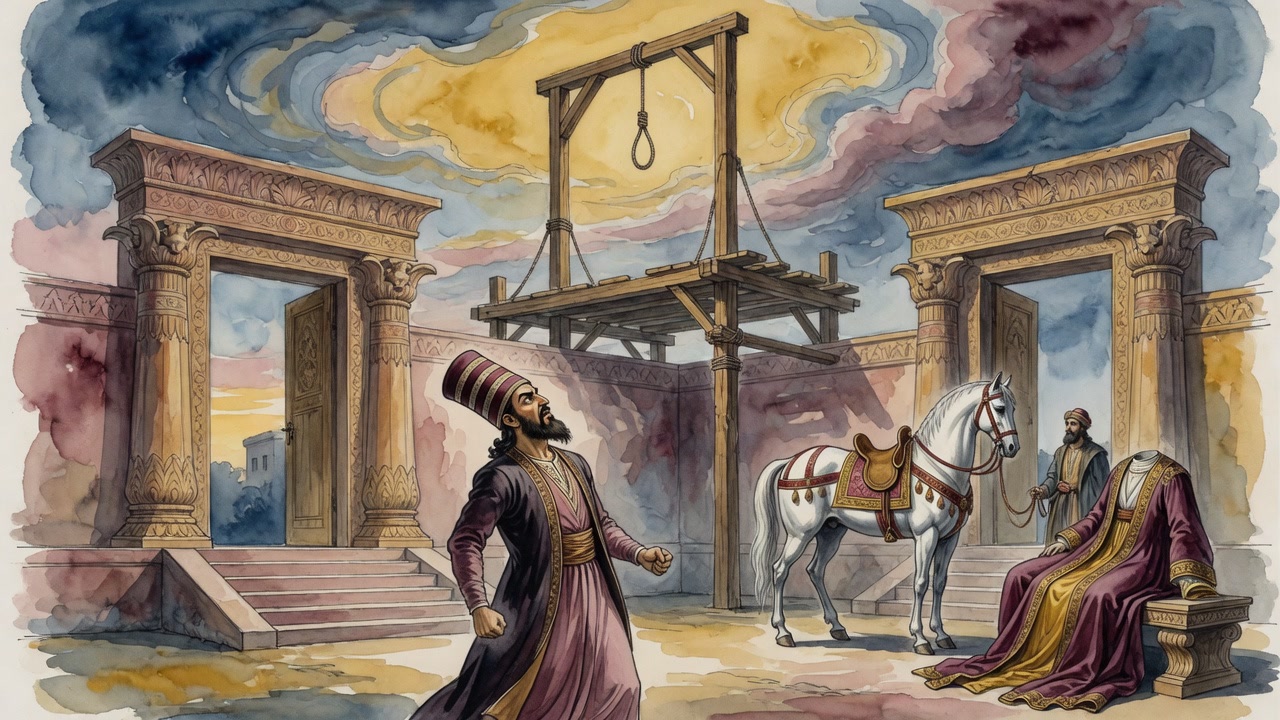
Haman had the gallows built before he had the execution order. Fifty cubits tall, high enough to be visible across Shushan, high enough that the whole city would see Mordechai hanging. He built it that night, in his own courtyard, because he was so certain of the outcome that he began construction on the conclusion before the conversation had taken place.

His wife Zeresh and his advisors had not tried to stop him. But one of them, or Zeresh herself, had said the words that had been running through the night like water under ice: "If Mordechai, before whom you have begun to fall, is of the seed of the Jews, you shall not prevail against him." They quoted the Book of Esther back at itself, as though aware they were already inside a story whose ending they could read. Haman had not listened. He had the gallows built anyway. He intended to go to the king at first light and ask for the hanging order, and then the question of Mordechai's seed would be irrelevant.

The Conversation He Walked Into

The king had not slept. His servants had read the chronicles aloud through the dark hours and had come to the story of Mordechai's unrewarded loyalty, how the man had reported the assassination plot that saved Ahasuerus's life, and the king had realized nothing had been done for him. He asked what honor had been given to Mordechai. His servants told him: nothing.

Haman arrived in the outer court before the palace had opened properly. The king heard he was there and called him in immediately. He had a question: what should be done for a man the king wishes to honor?

Haman, certain this was about him, described the most public and glorious ceremony he could imagine: royal robes, the king's own horse with a crown on its head, a noble to lead the horse through the city square while shouting that this is what the king does for a man he honors. He built the ceremony as carefully as he had built the gallows, constructing the humiliation of his enemy out of the bricks of his own pride.

The king said: "do exactly this for Mordechai the Jew who sits at the king's gate. Leave out nothing you have said."

What the Angels Saw

Pirkei DeRabbi Eliezer recorded what was happening in heaven while Haman bent low so that the exhausted and fasting Mordechai could climb onto the horse. Mordechai, worn out from three days without food or water, was too weak to mount the animal without help. Haman knelt as a step. The man who had built a fifty-cubit gallows for this person's execution was now serving as a footstool for his triumphant ride through the capital.

The angels of God were watching. They were doing something that angels are not commonly described as doing: they were laughing. The reversal was so complete, so precisely proportioned to the offense, so structured as a mirror image of what Haman had intended, that heaven itself found it formally satisfying.

Esther's Timing

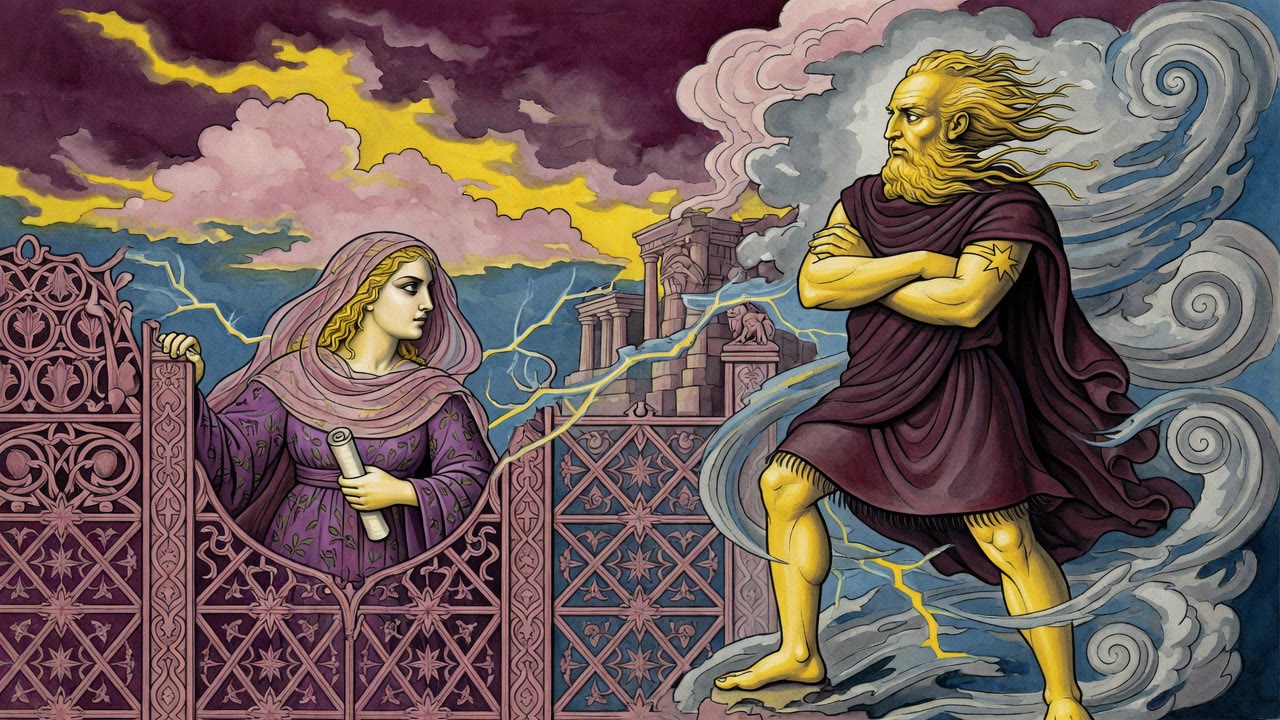
The Legends of the Jews noted that Esther had not been ready to reveal Haman's plot at the first banquet. She drew inspiration from Moses, who had prepared an entire day before facing the descendant of Amalek. Haman was that descendant. The confrontation required the same preparation. She gave the second banquet. She waited for the wine and the atmosphere and the king's repeated offer of whatever she desired. Then she made her accusation in a single sentence: "an adversary and an enemy, this wicked Haman."

The king stepped into the garden to recover his composure. Haman, alone in the room with Esther, fell on her couch to beg for mercy. The king came back and saw him on the couch and interpreted it as assault. The servants immediately covered Haman's face, the Persian gesture that meant a condemned man, a man whose fate was sealed.

The Gallows Already Built

One of the king's chamberlains mentioned, at exactly this moment, that there was a gallows standing in Haman's courtyard. Fifty cubits tall. Built last night, apparently, for Mordechai, the man who had saved the king's life.

"Hang him on it," the king said.

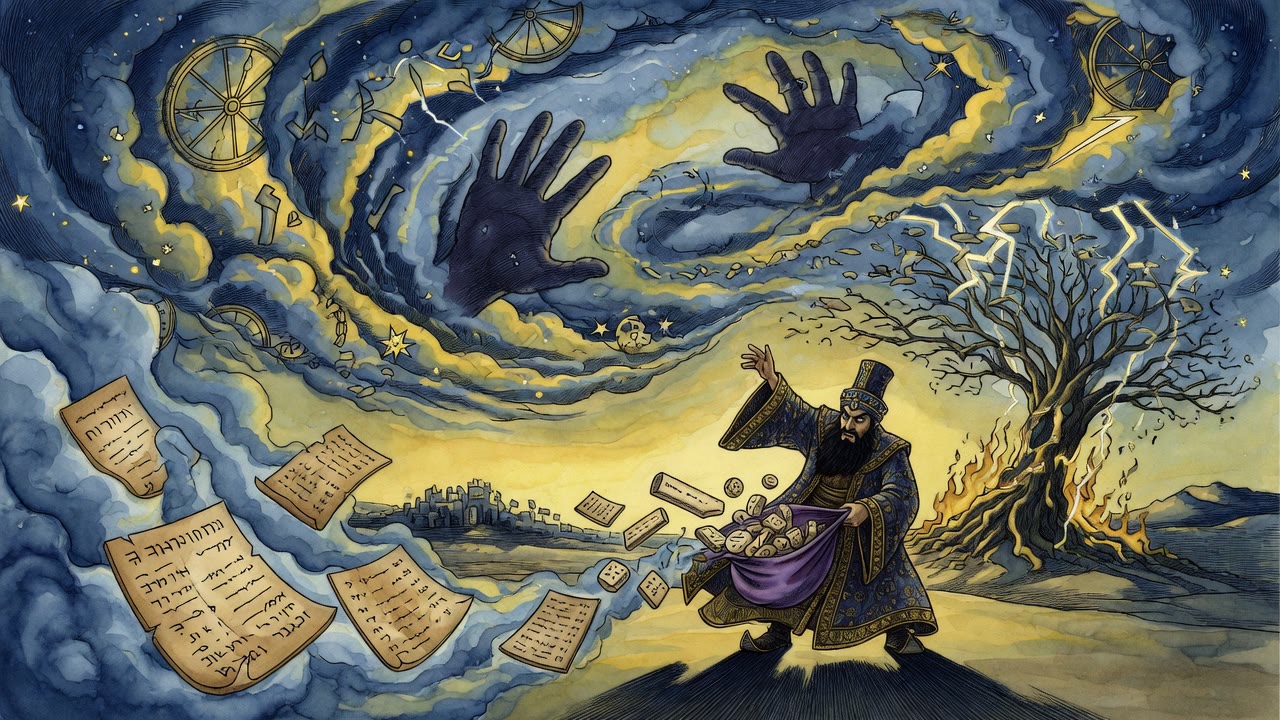
The Talmud tracked the mathematics of this reversal. The word for "the silver" that Haman had offered the king to destroy the Jews added up, in Hebrew gematria, to one hundred and sixty-five. The word for the gallows added up to the same number. The silver Haman had weighed out as the price of the Jews was numerically identical to the wood he had raised for Mordechai. The rabbis read this as the signature of divine justice: exact, proportional, hidden in the arithmetic of the letters themselves, visible only to those who knew how to count.


← All myths

From the tradition

Sources

6 sources

The texts this telling draws on, in full. Open a card to read inline, or expand it for a wider, quieter read.

Legends of the Jews 12:187Legends of the Jews

That’s where we find Esther in the story, right after that fateful banquet.

King Ahasuerus, still riding high on the wine and the atmosphere, repeats his offer. He's practically begging her: "Ask anything, Esther! Anything at all, and it's yours. Except," he adds, with a hint of stubbornness, "except the Temple. That's off-limits."

Esther, ever the shrewd strategist, isn't ready to play her hand. Not yet. Why? Well, she’s playing the long game. She understands timing. The text mentions her drawing inspiration from Moses himself. Remember when Moses prepared for a whole day before facing Amalek? (Exodus 17:9-13). Amalek, was considered the ancestor of Haman – a connection fraught with meaning. So, Esther needs a day to prepare before her confrontation with Haman. One day can make all the difference.

What about Haman? Oh, he's having a day.

He’s positively giddy! He's been invited to not one, but two private banquets with the King and Queen. He thinks he's the bee's knees, the cat's pajamas, the… well, you get the idea. He’s absolutely convinced that he's the most important person in the entire kingdom.

He's "deceived by the attention and distinction accorded him by Esther." He believes he’s got the king's favor, the queen's respect… What could possibly go wrong? He’s puffed up with pride, completely blind to the trap being set for him. He is blinded by his own ego.

It reminds you, doesn’t it, how easily we can misread situations when our own desires and ego get in the way? How often do we see what we want to see, rather than what's actually there? Haman’s overconfidence becomes his downfall, a potent reminder of the dangers of unchecked ego. What a setup for tomorrow’s revelation!

Full source
Legends of the Jews 12:230Legends of the Jews

The scene is set: a lavish banquet, King Ahasuerus at the head of the table, and the villainous Haman anxiously present. According to Legends of the Jews, even as everyone’s eating and drinking, the king's chamberlains are practically dragging Haman to the banquet, worried he and his sons might be plotting something against the king.

Ahasuerus, still clueless, repeats his promise to grant Esther whatever she desires. Now, all this time, he’s secretly hoping she’ll ask for the rebuilding of the Temple in Jerusalem. But Esther, she has a different plea altogether.

She raises her eyes heavenward – a little detail that speaks volumes, doesn't it? – and says, "If I have found favor in thy sight, O Supreme King, and if it please Thee, O King of the world, let my life be given me, and let my people be rescued out of the hands of its enemy."

She’s speaking on two levels here, addressing both the earthly king and, subtly, the King of the Universe. She’s not just asking for a personal favor; she’s pleading for the survival of an entire people.

Ahasuerus, though, completely misses the divine undertones. Thinking she’s talking only to him, he explodes in irritation: "Who is he, and where is he, this presumptuous conspirator, who thought to do thus?" He demands to know who dares threaten his queen.

Now, here’s a fascinating detail from Ginzberg’s retelling in Legends of the Jews. These were actually the first words the king had ever spoken directly to Esther! Up until this point, he’d always communicated through an interpreter. Can you imagine? The king and queen, living in the same palace, yet separated by formality and suspicion. He wasn’t sure she was “worthy” enough to address directly.

But now, everything changes. He's suddenly aware of the fact that she is a Jewess, and, even more, of royal descent! This revelation breaks through the barriers, and he speaks to her directly, without anyone in between.

It’s a powerful moment of recognition, isn’t it? A moment where prejudice and protocol crumble in the face of truth. The stage is set for Esther to reveal Haman's treachery and change the course of history. But the real question is: what will she say next? And how will Ahasuerus react when he finally understands the full scope of Haman's evil plan?

Full source
Pirkei DeRabbi Eliezer 50:10Pirkei DeRabbi Eliezer

Pirkei DeRabbi Eliezer turns to Esther, Haman and the Angels.

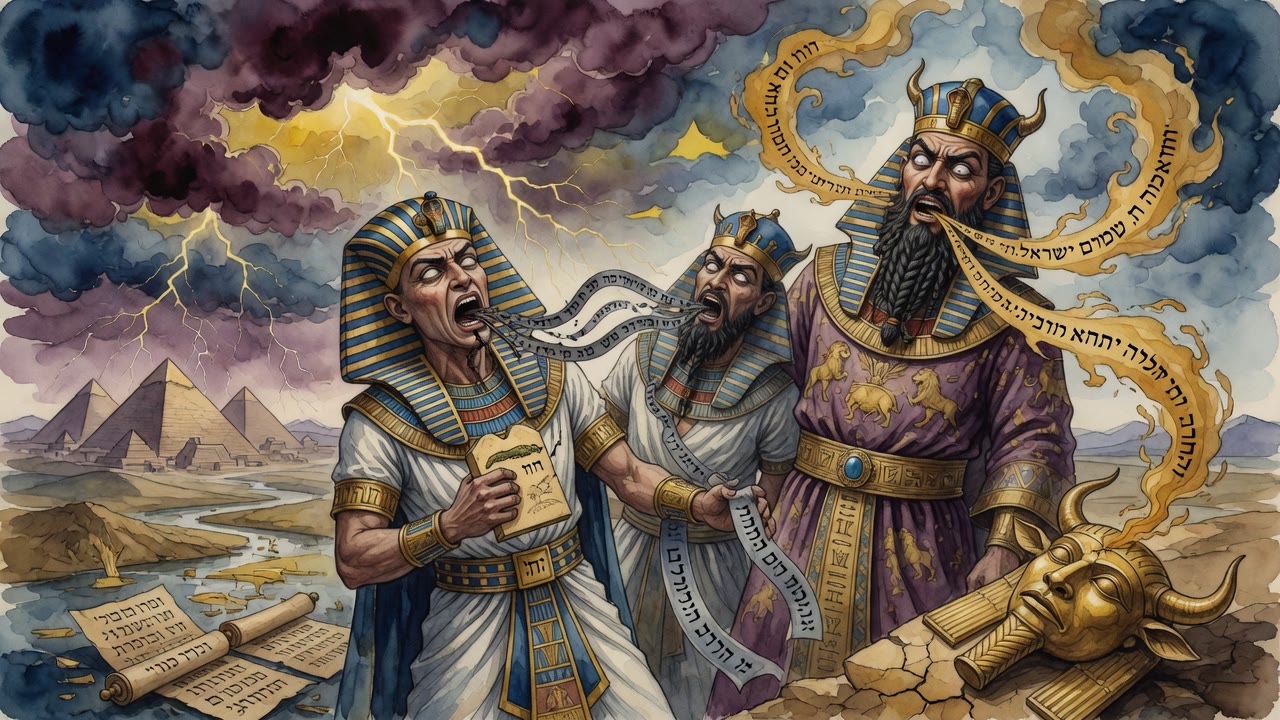
It all starts with Zeresh, Haman's wife, and his astrologers. They recognize a looming threat. "Haven't you heard what happened to Pharaoh?" she asks, according to the Pirkei DeRabbi Eliezer. She even quotes the Book of Esther itself (Esther 6:13): "If Mordecai, before whom you have begun to fall, is of the seed of the Jews, you shall not prevail against him."

Then comes the fateful banquet. Esther reveals Haman's plot to the king. When she pleads for her life and the life of her people, explaining that they've been sold to be destroyed, the king is understandably furious. "Who is this man?" he demands. Esther's response is iconic: "An adversary and an enemy, even this wicked Haman!" (Esther 7:6).

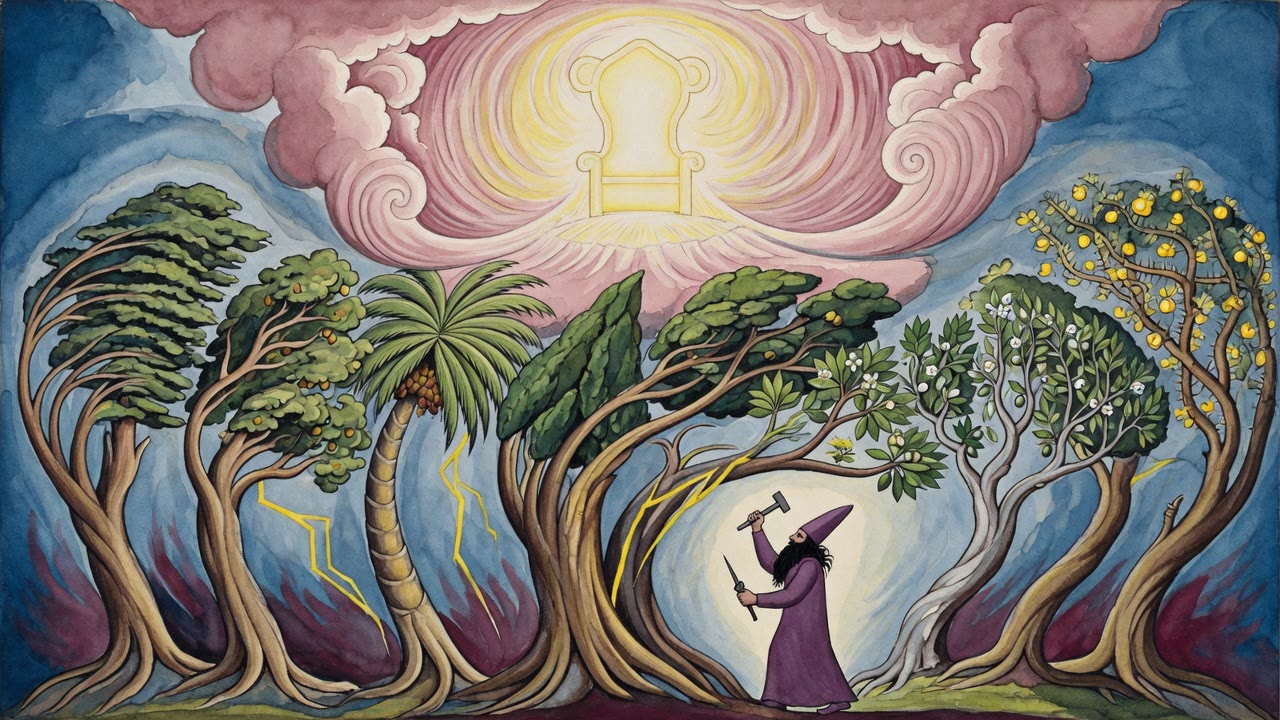
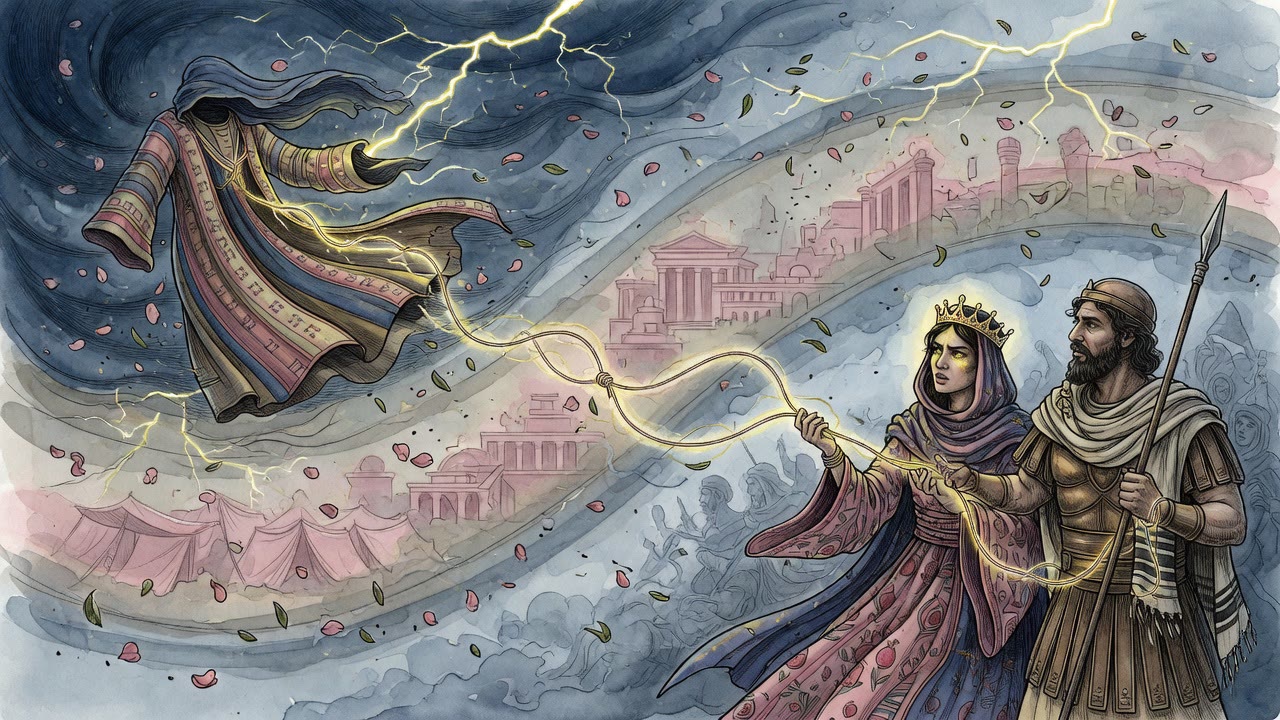
This is where the Pirkei DeRabbi Eliezer adds some real spice. "The king arose in his wrath" (Esther 7:7), and what does the angel Michael do? He starts cutting down the plants in the palace garden! Why? The text doesn't say explicitly, but we can imagine it's a symbolic act of divine fury, clearing the way for justice.

And it gets even more dramatic. When the king returns from the garden, Michael apparently lifts Haman up from Esther. The king, seeing this, cries out, accusing Haman of not just wanting to destroy her people but of assaulting the queen herself! The horror! Hearing this, Haman's face falls – literally. "They covered Haman's face" (Esther 7:8).

But wait, there's more! The Pirkei DeRabbi Eliezer credits the prophet Elijah, may his memory be a blessing, with a crucial assist. Disguised as Harbonah, one of the king's chamberlains, Elijah informs the king about a massive tree in Haman's house, a tree originally taken from the Kodesh Hakodashim, the Holy of Holies! The text connects it to the "house of the forest of Lebanon" mentioned in (1 Kings 7:2). Talk about poetic justice!

The king, enraged, orders Haman to be hanged on that very tree, fulfilling the prophecy: "Let a beam be pulled out from his house, and let him be lifted up and fastened thereon; and let his house be made a dunghill for this" (Ezra 6:11). And so, "they hanged Haman on the gallows that he had prepared for Mordecai" (Esther 7:10).

Finally, the king gives all of Haman's possessions to Mordecai and Esther, empowering them to write new decrees in the king's name. These decrees, sent throughout the provinces, authorize the Jews to defend themselves against their enemies on the thirteenth of Adar, a date that falls "on the third day in the constellation of Leo." The text draws a powerful analogy: "Just as the lion is the king over all the beasts, and he turns his gaze towards any place as he wishes; likewise did he think fit, and he turned his face to destroy and to slay all the enemies of Israel." What a vivid image of divine retribution!

So, what does this all mean? The Pirkei DeRabbi Eliezer gives us a richer, more textured understanding of the Purim story. It reminds us that even in the face of seemingly insurmountable odds, divine intervention, clever strategy, and unwavering faith can triumph over evil. And sometimes, a little help from the angel Michael and the prophet Elijah doesn't hurt either.

Full source
Antiquities XI.6Antiquities of the Jews (Josephus)

The story of Esther begins with a drunken king and a queen who said no. King Artaxerxes of Persia hosted a lavish feast, 180 days of celebration for his court, then seven more days for the public. Golden cups, purple curtains, pillars of silver. At the climax, he summoned Queen Vashti to display her beauty before his guests. She refused. Persian law forbade wives from appearing before strangers, but the king's advisors told him this defiance would inspire every woman in the empire to disobey her husband. Vashti was banished.

The king's servants searched the empire for the most beautiful virgins. They found Esther, a Jewish orphan raised by her uncle Mordecai of the tribe of Benjamin. She was, Josephus writes, "the most beautiful of all the rest." She told no one she was Jewish. The king fell in love immediately and crowned her queen.

Meanwhile, Mordecai uncovered an assassination plot against the king and reported it through Esther. The conspirators were executed, and the incident was recorded in the royal chronicles, then forgotten.

Enter Haman, an Amalekite nobleman whom the king elevated above all other officials. Every courtier bowed to Haman. Mordecai alone refused, not out of pride, but because as a Jew he would bow to no human. Haman was furious. But punishing one man was beneath him. He decided to destroy every Jew in the Persian Empire. He told the king that a dangerous people scattered throughout his provinces kept their own laws and refused to obey the king's commands. Artaxerxes, trusting his chief minister, signed the decree: on the thirteenth of the month of Adar, every Jewish man, woman, and child would be killed, and their property confiscated. Letters went out to all 127 provinces. Mordecai put on sackcloth and wailed at the palace gate.

Full source
Shabbat 88aTalmud Bavli, Shabbat

and according to the Rabbis, they established eight months that were lacking. The Gemara cites another objection. Come and hear that which was taught in a baraita in the anthology called Seder Olam: In the month of Nisan during which the Jewish people left Egypt, on the fourteenth they slaughtered their Paschal lambs, on the fifteenth they left Egypt, and that day was Shabbat eve. From the fact that the New Moon of Nisan was on Shabbat eve, we can infer that the New Moon of Iyyar was on the first day of the week, and the New Moon of Sivan was on the second day of the week.

This is difficult according to the opinion of Rabbi Yosei, who holds that the New Moon of Sivan was on Sunday. The Gemara answers that Rabbi Yosei could have said to you: Whose is the opinion in this baraita? It is the opinion of the Rabbis. Therefore, this baraita poses no difficulty to the opinion of the Rabbi Yosei.

The Gemara cites another objection: Come and hear from that which was taught, that Rabbi Yosei says: On the second day of Sivan, Moses ascended Mount Sinai and descended. On the third day, he ascended and descended. On the fourth day, he descended and did not ascend Mount Sinai again until he was commanded along with all of the Jewish people. And the Gemara asks: How is it possible that he descended on the fourth day?

Since he did not ascend, from where did he descend? Rather, this must be emended: On the fourth day, he ascended and descended. On the fifth day, he built an altar and sacrificed an offering. On the sixth day, he had no time.

The Gemara asks: Is that not because he received the Torah on the sixth day of the month? Apparently, this baraita supports the opinion of the Rabbis. The Gemara rejects this: No, he had no time due to the burden of preparing for Shabbat. The Gemara adds: A Galilean taught, while standing above Rav Ḥisda: Blessed is the all-Merciful One, Who gave the threefold Torah: Torah, Prophets, and Writings, to the three-fold nation: Priests, Levites, and Israelites, by means of a third-born: Moses, who followed Aaron and Miriam in birth order, on the third day of the separation of men and women, in the third month: Sivan.

On whose opinion is this homily based? It is based on the opinion of the Rabbis, who hold that the Torah was given on the third day of separation and not on the fourth day. The Gemara cites additional homiletic interpretations on the topic of the revelation at Sinai. The Torah says, “And Moses brought forth the people out of the camp to meet God; and they stood at the lowermost part of the mount” (Exodus 19:17).

Rabbi Avdimi bar Ḥama bar Ḥasa said: the Jewish people actually stood beneath the mountain, and the verse teaches that the Holy One, Blessed be He, overturned the mountain above the Jews like a tub, and said to them: If you accept the Torah, excellent, and if not, there will be your burial. Rav Aḥa bar Ya’akov said: From here there is a substantial caveat to the obligation to fulfill the Torah. The Jewish people can claim that they were coerced into accepting the Torah, and it is therefore not binding.

Rava said: Even so, they again accepted it willingly in the time of Ahasuerus, as it is written: “The Jews ordained, and took upon them, and upon their seed, and upon all such as joined themselves unto them” (Esther 9:27), and he taught: The Jews ordained what they had already taken upon themselves through coercion at Sinai. Ḥizkiya said: What is the meaning of that which is written: “You caused sentence to be heard from heaven; the earth feared, and was silent” (Psalms 76:9)?

If it was afraid, why was it silent; and if it was silent, why was it afraid? Rather, the meaning is: At first, it was afraid, and in the end, it was silent. “You caused sentence to be heard from heaven” refers to the revelation at Sinai. And why was the earth afraid?

It is in accordance with the statement of Reish Lakish, as Reish Lakish said: What is the meaning of that which is written: “And there was evening and there was morning, the sixth day” (Genesis 1:31)? Why do I require the superfluous letter heh, the definite article, which does not appear on any of the other days? It teaches that the Holy One, Blessed be He, established a condition with the act of Creation, and said to them: If Israel accepts the Torah on the sixth day of Sivan, you will exist; and if they do not accept it, I will return you to the primordial state of chaos and disorder.

Therefore, the earth was afraid until the Torah was given to Israel, lest it be returned to a state of chaos. Once the Jewish people accepted the Torah, the earth was calmed. Rabbi Simai taught: When Israel accorded precedence to the declaration “We will do” over the declaration “We will hear,” 600,000 ministering angels came and tied two crowns to each and every member of the Jewish people, one corresponding to “We will do” and one corresponding to “We will hear.”

And when the people sinned with the Golden Calf, 1,200,000 angels of destruction descended and removed them from the people, as it is stated in the wake of the sin of the Golden Calf: “And the children of Israel stripped themselves of their ornaments from Mount Horeb onward” (Exodus 33:6). Rabbi Ḥama, son of Rabbi Ḥanina, said: At Horeb they put on their ornaments, and at Horeb they removed them. The source for this is: At Horeb they put them on, as we have said; at Horeb they removed them, as it is written: “And the children of Israel stripped themselves of their ornaments from Mount Horeb.”

Rabbi Yoḥanan said: And Moses merited all of these crowns and took them. What is the source for this? Because juxtaposed to this verse, it is stated: “And Moses would take the tent [ohel]” (Exodus 33:7). The word ohel is interpreted homiletically as an allusion to an aura or illumination [hila].

Reish Lakish said: In the future, the Holy One, Blessed be He, will return them to us, as it is stated: “And the ransomed of the Lord shall return, and come with singing unto Zion, and everlasting joy shall be upon their heads” (Isaiah 35:10). The joy that they once had will once again be upon their heads. Rabbi Elazar said: When the Jewish people accorded precedence to the declaration “We will do” over “We will hear,” a Divine Voice emerged and said to them: Who revealed to my children this secret that the ministering angels use?

As it is written: “Bless the Lord, you angels of His, you mighty in strength, that fulfill His word, hearkening unto the voice of His word” (Psalms 103:20). At first, the angels fulfill His word, and then afterward they hearken. Rabbi Ḥama, son of Rabbi Ḥanina, said: What is the meaning of that which is written: “As an apple tree among the trees of the wood, so is my beloved among the sons. Under its shadow I delighted to sit and its fruit was sweet to my taste” (Song of Songs 2:3)?

Why were the Jewish people likened to an apple tree? It is to tell you that just as this apple tree, its fruit grows before its leaves, so too, the Jewish people accorded precedence to “We will do” over “We will hear.” The Gemara relates that a heretic saw that Rava was immersed in studying halakha, and his fingers were beneath his leg and he was squeezing them, and his fingers were spurting blood.

Rava did not notice that he was bleeding because he was engrossed in study. The heretic said to Rava: You impulsive nation, who accorded precedence to your mouths over your ears. You still bear your impulsiveness, as you act without thinking. You should listen first.

Then, if you are capable of fulfilling the commands, accept them. And if not, do not accept them. He said to him: About us,

Full source
Esther Rabbah 10:2Esther Rabbah

Esther Rabbah seizes on the precise moment when the plot against Mordekhai begins to collapse. "The king said: Who is in the court? Haman had come into the outer court of the king's palace, to tell the king to hang Mordekhai on the gibbet that he had prepared for him" (Esther 6:4). The rabbis dwell on the phrase "the gibbet that he had prepared for him," because in the unfolding of the story that gallows will hold not Mordekhai but Haman himself. It is taught: he prepared it for himself. What Haman intended as the instrument of another's death became, by divine reversal, the instrument of his own.

To frame this turn the midrash brings two verses from Psalm 7, which describe the wicked man undone by his own schemes. "Then against himself he readies deadly weapons, and makes his arrows sharp" (Psalms 7:14) teaches that the plotter's weapons rebound upon the one who forged them. And "He dug a pit and deepened it, and he fell into the trap he made" (Psalms 7:16) gives the principle its sharpest image: the deeper Haman dug, the surer his own fall. The sages read the whole Esther narrative through this lens of measure for measure, in which the towering gibbet built for a righteous Jew becomes the exact height from which its builder hangs. The hidden hand guiding events in Shushan turns every weapon of malice back against the one who raised it.

Full source