Parshat Ki Teitzei5 min read

Blood Guilt Waits on the Unfenced Roof Edge

A householder who leaves a roof unfenced or a pit open places blood in his house, and the Torah charges him to prevent the fall.

Curated by Arthur · Told by Maggid ·
Table of Contents
  1. The Child at the Edge
  2. If You Build
  3. The Open Pit
  4. Wish Is Not a Railing

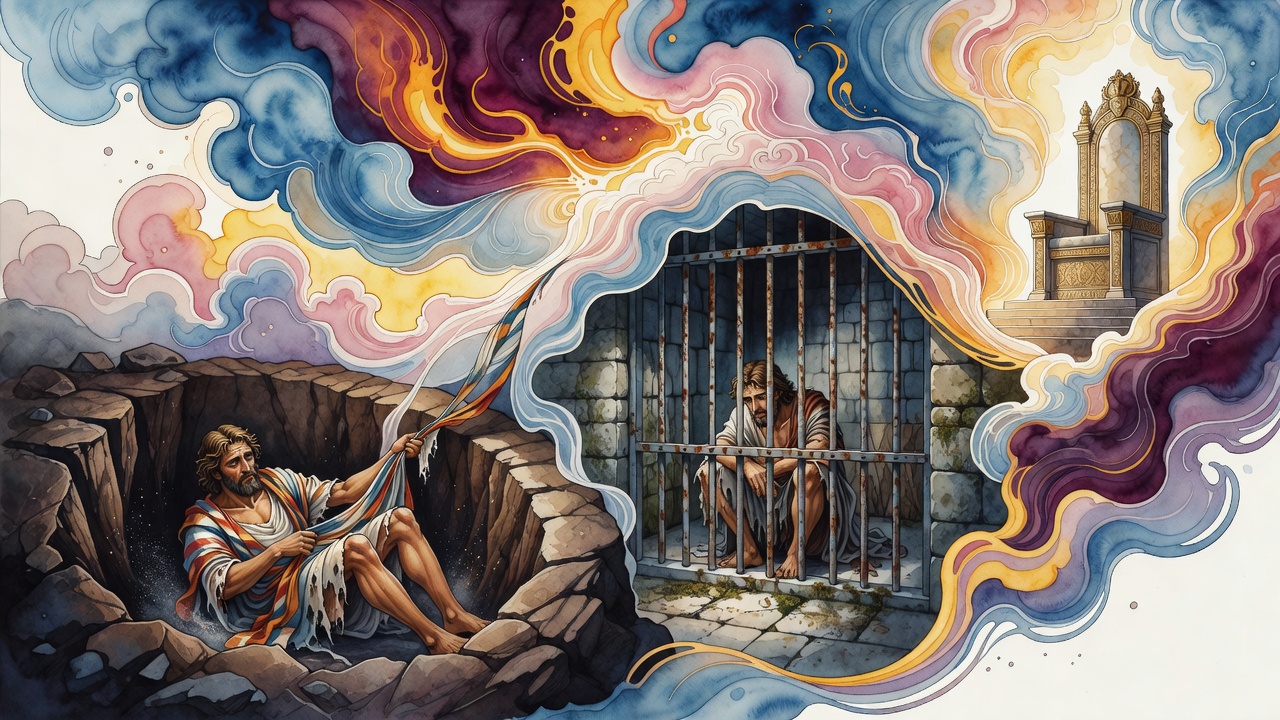
The child ran across the flat roof after a ball of rags, laughing, and the edge came sooner than his feet expected. There was no railing. For one long breath his body knew the air better than the plaster. A hand caught a sleeve. The laugh broke into a cry.
Blood Guilt Waits on the Unfenced Roof Edge Click for full size

"You shall make a railing for your roof." "You shall not place blood in your house." A house without a fence stores someone else's death in its architecture.

The Child at the Edge

Below, courtyard stones waited without pity. The near-fall was not a surprise to heaven. It was the exact case the commandment was built to prevent.

Wish is not a railing. The owner who says he did not know a child would run is answered by a law that assumes children run and night makes edges hard to see.

If You Build

"If you build" opens wider than one dwelling. Straw-bin, cattle-shed, store-house. Wherever people move, the duty follows. Then "house" tightens the net to places of occupancy.

Gateways and porches sit in the middle. A ramp is not a roof. The Torah focuses where a fall is likely and deadly.

The Open Pit

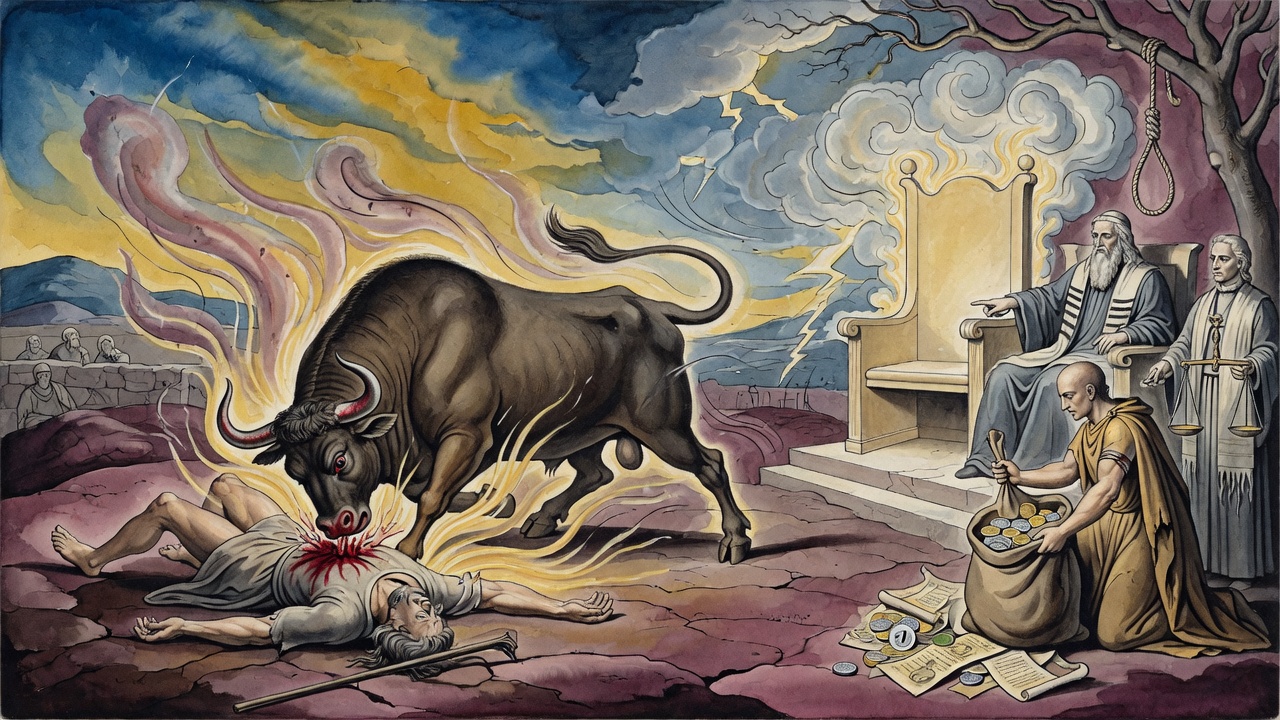
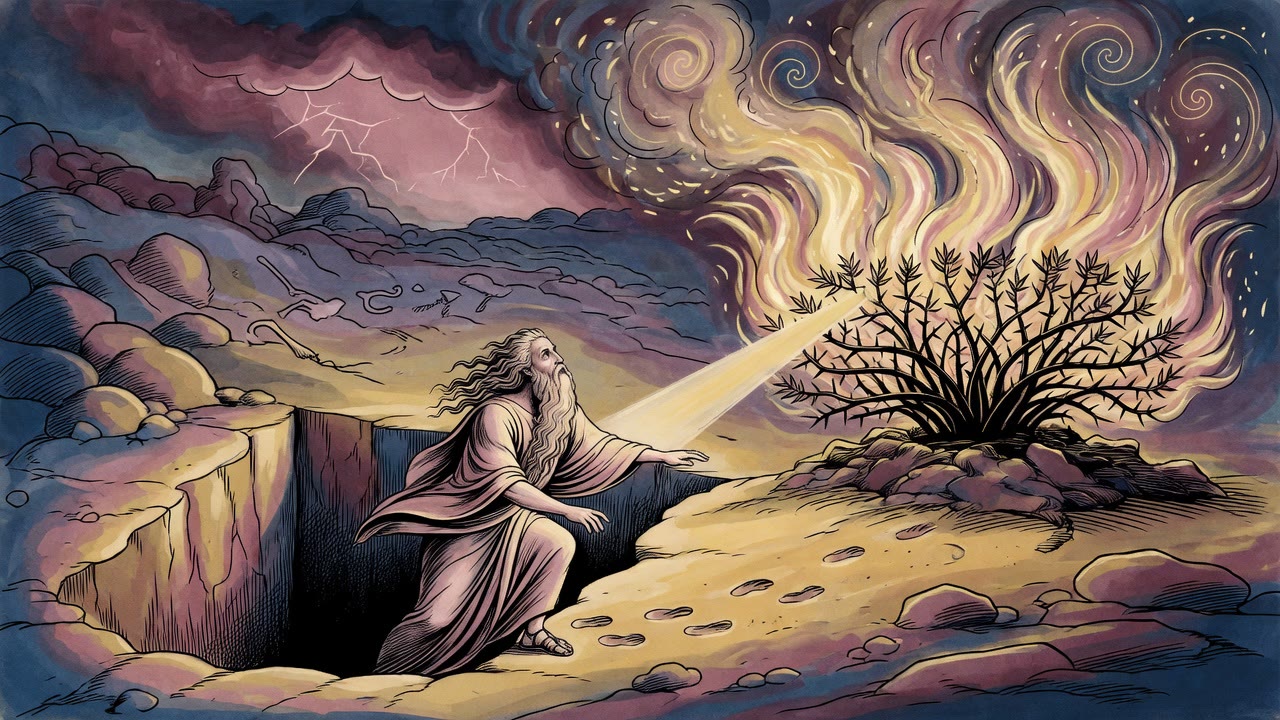
Holes, pits, caves, ditches. An uncovered pit is a mouth in the earth. When an animal falls in and dies, the digger pays. "Money shall he restore to its owner." Compensation stays concrete.

Roof and pit are cousins. Both turn private domain into public danger. A feast on an unfenced roof is a possible funeral beside the wine.

Wish Is Not a Railing

An ox that gores, shoves, kicks, or bites teaches the same habit. Living force and dead architecture both demand watchfulness. The Torah demands the fence before the funeral.

When the railing finally goes up, the edge becomes a boundary again instead of a betrayal. Money after failure is justice. The railing is justice before failure. The Torah prefers the second.

The pressure did not lift for those standing inside this hour. Someone swallowed. Someone clenched a fist around cloth or staff or coin. The next breath decided more than any later summary would admit. What looked like a small refusal or a small courage became the hinge the whole house turned on. Neighbors would argue the details by morning, but the people inside the moment carried the exact weight in their bones.

The pressure did not lift for those standing inside this hour. A throat tightened. Someone clenched a fist around cloth or staff or coin. The next breath decided more than any later summary would admit. What looked like a small refusal or a small courage became the hinge the whole house turned on. Neighbors would argue the details by morning, but the people inside the moment carried the exact weight in their bones.

The pressure did not lift for those standing inside this hour. A sandal scraped stone. Someone clenched a fist around cloth or staff or coin. The next breath decided more than any later summary would admit. What looked like a small refusal or a small courage became the hinge the whole house turned on. Neighbors would argue the details by morning, but the people inside the moment carried the exact weight in their bones.

The pressure did not lift for those standing inside this hour. A child went still. Someone clenched a fist around cloth or staff or coin. The next breath decided more than any later summary would admit. What looked like a small refusal or a small courage became the hinge the whole house turned on. Neighbors would argue the details by morning, but the people inside the moment carried the exact weight in their bones.

The pressure did not lift for those standing inside this hour. A door latch clicked. Someone clenched a fist around cloth or staff or coin. The next breath decided more than any later summary would admit. What looked like a small refusal or a small courage became the hinge the whole house turned on. Neighbors would argue the details by morning, but the people inside the moment carried the exact weight in their bones.

The pressure did not lift for those standing inside this hour. Oil smoke stung eyes. Someone clenched a fist around cloth or staff or coin. The next breath decided more than any later summary would admit. What looked like a small refusal or a small courage became the hinge the whole house turned on. Neighbors would argue the details by morning, but the people inside the moment carried the exact weight in their bones.

The pressure did not lift for those standing inside this hour. A coin rolled and stopped. Someone clenched a fist around cloth or staff or coin. The next breath decided more than any later summary would admit. What looked like a small refusal or a small courage became the hinge the whole house turned on. Neighbors would argue the details by morning, but the people inside the moment carried the exact weight in their bones.


← All myths

From the tradition

Sources

3 sources

The texts behind this telling. Some cards carry a translation of the source; others are our own retelling of it, and each card says which. Every card links out to the original.

Sifrei Devarim 229:4Sifrei Devarim

Retold in our words. Read the original at the link below.Sifrei by Rabbi Shraga Silverstein · CC-BY

A reader can get lost in the grand narratives, the sweeping commandments.. but sometimes, the Divine instruction comes down to something as simple as building a fence around your roof.

Wait, what? to a passage from Sifrei Devarim, a collection of legal interpretations on the Book of Deuteronomy. It seems almost mundane, but there's a depth here.

The passage starts with the seemingly simple phrase "a house." Okay, a house needs safety features. But, the Sifrei asks, does this law only apply to a house? What about other structures? What about a straw-bin, a cattle-shed, or a store-house? The text answers: these are included, derived from the phrase "If you build." If you build anything, this law applies.

Here’s where it gets interesting. If "If you build" includes everything, could it also include things like gateways, porticos, or porches? Things that aren't exactly dwellings? The text then specifies "a house" to limit the scope. The Sifrei explains: a "house" is characterized by being subject to occupancy. It's a place where people actually live. So, the law focuses on structures where people are regularly present.

It's a beautiful example of legal reasoning. Narrowing down a broad statement ("If you build") with specific examples ("a house") to arrive at a nuanced understanding of the law's intent.

Now, let's climb up to the roof. The Torah commands, "you shall make a railing for your roof." Again, seemingly straightforward. But what about other potential hazards on your property? What about holes, pits, caves, and ditches? Do we need to protect those too?

The answer, according to Sifrei Devarim, is yes! This is derived from the phrase "and you shall not place blood in your house" - meaning you are responsible for preventing accidental death within the domain of your house. The Torah cares about safety beyond just the roof; it cares about the whole property. So, why mention the roof specifically? To exclude something like a ramp.

The point is, the Torah focuses on situations where a fall is likely and could result in serious injury or death. A ramp, while potentially dangerous, isn't quite the same as a roof, a pit, or a hole.

So, what's the takeaway? It's not just about following the letter of the law, but understanding its spirit. The Torah isn’t just concerned with houses and roofs; it's concerned with preserving life and preventing accidental death. These seemingly small, specific laws about railings and coverings are actually expressions of a much larger principle: our responsibility to protect ourselves and others from harm. It's a reminder that even in the most mundane aspects of our lives – even in how we build our homes – we are called to act with care, foresight, and a deep respect for the sanctity of life. And isn't that a powerful message to carry with us, no matter where we live, or what we build?

Full source
Mekhilta Tractate Nezikin 11:18Mekhilta DeRabbi Yishmael

Retold in our words. Read the original at the link below.Mechilta, translated by Rabbi Shraga Silverstein · CC-BY

"Money shall he restore to its owner", when someone's animal falls into another person's uncovered pit and dies, the pit-digger must pay compensation. The Torah specifies "money." But the Mekhilta asks: can the pit-digger pay with a beast instead of cash?

The answer comes through a gezeirah shavah, a verbal analogy. The phrase "and the carcass shall belong to him" appears both in this passage and in (Exodus 21:36), which deals with an ox that gores another ox. In that second passage, the Torah says: "Then shall he pay an ox for an ox, and the carcass shall belong to him." There, the payment is explicitly made with a beast, an ox for an ox.

Since both passages use the same phrase, "and the carcass shall belong to him", the Mekhilta transfers the payment methods between them. Just as the ox-for-ox case allows payment with a beast, the pit case also allows payment with a beast. And just as the pit case specifies money, the ox-for-ox case also allows payment with money.

The gezeirah shavah works in both directions, creating flexibility in both passages. The pit-digger can pay with money or a beast. The ox owner can also pay with money or a beast. Neither passage alone permits both options, but the verbal link between them creates a reciprocal expansion. Each passage grants the other an additional mode of payment that it did not originally specify.

Full source
Yalkut Shimoni on Torah 341:18Yalkut Shimoni on Torah

Translation of the source text.Torat Emet (Yalkut Shimoni) · CC-BY-NC

"And if it gores" (Exodus 21:35) - included in striking are goring, shoving, lying down upon, kicking, and biting; the words of Rabbi Josiah. Abba Saul says in the name of Rabbi Eliezer: included in striking are goring, shoving, lying down upon, and kicking. From where do we learn biting? Scripture teaches "and its owner did not guard it" (Exodus 21:36). And the matter follows by inference from minor to major: if when he had guarded it and it got out and caused damage he is liable, then all the more so before he has guarded it. Then what does Scripture teach by "and its owner did not guard it"? Rather, Scripture comes to add yet another act of guarding, and which is it? This is biting.

"The ox of a man" (Exodus 21:35) - to exclude the ox of a minor. "The ox of a man" - to include the ox of others. "His neighbor's" - to include the ox of a minor. One might think Scripture speaks of two animals of equal value, or is it speaking both of equal and unequal value? You reason: just as it is the way of those who cause damage to gain or to lose, and so forth, so too those who suffer damage take their damages or more than their damages - you must say: not more than their damages. Rabbi Akiva says: half is stated regarding the living and half regarding the dead, so Scripture speaks of animals of equal value.

Full source