5 min read

Killer Ox and the Ransom That Bought a Life

A warned ox kills a man. The owner is not hanged. He pays a court-set ransom that buys back his own forfeited life.

Curated by Arthur · Told by Maggid ·
Table of Contents
  1. Whose Life the Money Redeems
  2. The Man Who Rose on His Staff
  3. When Life Outranks the Altar
  4. Silver on the Scale of a Neck

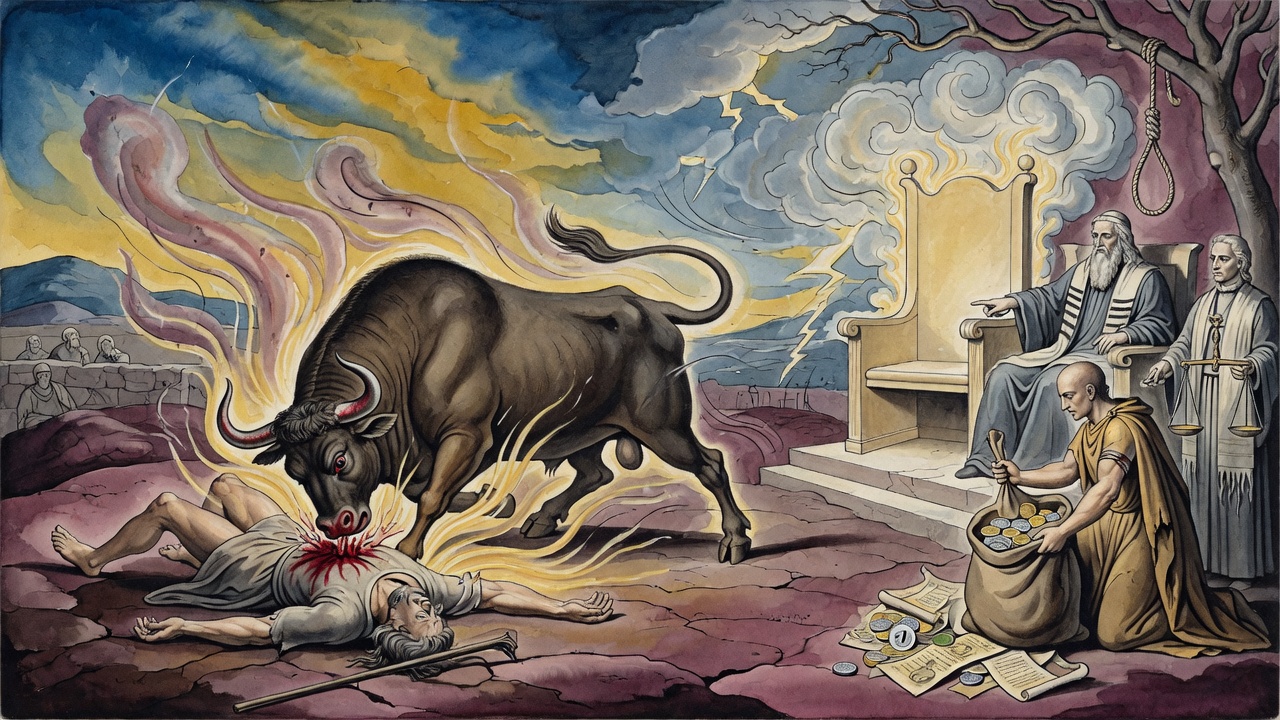
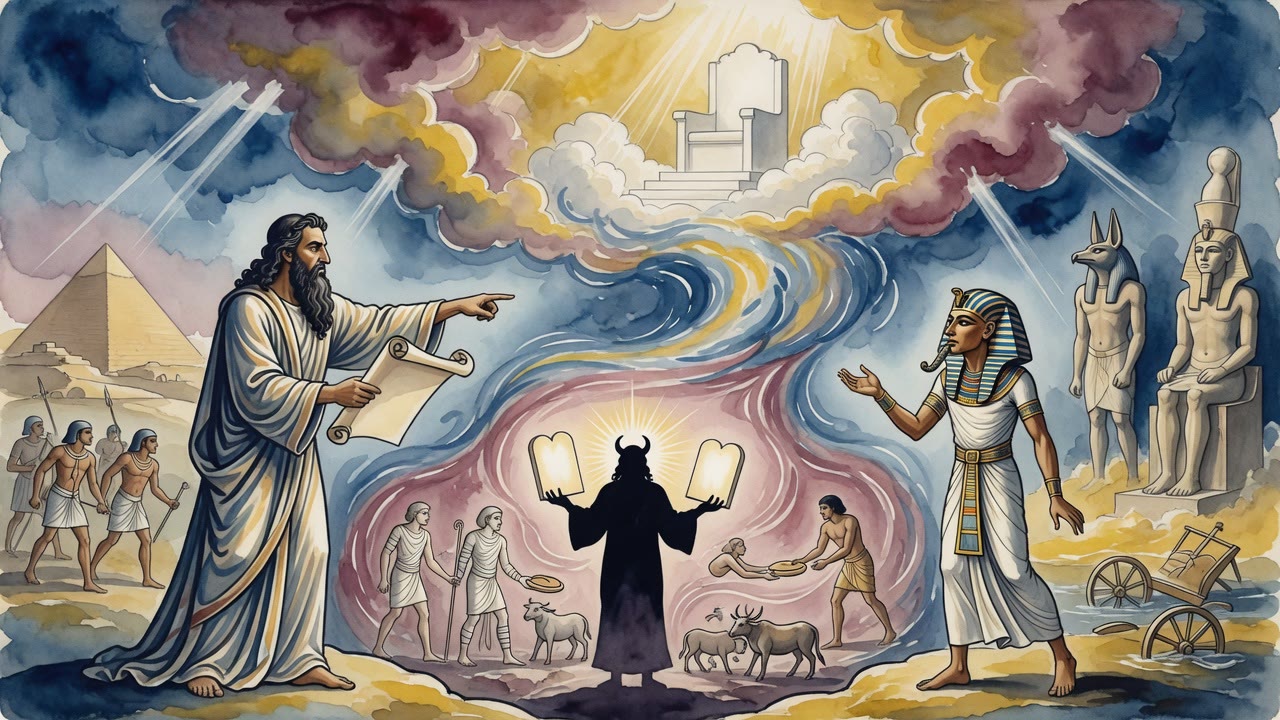
The ox had been warned. Neighbors had said it. Judges had said it. The owner had nodded and left the gate loose anyway. One morning the animal put its horn through a man who would not rise again, and the owner stood in the dust with blood on the ground and a Torah verse hanging over his neck.

Killer Ox and the Ransom That Bought a Life Click for full size

The verse did not hand him to the executioner. It laid a ransom on him, the redemption of his life. He would buy himself back with silver fixed by a court, not by his own swagger and not by the family's raw grief.

Whose Life the Money Redeems

First the sages close the exits. Is payment optional, a generous gesture the owner might decline? No. Scripture calls it the redemption of his life. A debt of the soul cannot be waived by the one who owes it.

Who sets the amount? Not the owner, who might lowball or grandstand with an impossible sum. Not the bereaved alone in their first shock. The court sets it, learned from parallel verses where judges assign payments. Justice runs through the bench, not through bargaining at the graveside.

Then the deepest cut: whose life is being redeemed? One might assume the victim's. Rabbi Ishmael ben Rabbi Yochanan ben Beroka reasons otherwise. The owner stood liable to death and was spared by paying. The money buys back the owner's own forfeited life. When partners own a goring ox, each pays a full ransom, because each needs complete atonement. Sons, daughters, and guardians are drawn into the net so no responsible party slips free.

The Man Who Rose on His Staff

Another courtyard, another wound. A man strikes his fellow, and the victim does not die. He rises again and walks in the street upon his staff. The striker is acquitted of death. He still owes for cessation from labor, for healing, for pain, for humiliation, for the damage itself: five payments spelled out in the Aramaic tradition so that a recovering body is not left to starve while the striker washes his hands.

The law watches the moment the wounded man puts weight on the staff and steps into public air. That step is the border between capital guilt and financial guilt. Life preserved redirects the case from the gallows to the ledger, but the ledger is not light. Flesh that heals slowly still costs.

When Life Outranks the Altar

The Mekhilta builds a ladder. Murder overrides the sacrificial service. Saving a life overrides the Sabbath. Therefore saving a life overrides the sacrificial service as well, by the argument from the lesser to the greater. If the stronger obligation yields to life, the weaker must yield more readily.

The hierarchy lands hard: pikuach nefesh, the guarding of a living soul, stands near the top of the system. Temple fire waits. Sabbath waits. Only the three cardinal refusals hold their ground against life-saving. The owner of the ox, the striker with the staff, the priest mid-service when a life is in danger: all of them are pulled into the same gravity. Human breath weighs more than ritual schedule.

Silver on the Scale of a Neck

Return to the owner. The court names a sum. He pays. He walks home under a sky that has not killed him, past a yard that still needs a better gate. The dead man is still dead. The ox is still forfeit. The living man's pulse continues because Torah preferred a redeemed life to a doubled corpse.

This is not softness. This is precision under pressure. A body died. Another body nearly followed by law. The ransom is the narrow bridge that lets one of them keep walking, and the five payments are the bridge for the wounded who can still stand. Above both bridges hangs the larger rule: when life can be saved, the altar itself must step aside.

The bereaved family wanted a neck, not a purse. The midrash does not mock that want. It relocates the payment so that blood-debt becomes court-debt, and the living owner walks out carrying a price instead of becoming a second corpse. Partners who shared the ox share the full ransom each, because negligence is not diluted by company. A guardian who failed to tie the gate learns that responsibility sticks to the hand that held the rope.

Meanwhile the man on the staff counts his five claims the way a sick person counts stairs. Damage to the body. Pain that does not show. Healing costs. Idle days. Shame in the street. The striker who thought a single bruise was cheap discovers the Torah itemizing a human life even when death was avoided. Above both cases, the rule about life versus altar waits for the next emergency: if the service is underway and a life can still be saved, the priest runs toward the living first. The fire can wait. The breath cannot.

These scenes are law under sweat. Horn, staff, altar ramp. Each one asks who is still breathing and what the living still owe.


← All myths

From the tradition

Sources

3 sources

The texts behind this telling. Some cards carry a translation of the source; others are our own retelling of it, and each card says which. Every card links out to the original.

Mekhilta DeRabbi Shimon Ben Yochai 21:30Mekhilta DeRabbi Shimon Ben Yochai

Translation of the source text.Mechilta de-Rabbi Simon b. Jochai, ed. D. Hoffmann, Frankfurt 1905 · Public Domain

"If a ransom is laid upon him" (Exodus 21:30). Might one think the ransom is optional? Scripture teaches, "then he shall give the redemption of his life": it is an obligation, not a matter of choice. "A ransom shall be laid upon him": might one think that if the court said a maneh he gives a maneh, and if it said a hundred maneh he gives a hundred maneh? It is said here "shall be laid upon him," and it is said elsewhere (Exodus 21:22) "he shall be made to pay." Just as the "made to pay" stated there is set by the court, so the "laid upon him" stated here is set by the court.

"Then he shall give the redemption of his life." Might one think it is the redemption of the life of the one harmed? Rabbi Ishmael the son of Rabbi Yochanan ben Beroka says: since you have made the owner liable to death yet exempted him through ransom, say from now on that it is the redemption of the life of the one who caused the harm. From here they said: an ox belonging to partners that killed [a person], each of the partners pays a full ransom, for each of them requires complete atonement.

"That shall be laid upon him" comes to include the son and the daughter. "According to all that shall be laid upon him" comes to include the unpaid bailee, the borrower, the hired worker, and the paid bailee.

Full source
Targum Pseudo-Jonathan on Exodus 21:19Targum Pseudo-Jonathan on Exodus

Retold in our words. Read the original at the link below.The Targum of Jonathan ben Uzziel, trans. J. W. Etheridge, London, 1862 · Public Domain

The Targum Pseudo-Jonathan spells out one of the most practical laws in the Torah, what a man owes his victim when the victim does not die. "If he rise again from his illness, and walk in the street upon his staff, he who smote him shall be acquitted from the penalty of death; only for his cessation from labour, his affliction, his injury, his disgrace, and the hire of the physician, he shall make good until he be cured" (Exodus 21:19).

The Targum catalogs five distinct damages. The rabbis of the Talmud (Bava Kamma 83b) would later codify these as the famous five payments: nezek (injury), tza'ar (pain/affliction), ripui (medical costs/physician's fee), shevet (lost wages/cessation from labor), and boshet (humiliation/disgrace). The Targum lists them in almost the exact order the Talmud will systematize centuries later.

What a civilizational leap this is. Most ancient legal codes knew lex talionis, an eye for an eye, a tooth for a tooth. The Targum understands that a retaliatory injury repairs nothing. Instead it requires the striker to pay for five different kinds of harm. The injury itself is one. The pain is another. The doctor's bills are a third. The lost work is a fourth. And, most remarkably, the humiliation is a fifth. The Torah recognizes that a beating damages a person's dignity, and dignity is a thing that can be owed and repaid.

The Targum's phrase walk in the street upon his staff is a tender detail. The victim has survived. But only just. He walks with a cane. He is visibly diminished. The law will not sentence the striker to death, because the victim lived; but the law will not let the striker walk away either. Five payments are owed, and none of them are optional.

The takeaway: justice is rarely symmetrical. The damage done in one second takes five categories and many months of payment to begin to repair.

Full source
Mekhilta Tractate Nezikin 4:26Mekhilta DeRabbi Yishmael

Retold in our words. Read the original at the link below.Mechilta, translated by Rabbi Shraga Silverstein · CC-BY

The Mekhilta now draws the ultimate conclusion from the legal hierarchy it has been constructing. Murder overrides the sacrificial service. This is established. But saving a life overrides even the Sabbath. The Mekhilta uses these two established principles to derive a new one through a kal va-chomer, an argument from the lesser to the greater.

If the Sabbath, which is not overridden by murder (a convicted killer is not executed on the Sabbath), is nevertheless overridden by the saving of a life (pikuach nefesh (the vital soul)), then the sacrificial service, which is overridden by murder, must certainly be overridden by the saving of a life as well. The logic is airtight. If the stronger obligation (the Sabbath) yields to life-saving, then the weaker obligation (the Temple service) must yield even more readily.

This passage establishes one of the most important principles in all of Jewish law: the saving of a human life takes precedence over virtually every other commandment. The Mekhilta arrives at this conclusion not through a single dramatic declaration but through methodical legal reasoning, building the principle step by step from the relationships between Sabbath observance, Temple service, and capital punishment.

The hierarchy that emerges is clear. Saving a life stands at the very top. It overrides the Sabbath. It overrides the Temple service. It overrides everything except the three cardinal sins (idolatry, murder, and sexual immorality). The Mekhilta's chain of reasoning demonstrates that this principle is not a modern innovation or a sentimental preference. It is embedded in the structure of the Torah's own legal system, derivable from the relationships between its commandments through rigorous logical analysis.

Full source