5 min read

The Dead Thief Who Could Not Rest in the Forest

A traveler met a dead man in the woods who still could not rest because a stolen field sat in the wrong hands among the living.

Curated by Arthur · Told by Maggid ·
Table of Contents
  1. Moonlight Enough for Recognition
  2. The Empty Grave and the Tree
  3. The Worst Thief Does Not Touch the Purse
  4. What the Forest Still Demands
  5. The Boundary Stone That Still Lied
The Dead Thief Who Could Not Rest in the Forest Click for full size

Moonlight Enough for Recognition

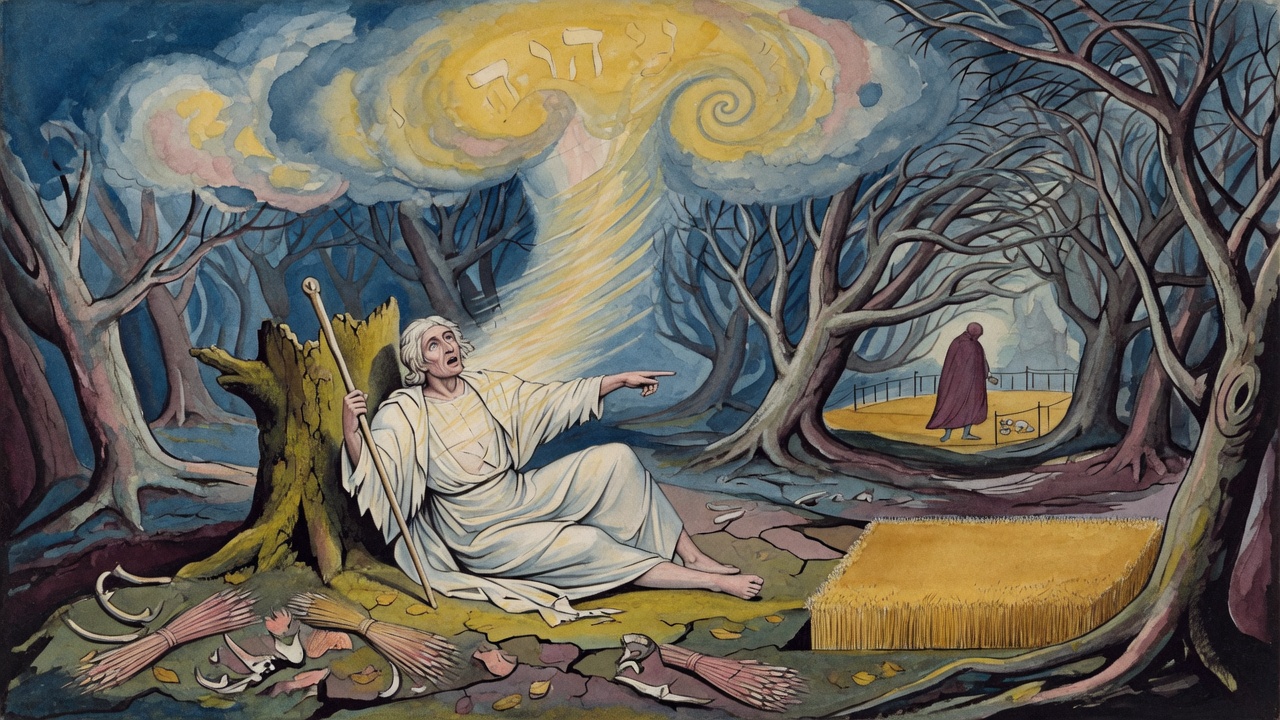
A man lost his way in the forest at night. Branches scraped his sleeves. The path he thought he knew kept ending in thicker dark. Owls shifted somewhere above. Then moonlight found a figure walking toward him, and the light was enough for recognition.

It was not a stranger. It was a dead man.

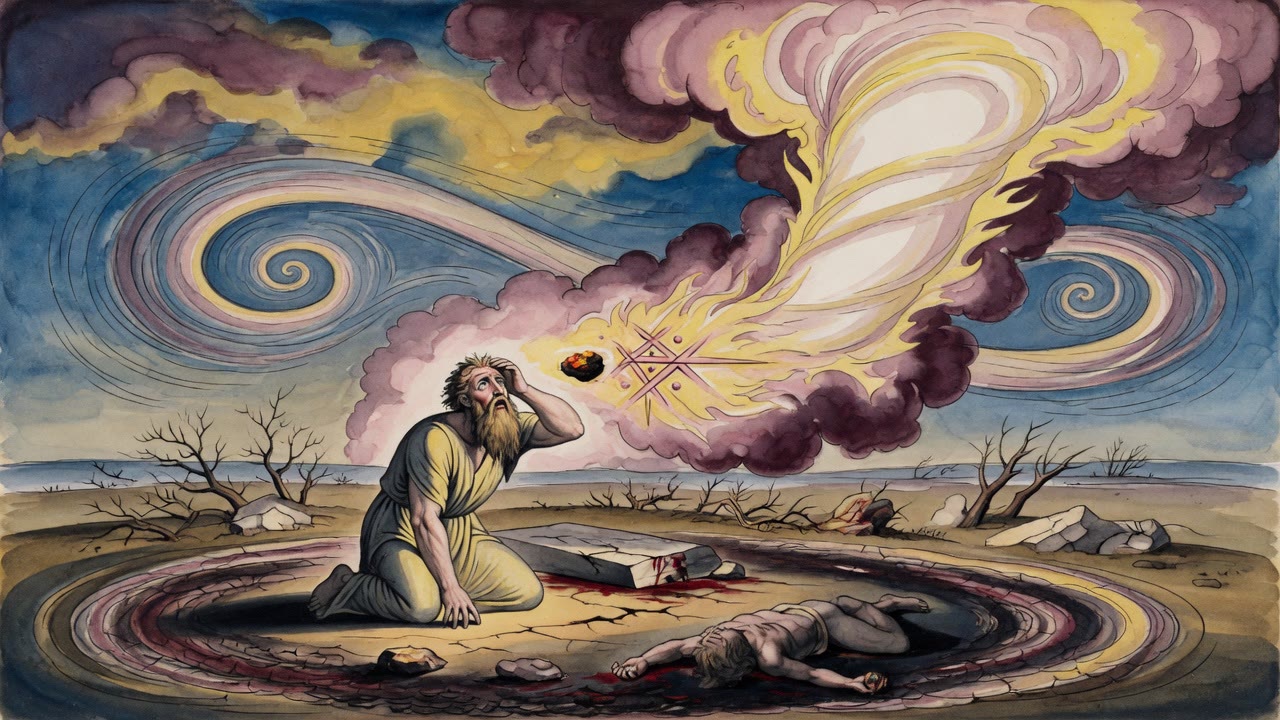
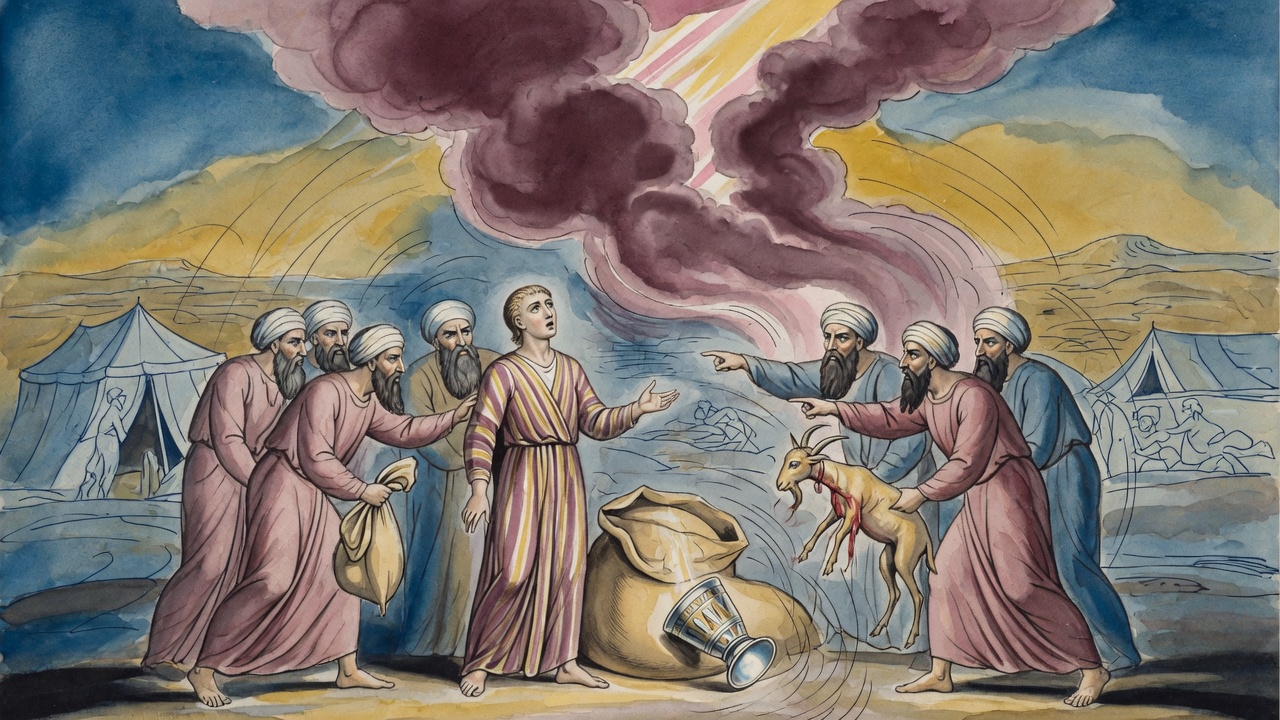
The traveler turned to run. The dead man stopped him without a blow. He would not harm him. He only wanted the truth carried back into the living world. He had no rest because he had stolen a field. The punishment was not abstract. He was driven through the forests because a specific piece of land still sat in the wrong hands. Until that ground returned to its owner, his soul could not lie still. The traveler's terror mattered less to him than the message. The living still held his crime in a deed and a boundary stone.

The Empty Grave and the Tree

Another dead man appeared to his servant and ordered him to tell the widow to return an inheritance taken by force. The servant feared no one would believe a message from the night. Ghost stories make bad evidence in daylight. The dead man gave a sign. The townspeople would find him the next day on a tree.

They did. His grave was empty. The body that should have stayed underground hung where the living could not argue with it. Rest for the dead, the tale insists, is tied to repair among the living. Prayer and charity can help a soul that still has merit. Stolen property needs return, not sentiment. Until the theft is undone, the soul remains troubled by what the body left behind, and the forest keeps company with the unrest.

The Worst Thief Does Not Touch the Purse

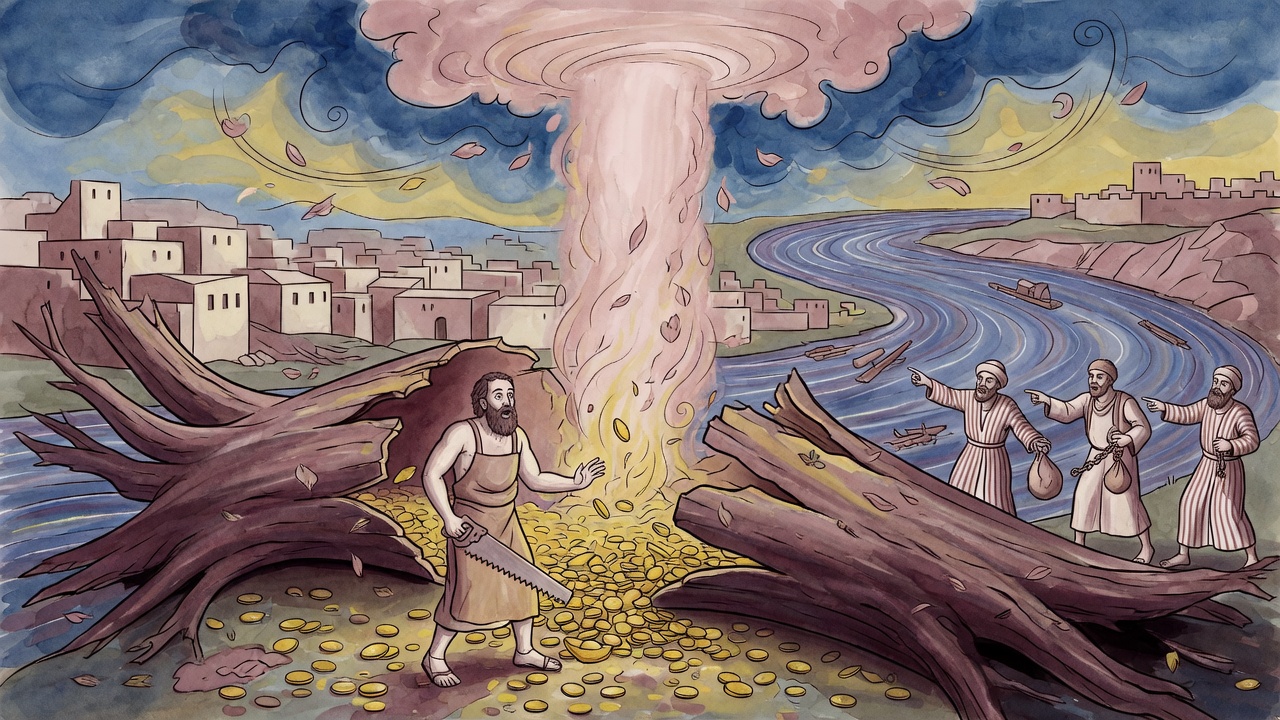
How many ways are there to be a thief? The sages count seven, and the worst is not the one who lifts a purse. The first and foremost thief steals the mind, the trust, of another person. He pours on hospitality he does not mean. He presses gifts he knows the guest will refuse. He opens a cask as though for the guest's honor when he opened it to sell. He rigs his scales. He doctors his goods, sand in the beans, vinegar in the oil.

The deeper crime is the deception itself. Such a person would cheat Heaven too if he could, and the sages count it against him as if he tried. They point to Absalom, who stole three hearts at once: his father's, the court's, and all of Jerusalem's, with flattery before he raised his revolt. Theft begins in the tongue and the smile long before it reaches a boundary stone or a midnight transfer of a field.

What the Forest Still Demands

The dead man in the trees and the seven living thieves stand in one chain. A field taken by force keeps a soul walking. A mind taken by false welcome keeps a community blind until the trap closes. Both kinds of stealing refuse to stay buried. One returns as a body on a tree. One returns as a revolt dressed as charm. The traveler who meets the dead has one task: carry the truth home and force the living to put the land back. The person who meets a flattering host has another: notice when the open cask is already for sale.

Rest does not come from forgetting. Rest comes when the stolen thing returns to the hand that owned it. Charity without restitution is a soft song over a locked barn. The forest, in these stories, is not haunted for sport. It is the waiting room of unfinished justice, and every living thief who steals trust is already practicing the same refusal of rest, only with better manners and a full cellar.

The Boundary Stone That Still Lied

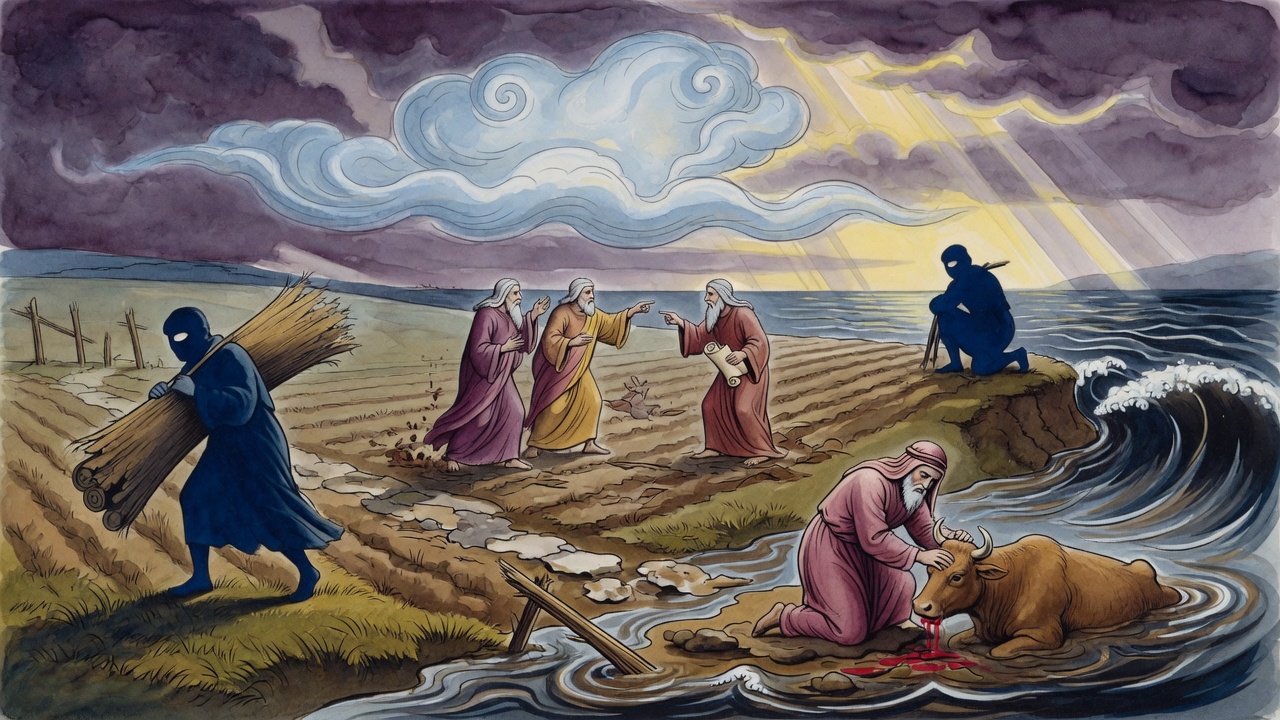
By day the stolen field looked ordinary. Wheat grew. A boundary stone sat where a thief had moved it. Neighbors walked past without knowing a soul was still pacing the woods because of that one shift of rock. The living argued about weather and price. The dead man argued about a single strip of earth that would not leave him alone.

When the traveler finally carried the message into town, doors closed first. Then someone remembered the empty grave on the tree and the inheritance the widow still held. Shame moved faster than sermons. The field returned, not because fear of ghosts is holy, but because unfinished theft is a chain, and someone finally cut a link. The forest went quieter after that. Not empty of night sounds. Empty of one particular restless step that had been measuring the same crime over and over.


← All myths
From the tradition

Sources

2 sources

The texts behind this telling. Some cards carry a translation of the source; others are our own retelling of it, and each card says which. Every card links out to the original.

Sefer Chasidim 170Sefer Chasidim

Translation of the source text.Sefer Chassidim, Zhitomir, 1857 + JewishMythology.com faithful English Beta translation · Public Domain

It happened with a certain pious man who would make vows on behalf of the souls, on behalf of his relatives, and afterward he would vow everything in a general way on behalf of all the souls. They said to him, "Why do you do this?" He said to them, "Because there are among them those by whose merit I benefit, and I will not be ungrateful. And furthermore, they likewise on their account it will be well with me." And if you should say: behold, a sin-offering whose owners have died is left to die, because the sin-offering serves to protect from sufferings, and he has already died; and furthermore, death atones. But the charity that is given resembles the heifer whose neck is broken, of which they said, "This atonement is fit to atone for those who went out of Egypt retroactively." And furthermore, if a person should say, "What use is it after death? If the son is wicked, behold the father can redeem him through charity," and it says, "No man can by any means redeem his brother" -- rather, since we find that if one vowed to bring a burnt-offering, the son brings it after his death; and since whatever we find regarding a burnt-offering we find regarding charity -- this one comes by a vow and this one comes by a vow and a freewill-offering, even though it is not entirely comparable, for the son cannot bring a burnt-offering unless the father consecrated it. It happened with one who was going and lost his way in a forest, and at night by the light of the moon a man came, and he recognized that that man was dead and wished to flee. He said to him, "Do not flee from me, for I will not harm you. I am so-and-so." He said to him, "But are you not dead?" He said to him, "Yes, but on account of a certain field I have no rest, and they torment me in the forests on account of a certain field that I robbed from him." And like it, an incident I heard: a certain gentile died, and after some days his servant went and found him at night. He said to him, "Do not flee, I will not harm you." He said to him, "But are you not dead?" He said to him, "True, but they torment me because I took the inheritance of so-and-so against his will; and now tell my wife to return it to him." He said to him, "But they will not believe me." He said to him, "Tell them to go tomorrow to a certain place and they will see me there." The servant went and told the city, "Thus and thus so-and-so, who died several years ago, told me." They said to him, "Did he tell you any sign?" He said, "You will find me at a certain place tomorrow at that tree; then you will believe me." They all went and saw him on a tree, and they searched for him in his grave and did not find him. The servant said, "Return to the robbed one his inheritance, then he will rest." This is among the gentiles. And if you should be in doubt whether this is true or false, behold among Israel the law is certainly thus. And if you should say, "Why should it avail in that world, since in his lifetime he neither did nor commanded, but they act on his behalf?" -- we say that there is a distinction among people, that if one did not merit in his lifetime, all the charities will not save him. But if he merited and sinned, and on account of his iniquity they drive him from the Garden of Eden, or they execute judgment upon him in Gehinnom, or they torment him through thorns, or the angels of destruction make sport of him; or a righteous man who because of an iniquity they do not bring into the partition of the righteous -- then it avails if they pray, or if they give charity on his behalf, or if he robbed and the heirs return it, or if the dead one is disgraced so as to diminish and lessen his iniquities. But one who did not merit, after death nothing they do on behalf of the dead will avail, unless this one commanded it and discerned, and they did at his death as he did. As was done with Moses and Joshua and all Israel, and David and Solomon, Scripture attributed it to Moses and David. The explanation: that Moses commanded to bring up the coffin of Joseph, and the children of Israel brought it up, and it is called by the name of Moses, as it is written (Exodus 13:19) "And Moses took." And likewise David sought to build the Temple, and it did not come about by his hand according to the word, and he commanded Solomon to build it, and Scripture attributed it to David; and this is what they said, Scripture attributed it to Moses and David.

Full source
Yalkut Shimoni on Torah 343:3Yalkut Shimoni on Torah

Translation of the source text.Torat Emet (Yalkut Shimoni) · CC-BY-NC

"If the stolen item is actually found in his hand" (Exodus 22:3): there is no "finding" except by witnesses. "In his hand" - "in his hand" everywhere means only his domain.

"From ox to donkey": Rabbi Akiva says: since Scripture need not have said "alive," it comes to include the wild beast. "Alive - he shall pay double" - and not when dead.

"He shall pay double": You thus find that there are seven kinds of thief. The first among thieves is one who steals the mind of his fellow creatures: one who urges his fellow to be his guest when he has no intention in his heart to invite him; one who plies him with gifts while knowing he will not accept them; one who opens a cask [implying he opened it for the guest when he had opened it for sale]; one who falsifies measures; one who tampers with weights; and one who mixes seeds of the carob into fenugreek, or sand into beans, or vinegar into oil. Because they said: oil does not absorb misuse [its quality is not so easily hidden], therefore kings are anointed with it. And not only that, but they reckon it against such a person as though, were he able to steal the mind of the One on high, he would steal it.

And so we find with Absalom, who stole three thefts: the heart of his father, the heart of the court, and the heart of the men of Jerusalem, as it is said, "And Absalom stole the heart" (2 Samuel 15:6). And who is the greater, the one who steals or the one stolen from? You must say: the one stolen from, who knows he is being robbed and stays silent. And so we find that when Israel stood before Mount Sinai to receive the Torah, they sought, as it were, to steal the mind of the One on high, as it is said, "All that the LORD has spoken we will do and we will hear" (Exodus 24:7); and the heart of the court was, as it were, stolen into their hand, as it is said, "Who would give that this heart of theirs would remain in them" (Deuteronomy 5:26). And should you say that not all is revealed before Him, has it not already been said, "And they enticed Him with their mouth and with their tongue they lied to Him, and their heart was not steadfast with Him" (Psalms 78:36-37)? Yet even so, "He, being compassionate, atones for iniquity" (Psalms 78:38). And it says, "Like silver dross overlaid upon earthenware are burning lips and an evil heart" (Proverbs 26:23).

One who stole items forbidden in benefit is exempt from payment. For clothing, produce, vessels, a wild beast, or a bird, he pays the double penalty. For slaves, bonds, and land, he pays only the principal. For the firstborn of a donkey he pays double, for although it is forbidden now, it has a release at a later time.

"He shall pay five for the ox and four for the sheep" (Exodus 21:37). Above these is one who steals a human being, for he is liable with his life. Rabbi Shimon ben Yochai says: A parable. To what is this compared? To one who was leaving his fellow's house laden with vessels. His fellow met him and said, "What are you doing?" He answered, "Take your share and tell no one." Later the owner of the stolen goods came and said, "I adjure you, if you saw so-and-so leaving my house laden with vessels," and he answered, "I swear I do not know what you are talking about" - such a man is liable with his life. Of him it says, "He who shares with a thief hates his own soul" (Proverbs 29:24).

But one who "steals" from behind his fellow and goes off and studies words of Torah, even though he is called a thief, acquires merit for himself, and of him it says, "They do not despise a thief" (Proverbs 6:30). In the end he is found appointed over the community, and he "repays sevenfold" (Proverbs 6:31), as it says, "all the wealth of his house he gives." And "sevenfold" means nothing but words of Torah, as it is said, "The words of the LORD are pure words" (Psalms 12:7).

Full source