5 min read

Abraham the Carpenter Cut Open a Tree Full of Gold

A thief stole the carpenter's savings and died on the road. The purse spent years inside a hollow tree, then floated back to the man it belonged to.

Curated by Arthur · Told by Maggid ·
Table of Contents
  1. Wood That Knew Its Owner
  2. Cake at the Gate
  3. Another Abraham, Same Refusal of False Gods
  4. What the Coins Finally Bought

Abraham the carpenter saved his coins the slow way, board by board, until a neighbor's hand made the saving look foolish.

Abraham the Carpenter Cut Open a Tree Full of Gold Click for full size

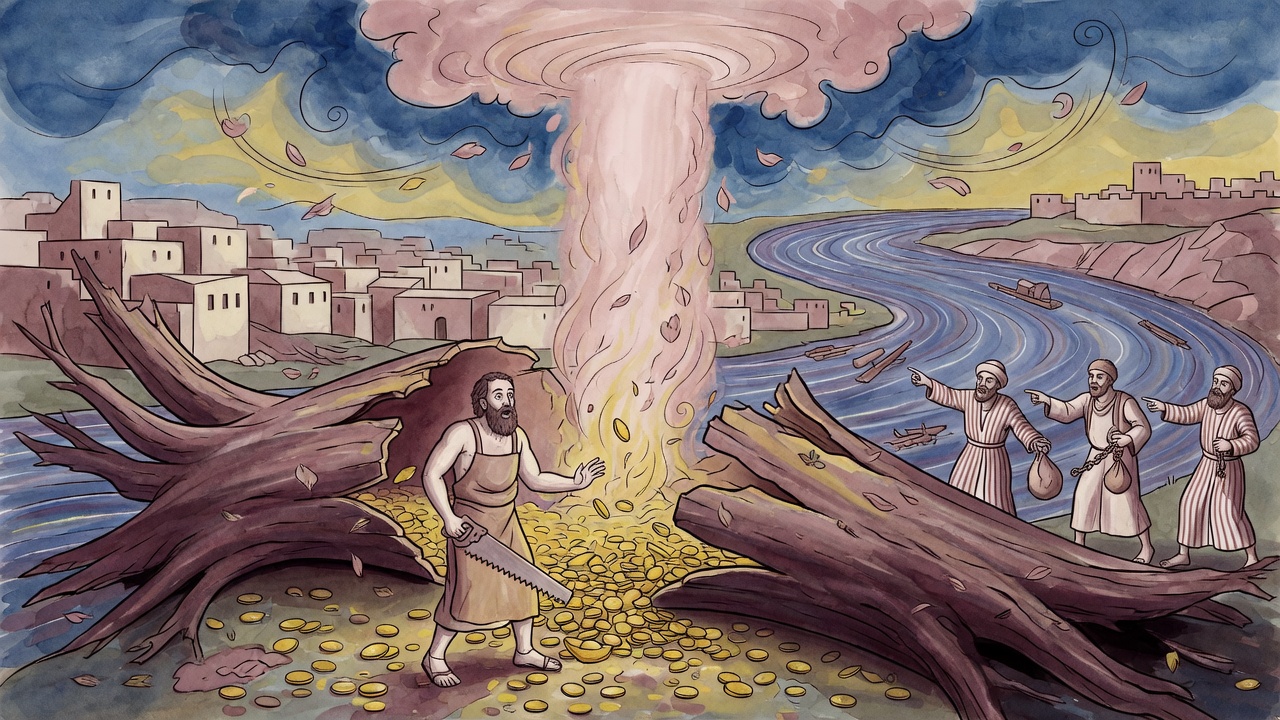
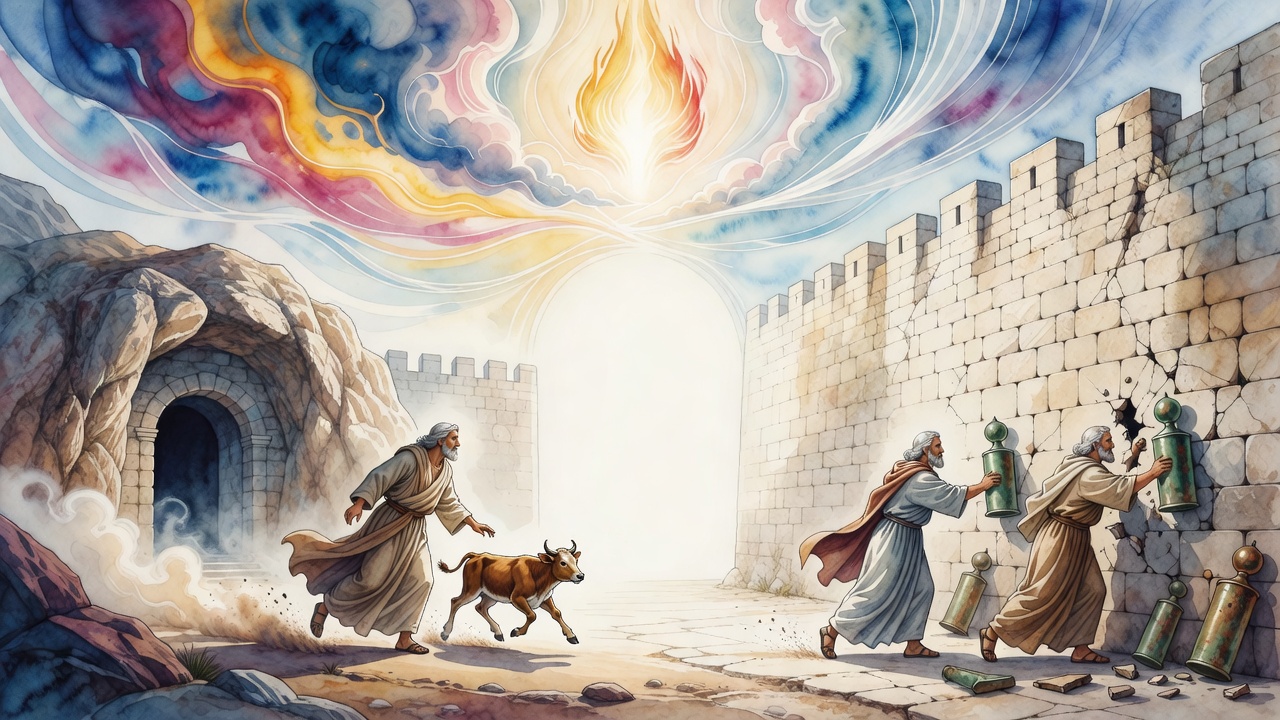
The neighbor stole the purse and ran. On the road his heart stopped as if the dust itself had filed a claim. A young man found the body, dug for burial, and felt the sack fall from the dead man's clothes. Reward for a pious act, he told himself, and took the gold home.

Night disagreed. A voice told him the money had an owner still living. He hid the sack in the hollow of a tree and tried to sleep like a man who had obeyed.

The river did not care about his obedience. Flood came, tore his house, and carried the tree like a spear of timber toward other hands.

Wood That Knew Its Owner

Villagers fished the trunk from the water and sold it as good wood to Abraham the carpenter in Jerusalem. He paid a fair price for a beam. He did not know he was buying his own life back.

Time thinned the young man into poverty. He came to Jerusalem looking for any wage and found work in Abraham's shop. Sawdust stuck to his sweat. One day the saw sang through the old trunk and he said, half to himself, that this wood was like the tree where he had hidden a sack of gold.

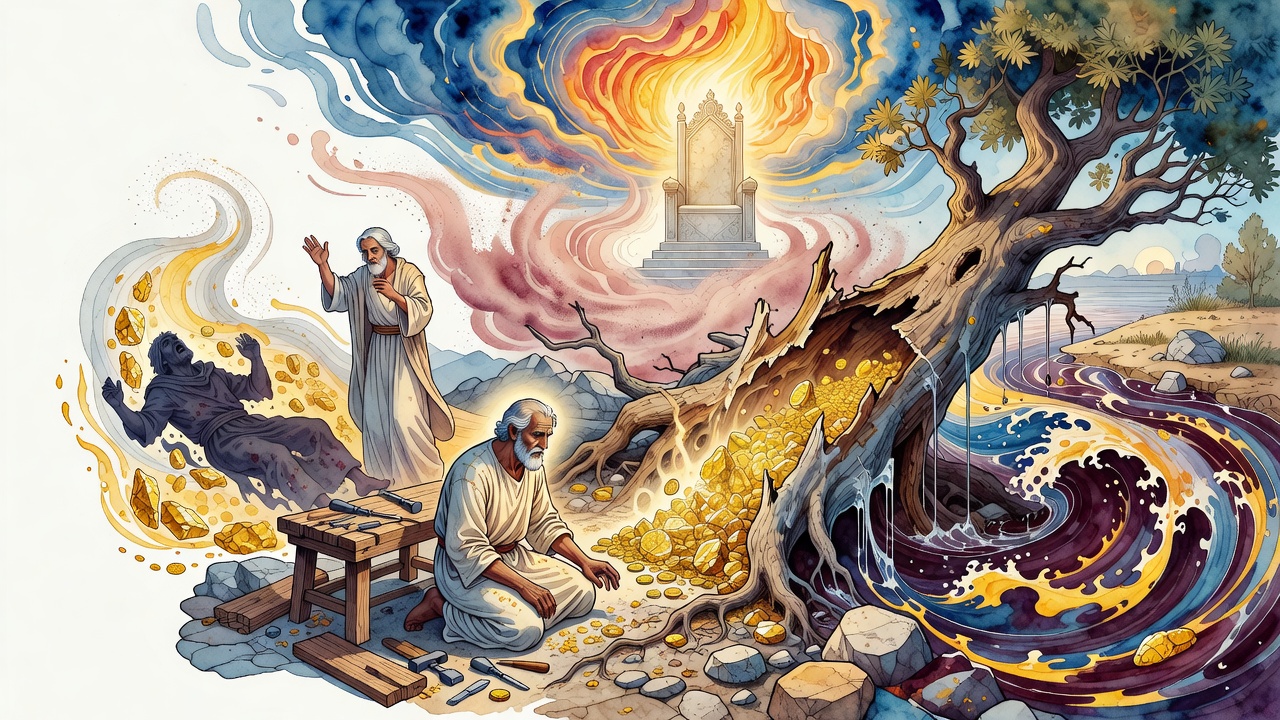
Abraham's hands stopped. Questions came. The trunk opened under the blade and the sack blinked in the light like an eye that had been underground too long.

Abraham offered the young man a share. The young man refused. He had already learned what happens when you call stolen things wages.

Cake at the Gate

Abraham, who understood both justice and joy, married his daughter to the honest finder and sent him toward his people with a cake. Inside the cake he sealed a hundred gold pieces, a dowry traveling as bread.

At the town gate a governor met the young man, bought the cake for a trifle, and sent it as a wedding gift to Abraham's daughter, who had invited the great man in the way families invite power when they hope power will be kind. Abraham received the cake back into his own house and set it aside, surprised by the circle but not yet finished with it.

Gold wants to test everyone it touches. It had tested the thief, the finder, the river, the carpenter, the governor. It was not done.

Another Abraham, Same Refusal of False Gods

The carpenter's name was not an accident of the tale. Behind every Abraham who will not keep what is not his stands the first Abraham, who fled a father's house of idols and smashed the quiet lie that clay can own a man's fear. That Abraham kept charge and commandment and statute before Sinai wrote them down, including the fences that keep a hand off another man's purse (Genesis 26:5). He cleared idols. He circumcised on the eighth day when told. He lived as if Torah were already the weather.

The carpenter Abraham did not smash statues in a shop. He smashed the softer idol of profit-without-question. When the trunk yielded the sack, he did not invent a law that finders keep forever. He traced ownership through flood and night-voice and burial. That tracing is also monotheism: one truth of whose the coins are, not a shelf of convenient gods of appetite.

The young man, by refusing a share he had not earned twice, joined that lineage for a day.

What the Coins Finally Bought

When the cake's secret opened in the right house, the hundred pieces found their work as marriage-gold rather than theft-gold. The governor's cheap purchase became, without his planning, a courier of dowry. Human schemes braided into a rope that pulled the story upright.

Abraham the carpenter did not preach. He fed workers. He cut wood square. He watched his daughter begin a life with a man who had heard a voice say no and had listened. In a city that has always known both Temple and market, that listening is a kind of offering.

Somewhere a river still carried other trees. Somewhere another thief still ran. The tale does not claim the world emptied of crime. It claims that stolen gold is a poor sleeper, and that a carpenter's honesty can be a tool as sharp as any saw.

At dusk Abraham swept the shop. Sawdust rose and fell. He put the empty trunk-space to new use as ordinary timber. The sack's shape remained only as a story he would tell when apprentices reached for nails that were not theirs.

"Bring it back before the river has to," he would say, and they would laugh, and then they would think, which was the point.


← All myths

From the tradition

Sources

3 sources

The texts behind this telling. Some cards carry a translation of the source; others are our own retelling of it, and each card says which. Every card links out to the original.

Exempla of the Rabbis, No. 423Exempla of the Rabbis (Gaster, 1924)

Retold in our words. Read the original at the link below.The Exempla of the Rabbis, Moses Gaster (1924) · Public Domain

Abraham, the Carpenter in Jerusalem, hac. saved some money through hard work. His neighbour stole it and ran away, but dropped down dead on the road. A young man found him, dug his grave to bury him, when the sack of money fell out of his bosom. The young man picked it up and took it away as a reward for his pious deed. At home

165,

he hid it but in the night he heard a voice telling him not to touch it as the money belonged to someone else from whom it had been stolen. So he put it in the hollow of a tree. After a time the river overflowed, destroyed his home and carried this tree away. It was found by villagers and brought to Abraham the Carpenter as a good piece of wood. He bought it. The young man, now poor, came to Jerusalem and got work with Abraham. One day, sawing the trunk, he said, “This is just like the trunk in which I hid my sack of gold.” Abraham overheard him and asked him what had happened. He sawed it, found a sack of gold inside and Abraham offered him a share of it but the young man refused. Soon after Abraham married his daughter and sent the young man on a visit to his people, giving him a cake in which he had put ioo pieces of gold. At the gate of the town the young man was met by the governor who bought the cake for a few pieces of money and sent it as a wedding gift to Abraham’s daughter by whom he was invited. Abraham very surprised, put the cake away. When the young man returned Abraham showed him the cake, asked him what had happened and cut it open. The young man said, “You see, the money was not to be mine.” Abraham, however, married him to a younger daughter so that then he would be able to keep part of the property.

Full source
Targum Pseudo-Jonathan on Genesis 20:13Targum Pseudo-Jonathan on Genesis

Retold in our words. Read the original at the link below.The Targum of Jonathan ben Uzziel, trans. J. W. Etheridge, London, 1862 · Public Domain

Every family has a story it tells to the outside world. Abraham's was quieter than most. In Targum Pseudo-Jonathan on (Genesis 20:13), he finally explains to Abimelech why he left the house of Terach: they tried to turn him toward pulchana nukhraya, foreign worship, and he walked away.

The biblical Hebrew simply says, when God caused me to wander from my father's house. The Targum sharpens the verb. Abraham did not drift. He was pushed, pressed toward idolatry. And he refused. The flight to a new land begins as a flight from the altar of his father.

The arrangement with Sarah comes next. In every place to which we come, say concerning me, He is my brother. The Targum of Pseudo-Jonathan preserves the agreement without softening its strangeness: two people walking a hostile world, staying alive by telling half the truth.

The Maggidim taught that Abraham's first act of faith was not obedience to a command. It was the courage to leave behind the gods of his household. Before he could hear the voice in Genesis 12, he had to silence the voices at home.

Full source
Midrash Aggadah, Genesis 26:5Midrash Aggadah

Retold in our words. Read the original at the link below.Sefaria Community Translation · CC0

God praises Abraham for keeping His charge, His commandments, His laws, and His teachings, and the Midrash Aggadah refuses to treat that as flattery. Each word, the rabbis insist, points to a real thing Abraham did, centuries before Moses ever stood at Sinai.

"He kept My charge" means he built fences around fences, guarding against sin before sin could come near. To his eternal credit, he smashed and cleared away his own father's idols. "My commandments" points to the knife: Abraham circumcised his son Isaac on the eighth day, exactly as God had ordered. "My laws" means even the fine rules of forbidden mixtures, the kind Leviticus would later spell out when it commanded, "My rules shall you observe" (Leviticus 18:4).

And "My teachings," plural, carries the boldest claim of all. Abraham kept both the Written Torah and the Oral Torah, the rabbis say, holding in his life a revelation that would not be written down for generations.

Full source