Gold That Refused Every Thief and Every Finder
The thief made it less than a mile before he dropped dead. A traveler buried him and took the bag. Then a voice in his sleep said the gold was stolen.
Table of Contents
 Click for full size
The Bag Under the Board
Abraham the Carpenter lived in Jerusalem and worked wood until his hands knew every grain. He lived plainly. Over years he saved a small bag of gold and hid it where a careful man hides what he cannot afford to lose. A neighbor watched, broke in, stole the bag, and ran down the road out of the city.
He had not traveled a mile before he dropped dead.
A young traveler found the body. He did what a pious Jew does for an unclaimed corpse. He began to dig a roadside grave. When he lifted the dead man, the bag fell from the bosom. The traveler was poor. He took the gold as payment for a burial no one else would perform and hid it under his pillow that night.
A Voice That Named the Theft
In sleep a voice spoke without softness. Do not touch that money. It is not yours. It was stolen from another man. The traveler rose at dawn, carried the bag into the forest, and pressed it into the hollow of an old tree. Then he walked on, poorer than before and lighter in conscience.
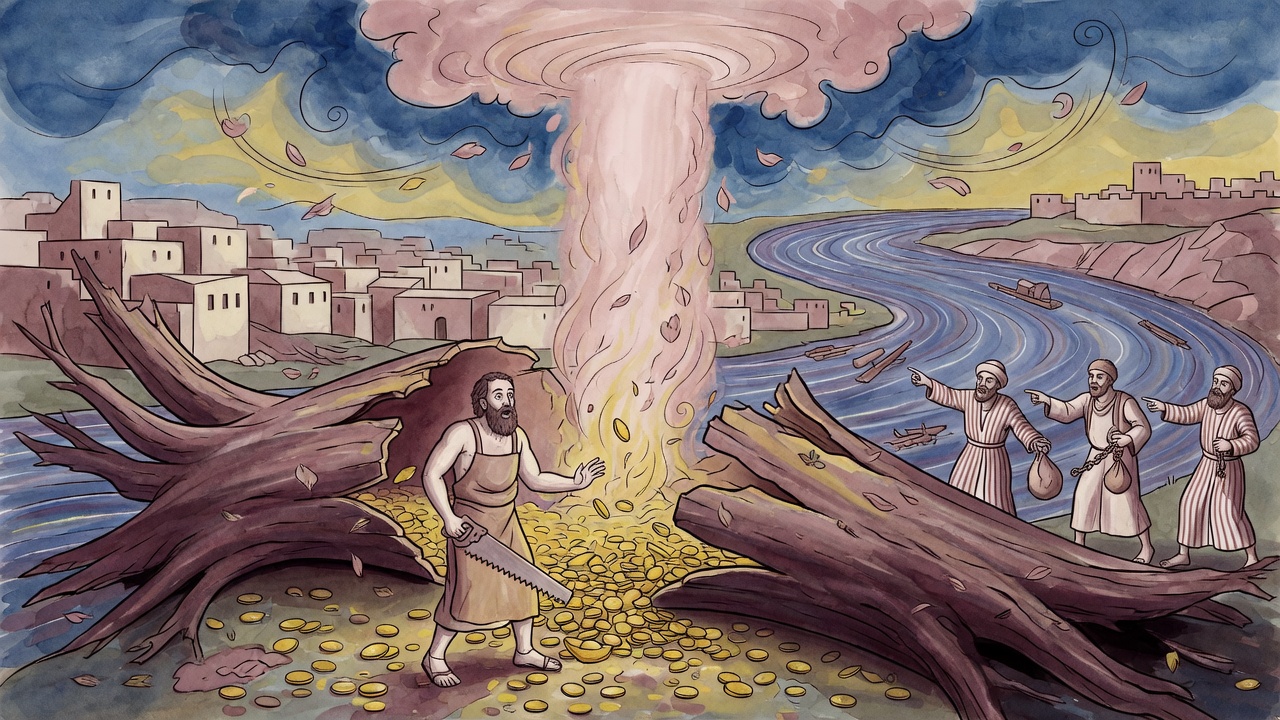
Months later a river flooded the region. It tore houses and tore the hollow tree from its roots. The tree rode the water downstream. A woodcutter pulled it out, sold it as timber, and the beam traveled until it reached a carpenter's yard in Jerusalem. Abraham bought it for a project and set it among his other wood.
The Apprentice Who Recognized the Tree
The young traveler, penniless again, wandered into the same city looking for work. He found a place at Abraham's bench. One morning, sawing a large beam, he murmured to himself that this hollow looked like the tree where he had once hidden a bag of gold. Abraham, at the next bench, heard him. "What did you say?"
The boy told the whole story. Abraham sawed through. Inside the hollow lay the original bag, the same cloth, the same weight. Abraham tried to split the gold as a finder's fee. The young man refused. The gold was not his. So Abraham did something harder than payment. He married the young man to his own daughter and sent him on a family visit with a special loaf into which he had baked a hundred gold coins.
The Loaf That Would Not Stay Given
At the city gate the governor liked the look of the loaf and bought it for a few small coins. Knowing it was a wedding-season journey, he sent the bread as a gift toward Abraham's household. When Abraham cut the loaf open, the hundred coins winked up from the crumb. Even now the gold refused to become the young man's private fortune by accident.
When the apprentice returned, Abraham said the truth out loud. Even now the gold refuses to be yours by the wrong door. He married him to his younger daughter as well, folding him into the household in a permanent way, so the man who twice refused what was not his entered the family that matched his heart.
Another House Where Providence Waited a Year
In another household of two brothers, one rich and one poor, a boy named Isaac was taken into his uncle's house for a single measure of grain and grew up loving his cousin. A rabbi told him to declare his love with a drawn sword between them as a sign of restraint. The uncle agreed. The aunt did not. She meant the girl for her own brother, Isaac's father, and sent both young men away with a hundred dinars each, to return in a year and prove who had prospered.
Isaac's ship wrecked. On an island he found two herbs, one that caused an illness and one that cured it. He healed a king, was made ruler of a town, and returned in robes on the very day his cousin was being betrothed to his father. He interrupted the ceremony, married her on the spot, and the aunt's scheme collapsed. The nephew sold for grain became a ruler married to the woman he loved.
Stolen gold cannot be laundered into peace. A measure of grain cannot seal a boy's future shut. In both houses the wrong door kept slamming until the right one opened.
Abraham the Carpenter stood with the open beam and felt years of careful saving look back at him from a cloth he thought gone forever. The neighbor's greed had lasted less than a mile. The traveler's honesty had lasted through flood and poverty. The gold had taken the long way home through a corpse, a dream, a hollow, a river, and a saw.
In the workshop dust, the apprentice waited for anger that never came. Abraham asked only whether the voice in the dream had been kind or hard. Hard, the boy said. Hard enough to make a hungry man bury treasure he could have eaten. Abraham nodded. Hard voices sometimes do the work soft ones postpone.
When the loaf failed as a secret gift, Abraham stopped trying to smuggle fortune into the young man's hands. Marriage was the only transfer the gold would allow, not because coins have morals, but because the story's God does. A household can hold what a pocket cannot cleanse. The younger daughter's wedding closed the circuit. The bag could rest. The thief could stay dead without infecting the next owner.
Isaac the nephew, in his parallel house of schemes, learned a similar math. A year of herbs and kingship weighed more than the aunt's hundred dinars and her preferred brother-groom. Interrupting a betrothal with official robes is not polite. It is what providence looks like when it refuses to miss the appointment it set for itself. Both tales end in a wedding because Jewish exempla prefer life attached to life over gold attached to excuses.
← All myths