God Covered His Face and the Dark Learned to Walk
When God concealed His countenance the world felt a cold seam open, and evil entered not as a rival god but as a shadow of withdrawal.
Table of Contents
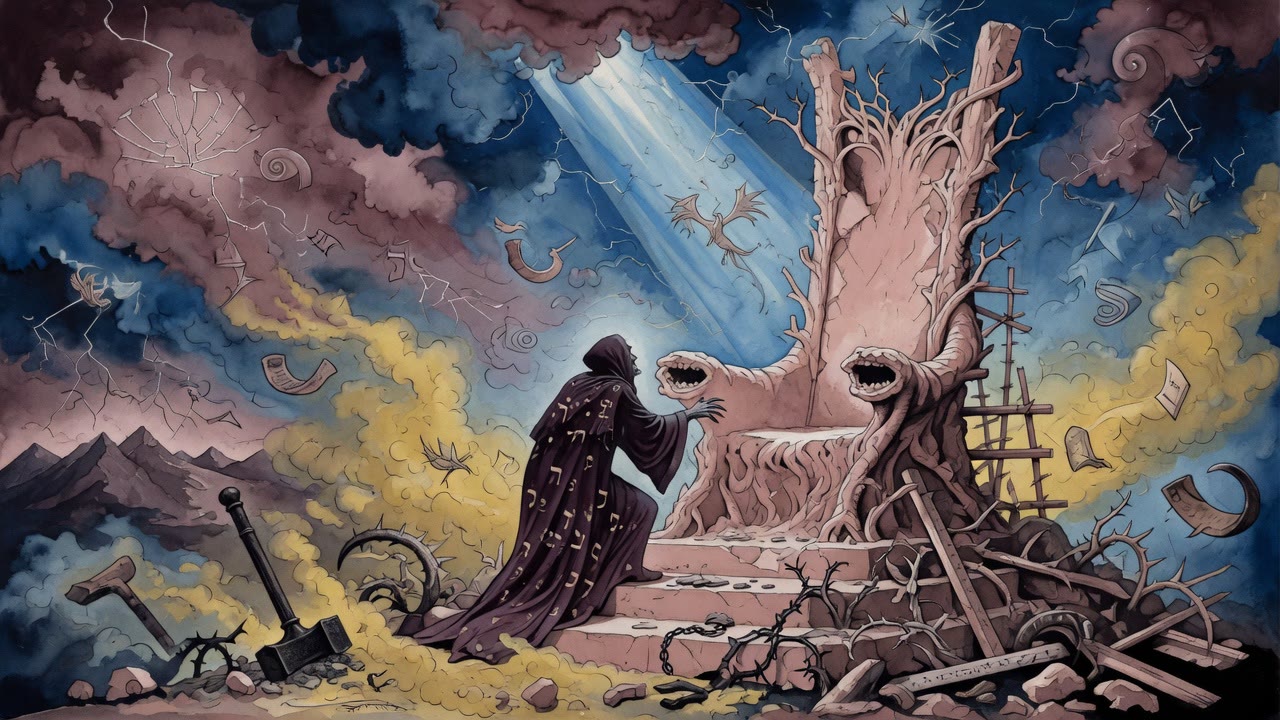
God covered His face, and the Soul climbed the stairs with her hands raw from feeling along a wall in the dark.
 Click for full size
The Intellect had lit one lamp and set a block of limestone on the table. He did not stand when she came in. He turned the stone a quarter turn. Then he picked up a chisel and waited.
The Soul Came In With a Complaint
She had been down among the living all week. She had walked behind a man who carried his own sins the way a porter carries sacks, one and then another, year after year, until his back would not straighten. She had watched wrath poured out on him and nobody catch it. She put both palms flat on the table.
"Name the other one," she said. "The one whose hand did that. Say the name and I will know what I am fighting."
"There is no other one."
"Then say the light went out."
"The light of the countenance of the King is life," he answered. "It did not go out. It was covered. A cover is a hand, and a hand belongs to somebody."
She sat down on the bench. That was the worse answer and she had known it was coming. Two thrones would have been a mercy. Two thrones meant the bad week had an author who was not the same author as the good one.
The word she wanted was hester panim (הסתר פנים), the hiding of the face, and she refused to say it out loud, because saying it made an injury sound like a policy.
He Set the Chisel Against the Stone
He struck. A chip flew off the top corner and landed in the fold of her sleeve. He struck again, and again, and the block lost a hand's width of its crown and began to look wrecked rather than whole.
"Stop."
"Why."
"Because you are breaking it."
He blew the dust off and turned the stone until the lamp fell across the near face. Under the ruin a shoulder had come up out of the limestone, and below the shoulder the start of an arm.
"Anyone who counts only the chips calls me a destroyer," he said. He scraped a burr off the shoulder with his thumbnail. "The chips are how the shoulder gets out. And whoever holds the chisel over your porter with the sacks holds it steadier than I hold this one."
She picked the chip out of her sleeve and did not throw it away.
She Dug Up the Seed to See If It Was Rotting
She took the lamp without asking and went down to the strip of garden along the wall. She knelt in the wet bed, scraped the dirt back with two fingers, and lifted the seed out.
It had split. A white thread had come out of the split, and in the black under the soil it had turned toward something she could not find from where she knelt.
"It is rotting," she called up the stairs.
"It is opening."
She held it near the flame and the thread curled away from the heat like a finger pulled off a stove. So she buried it again. She pressed the soil down with her palm, left her hands dirty on the way back up, and did not tell him what she had worked out on her knees in the dark, which was that the seed was not being punished.
Nobody Is Paid at Noon
He had swept the chips into a ridge along the table edge. She asked him how long.
He wet his thumb and drew a line through the dust. Six thousand years, the count the Rabbis set, and after that a world made new.
"And in the meantime."
"In the meantime the work is the work. Today to do them. Tomorrow to take the wage."
She said the men in the field did not know a dusk was coming. They broke their hands on stones all afternoon with nothing in their pockets. And a laborer who gets paid at noon stops at noon.
He accepted the last part. The commandments were hidden at the start of things, he said, for that exact reason, so hands would have to go out and hunt for them in the dark. A man is born for effort the way a spark is born to fly upward (Job 5:7). Every one he finds and does lifts the corner of the cover by a finger's width, and the reward of a commandment is another commandment, which is either the cruelest wage ever offered or the only one that does not run out.
The yetzer hara (יצר הרע), the inclination that leans a person toward ruin, was why the hunting went hard. It stood between the hand and the thing the hand reached for. It was also, he said, the reason there was anything left to hunt.
The Heart of Stone Comes Out Whole
She wanted the end of it, so he gave her the end.
The stone heart lifted out of the flesh, he said, and a heart of meat set into the cavity where it had been (Ezekiel 36:26). The porter puts the sacks down and does not pick them up again. The coarse material burns off a man the way slag comes off metal, and what is left stands nearer to an angel than to a beast of burden. Nothing pulling sideways in the chest. Nothing over the face.
"And service then?"
"It runs by itself. Nobody earns anything. A man will reach years he says he has no desire in, because there is no merit left to gather and no obligation left to carry."
She did not like it and she said so. A world where the good arrives and nobody earned it is a world where her porter carried the sacks for nothing.
"He earns it now," the Intellect said. "That is what now is for. There is no other room in the house where earning happens."
She Went Back Down Into the Street
At the door she asked whether the cover would be torn off all at once, the way a man rips a sheet off a thing he is ashamed of having hidden.
He said no. A hand pulled away in a rush is the gesture of somebody acting out of regret, and there is no regret in the wisdom that arranged this. The uncovering would come up through the same cloth that did the hiding, from inside the good and the bad rather than by throwing them out. The exile does not stay exiled (2 Samuel 14:14), and the door he returns through is the one he was pushed out of.
She trimmed the wick until the flame stopped smoking. Then she carried the lamp down to the street, where the porter was still walking under his load and the cold ran along the seam of the world like a draft under a door nobody could find.
Behind her the limestone kept its shoulder and its half-finished arm, and where the face would be there was still only stone.
← All myths