5 min read

Prophet Reads Circles Where Light Governs

A ring of light hung over the town without flame, wide enough to cover every roof. Dogs slept through it. Below it a birth and a funeral shared one night.

Curated by Arthur · Told by Maggid ·
Table of Contents
  1. A Ring of Light Over a Sleeping Town
  2. Forms That Are Not the Essence
  3. How a Circle Differs From a Line
  4. Rabbi Shimon's Kind of Fear
  5. Dawn Under a Fading Ring
Prophet Reads Circles Where Light Governs Click for full size

A Ring of Light Over a Sleeping Town

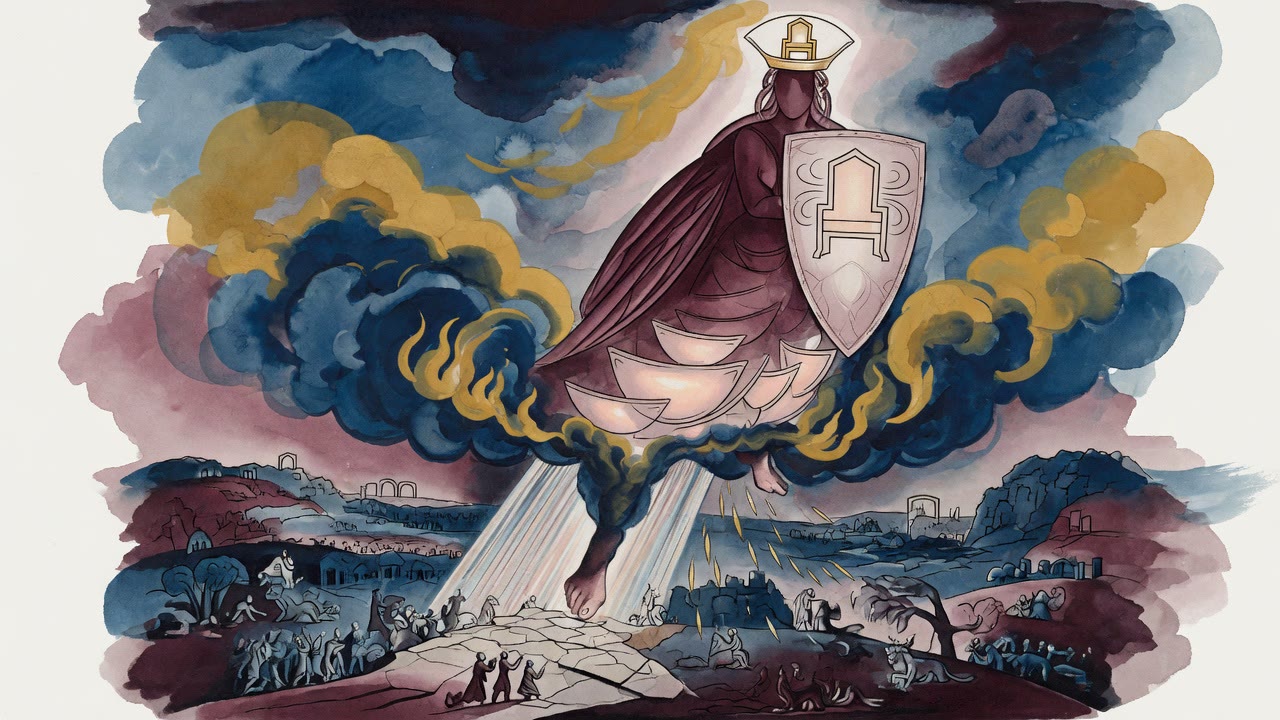
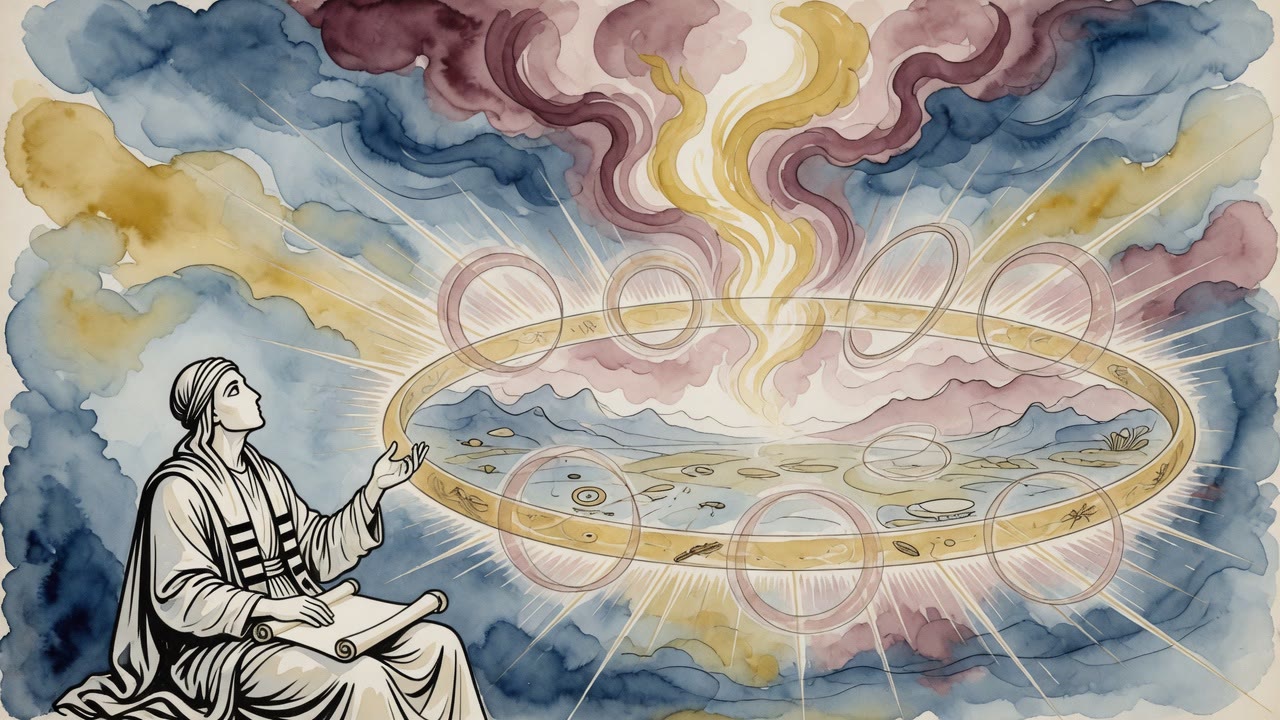
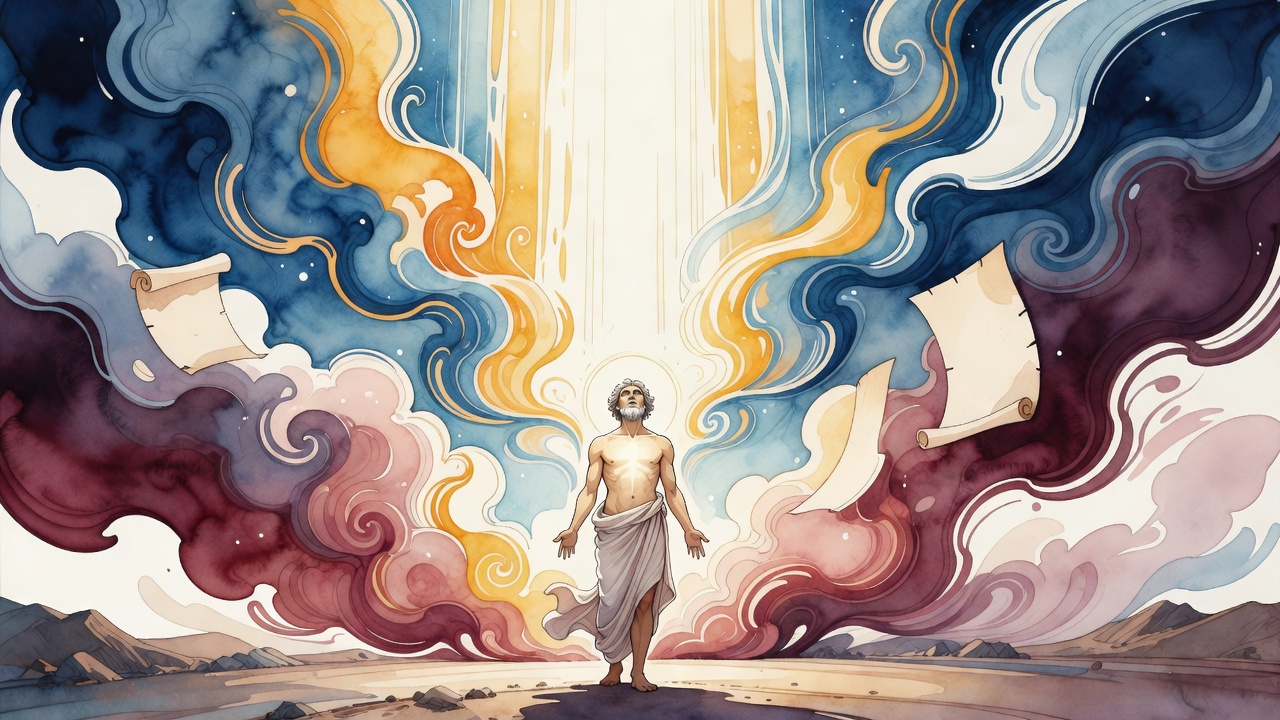
The prophet woke already standing. Above the town a circle of light hung without flame, wide enough to cover every roof. No face in the ring. No sword. Only a general shining, providence without a preferential edge.

He understood, without being told in words, that the circle was governance in its broad mode: light over all that exists, not yet divided into the particular powers of kindness, judgment, and mercy. The ring holds. The ring does not explain its sides.

"Show me the parts," he begged.

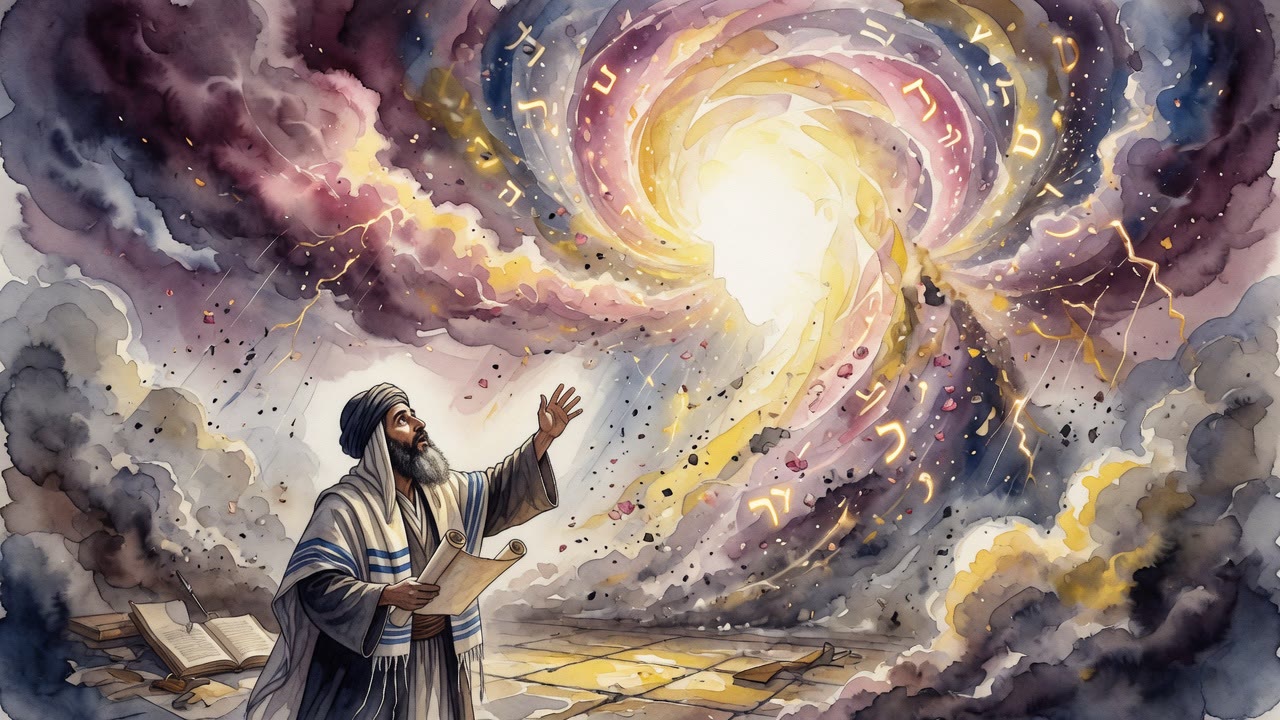
The circle thinned into lines. Straight paths of light ran like decisions with direction. Points glowed and did not extend. Each point a root that stays above. Each line a power that spreads below. The alphabet of vision opened.

Dogs in the alleys slept through the geometry. Children turned in their beds. Only the prophet stood under a grammar that could unmake a man who loved pictures more than truth.

Forms That Are Not the Essence

He reached to touch a line and touched meaning instead of metal. The sefirot (the ten channels of divine power) have no fixed physical form. Torah already warned a people who saw no form at Sinai's fire (Deuteronomy 4:15). What prophets see is likeness, accommodation, a language of shapes for minds that need edges.

"In the hand of the prophets I have used likenesses," the old verse presses (Hosea 12:11). Likeness is gift and limit. Idolatry begins when the likeness is nailed down as the Thing.

Language failed him in the middle of the vision. Words for body parts and metals tried to climb toward formless powers and fell back like poor ladders. He learned to let sentences break rather than lie.

The lights shifted with his readiness. Bright for a clean hour. Dim when his fear made him small. Appearance depends on the seer. Essence does not become clay because clay eyes need symbols.

He bit his tongue to keep from preaching the vision too soon. Premature sermons turn living light into souvenir theology. A rooster crowed under the ring as if to remind him that bodies still need morning.

How a Circle Differs From a Line

A teacher of fire walked the air beside him. "Circular light is general government. Linear light is particular force with direction. Misread a circle as a private favor and you will invent election where the vision offered only wide care. Misread a line as the whole sky and you will turn one attribute into a god."

The prophet looked down. In the town a birth and a funeral occupied the same night under the same ring. General light does not erase particular lines. It frames them.

He saw how physical forms below answer the symbolic forms above. A wall, a road, a closed gate in vision can map to real structures of permission and restraint. Prophecy is not decoration. Prophecy is a mirror of governance.

He wept for every year he had treated visions as riddles for clever men rather than as weather reports from the King.

The teacher pointed at a single point of light that refused to stretch. "Root," he said. "Not yet a road. Do not demand that every power become a story you can walk. Some lights only hold the system from above."

Rabbi Shimon's Kind of Fear

For a breath he stood near a memory of Rabbi Shimon and the companions who handled mysteries like live coals. Their fear was not theatrical. Their fear was accuracy. Wrong form, wrong theology. Wrong theology, broken people.

The prophet folded that fear into his ribs. He would tell what he saw. He would not pretend the sefirot (divine emanations) are limbs of a body in heaven's warehouse. He would not pretend they are nothing when they govern everything he can survive.

Points. Lines. Circles. Faces only when the light assembles that far. Always one source behind the grammar.

The teacher of fire vanished. The town's dogs began to bark at ordinary dark.

He stayed on the roof until his legs hurt. Pain returned him to a body that still needed gates, roads, and circles of neighbors, the lower echoes of what he had read above. A watchman called the hour. The prophet answered with a nod the watchman could not see.

Dawn Under a Fading Ring

Dawn thinned the circle until only a pressure remained, like a hand lifted from the crown of the sky. The prophet wrote on clay: general light, particular lines, no fixed form, language on a leash.

When students asked for the picture that would make them powerful, he drew a ring and a single straight stroke and stopped. "If you need more ink," he said, "you are already hungry for an idol."

He walked the market and watched measures, gates, and circles of dancers. The lower world kept echoing the upper grammar. He blessed the echoes and refused to worship them.

Night would bring the ring again or not. Either way, governance continued. He had learned to read enough to obey. In the evening he fixed a crooked gate in a neighbor's fence, because a line that should open must not pretend to be a wall forever. The neighbor offered wine. He took water. Some nights the vision asks for a dry throat.


← All myths

From the tradition

Sources

5 sources

The texts behind this telling. Some cards carry a translation of the source; others are our own retelling of it, and each card says which. Every card links out to the original.

Kalach Pitchei Chokhmah 13:2Kalach Pitchei Chokhmah

Retold in our words. Read the original at the link below.138 Openings of Wisdom, trans. Rabbi Avraham Greenbaum, Azamra Institute (2005) · CC-BY

It's about understanding the very fabric of reality.

Kalach Pitchei Chokhmah, a relatively obscure but fascinating Kabbalistic text, gives us a clue. It suggests that the shapes and forms seen in prophecy aren’t arbitrary. They're deeply symbolic, reflecting how divine energy manifests in our world. When a prophet has a vision, they’re not just seeing pretty pictures. They’re glimpsing the underlying spiritual architecture of the universe. And according to this text, those visions are shaped by the specific Sefirah (a divine emanation), or divine attribute, being revealed.

The passage focuses on two key forms: the circle (igul) and the straight line (yosher). What do they represent?

The circle, or igul, symbolizes an all-encompassing kind of governance. It’s a holistic view, where distinctions between Chessed (Kindness), Din (Judgment), and Rachamim (Mercy) blur into a unified whole. Imagine a general overview, a broad stroke of providence that reflects the unique quality of the particular Sefirah at play. This is how things appear from the perspective of hishtalshelut, the chain of unfolding or causal development. Everything is interconnected, flowing seamlessly.

But then there's the straight line, or yosher. This form represents something entirely different: detailed governance. Here, the distinctions between Kindness, Judgment, and Mercy are sharp and clear. Right, left, and center – each aspect of divine administration operates according to its specific requirements. It’s a more granular, differentiated view of the world.

So, what’s the takeaway? The forms seen in prophetic visions aren't just random occurrences. They’re coded messages, revealing the nature of divine governance. A circle suggests unity and encompassing providence. A straight line signifies detailed, differentiated judgment.

And it doesn’t stop there. Kalach Pitchei Chokhmah suggests that this principle extends to all the other forms seen by prophets. Each shape, each symbol, offers a window into the divine plan. Each vision offers a deeper understanding of how the divine interacts with our world.

Next time you encounter a prophetic vision in scripture or folklore, remember the circle and the line. Consider what these forms might be telling you about the nature of the divine force at work. What kind of governance is being revealed? Is it all-encompassing, or highly specific? The answers may be hidden in plain sight, waiting to be deciphered.

Full source
Kalach Pitchei Chokhmah 13:7Kalach Pitchei Chokhmah

Retold in our words. Read the original at the link below.138 Openings of Wisdom, trans. Rabbi Avraham Greenbaum, Azamra Institute (2005) · CC-BY

It's not a simple, linear thing. They used both circles and lines to explain it.

The igul, the circle, represents an all-encompassing governance. It doesn't discriminate between Chessed, Kindness, Din, Judgment, and Rachamim, Mercy. It's a holistic view. This concept, by the way, applies to all the Sefirot (the divine emanations).

Yes, you heard right: all of them. Each Sefirah, these divine emanations or attributes, can be seen in circular form, or in a straight, upright form. Why both? Because the Sefirot exist as a hierarchy, different levels, and that means there are different ways of looking at them. We can view them as a causal chain – how one develops from another – or in terms of how they actually govern the world.

Think of it like this: When looking at how the Ten Sefirot manifest, level by level, each one is caused by, and develops from, the one above it. In this aspect, it’s not important that one Sefirah leans towards Kindness while another leans toward Judgment. Because even though Kindness and Judgment partner in governing, from a developmental point of view, Judgment emerges from Kindness.

It’s a fascinating chain of being. From this viewpoint, each successive Sefirah is “lower” than the one above it. And this is really interesting: the Sefirah of Gevurah (Severity), often translated as “Strength” or “Severity," develops out of Chessed, "Kindness".

As the sages said, "The waters conceived and gave birth to darkness," (Midrash Rabbah (Exodus 15:2)2). Here, water symbolizes Kindness, and darkness symbolizes Judgment. So, Kindness produces Judgment. From this perspective, the Ten Sefirot emerge as ten distinct levels, one below the other.

And here's where the imagery gets even more evocative. Because each higher Sefirah bears and carries the Sefirah below it, we can picture them nested, one inside the other. Like…the skins of an onion. Layer upon layer, each containing the next.

So, what does this all mean? Well, maybe it means that even seemingly opposing forces like Kindness and Judgment aren't truly separate. They're part of the same unfolding process, each giving rise to the other. And that perhaps, understanding the layers, the circles and the lines, brings us closer to understanding the very fabric of existence itself.

Full source
Kalach Pitchei Chokhmah 13:12Kalach Pitchei Chokhmah

Retold in our words. Read the original at the link below.138 Openings of Wisdom, trans. Rabbi Avraham Greenbaum, Azamra Institute (2005) · CC-BY

It uses the image of a circle to describe a specific level of divine light and its influence on the world.

A circle of light encompassing everything. According to this text, that circular form represents how divine light shines down “generally over all that exists.” It’s a broad, all-encompassing providence.

Here’s the kicker: the circle, in this context, only gives us the general idea.

It doesn't reveal the particular powers of this level, the specific ways this light operates. Think of it as the overall governance of the universe. It’s there, it's constant, but it's not broken down into its individual components.

So, what are those components? That’s where things get interesting. The text hints that the light needs to appear in a different form, "one that divides it into its different sides properly," for us to understand its specific powers.

What does it mean to "divide the light into its different sides?" Well, it’s talking about aspects like Kindness, Judgment, and Mercy. These are fundamental attributes, or middot, through which the divine interacts with creation. The circular form, as a symbol, doesn’t differentiate between them. It represents a unified, undifferentiated influence.

It’s like saying, "God provides." Okay, but how does God provide? Is it through acts of great kindness? Sometimes. Is it through challenges that force us to grow, a form of divine judgment? Perhaps. Or is it through unwavering mercy, even when we don't deserve it? All of the above, but the circle alone doesn't show us that.

The text holds back on revealing those specific powers here. It suggests we need to look elsewhere, to another form, to truly grasp the nuances of how this divine light manifests. It’s a reminder that sometimes, we need to move beyond the broad strokes and explore the details to truly understand the bigger picture.

So, the next time you feel like you’re only seeing a general overview, remember the circle. Remember that there are deeper, more specific aspects at play. Keep searching, keep questioning, and keep seeking the light that reveals all its different sides. Because ultimately, true understanding comes from seeing the whole, in all its glorious complexity.

Full source
Kalach Pitchei Chokhmah 7:3Kalach Pitchei Chokhmah

Retold in our words. Read the original at the link below.138 Openings of Wisdom, trans. Rabbi Avraham Greenbaum, Azamra Institute (2005) · CC-BY

The truth is, it's complicated. They’re not physical things, not really. They're more like… energetic pathways, divine characteristics that shape our reality.

Here's the kicker: according to the ancient text Kalach Pitchei Chokhmah, these Sefirot, these fundamental aspects of divinity, don't actually have a fixed form. The most profound, powerful forces in the cosmos, and they're essentially formless.

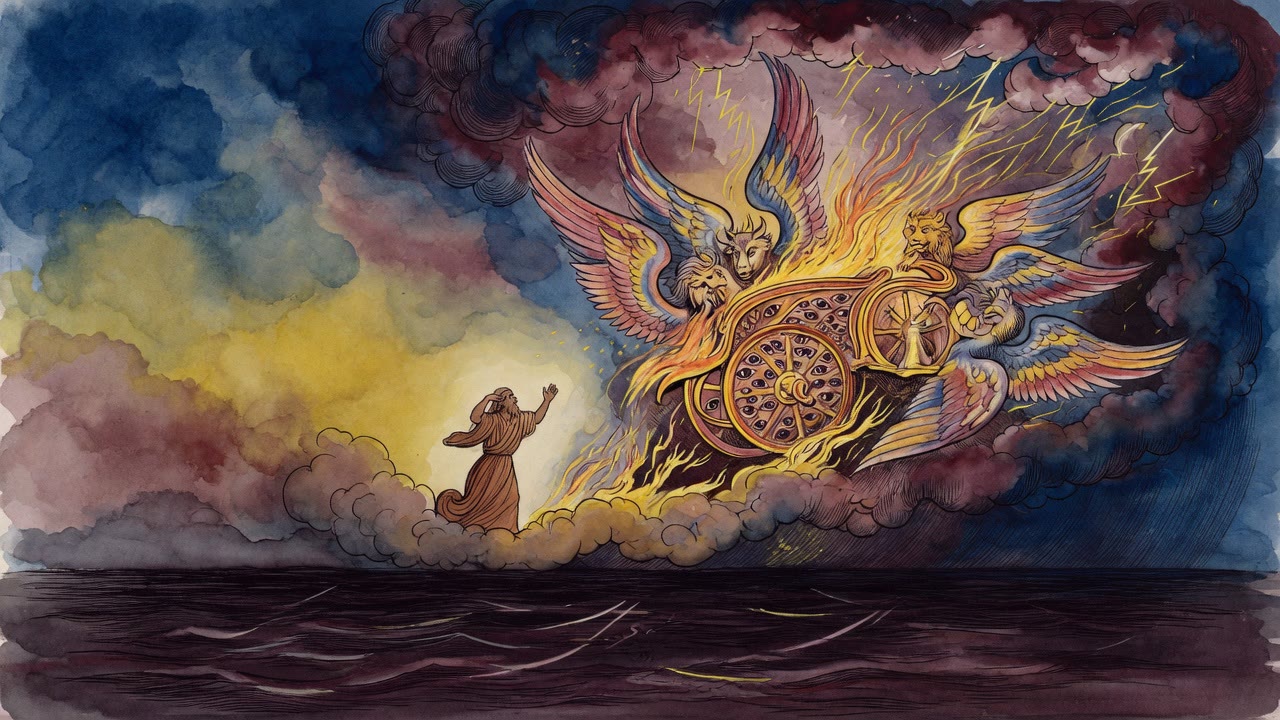
So, what's with all the fiery chariots and winged creatures in the prophetic visions? Well, Kalach Pitchei Chokhmah tells us that the way the Sefirot appear – whether shining brilliantly or dimly – depends on the one who's seeing them. It's all about perspective.

Think of it like this: you and I can look at the same piece of art and see completely different things. Our experiences, our beliefs, our very souls shape what we perceive. It's the same with prophecy. The prophets, in their unique states of consciousness, perceived the Sefirot in ways that resonated with their own understanding.

That's why (Hosea 12:11) says, "And in the hand of the prophets I have used likenesses." The Divine uses images, symbols, and forms that are meaningful to the prophet, allowing them to grasp something of the infinite. It's like God is meeting them where they are, speaking their language.

But let's not mistake the image for the reality. Underneath all the dazzling visions, the Sefirot are, in their essence, a network of interconnected forces. They're an "extended array of powers organized in their necessary order," as Kalach Pitchei Chokhmah puts it. Each Sefirah (a divine emanation) influences the others, all working together to bring about the "perfection of the entire ordered plan."

So, the next time you read about a prophet's vision, remember that you're seeing a glimpse of something far beyond human comprehension. It’s a glimpse filtered through the lens of a human soul, a unique interpretation of the Divine. The vision is real, powerful, and transformative. But it’s also just a single facet of an infinite, unknowable truth. And maybe, just maybe, that makes it even more wondrous.

Full source
Kalach Pitchei Chokhmah 7:8Kalach Pitchei Chokhmah

Retold in our words. Read the original at the link below.138 Openings of Wisdom, trans. Rabbi Avraham Greenbaum, Azamra Institute (2005) · CC-BY

These are the ten emanations, or attributes, through which the Infinite reveals itself and continuously creates both the physical realm and the chain of higher metaphysical realms. It's a complex concept in Jewish mysticism, central to understanding the very fabric of reality.

The language we use to It's almost as if we're trying to grasp something beyond comprehension with the limited tools of our earthly vocabulary. Because here's the thing: we absolutely cannot say that the Sefirot themselves possess any kind of physical form or substance. That would be… well, heresy. The Torah itself states explicitly, “For you did not see any form” (Deuteronomy 4:15). This isn’t just a casual aside; it’s a fundamental principle. God is beyond form, beyond our limited human understanding of what constitutes existence.

So, how do we reconcile this? How do we

Well, as we’ve discussed before, the Sefirot are the powers of the Supreme Thought. The Kalach Pitchei Chokhmah (Wisdom), our source for today, hints that prophets or spiritually enlightened souls can “see” them, not with physical eyes, but with spiritual vision. It’s a bit like seeing the thoughts passing through your own mind. You can sense them, grasp their essence, but you can't exactly hold them in your hand.

But even that analogy falls short. Because here’s the crucial difference: your mind, your thoughts, they’re within you. They're human. Imperfect. The Sefirot, on the other hand, are the powers of the Thought. Or the Mind, of the Supreme Will, blessed be He. They are Divine.

We might be tempted to apply concepts of “form,” “likeness,” and “appearance” to the thoughts in a person's mind, even if that form is spiritual rather than physical. But we can’t do that with the Sefirot. It is impossible to say that they possess any form at all.

Why? Because, in all His aspects, the Emanator, blessed be His Name, completely transcends all the incidents and events that occur to those He created. God isn’t limited by the boundaries of creation. He’s not subject to the same rules. He's beyond definition.

So, the next time you encounter descriptions of the Sefirot that seem to imply form or substance, remember this: we're using metaphors, analogies, imperfect language to try and capture something that ultimately lies beyond human comprehension. We're reaching for the Infinite, knowing we can only ever glimpse a reflection. But even that glimpse, that fleeting moment of understanding, can be enough to change the way we see the world, and our place within it.

Full source