5 min read

Ezekiel Reads the Letters of the Chariot

By the river Chebar Ezekiel sees wheels and living beings, then the shapes of letters themselves begin to teach what he saw.

Curated by Arthur · Told by Maggid ·
Table of Contents
  1. By the River of Exile
  2. When Form Is Already a Translation
  3. Letters That Carry the Vision
  4. Names of AV and the Structure of Ascent
  5. What the Captives Needed
Ezekiel Reads the Letters of the Chariot Click for full size

By the River of Exile

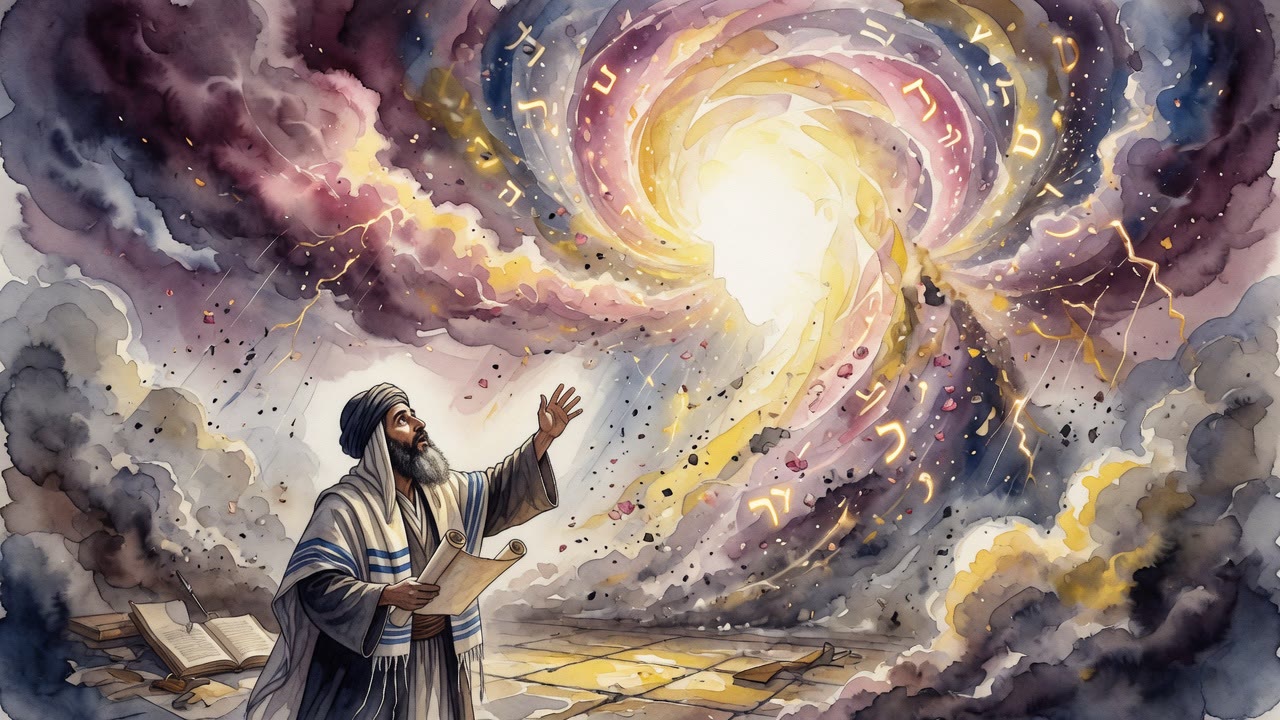
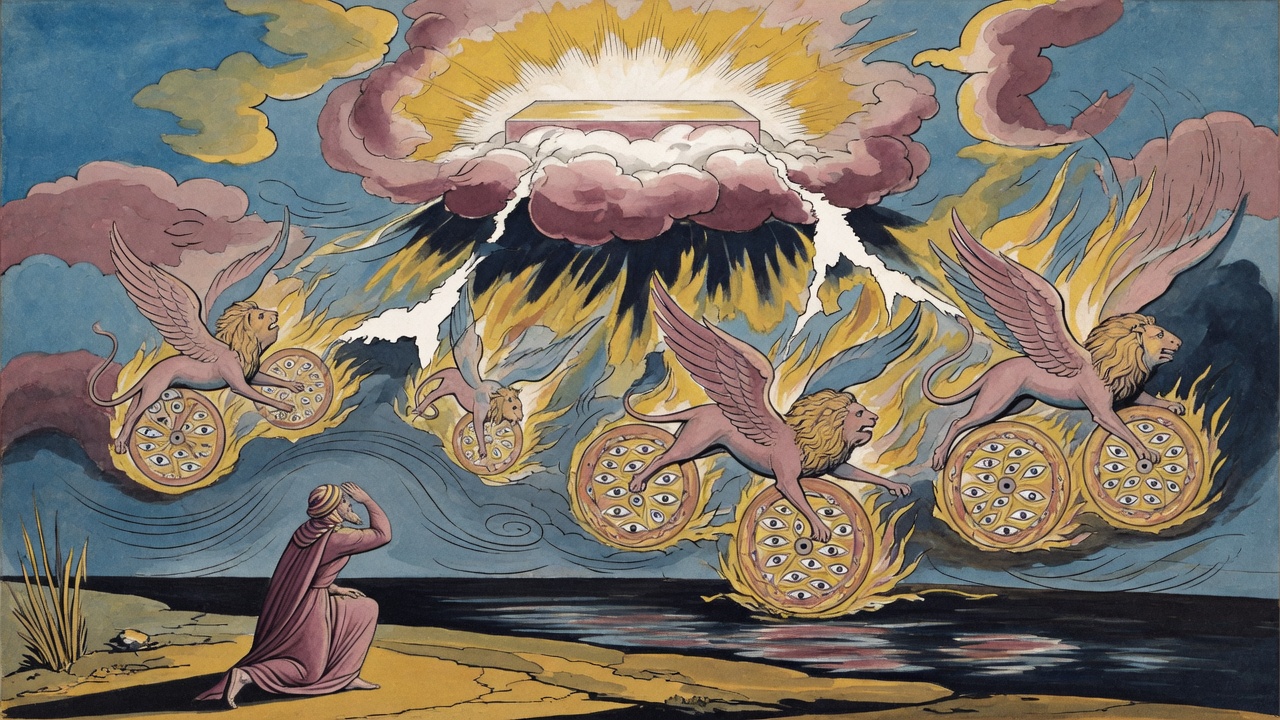
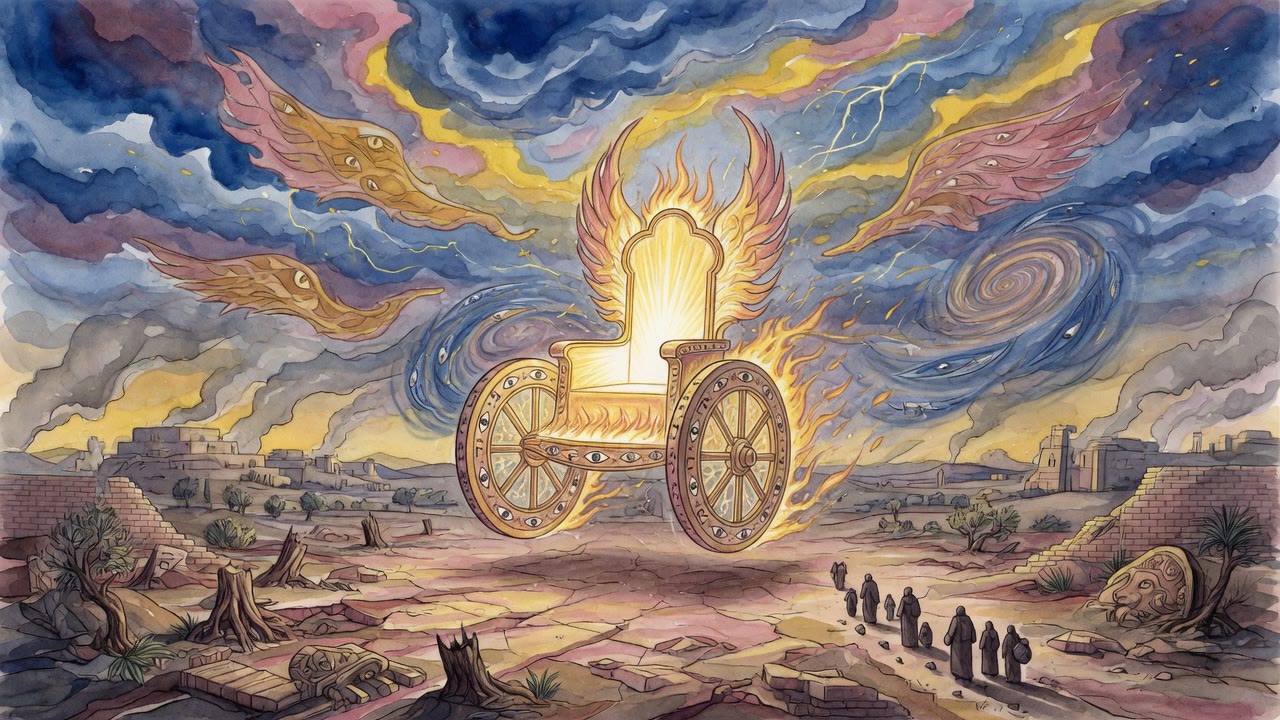
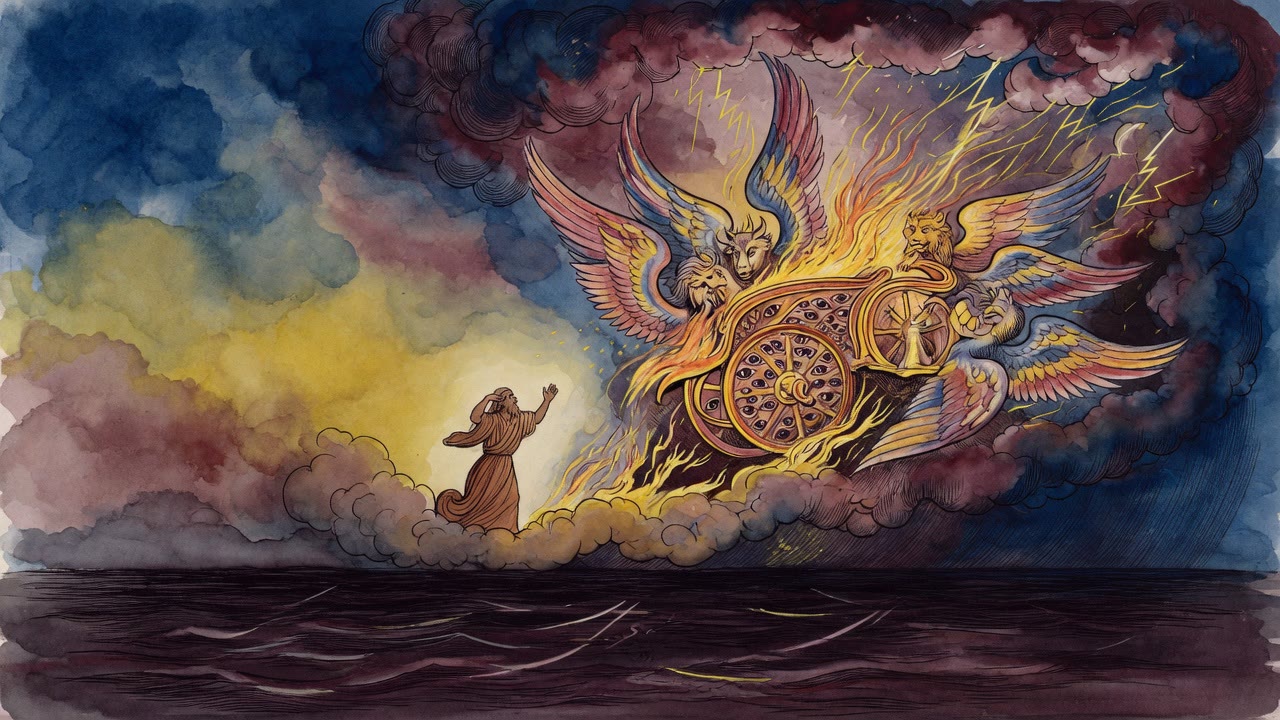
Ezekiel sat among the captives by the river Chebar when the heavens opened and nearly unmade him. Four living beings. Wheels within wheels. Eyes on the rims. A throne above a firmament that glittered like terrible ice (Ezekiel 1:1-28). He fell on his face because standing was not an option. Exile had already taken the Temple. Now exile was taking the last privacy of ordinary sight.

Mud on his knees. The river's slow smell. A sound of wings like many waters. What he saw could not be pocketed as a souvenir of mysticism. It could only be carried as a wound that teaches. The captives nearby did not all share the vision. Some only saw a man collapse and rise different, eyes too bright for a slave market afternoon.

When Form Is Already a Translation

Isaiah had already warned the imagination. To whom will you liken Me, that I should be equal (Isaiah 40:25)? Baal HaSulam, reading the Zohar's doorway, presses the point: God may manifest in vision and imagination, in "your forms," and still no form is God. Before creation there was no likeness at all. Above a certain height of worlds, comparison itself becomes forbidden speech.

Ezekiel's chariot is therefore not a portrait hung for worship. It is a mercy of form for a prophet who would otherwise have nothing to report to a broken people. The vision is real as address. It is limited as picture. Grab the wheels as if they were God's body and you have already failed the warning Isaiah left in the air. The captives needed a report, not a new idol made of fire and geometry.

Letters That Carry the Vision

Tikkunei Zohar will not leave the letters of Scripture as dead ink. Rapheh and dagesh, soft and hard marks inside consonants, become hinges of meaning. The shapes themselves lean, open, close. What Ezekiel saw in fire and wheel, the mystics also hear in the way a letter sits on a line, in the stroke that hardens a sound or lets it breathe.

Study becomes a second chariot. A student who never stood by Chebar can still feel a letter flare when the portion of the vision is read with the body leaning forward. The danger is the same danger as the riverbank: to grab the form and forget the One who refuses likeness. Ink can idolize as easily as gold if the heart is hungry enough for something to touch.

Years after the riverbank, when elders asked him to describe the throne again, he chose words the way a man chooses steps on ice. Too much detail and the young would carve idols of wheels. Too little and the captives would think God had gone quiet forever. Letters became his compromise: shapes that move without pretending to be the Mover.

Names of AV and the Structure of Ascent

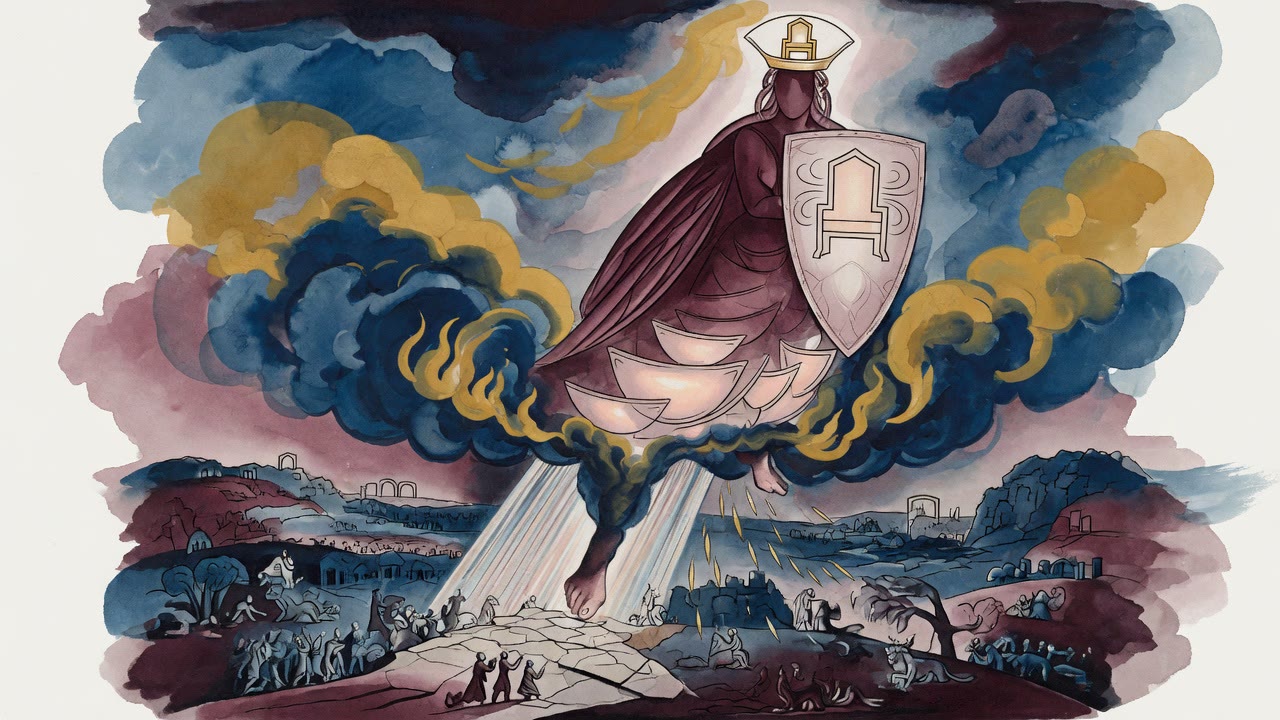
Kalach Pitchei Chokhmah turns the chariot toward the deep names, the expansions of the divine Name counted as AV and its kin, the architecture through which light steps down without shattering the receiver. The living beings and the wheels are not zoo specimens. They are how will becomes motion in worlds below the Infinite.

Ezekiel, priest without an altar, becomes the witness that heaven still runs Temple traffic even when Jerusalem's gates are burned. The chariot moves. The glory can relocate. That news is terror and comfort in the same breath for anyone who thought God was furniture bolted to one hill. In Babylon's markets, other nations told stories of gods who bled and quarreled. Ezekiel's people carried a vision that refused those plots. The living beings did not rebel. The wheels did not scheme. Everything answered a will above the firmament.

What the Captives Needed

They did not need a diagram. They needed to know the God of the ruined house had not been captured with the house. Ezekiel ate a scroll bitter in the belly and sweet in the mouth. He lay on his side for the years of guilt. He spoke until his wife died and he was forbidden ordinary mourning. Through all of it the first vision stayed under his ribs: eyes, wheels, a voice, a form that was already a translation.

Later kabbalists would map what he survived, letter by letter, name by name. A scribe copying the chapter would feel his hand shake at the same places the prophet's knees had failed. On the riverbank Ezekiel only knew that he had been seized, and that Israel in exile still stood under a moving throne that no Babylonian general could inventory among the spoils.


← All myths
From the tradition

Sources

3 sources

The texts behind this telling. Some cards carry a translation of the source; others are our own retelling of it, and each card says which. Every card links out to the original.

Tikkunei Zohar 40:23Tikkunei Zohar

Retold in our words. Read the original at the link below.Sefaria-hosted English translation · CC-BY

The Tikkunei (spiritual repair) Zohar, a profound work of Kabbalah expanding upon the Zohar, certainly thinks so. It sees the very shapes and markings of the letters as brimming with mystical significance. to just one tiny, yet fascinating, corner of this vast ocean of wisdom: the rapheh and the dagesh.

You might be asking, what in the world are a rapheh and a dagesh? Don't worry, we'll break it down. In Hebrew, the dagesh (דָּגֵשׁ) is that little dot you sometimes see inside a letter, changing its sound or emphasizing it. The rapheh (רָפֶה), on the other hand, is a subtle horizontal line that used to be written above certain letters, indicating a softer pronunciation. It's much less common these days, having mostly disappeared from modern Hebrew.

The Tikkunei Zohar in Tikkun (section) 40, however, elevates these seemingly minor markings to cosmic significance. It connects the rapheh to a verse from Ezekiel (1:22) describing a firmament above the heads of the ḥayot (חַיּוֹת), the holy "living creatures" of Ezekiel's vision: "And the image upon the heads of the ḥayah, was of a firmament, like the hue of the awesome ice, extended over their heads from above." The text emphasizes the word "extended" (רָפוּי, rafui, related to rapheh) linking this extension to the marking itself.

What does it all mean?

The Tikkunei Zohar goes on to explain that the rapheh exists above the letters, while the dagesh resides within. Think of the letters themselves as representing the divine name, YHVH (י-ה-ו-ה), the most sacred name in Judaism, sometimes called the Tetragrammaton. In this context, the letters are represented by YQV"Q, a permutation of the letters in YHVH. The dagesh intensifies these letters, focusing their energy. The rapheh, hovering above, acts as "a bridle and curb" (meteg) offering a sense of containment and control.

The text continues, referencing another verse from Ezekiel (1:14): "And the ḥayot were running and returning.." The Tikkunei Zohar interprets this as "running – with dagesh, and returning – with rapheh." Running, a dynamic, outward motion, is associated with the intensified energy of the dagesh. Returning, a movement inward, towards rest and reflection, is linked to the gentle release of the rapheh.

So, what's the takeaway? The Tikkunei Zohar isn't just giving us a grammar lesson. It's using the very structure of the Hebrew language to reveal profound truths about the nature of reality. The push and pull of energy, the balance between intensity and release, the constant dance between outward action and inward reflection – all are encoded within these tiny markings.

Next time you see a Hebrew letter, remember the rapheh and the dagesh. Think about the hidden forces at play, the subtle energies shaping our world. It might just change the way you see everything.

Full source
Kalach Pitchei Chokhmah 57:2Kalach Pitchei Chokhmah

Retold in our words. Read the original at the link below.138 Openings of Wisdom, trans. Rabbi Avraham Greenbaum, Azamra Institute (2005) · CC-BY

Kalach Pitchei Chokhmah turns to The Chariot of Ezekiel in Kabbalistic Thought.

It all begins with the names of AV. These aren't just random letters; they represent a specific configuration of the divine name, a source of immense power. The four Partzufim (a divine configuration) (פרצופים) – think of them as divine "faces" or aspects – draw strength from Arich Anpin (אריך אנפין). Now, Arich Anpin is something special. It's considered the "Long Face" or "Vast Countenance" of God, a realm so high and sublime that it's beyond the reach of.damage. Yes, even in the supernal realms, things can get a little dicey.

The text says that the Throne – again, not just a seat, but a symbol of divine authority – carries its bearers. It's not just that the bearers are supporting the Throne; the Throne itself is actively sustaining them. It's a reciprocal relationship of power and support.

What about that damage we mentioned? Well, according to Kalach Pitchei Chokhmah, it was necessary for 288 sparks to descend from this high realm. These weren't just any sparks; they were specifically sent to hold and sustain the vessels as they descended. Why? So that the destruction wouldn't be complete. The idea is that without these sparks, the vessels – which can be understood as containers for divine light – would have shattered completely.

The descent of these 288 sparks is a crucial concept in Kabbalistic thought, often associated with the breaking of the vessels, or Shvirat HaKelim (שבירת הכלים). This "breaking" isn't a failure, but a necessary part of the cosmic process. It's what allows for the creation of our world, a world where good and evil, light and darkness, are intertwined.

The text emphasizes that the affairs of this world are rooted in such a way that one power should endure. This remaining power acts as an anchor, preventing the complete destruction of the world, God forbid. Through this enduring force, what was damaged can ultimately be repaired.

Think of it like a resilient plant pushing through cracked concrete. Even in the face of immense pressure and destruction, there's an inherent force that strives to rebuild, to heal, to restore. This is the message of Kalach Pitchei Chokhmah. It's a message of hope, a reminder that even in the darkest of times, the potential for repair and renewal always exists.

So, the next time you feel like the world is crumbling around you, remember the 288 sparks, the enduring power, and the promise of repair. Maybe, just maybe, that's the secret sauce we've been searching for all along.

Full source
Baal HaSulam's Preface to Zohar 35:6Baal HaSulam's Preface to Zohar

Retold in our words. Read the original at the link below.Sefaria-hosted English translation · CC-BY

Baal HaSulam, in his preface to the Zohar, a foundational text of Kabbalah, delves deep into this question. He reminds us that while God may "manifest Myself to you in your forms, i.e., in vision and imagination," as Isaiah (40:25) says, "to whom will you liken Me, that I should be equal?" In other words, even when we experience what feels like a direct connection to the Divine, we must remember that any image or form we perceive is ultimately limited by our own human capacity.

Before creation, before any image or form existed, God was utterly singular, without any likeness whatsoever. This is a crucial point. readers often try to understand the Divine through analogy, through metaphors drawn from our own experiences. But Baal HaSulam cautions us against this. He's not saying we shouldn't try to understand, but rather that we need to be aware of the inherent limitations of our understanding.

Think of the Sefirot (the divine emanations), those ten emanations through which God manifests in the world. Kabbalists use them as a map to understand the Divine flow. But even this map has its limits! Baal HaSulam explains that those who grasp God above the level of Beria, the world associated with the Sefirah (a divine emanation) of Bina (understanding), are forbidden to compare God to any form or image.

Why Beria specifically? Because above Beria, in the realms of Atzilut (emanation) and Adam Kadmon (primordial man), corresponding to the Sefirot of Ḥokhma (wisdom) and Keter (crown) respectively, there is no form or image at all. There are no vessels or boundaries as Baal HaSulam notes. As the verse says, “For you did not see any image.” He clarifies that this verse applies specifically to those who have merited grasping God above the level of Beria, in the realms where form dissolves into pure, undifferentiated being.

Therefore, even the allusions found in letters, dots, or holy names – like the Havaya, the four-letter name of God (Yud-Hey-Vav-Hey) – are only relevant from Bina downward. Even then, they don't describe the Sefirot themselves, but rather exist in relation to the recipients of Divine emanation, as explained regarding the Sefirah of Malkhut (kingship).

It means that our attempts to understand God are always a dance between revelation and concealment. We can catch glimpses of the Divine through our experiences, through the teachings of Kabbalah, through the beauty of the world around us. But we must always remember that these are just glimpses. The ultimate reality of God remains beyond our full comprehension. And perhaps, that's exactly as it should be. The mystery, the unknowable, is what keeps us reaching, keeps us searching, keeps us connected to something far greater than ourselves.

Full source