5 min read

Chesed and Din Trade Crowns Across the Days

A thief got a second chance before noon. By afternoon a scale refused to lie and a fever found a house that had mocked the poor. Rachel locked her shop early.

Curated by Arthur · Told by Maggid ·
Table of Contents
  1. Morning Under a Soft Crown
  2. Three Pillars Under One Roof
  3. When Evil Is Allowed to Flex
  4. Inside the Lights, the Same Quarrel
  5. The Crown Passes at Dusk
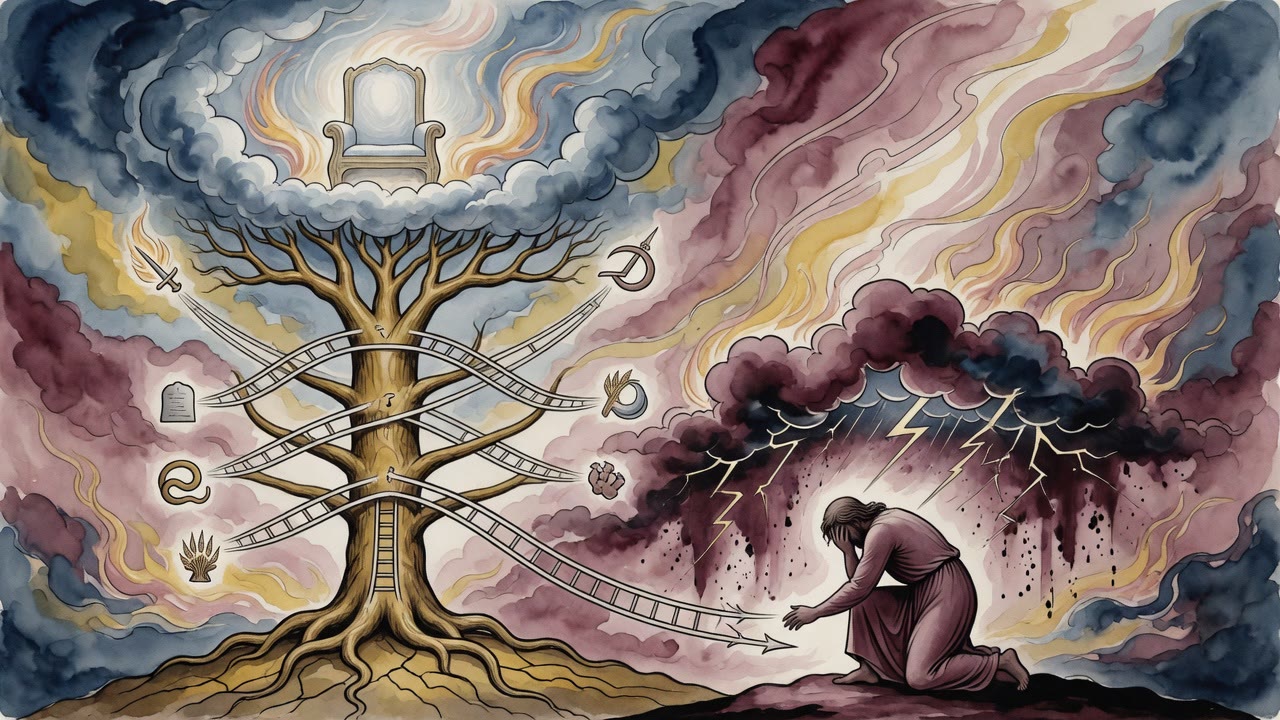
Chesed and Din Trade Crowns Across the Days Click for full size

Morning Under a Soft Crown

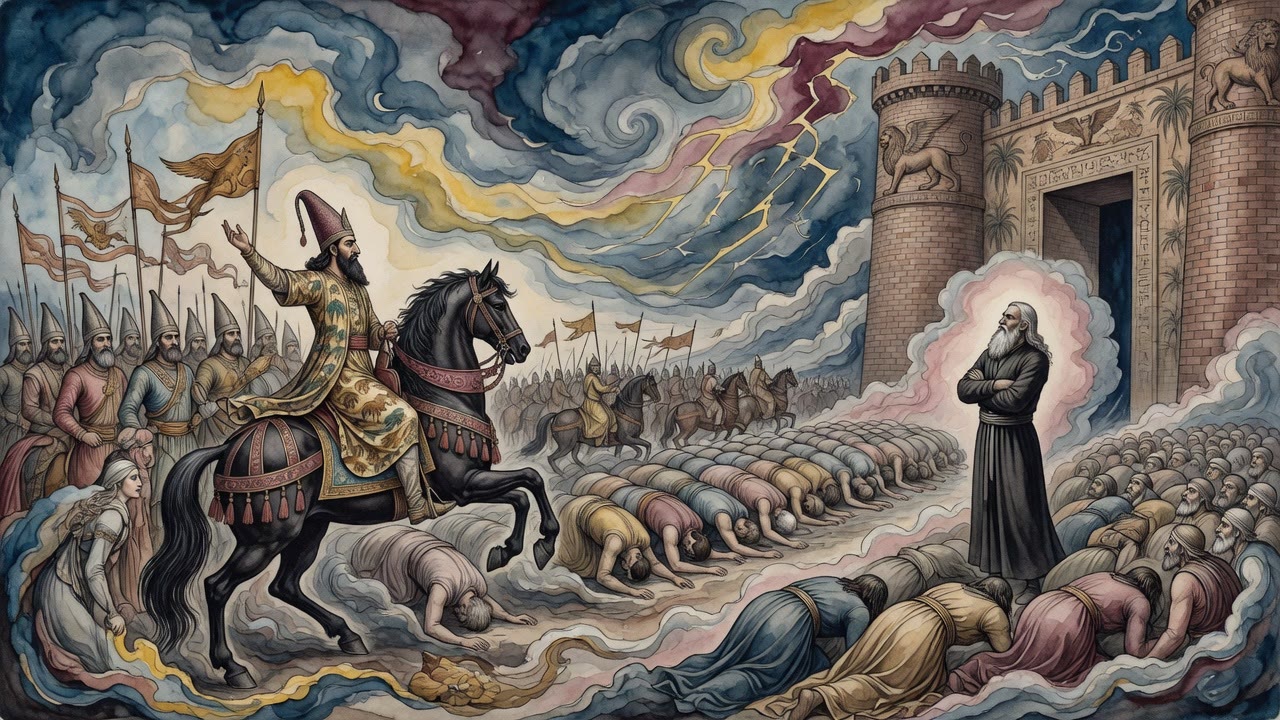
Rachel opened her shop to a day that forgave too easily. Debts slipped. A thief found an open door and, somehow, a second chance before noon. The air itself felt generous. Old women called it luck. Above the street, Chesed wore the crown of governance and poured without counting.

By afternoon the crown had moved.

A scale refused to lie. A judge's face hardened. A fever found a house that had mocked the poor. Din stood upright, strict as a drawn line. Rachel felt the shift in her bones before she had a name for it. The world's weather is not only wind. It is which divine attribute currently holds the scepter of days.

She locked her door early and whispered, "Who rules now?"

Her apprentice wanted to keep selling under the soft morning's rules. Rachel shook her head. Trading kindness for a cheat when Din holds the hour is how shops and souls both break.

Three Pillars Under One Roof

In the chamber above weather, three pillars locked into a single roof. Kindness. Judgment. Mercy. Existence does not stand on a single mood of heaven. Chesed alone would dissolve law into syrup. Din alone would grind the world to powder. Mercy, Rachamim, holds the seam where the other two would tear.

The sefirot (the ten channels of divine governance) that carry these powers do not fight as rival gods. They shift intensity inside one government. A day leans left or right the way a body leans into wind, still one body.

Rachel's city had lived a month of soft rule and grown sloppy. Din's turn was not hatred. It was correction. A pillar does not apologize for bearing weight.

An angel of the seam walked the streets unseen, measuring where kindness had become permission for cruelty, where judgment had become love of breaking.

In a side alley a man beat a debtor while quoting soft slogans from the easy month. The angel of the seam marked him. Slogans do not outrank the crown of the hour.

When Evil Is Allowed to Flex

A darker market opened at the edge of town. For a season, harm seemed self-funded, as if it needed no permission. The teaching from the upper books is colder and clearer: perfection was concealed enough for evil to flex, not to found a kingdom. Governance includes that terrible allowance and already contains the repair.

"At the end of everything," a voice like metal said in Rachel's dream, "damage turns. Evil reverts into actual good. Concealment first. Revelation of oneness last. Do not crown the temporary as eternal."

She woke tasting copper. In the street, Din still held the day. A corrupt clerk lost his post. A widow received a ruling she had been denied under softer weather. Chesed would return. The trade of crowns is not chaos. It is how one Will governs a world that must both grow and answer.

Rachel paid a debt she could have delayed. The act felt like aligning with a pillar rather than hiding from it. Her apprentice watched and learned that fear of Din can be a kind of honesty.

That evening the darker market lost three stalls to a sudden inspection. Evil flexed and then found the leash again. No one in the stalls called the leash love. The leash still held.

Inside the Lights, the Same Quarrel

Higher still, within the sefirot (divine emanations) themselves, kindness and judgment interpenetrate. No pure lamp of only one color reaches the lower worlds unmixed. A kindness that arrives as pure flood would drown. A judgment that arrives as pure blade would end the story. The mixtures are the mercy of design.

Prophets sometimes see the shift as weather, beasts, or changing faces of fire. Shopkeepers feel it as a week that will not forgive a lie. Both readings point to the same machinery.

Rachel began to watch her own mouth when the crown moved. Soft days did not make her god. Hard days did not make her abandoned. She practiced a smaller governance: open hand, straight measure, refusal to worship either extreme.

She taught the apprentice a rule with no mysticism in its wording and plenty in its spine: when the day is soft, do not cheat; when the day is hard, do not despair; when mercy seals the seam, do not pretend the other pillars vanished.

The Crown Passes at Dusk

Dusk of the hard day softened. Mercy sealed the seam. A child laughed in a courtyard that had been silent with fear since noon. Chesed would take tomorrow's early hours. Din would keep a residue in the locks and the courts.

Rachel swept her floor and left the door's bolt honest. Above her, pillars held. Above the pillars, one government turned evil's season toward a good it did not invent for itself.

She slept without needing the full map of heaven. She needed only the craft of a creature under shifting crowns: receive kindness without going soft in the spine, receive judgment without calling it a second god, and keep the seam open where mercy still walks.

Night kept the city. The crowns traded in silence. In her dream the three pillars stood without rivalry, and she woke ready to open the shop under whatever weather the One assigned.


← All myths
From the tradition

Sources

4 sources

The texts behind this telling. Some cards carry a translation of the source; others are our own retelling of it, and each card says which. Every card links out to the original.

Kalach Pitchei Chokhmah 6:15Kalach Pitchei Chokhmah

Retold in our words. Read the original at the link below.138 Openings of Wisdom, trans. Rabbi Avraham Greenbaum, Azamra Institute (2005) · CC-BY

That movement, the Kalach Pitchei Chokhmah (Wisdom) suggests, isn't random. It’s a direct reflection of how the divine attributes are influencing the world at any given moment. sometimes the world feels like it's governed by chesed (kindness and mercy), and other times by din (strict justice). It's not static. These shifts, these changes in the way the world is governed, are mirrored in the movements of that light.

The text explains that the various powers involved in governing the worlds are not fixed. They change according to the time. And it's not just a broad shift between kindness and judgment. Even within each individual attribute, there are subtle fluctuations, tiny adjustments that are expressed in the movements of the light.

So, how do we see this? How do we decipher the cosmic weather report? Well, the Kalach Pitchei Chokhmah suggests that prophets can perceive these movements. They see the shifts in the Sefirot – the ten emanations of God's divine energy – and understand what they signify.

It's all about understanding the influence of each attribute on the government of the worlds at that specific time. These lights make themselves visible, because of the desire of the Supreme Will to reveal to His creatures how He governs the world. The Divine is not hidden, but actively seeks to show us the way the universe functions.

Perhaps it's an invitation to be more attuned to the subtle shifts around us. To understand that everything is interconnected, and that even the smallest movements can have profound meaning.

It invites us to look deeper, to pay attention, and to recognize that the universe is constantly speaking to us, if only we know how to listen. Are we ready to start learning the language?

Full source
Kalach Pitchei Chokhmah 7:11Kalach Pitchei Chokhmah

Retold in our words. Read the original at the link below.138 Openings of Wisdom, trans. Rabbi Avraham Greenbaum, Azamra Institute (2005) · CC-BY

Jewish mystical tradition offers a fascinating perspective, and it all boils down to three foundational forces: Kindness, Judgment, and Mercy. Now, these aren't just abstract concepts; they're the very pillars upon which existence is built.

The Kalach Pitchei Chokhmah (which translates roughly as "400 Gates of Wisdom") teaches us that these three powers are all-encompassing. Each one contains within it everything needed for… well, everything!: Judgment, with its inherent element of reward and punishment, is essential for maintaining order. Mercy, that boundless compassion, sustains the world's very existence. And Kindness, in its purest form, points toward the ultimate eternal reward.

The text goes on to say that the "Supreme Mind" – often understood as referring to God – meticulously planned everything in advance. Nothing is left to chance. From the smallest seed to the grandest galaxy, everything was calculated "until the end of the entire cycle." It's a mind-boggling thought.

It's all interconnected, like a single, intricate weave. These three powers, Kindness, Judgment, and Mercy, work together, creating a tradition of "controls, laws, and pathways" that are precisely what’s needed to bring about everything that is destined to be. Nothing is superfluous; nothing is missing.

This idea, found in the Kalach Pitchei Chokhmah, invites us to see the world not as a chaotic jumble, but as a divinely orchestrated harmony. It challenges us to look for the underlying balance, the interplay of these three forces, in every aspect of our lives.

So, the next time you’re facing a challenge, or witnessing something beautiful, ask yourself: where do I see Kindness, Judgment, and Mercy at play here? It might just change the way you see the world.

Full source
Kalach Pitchei Chokhmah 13:10Kalach Pitchei Chokhmah

Retold in our words. Read the original at the link below.138 Openings of Wisdom, trans. Rabbi Avraham Greenbaum, Azamra Institute (2005) · CC-BY

It speaks about the Sefirot (divine emanations), the ten attributes or aspects through which the Ein Sof (the Infinite) reveals itself and continuously creates both the physical realm and the chain of higher metaphysical realms. And within the Sefirot, we find a profound relationship between seemingly opposing forces, like Kindness and Judgment.

At first, Chessed (Kindness) and Gevurah (Judgment) seem like polar opposites. One is about boundless giving, the other about necessary restriction. But the Kalach Pitchei Chokhmah offers a perspective that challenges our assumptions. It tells us that from a developmental standpoint, there's actually no difference between them.

How can that be?

The text explains that Gevurah, which leans toward the left or the side of Judgment, actually emerges from Chessed, which leans to the right or the side of Kindness. And Gevurah remains beneath it in the cosmic hierarchy. Similarly, Netzach (Endurance), another right-leaning Sefirah (a divine emanation), emerges from Tiferet (Beauty), which occupies the center.

This isn't about downplaying the unique qualities of each Sefirah. Rather, it's about understanding their place in the grand scheme of creation. When we look at the developmental aspect, we're not focusing on a Sefirah's specific action or characteristic. Instead, we're looking at its proximity to the Source, to the Ein Sof.

Closer to the source, the water is pure potential, undifferentiated. As it flows further downstream, it carves channels, encounters obstacles, and develops distinct characteristics. But its essence remains connected to its origin.

From this higher vantage point, the distinct qualities of each level become less apparent, revealing a more general sense of divine providence. The underlying form is like a sphere – perfectly round, without divisions. As the Kalach Pitchei Chokhmah beautifully puts it, "you cannot say it has a head, top or beginning, or a bottom or end, or a middle, right or left."

Perhaps it's a reminder that even in the seemingly opposing forces we encounter in life, there's a deeper unity, a connection to a single Source. Perhaps by understanding the developmental relationship between seemingly disparate things, we can gain a more holistic view of the world and our place within it. And perhaps that's the key to unlocking a little bit more of the wisdom hidden within the universe.

Full source
Kalach Pitchei Chokhmah 4:11Kalach Pitchei Chokhmah

Retold in our words. Read the original at the link below.138 Openings of Wisdom, trans. Rabbi Avraham Greenbaum, Azamra Institute (2005) · CC-BY

This isn't about some abstract philosophical argument. It's about how the very nature of God's oneness manifests in the world, even, perhaps especially, through the presence of what seems to oppose it.

The Kalach Pitchei Chokhmah (Wisdom) explores the divine system of governance, a system, it says, that ultimately transforms evil into good. Sounds impossible. But stay with me.

The text suggests that God, in a sense, "allowed" evil a space to operate. Why? Not because God is evil, but precisely the opposite! According to this view, God initially concealed His perfection, giving evil the illusion of power.

Here's the kicker: This isn't a permanent situation. The Kalach Pitchei Chokhmah doesn't leave us in despair. It assures us that at the end of everything. And I mean everything, all the damage caused by evil will be repaired. It won't just be negated or forgiven; it will be transformed into actual good.

This is the ultimate revelation of God's oneness, the text explains. What began as potential within His unity becomes manifest in actuality. It's a cycle where initial concealment leads to ultimate revelation. Evil gets its shot, so to speak, but then it’s reabsorbed and transmuted.

That evil isn’t just something to be defeated, but something that, in the grand scheme of things, contributes to the fuller expression of God's perfect goodness. It's a hard pill to swallow, especially when we witness the suffering in the world. But maybe, just maybe, it offers a glimmer of hope – a suggestion that even the darkest moments are part of a larger, ultimately benevolent design.

Perhaps it means trusting that even when we can’t see the purpose, even when evil seems to be winning, there's a force at work, slowly but surely turning it all towards good. Maybe it means having faith that the story isn't over yet, and that the ending, when it comes, will reveal a unity and a goodness we can scarcely imagine.

Full source