Mercy Dripped From the Beard of Arich Anpin While Job Sat in Ash
Friends circled with speeches polished for other men's disasters. Job scraped his skin with a potsherd and counted his dead in the pauses between paragraphs.
Table of Contents
 Click for full size
Ash and the Long Face
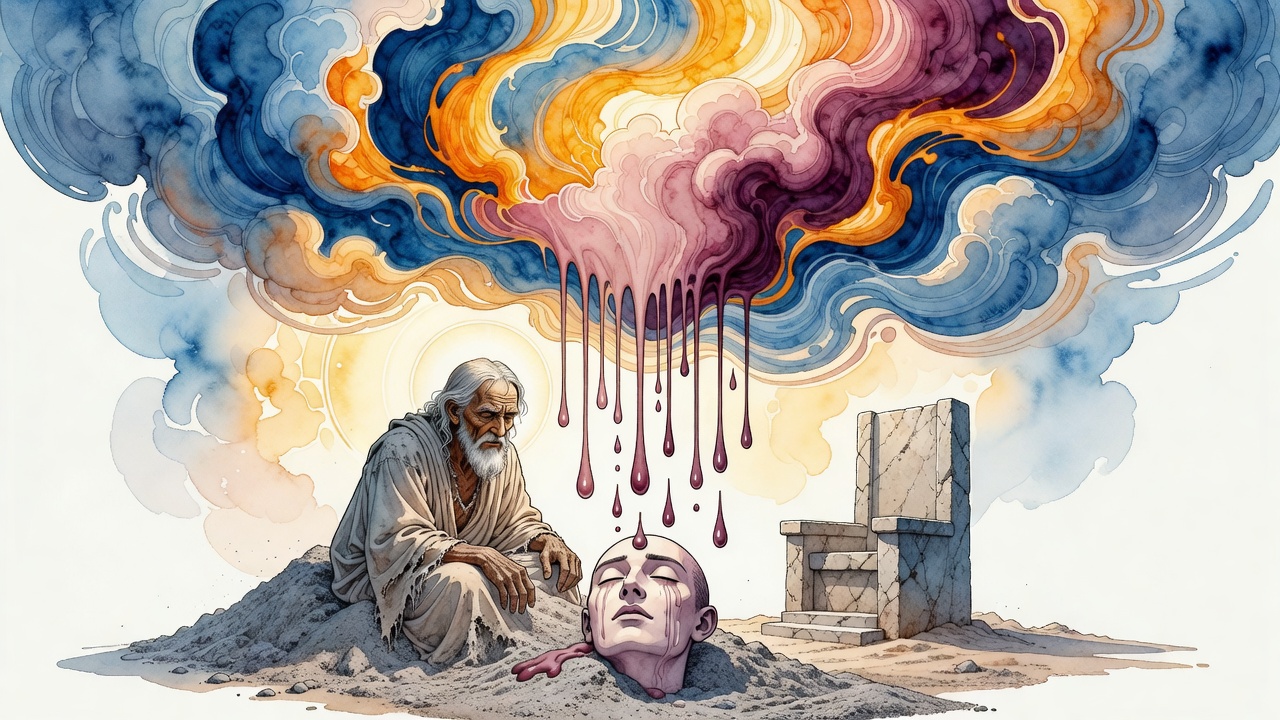
Job scraped his skin with a potsherd and watched the sky refuse a verdict. Friends circled with speeches polished for other men's disasters. His wife spoke a hard word and left him to the ash. He held to his integrity the way a man holds a door against wind that has already taken the roof. Above that circle, the sources say, another structure moved: not a court of human judges, but the faces of the divine itself.
Arich Anpin, the Long Face, the Vast Countenance, held patience the way a cliff holds weather. From the hanging hairs of that beard an influence called Mazala stirred when the world needed mercy. Mercy did not arrive as a soft slogan. It arrived as a cascade, filling the features of the smaller face, Zeir Anpin, until judgment loosened its jaw and the lower worlds could breathe without choking on measure for measure.
Job did not see the beard. He felt the gap between the blow and the explanation. That gap is where the hanging hair works or fails. He counted his dead in the silence between his friends' paragraphs. The potsherd bit. Blood mixed with dust. He would not curse the Name to make the pain simpler.
Children gone. Herds gone. Skin turned against him. Still he sat where the wind could find him, as if exposure were a kind of honesty the covered world had forgotten.
When Judgment Must Appear
The same structure that pours mercy can bare its teeth. When the world requires justice, judgment appears. Forces rise against those who grind the weak. The Idra does not pretend mercy is the only weather. The preciousness of the beard, it says, lies in the visible strands, the central column of knowledge, beauty, and foundation. Mercy and judgment both root there. One day the drip of compassion; another day the edge that cuts the oppressor before the oppressed vanish entirely.
Job sat between those weathers. His losses were not a game for sport. They were the place where the two faces of divine government met a single body and refused to explain themselves on his schedule. He wanted a summons. He wanted a written charge. Heaven gave him sores and silence and friends who confused piety with a closed case.
In that silence the beard still hung. Mazala could still move. Job had no map of either. He only had the scrape of clay on flesh and a refusal to call darkness light so the conversation could end.
The Shekhinah's Complaint
Elsewhere the repair texts dress the Shekhinah (God's indwelling Presence) in blue, the tekhelet thread of the fringe, a garment for skin in exile. She is spoken of as one who waits in a levirate of distance, bound to a name that has not yet returned to dwell in full. Job's complaint and Her complaint share a throat: the righteous suffer, the Presence feels far, the garment of blue hangs on a body that still remembers home and will not settle for a cheap substitute.
Forty-two mentions of the Name hide in the sections of scripture the mystics count like ribs. Job's speeches press against those ribs from the outside. He will not call evil good to make the friends comfortable. She will not pretend exile is wedding until the groom returns and the house is more than a rumor of return.
When Job speaks of a Redeemer who lives, he speaks from ash toward a blue that has not yet finished its argument above. The Shekhinah's (the Divine Presence) case and the man's case run on parallel tracks that sometimes touch in a single cry.
Dogs at the Second Watch
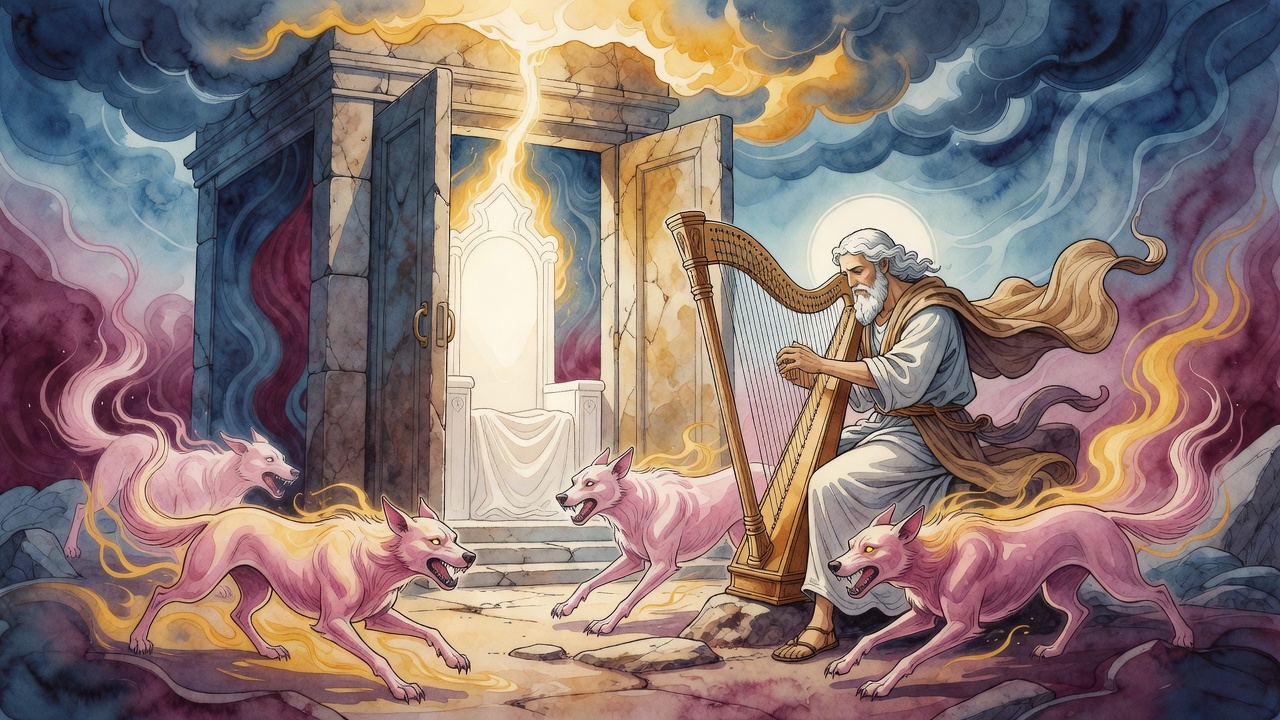
David, in another night, cried to be saved from the hand of the dog. The repair texts hear angels of destruction in that bark, forces that shout "Give! Give!" in the second watch, hungry for rejected offerings, for what falls outside the altar's pure line. Gehinnom (the realm of punishment after death) has a leash. The dog is not a stray in an alley. It is appetite with a legal claim on what the world throws away when holiness has been careless.
Job knew that appetite. His children, his herds, his skin: all of it felt claimed by a hunger he could not name. Between David's midnight dog and Job's daytime ash sits the same government: mercy hanging in hair, judgment pacing for its hour, a Presence in blue still arguing for Her children while the bark works the edge of the camp.
David had a harp. Job had a potsherd. Both faced a night-shift of forces that do not negotiate in the language of friends who think suffering always equals guilt. The dog wants payment. The beard may still drip. The man in the middle must decide whether to hand over his unique soul or hold the door until morning.
What Waited in the Whirlwind
When the answer finally came, it did not hand Job a chart of the beard. It handed him the weight of a world too large for his friends' proverbs: storehouses of snow, chains of the Pleiades, the wild ass that answers to no master. Job put his hand over his mouth. The structure remained: Long Face above, smaller face below, Mazala ready when mercy is needed, judgment ready when it is not.
He rose from the ash with new herds and old scars. The hanging hair kept dripping or drying according to a clock no potsherd can scrape into view. Friends brought comfort that arrived late and still counted. The Shekhinah's blue did not vanish because one man's case closed. David would still need the psalm against the dog. Mercy and judgment would still share one beard and refuse to let either word own the whole sky.
← All myths