5 min read

David Asked God for a Test and Bathsheba Was the Answer

David demanded to be tested the way the patriarchs were tested. Heaven obliged. A bird, a broken screen, and a woman on a rooftop followed.

Curated by Arthur · Told by Maggid ·
Table of Contents
  1. A Bird, A Screen, A Rooftop
  2. The Cover-Up That Could Not Work
  3. Nathan and the Parable
  4. The Six Months Nobody Counted

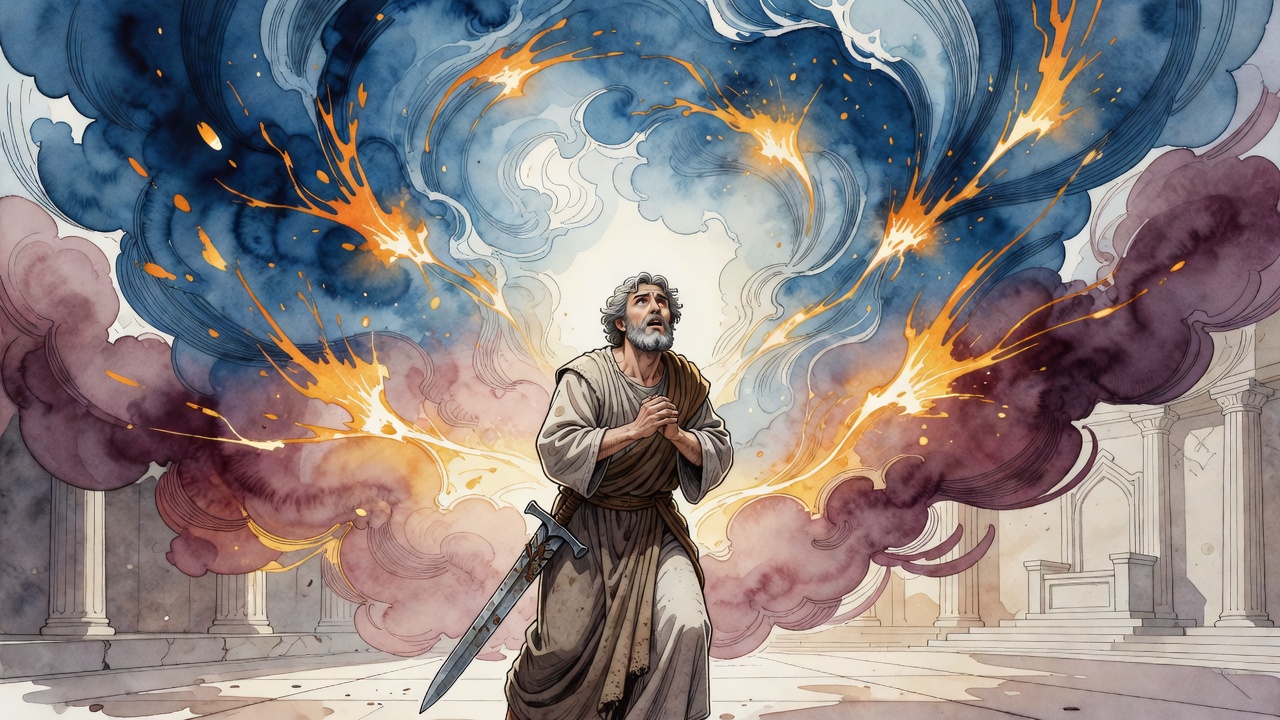
David wanted to be named with the patriarchs. When people said God of Abraham, God of Isaac, God of Jacob, there was a sequence that ended before him. He asked why his name was not in that sequence. The answer came back sharp: the patriarchs were tested. Abraham was asked for his son. Isaac lay on the altar. Jacob wrestled in the dark. David had not been tested.

A wiser man would have gone silent at this point and accepted the asymmetry. David asked to be tested. The request sounded religious. He wanted his name attached to God with the ancestors. What he did not understand yet was what a test from God actually costs.

A Bird, A Screen, A Rooftop

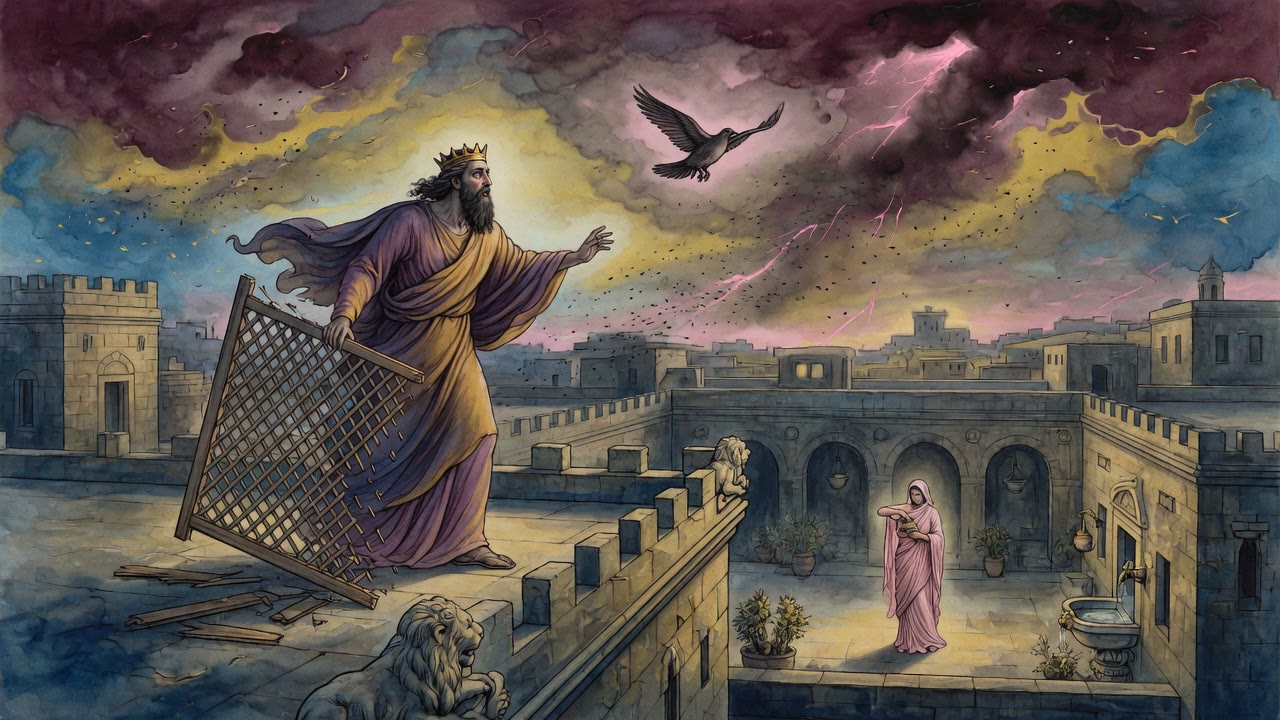
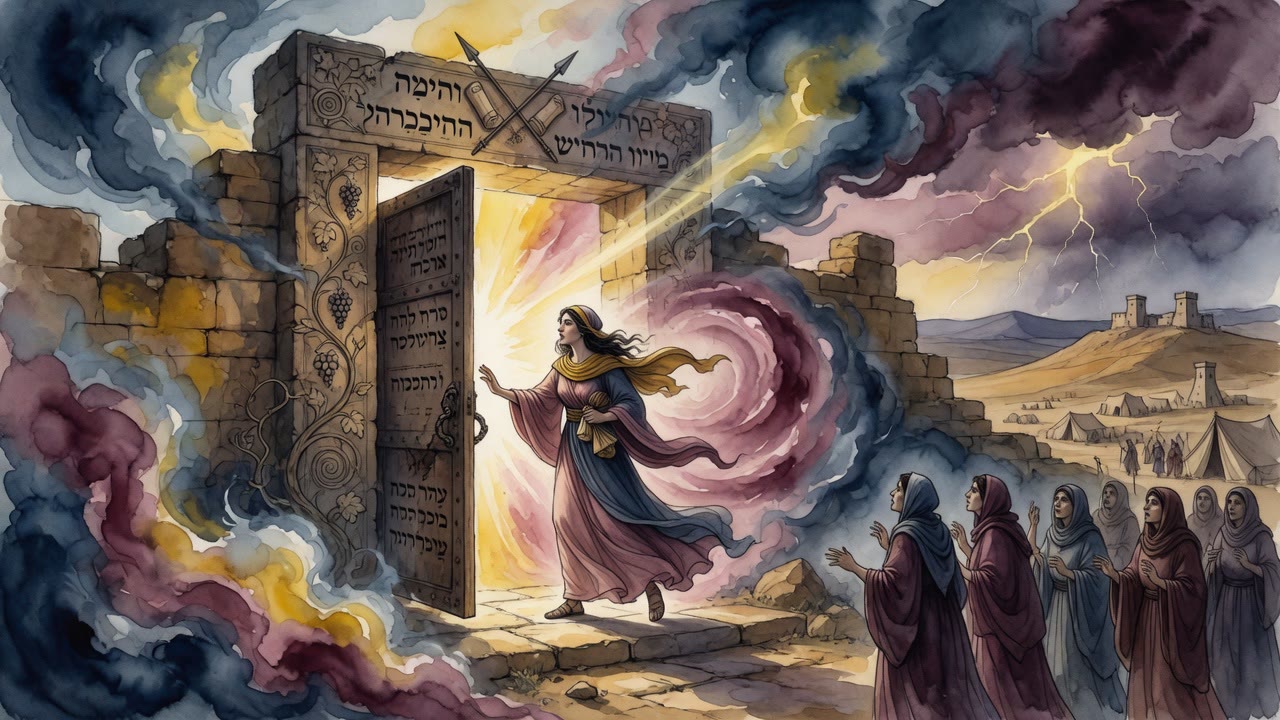
Ha-Satan, the heavenly accuser whose function was to administer the test David had requested, appeared as a bird. David saw it from his roof and shot at it. The dart missed the bird and struck a screen on the opposite rooftop. The screen fell, and behind it was Bathsheba, combing her hair. The sight of her ignited a desire that moved faster than judgment.

He sent messengers. She came. She was the wife of Uriah the Hittite, who was at that moment in the field with Joab's forces besieging the Ammonite capital. David knew this and sent for her anyway. She conceived.

The Cover-Up That Could Not Work

What followed was not passion but calculation. David recalled Uriah to Jerusalem, asked him questions about the war, and told him to go home and rest with his wife. The plan was straightforward: Uriah would sleep with Bathsheba, the pregnancy would appear to be his, and the whole thing would dissolve into a domestic timeline with no visible seams.

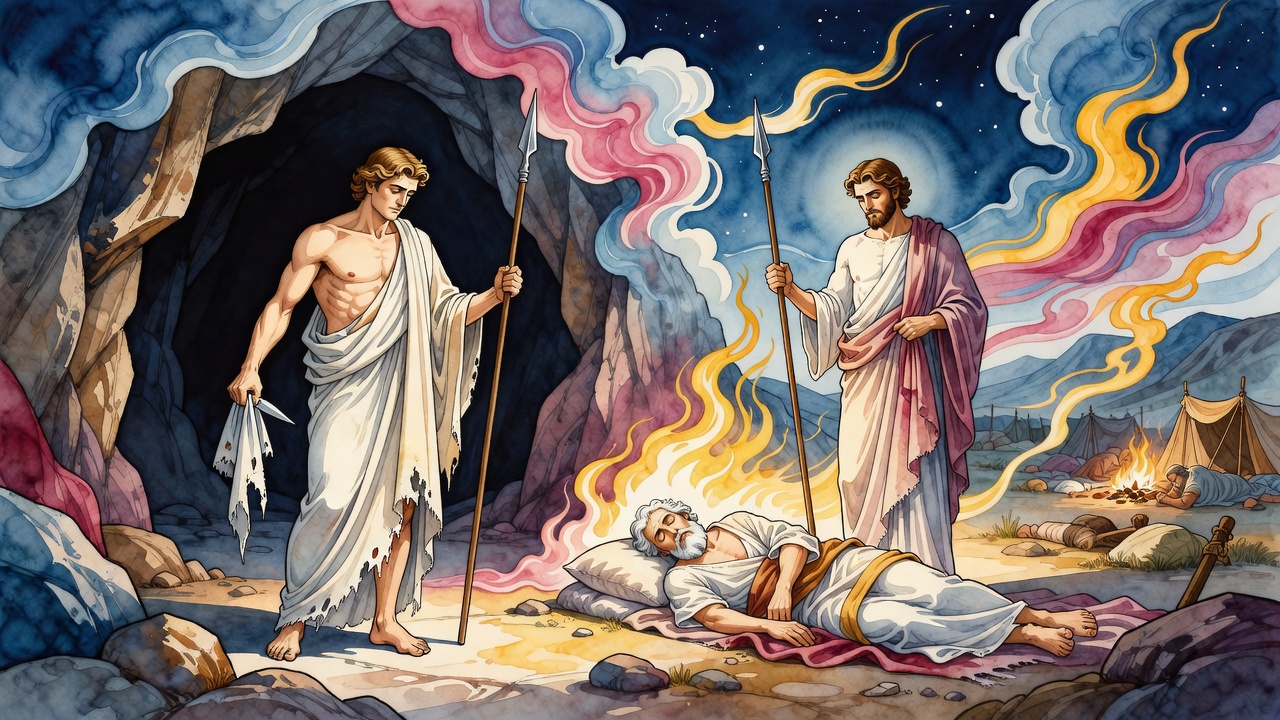
Uriah refused to go home. "While the Ark and Israel and Judah were sheltering in tents in the field," he said, "how could he go into his house to eat and drink and sleep with his wife?" He slept at the palace gate instead. David tried again the next night with wine. Uriah still did not go home. So David wrote a letter to Joab and sent it by Uriah's own hand: "put this man in the front of the hardest fighting and draw back from him so that he dies."

Nathan and the Parable

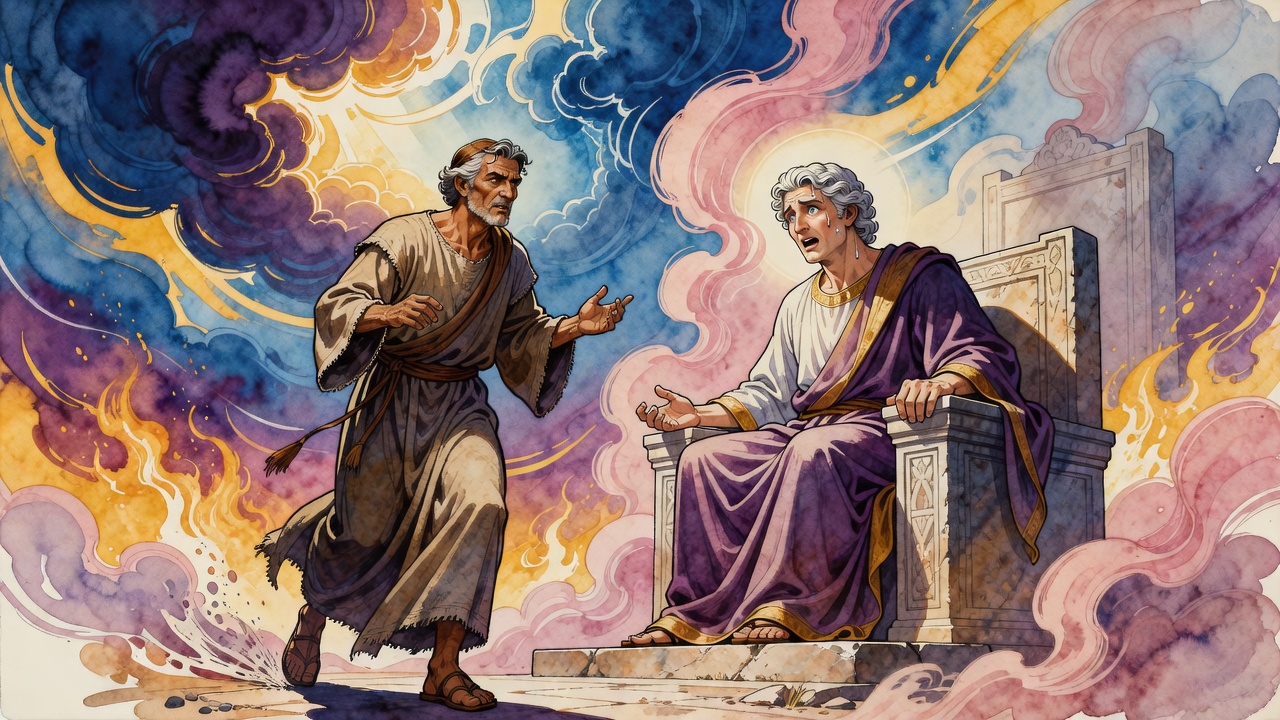
Nathan the prophet came to David with a story. A rich man had many flocks and herds. A poor man had one lamb, which he had raised from birth and which ate from his table and drank from his cup and slept in his arms like a daughter. A traveler came to the rich man's house, and rather than take from his own flock, the rich man took the poor man's lamb.

David's fury was immediate and genuine. "The man who did this deserves to die," he said. "He must repay fourfold." Nathan said: "you are the man." God had given David everything, and he had taken Uriah's one thing and had him killed to keep the secret. The sword would not depart from David's house.

The Six Months Nobody Counted

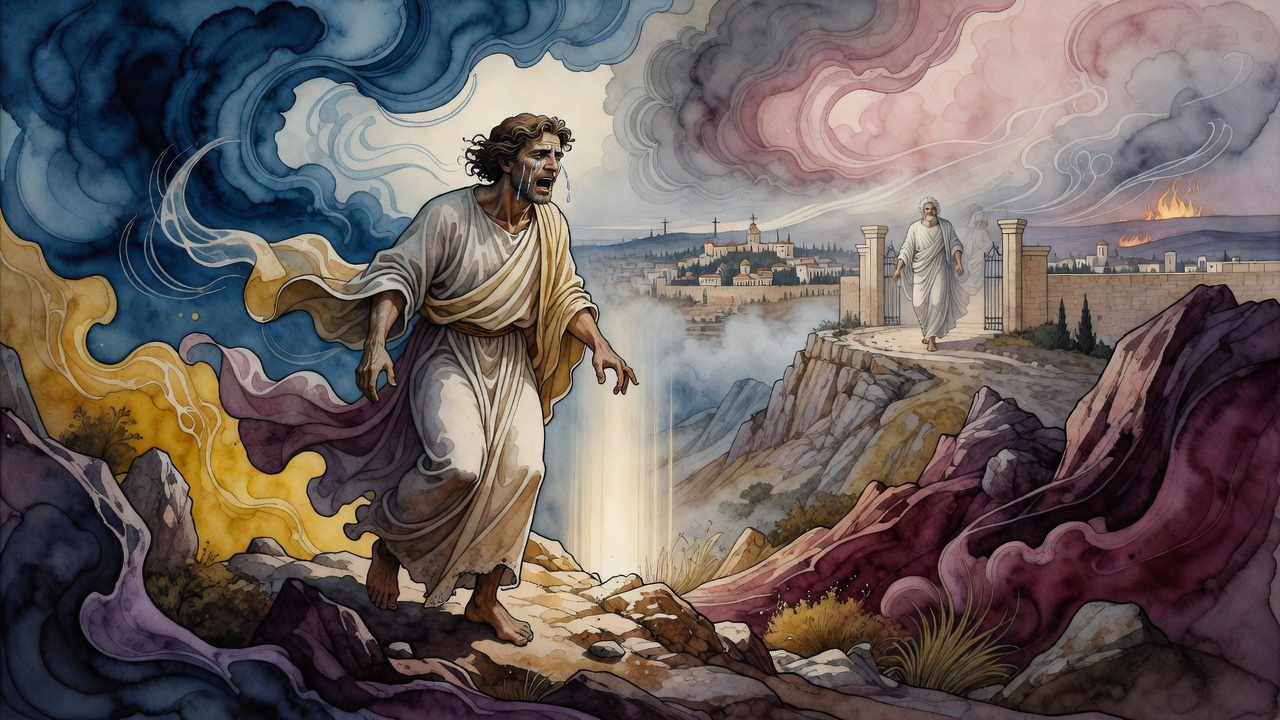
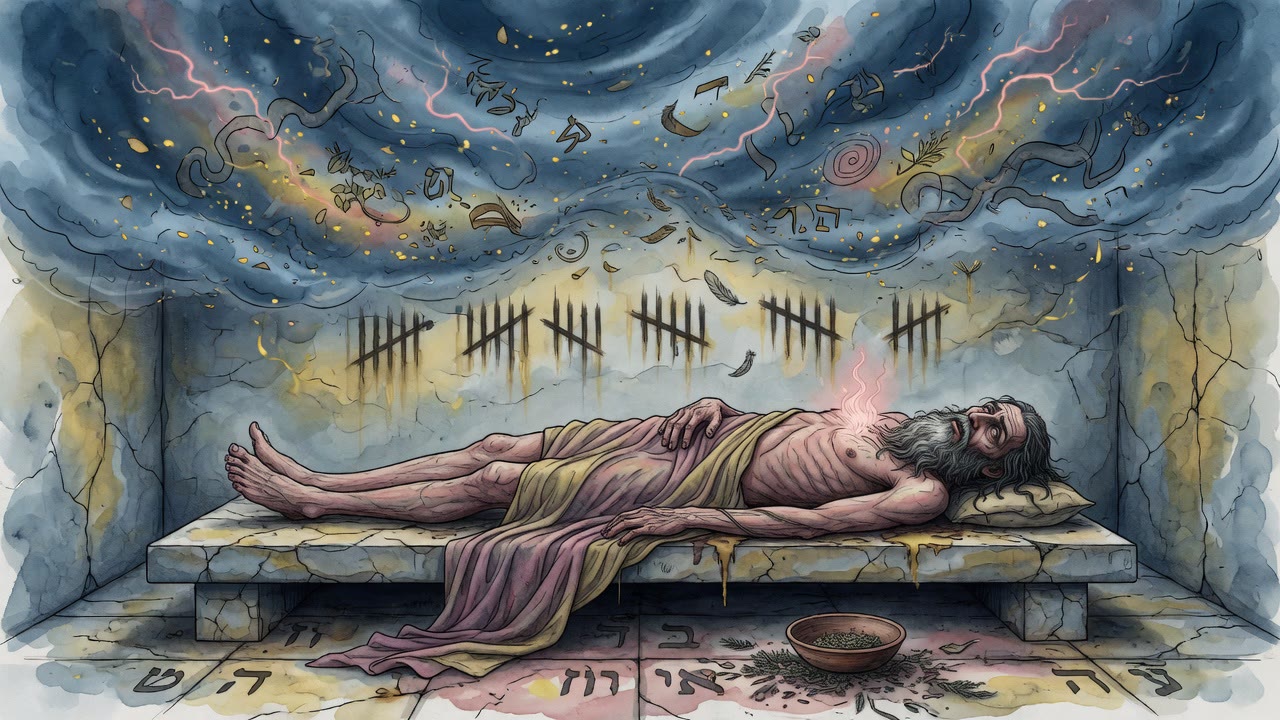
David repented, and God told Nathan that David's sin was set aside. But the accounting did not end there. The books of Samuel and Kings give David's reign as forty years. Samuel says he reigned in Hebron seven years and six months and in Jerusalem thirty-three years, which adds to forty and a half. Kings rounds it to forty. The six missing months had to be somewhere. The sages of the Sanhedrin asked the question and gave the answer: David spent those six months afflicted with a skin condition, the Shechinah departed from him, and the Sanhedrin kept its distance. He sat outside the court of judgment, waiting. The leprosy was not public. The six months were not recorded in the official count. The history moved on as if they had not happened, but they had happened, and the six months lived inside the difference between two numbers in two books.


← All myths

From the tradition

Sources

6 sources

The texts this telling draws on, in full. Open a card to read inline, or expand it for a wider, quieter read.

Legends of the Jews 4:53Legends of the Jews

The story of David and Bath-sheba is one of the most well-known, and often critiqued, episodes in the Bible. But what if I told you that some traditions see it as a direct consequence of David practically begging for a challenge? It’s true!

Ginzberg, in his monumental work, Legends of the Jews, recounts a remarkable explanation for the whole affair. It all boils down to David's ego, a touch of excessive self-awareness. Imagine this: David, in all his glory, actually complains to God. He asks, "O Lord of the world, why do people say God of Abraham, God of Isaac, God of Jacob, and why not God of David?"

It's like he's feeling left out of the divine legacy!

The response he receives is… well, let’s just say it's not exactly what he was hoping for. God basically tells him, "Abraham, Isaac, and Jacob? They were tested. You, David, haven't been proved yet."

Now, a reasonable person might have taken that as a gentle hint to just… chill. To be content with their already impressive accomplishments. But not David! Oh no. David, in his infinite wisdom, then entreats God, "Then examine me, O Lord, and try me!"

It's like he's saying, "Bring it on! I can handle anything!" Talk about tempting the yetzer hara (יֵצֶר הָרַע), the evil inclination!

And God, ever obliging, responds, "I shall prove thee, and I shall even grant thee what I did not grant the Patriarchs. I shall tell thee beforehand that thou wilt fall into temptation through a woman."

Wow. Just...wow. Preemptive warning of a specific, devastating temptation. It seems almost cruel, doesn’t it? But according to this legend, it was David’s own yearning for validation, his desire to be seen as equal to the Patriarchs, that set the stage for his ultimate downfall.

This isn't just a story about sin and punishment, though. It’s a story about the dangers of unchecked ego, of seeking external validation instead of finding contentment within. It's a reminder that sometimes, the greatest challenges we face are the ones we unknowingly invite upon ourselves.

So, the next time you find yourself wishing for a test, a challenge, a way to prove yourself... maybe, just maybe, take a moment to consider if you're truly ready for what you're asking for. Sometimes, the greatest strength lies not in seeking trials, but in recognizing the blessings we already possess.

Full source
Legends of the Jews 4:54Legends of the Jews

King David, the sweet singer of Israel, the warrior king, knew that feeling all too well.

The story, as retold in Ginzberg's Legends of the Jews, takes a startling turn. It begins innocently enough. Satan, that wily tempter, appears to David, not in some terrifying demonic form, but as a simple bird. David, ever the hunter perhaps, throws a dart.

The dart misses its mark. Instead of striking Satan, it ricochets off, breaking through a screen. And behind that screen? Bathsheba, combing her hair. The sight of her, in that unguarded moment, ignites a passion in David that he can't control.

It's a chilling reminder that even the most righteous among us are vulnerable.

David, a man known for his deep connection to God, immediately understands the gravity of his transgression. The consequences? Profound and lasting. For twenty-two long years, David lives as a penitent. Imagine that – decades of regret and remorse.

The Talmud (Sanhedrin 107a) speaks of his intense sorrow. He wept for an entire hour each day, and he ate his "bread with ashes," a symbolic act of mourning and repentance.

But even that wasn't enough. David's penance had to go deeper.

For six agonizing months, he was afflicted with tzara'at, often translated as leprosy. This wasn't just a physical ailment; it was a spiritual crisis. The Sanhedrin, the high court that usually stayed close to the king for guidance and counsel, had to distance themselves from him.

David wasn't just physically isolated. He was spiritually cut off. The Shekhinah, the divine presence, departed from him during this dark time. The man who communed so closely with God, the one who penned the Psalms, was now utterly alone. The Shekhinah leaving him represents the severing of that sacred bond.

It’s a stark reminder that even our heroes are flawed, capable of great mistakes. David's story isn't just about sin; it's about the long, arduous journey of repentance, the pain of isolation, and the hope, however faint, of reconciliation. It forces us to ask ourselves: What lengths are we willing to go to when we've strayed from our path? And can we ever truly regain what we've lost?

Full source
Antiquities VII.6-7Antiquities of the Jews (Josephus)

It started from a rooftop. Late one evening, David, king of Israel, conqueror of nations, the man after God's own heart, looked down from his palace and saw a woman bathing. Her name was Bathsheba. According to Josephus in Antiquities of the Jews, she was extraordinarily beautiful, surpassing all other women. David sent for her. She conceived.

What followed was not a crime of passion but a calculated cover-up. Bathsheba's husband Uriah was at the front lines, serving as Joab's armor-bearer in the siege of the Ammonite capital Rabbah. David recalled Uriah to Jerusalem, asked him casually about the war, then told him to go home and rest with his wife. The plan was simple: if Uriah slept with Bathsheba, no one would question the pregnancy.

Uriah refused to go home. He slept at the palace gates instead, saying it would be wrong to enjoy comfort while his comrades slept on the ground in enemy territory. David tried again the next night, getting Uriah drunk at dinner. Still Uriah would not go to his wife. His integrity was destroying David's scheme.

So David wrote a letter to Joab, carried unwittingly by Uriah himself, ordering that Uriah be placed at the most dangerous point in the siege and then abandoned by his fellow soldiers. Joab obeyed. The Ammonites surged out of the city. Uriah's companions retreated as ordered. Uriah stood his ground alone, killed several of the enemy, and was overwhelmed and slain.

When Joab sent his battle report, he included one crucial detail: Uriah was dead. David's reaction was chilling in its composure. He told the messenger to assure Joab that such losses were normal in war. After Bathsheba's mourning period ended, David married her. A son was born.

Then Nathan the prophet arrived. Josephus notes that Nathan understood something crucial about confronting a king: direct accusations provoke anger, not repentance. So he told a parable. A rich man with vast flocks stole a poor man's only lamb, a ewe he had raised like a daughter, to feed a guest. David was furious. "That man deserves death!" Nathan's reply was devastating: "You are that man."

The prophet laid out God's punishment: David's own wives would be violated by his son, his household would be torn apart by treachery, and the child Bathsheba carried would die. All of it would be public, because what David had done in secret, God would repay in the open. David broke down and confessed. Josephus adds a striking editorial note, that David was guilty of no other sin in his entire life except the matter of Uriah.

The child fell ill. David fasted seven days, lying on the ground in sackcloth, begging God for mercy. On the seventh day, the child died. David's servants were afraid to tell him, expecting the news would destroy him entirely. Instead, David rose, washed, put on white garments, and went to the tabernacle to worship. He then sat down and ate. His bewildered household asked why he mourned while the child lived but stopped when it died. David's answer was plain: while there was hope, he prayed. Now there was none. Grief would not bring the child back. Afterward, Bathsheba conceived again and bore a second son. Nathan the prophet gave him his name: Solomon.

Full source
Sifrei Devarim 26:4Sifrei Devarim

Sifrei Devarim turns to David Begged God to Erase His Sin with Bathsheba.

The tale begins with David pleading with the Holy One, Blessed be He. His request is simple, yet profound: "Let my transgression before You (with Bathsheba) not be written after me." He wants his sin, his failing, to be erased from the historical record. To want your mistakes forgotten, vanished as if they never occurred.

God, in this telling, responds with a counter-argument, a divine perspective on justice and perception. God essentially says, "Isn't it enough that people might whisper, 'Because He loved him, He forgave him'?" The concern isn't about hiding the sin, but about fairness and the message it sends.

To illustrate this, the text provides an analogy, a parable of sorts. Imagine a man who owes the king a massive debt – twenty kor of wheat each year. A kor was a significant unit of measure, suggesting a substantial amount. The people around him scoff, wondering how he could ever repay such a sum. They assume the king must have secretly forgiven the debt, writing off the settlement behind closed doors.

But then, the king sends his collectors, demanding payment. The man can't pay. The king, in turn, enters the man's house and takes his sons and daughters, putting them up for sale at the auction block. A harsh image, for sure, but one that drives home the point: the man hadn't been pardoned. His debt was very real, and the consequences were visible for all to see.

This, is what’s at stake for King David. If his sin is hidden, people will assume he received special treatment, that his punishment was waived due to his favored status. Therefore, Sifrei Devarim continues, all the punishments that befell David were publicized and even magnified. The verse from II (Samuel 12:6), "And he (David) must pay four for the ewe," is cited.

Then, Rabbi Chananiah adds a layer of interpretation, suggesting that the word "arbatayim" – four – should be understood as "sixteen." The punishment, in this view, wasn't just quadrupled; it was increased sixteenfold. A public and amplified consequence.

So, what does this all mean? It seems that the narrative isn't solely about punishing David for his sin. It’s about upholding a sense of divine justice that is transparent and equitable. It's about ensuring that even a beloved king is held accountable, not just for his actions, but for the message those actions send to the world. It prompts us to consider: How do we balance mercy and justice? How do we ensure that forgiveness doesn't become a shield for inequity? It's a tough question, with layers upon layers of meaning, and one that continues to resonate even today.

Full source
Sanhedrin 107aHebraic Literature (1901)

Open the book of Kings and read: And the days that David reigned over Israel were forty years: seven years reigned he in Hebron, and thirty and three years reigned he in Jerusalem (1 Kings 2:11). Now open Samuel: In Hebron he reigned over Judah seven years and six months (2 Samuel 5:5).

Seven plus thirty-three is forty. But seven and a half plus thirty-three is forty and a half. Where did the missing six months go?

The sages of the Sanhedrin asked this question (Sanhedrin 107a) and answered it with a second question: what happened to David after Bathsheba, after Nathan the prophet stood over him and said, Thou art the man?

For six months, the tradition teaches, David was afflicted with leprosy. During those months the Shechinah departed from him. During those months the Sanhedrin kept their distance. He sat alone, scraping his skin, composing the psalm that carries his grief forward through every generation (Psalms 51:7): Purge me with hyssop, and I shall be clean; wash me, and I shall be whiter than snow. And again (Psalms 51:12): Restore unto me the joy of thy salvation. And still again (Psalms 119:79): Let those that fear thee turn unto me.

The Book of Kings quietly omits those six months. It will not count them as reign. A king who is not clean before God is not, for that span, a king at all.

David's psalms remember what the chronicle refuses to.

Full source
Midrash Tehillim 17:7Midrash Tehillim

The ancient rabbis certainly did. And they taught that we are, in fact, surrounded by forces we can’t always perceive. a fascinating passage from Midrash Tehillim, a collection of rabbinic teachings on the Book of Psalms, that dives into this very idea.

The passage begins with David, the legendary King of Israel, declaring "I have examined my heart in the night." (Psalm 26:2). He's asking God to test him, to see if he's truly worthy. But God warns him, "You cannot stand!" David, ever the confident one, insists he can. And here’s the kicker: only after passing a test does he cry out, "Support me, and I will be saved!"

What's going on here? It seems like David is acknowledging that even with his best intentions, he needs divine help. God reminds him that, in a way, he was right all along. It's a powerful admission of human fallibility and the constant need for divine support. "Therefore, I call upon you, answer me," the text says. It's a plea for chesed (Lovingkindness), or loving-kindness.

The Midrash (rabbinic interpretive commentary) doesn’t stop there. It goes on to paint an incredible picture of the world around us. Rabbi Yudan, quoting Rabbi, declares, "There is no square cubit in the entire universe where there are not nine harmful spirits!" Can you imagine? We're constantly surrounded by unseen forces. And yet, when we put our hand into this spiritual fray, "the Lord guards him." It's a comforting thought, this idea of divine protection in the face of overwhelming odds.

Rabbi Yehoshua ben Levi adds another layer, suggesting that when a person travels, a "heavenly escort walks before him and proclaims, 'Make way for the escort of the Holy One, blessed be He.'" Wow! It’s like having a divine entourage clearing the path for us.

The rabbis then use an analogy: imagine someone carrying a jar of oil on their head, being chased by wasps. The owner of the field invites them to walk with his laborers. This symbolizes the idea that walking with the righteous offers protection.

But there's a twist: omens from the right are good, while those from the left are bad. The text even connects this to mitzvot (commandments), or commandments. The left hand, we’re told, only controls one mitzvah: the wearing of tefillin (phylacteries), the leather boxes containing scriptural verses worn on the arm and head during prayer. Because of this, "a thousand were assigned to the left."

What does it all mean? The Midrash interprets "it will not come near you" to mean that while earthly kings need officials to guard and provide for them, God has entrusted us with angels to guard us. And these angels need us to guard them by doing good deeds!

Rabbi Chanina adds that "he shall fall" (referring to harmful angels) actually means that these angels will fall before you, vanquished by your righteousness. He also connects it to a verse from Chronicles, suggesting that God will provide for you, just as angels fell upon David to help him.

Perhaps the most poignant teaching comes from Rabbi Elazar HaKappar. He says that God tells us, "Let My lamp be in your hand and your lamp be in Mine." "My lamp in your hand" refers to the Torah, as Proverbs tells us, "For a commandment is a lamp and Torah is light." And "Your lamp in Mine" refers to the soul, as Proverbs says, "The lamp of God is the soul of man." If you guard what is Mine, the Torah, I will guard what is yours, your soul.

Rabbi Chiya seals the deal with a parable of two vineyard owners, one in Galilee and one in Judea, each owning land in the other's region. They agree to protect each other's vineyards, understanding that if one fails, both lose. So too, the Holy One says to Israel: "If you guard the Torah, I will guard you." This is echoed in Deuteronomy: "If you shall diligently keep all this commandment which I command you to do it...then will the Lord...keep the covenant and mercy with them that love Him and keep His commandments."

So, what's the takeaway? This Midrash offers a powerful reminder that we are never truly alone. We are surrounded by unseen forces, both good and bad. But through our actions, through our commitment to Torah and mitzvot, we can tap into a divine protection that shields us from harm. It's a partnership, a covenant, a mutual responsibility. We guard the Torah, and God guards us. It’s a thought to carry with you as you work through the world, knowing that even in the face of unseen dangers, you are watched over and protected.

Full source