2 min read

Kings Who Shattered So Evil Could Be Named

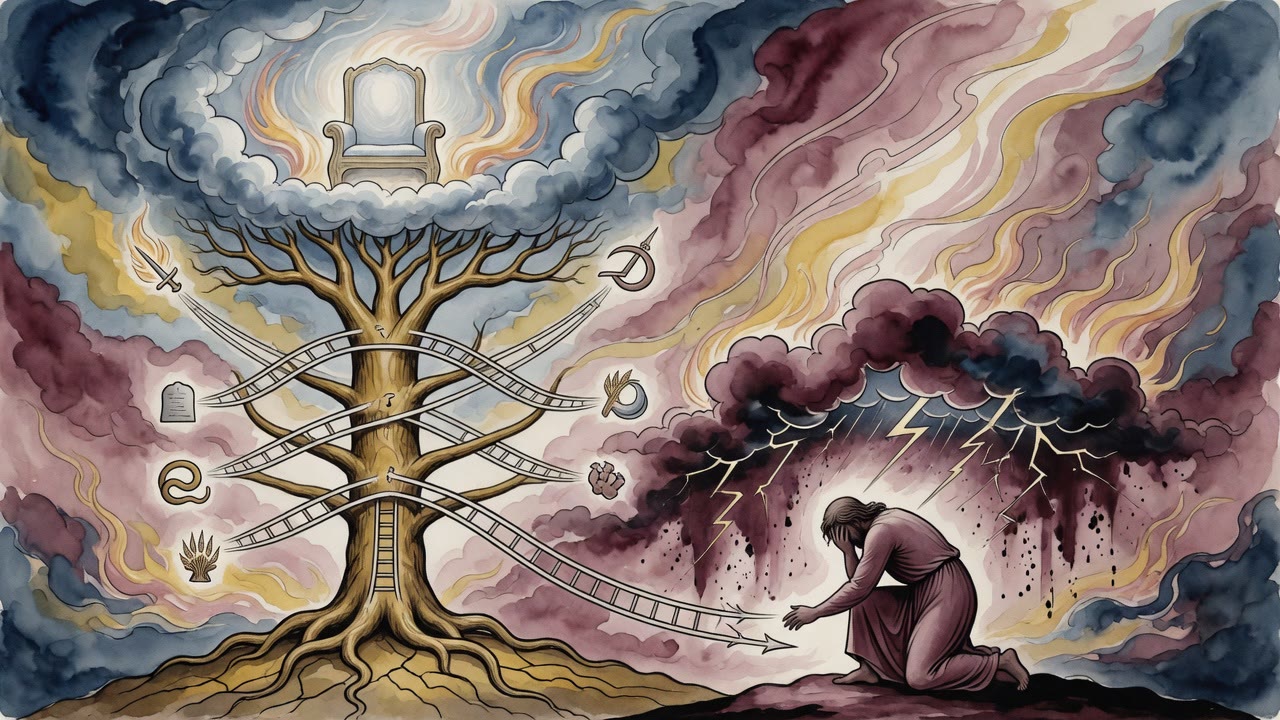
Primordial kings fall and vessels crack before the world is ready. Judgment hardens into limits, garments seize control, and light later sifts toward repair.

Curated by Arthur · Told by Maggid ·
Table of Contents
  1. Why the Fall Was Allowed to Last
  2. When Garments Took the Wheel
  3. Judgment as Necessary Limit
  4. Sifting Level by Level

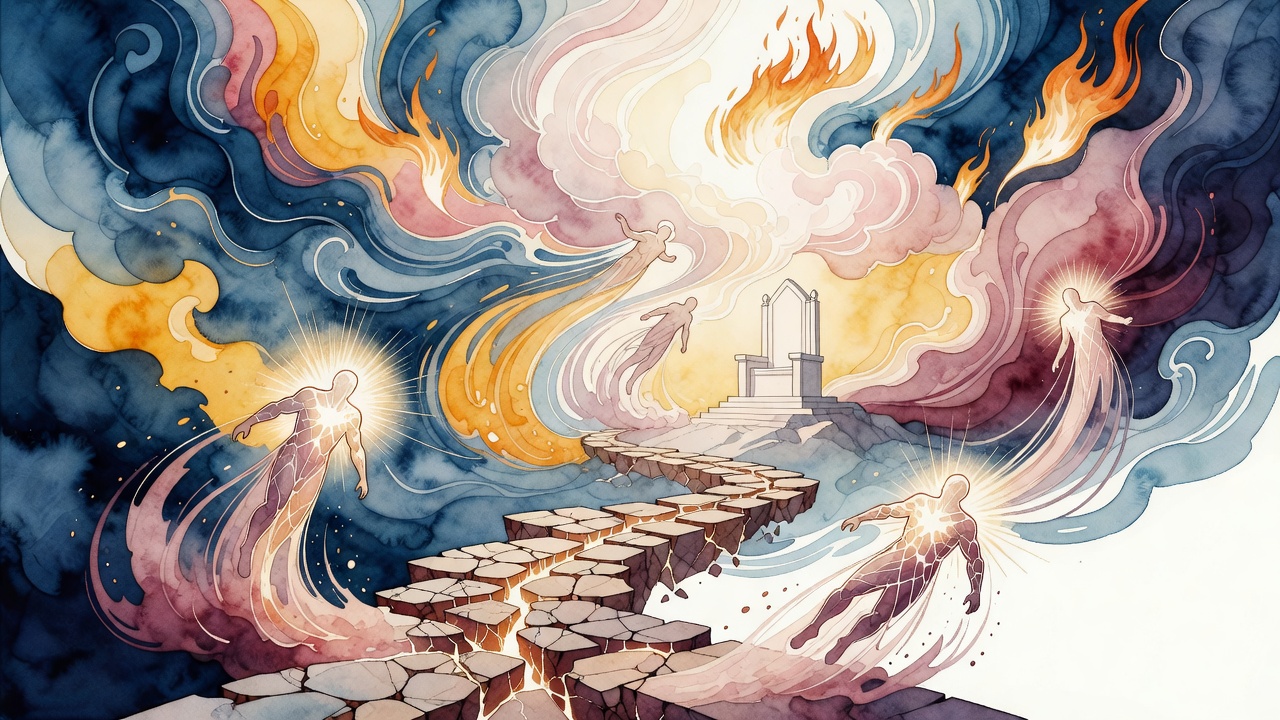
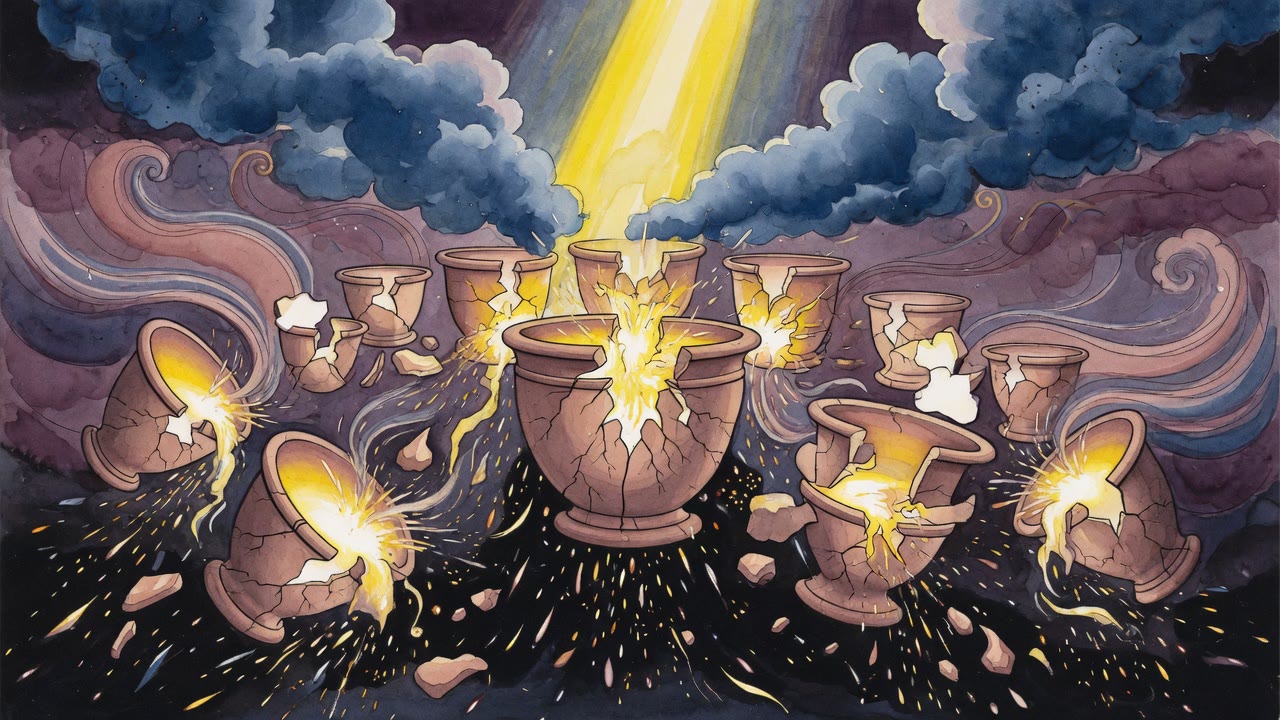
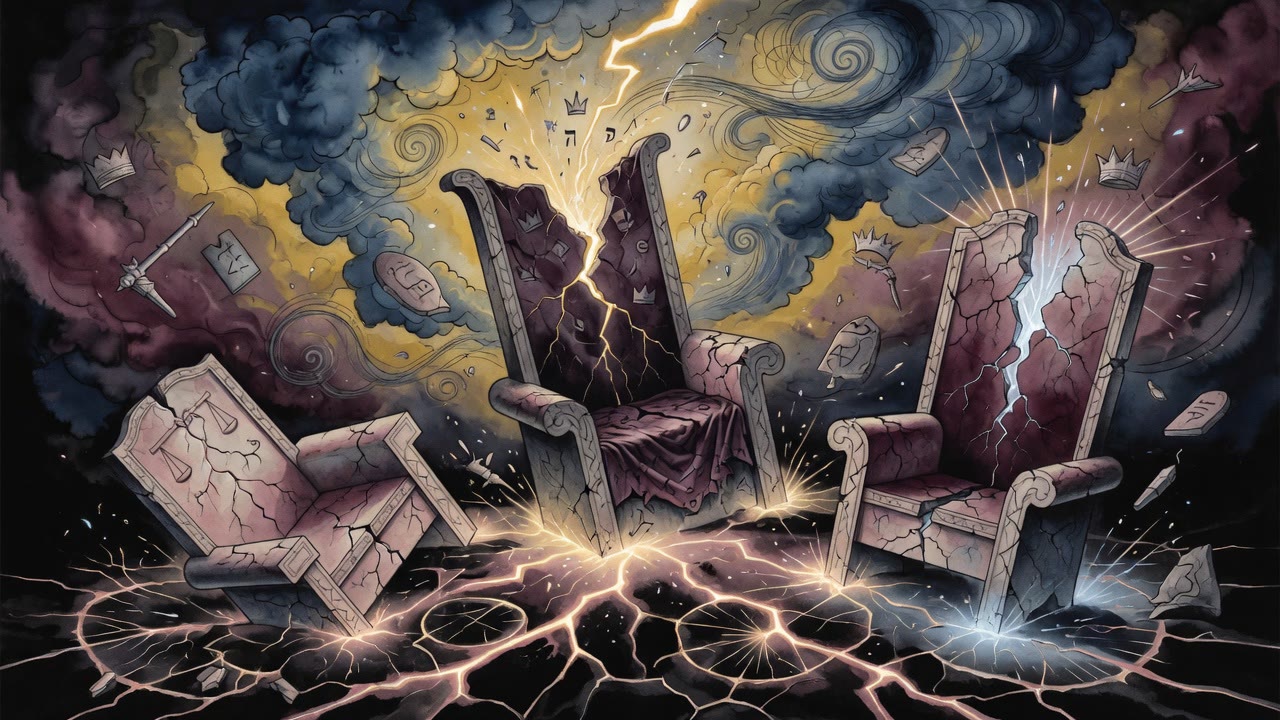
Before human thrones, kings rose, took light too hard, and broke. Crowns rolled into darkness. Sparks scattered and waited for hands.

Kings Who Shattered So Evil Could Be Named Click for full size

The Emanator did not look surprised. Brokenness had been budgeted for a while.

Why the Fall Was Allowed to Last

The Primordial Kings remained shattered long enough for evil's divisions to show. Exile later rhymes: oppression fully exposed, then repair. Darkness is not loved; it is timed.

When Garments Took the Wheel

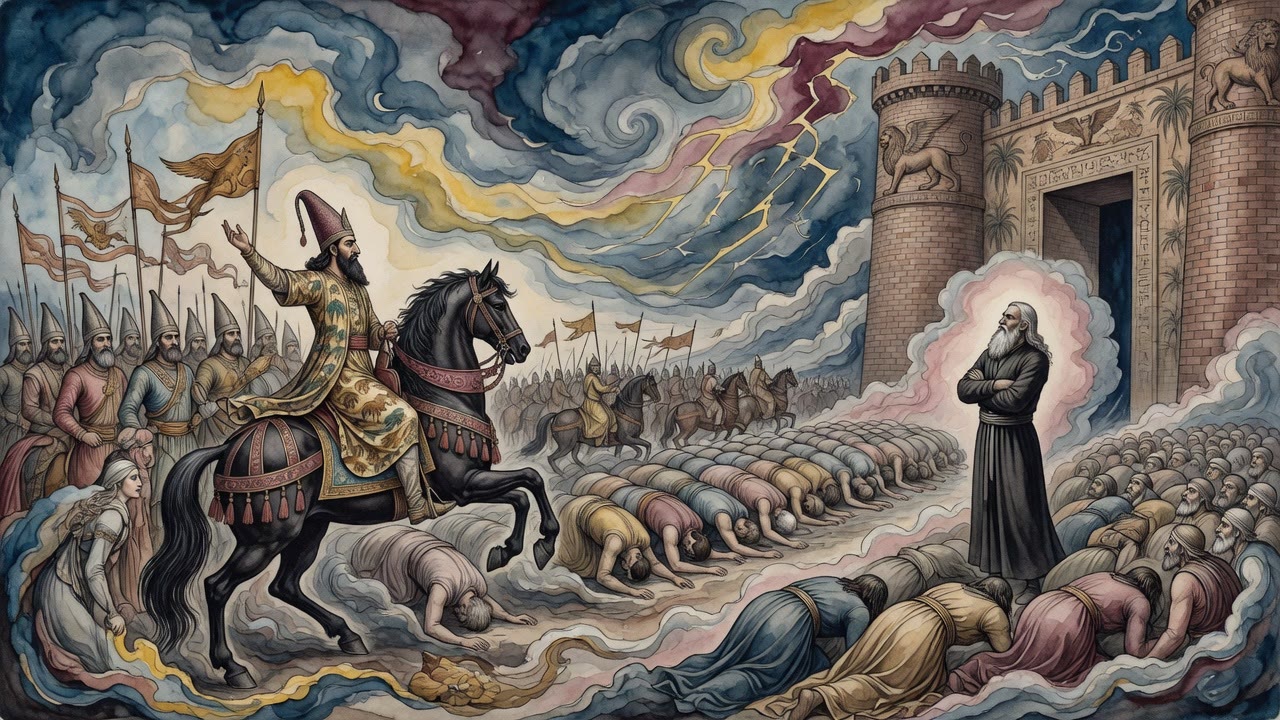
Control passed to concealing garments so the Other Side could take form for later tikkun (a repair). Evil then consumed its midwives. Unruled form is dangerous even when form was needed.

Judgment as Necessary Limit

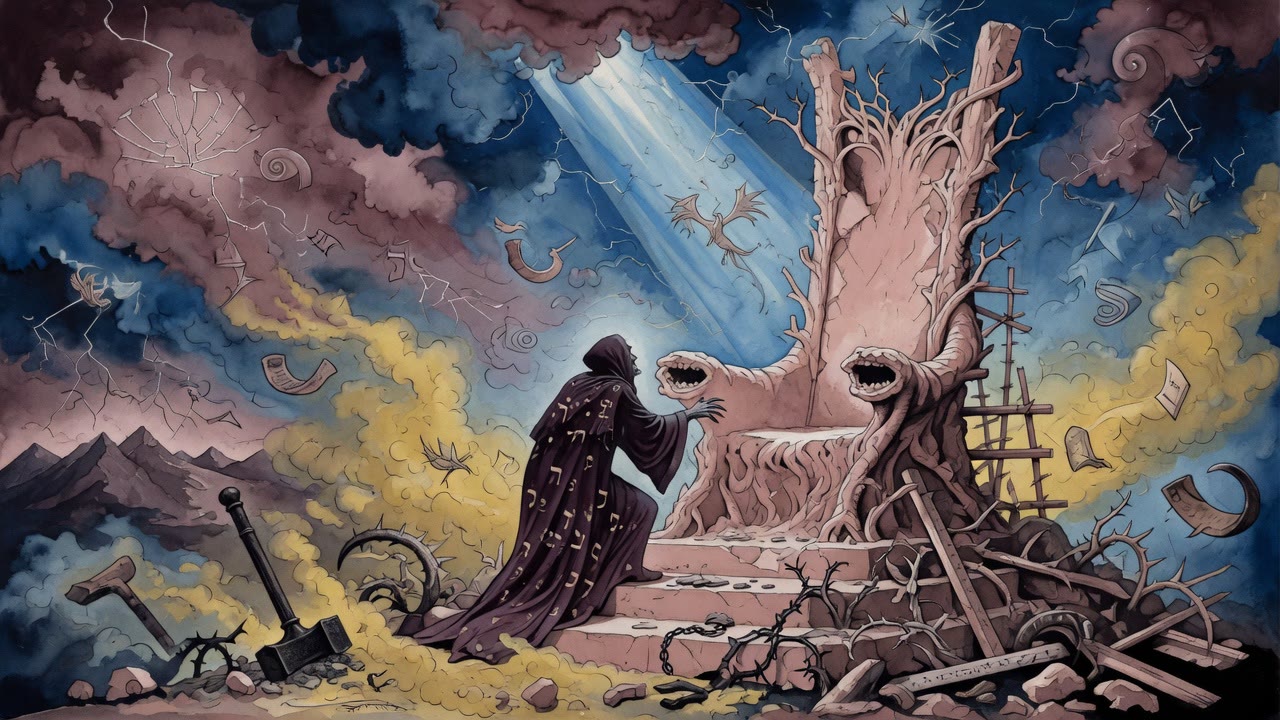
Din is boundary, not an outside demon. Mild limit protects; excess in Nekudim roots evil in vessels that assert rule. Limits make a world; wild limits make a wound.

Sifting Level by Level

Sefirot (the ten channels of divine emanation) refine as they descend; impurity clings toward Malchut of Asiyah, salvaged yet tasked to hold Other Side for a time (Psalms 103:19). Every tikkun refuses to leave the kings on the floor forever.


← All myths

From the tradition

Sources

4 sources

The texts behind this telling. Some cards carry a translation of the source; others are our own retelling of it, and each card says which. Every card links out to the original.

Kalach Pitchei Chokhmah 47:8Kalach Pitchei Chokhmah

Retold in our words. Read the original at the link below.138 Openings of Wisdom, trans. Rabbi Avraham Greenbaum, Azamra Institute (2005) · CC-BY

Our tradition grapples with this question, too. It dives deep into the mysteries of creation, of brokenness, and of eventual repair. One fascinating source for this is the Kalach Pitchei Chokhmah, a Kabbalistic text. It offers a powerful, if somewhat challenging, image: that of "garments" needing rectification.

What does that mean, exactly?

The passage speaks of the Emanator, blessed be He – a reference to God – wanting to rectify these garments. But before that could happen, something else had to play out. The Primordial Kings, ancient figures representing early stages of creation, remained broken. Not just for a moment, but for a specific duration. And why?

Because this brokenness was necessary for the powers of evil to be revealed. Think of it like this: sometimes, in order to understand the full scope of goodness, we need to see the extent of its opposite.

The Kalach Pitchei Chokhmah draws a parallel to the exile of Israel. The Jewish people went down into exile, and according to this idea, they had to remain there for as long as it took for all the levels of evil ruling over them to unfold. This wasn't arbitrary. It was a process. A painful one, yes, but also one with a purpose: to allow for rectification through suffering, or through overcoming tests of faith like idolatry, philosophy, and secularism.

In the same way, these Primordial Kings remained in their state of destruction for a specific time – on just as many levels – as was required to produce the different divisions of evil.

That darkness needs its time, its space, even its unfolding. But the text doesn't leave us there. It offers hope.

After this period of brokenness, the Supreme Will will be revealed. It will repair everything through the mystery of unity. This idea of tikkun (spiritual repair) olam – repairing the world – is central to Jewish thought. It suggests that even in the face of overwhelming darkness, there is always the possibility, indeed the imperative, to heal and restore.

The Kalach Pitchei Chokhmah doesn't shy away from the reality of evil. It acknowledges that evil seems to be getting stronger every day. We see it in the headlines, in our communities, even within ourselves. But the text insists that the Supreme Will will ultimately put a stop to it. There's a divine limit.

This is a powerful reminder that even when things seem bleak, the story isn't over. The process of revealing and understanding evil is a necessary step towards the ultimate repair. And that ultimate repair, that revelation of the Supreme Will, is what we strive for. What we hope for. What we work towards, every single day.

Full source
Kalach Pitchei Chokhmah 47:15Kalach Pitchei Chokhmah

Retold in our words. Read the original at the link below.138 Openings of Wisdom, trans. Rabbi Avraham Greenbaum, Azamra Institute (2005) · CC-BY

Jewish mystical tradition, specifically in texts like the Kalach Pitchei Chokhmah (Wisdom), offers a pretty wild explanation.

It all starts "up above," in the realms of the Sefirot (the divine emanations). Now, the Sefirot (literally "emanations") are these divine attributes or aspects of God, like wisdom, understanding, kindness, and strength, through which the divine manifests in the world. Imagine them as blueprints for creation, or even different facets of a single divine light.

Here’s the kicker: initially, these Sefirot weren’t just about pure goodness. According to the Kalach Pitchei Chokhmah, they were also designed, in a way, to bring evil into existence. Yep, you read that right. The very structure of creation, at its inception, included the potential for darkness. Why? So that through the process of repairing the world – what we call tikkun (spiritual repair) olam – God's ultimate unity, God's Oneness, could be revealed in its full glory. Think of it like a sculptor who starts with a rough block of stone, knowing that only by chipping away at it can the beautiful form within be revealed.

During what's often referred to as "the fall" – a moment of cosmic imbalance – control was handed over to what the text calls "the garments." These "garments" are metaphors, often understood as the outer layers that conceal the divine light, and in this context, they become associated with forces of negativity. The intention, at that point, was actually to produce evil. The Sefirot, in this diminished state, weren’t capable of fully negating evil because their purpose, at that specific moment, was to give it form.

And it gets even more intense. After evil was unleashed, it started to consume the very forces that brought it into being. The good within the Sefirot became weakened, existing only in a state of "negation," unable to act. It was the destructive forces that took center stage, wreaking havoc. The good was still there, mind you, but it was suppressed, overshadowed by the power of destruction.

So, what does this all mean for us down here? Well, it suggests that the struggle between good and evil isn't some accident, some cosmic afterthought. It's baked into the very fabric of reality. The presence of evil isn't a flaw in the design, but a necessary step in the process of revealing God's ultimate unity and goodness. It's a challenging thought, for sure. But it also offers a glimmer of hope: that even in the darkest of times, the potential for repair, for tikkun olam, remains. And perhaps, our efforts to fight injustice, to heal the world, are actually part of this grand, cosmic process. Maybe, just maybe, we are helping to restore the light that was once dimmed, revealing the divine unity that lies at the heart of everything.

Full source
Kalach Pitchei Chokhmah 47:25Kalach Pitchei Chokhmah

Retold in our words. Read the original at the link below.138 Openings of Wisdom, trans. Rabbi Avraham Greenbaum, Azamra Institute (2005) · CC-BY

Kabbalah, Jewish mysticism, has some fascinating answers. And like any good story, it involves cosmic drama, shattered vessels, and sparks of light scattered everywhere.

Kalach Pitchei Chokhmah says a profound Kabbalistic text, as the Sefirot descended, level by level, they were also undergoing a process of refinement. Think of it like sifting flour – you're getting rid of the impurities, the clumps, leaving behind only the finest powder. But what happens to those clumps? What happens to the impurities?

Well, it seems all the "evil" – and I use that word cautiously, because we're really talking about imbalance and unrefined energy – was left clinging to the very last level, the Malchut of Asiyah (the World of Action). a bit. Malchut (Kingship) is the final Sefirah, the one closest to our physical world, the realm of Asiyah (Action). It's the vessel that receives and manifests all the energies from above. Now, Kalach Pitchei Chokhmah tells us that this Malchut of Asiyah ended up sustaining all the negativity that the higher Sefirot had shed.

Here's a crucial point: Malchut itself was also salvaged from the cosmic shattering. If it hadn't been, Malchut – and by extension, our entire world – wouldn't even exist. But, unlike the other Sefirot, Malchut wasn't completely cleansed. Why?

Because its very purpose, its divinely ordained task, was to maintain the "Other Side" – the realm of negativity – for as long as necessary. It's a delicate balance, this whole creation thing. As it says in (Psalms 103:19), "And His kingship (Malchut) rules over all." Even over the "Other Side."

Think of it like this: a gardener doesn't just plant beautiful flowers. They also have to deal with the weeds, the pests, the less desirable elements that are part of the ecosystem. Malchut, in a way, is the cosmic gardener, keeping everything in check.

So, while the other Sefirot were purified and elevated, Malchut remained, shall we say, a bit… complicated. It wasn’t cleansed in the same way, because it had a job to do. A difficult, essential job, maintaining the tension between holiness and… well, everything else.

About the nature of good and evil, about the roles we all play in this grand cosmic drama. And perhaps, about the spark of divinity even within the things we perceive as negative, waiting to be revealed, waiting to be refined.

Full source
Kalach Pitchei Chokhmah 44:9Kalach Pitchei Chokhmah

Retold in our words. Read the original at the link below.138 Openings of Wisdom, trans. Rabbi Avraham Greenbaum, Azamra Institute (2005) · CC-BY

Is it a force from outside, an external demon tempting us? Or is it something...else? Jewish mystical tradition, particularly in texts like Kalach Pitchei Chokhmah (Forty-Four Openings of Wisdom), delves deep into this very question. It's a journey into the subtle architecture of creation itself, and it might surprise you.

Judgmentdin in Hebrew – is often remembered as a negative thing. But in Kabbalah, judgment is a necessary force. It's the principle of limitation, of definition. It's what allows things to be distinct, to have boundaries. But what happens when that judgment becomes..excessive?

Kalach Pitchei Chokhmah tells us that the judgment revealed in what's called the "Residue" wasn't potent enough to actually cause the Other Side – that is, the realm of negativity, of evil. Think of it like this: a little bit of restriction, a little bit of "no," isn't inherently bad. It can even be protective. But too much? That can lead to a whole different ballgame.

That's why, the text explains, we only find a true "root" of evil when we get to the world of Nekudim. Now, this is where it gets interesting. Before Nekudim, there was Akudim. These are stages in the emanation of the divine light, stages in the unfolding of creation. In Akudim, the light – the divine energy – was primary. There was a "vessel," a container for that light, but it was completely subservient to it.

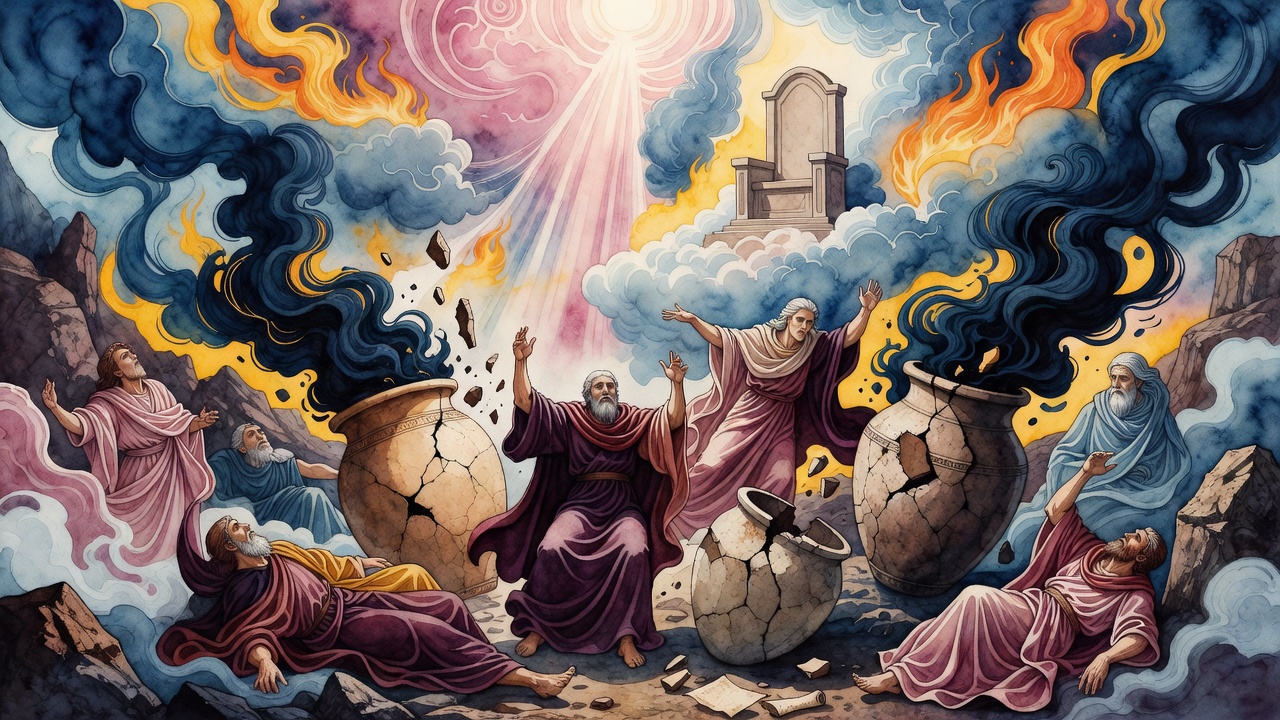
But then came Nekudim. And here's the key: "the root of evil lies in the vessels." Just like the body depends on its organs, the vessel is the cause of the body. In Nekudim, the vessels – the containers – started to assert themselves. They became differentiated, distinct. They took control.

Why is this significant? Because, in Akudim, even though a vessel existed, it didn't "rule." It was just one unified vessel with ten lights. It hadn’t yet become differentiated. Think of it as potential energy, a seed that hasn’t yet sprouted. It wasn’t yet called a root to the Other Side. But as soon as it became revealed in all its constituent details and took control – namely, in the world of Nekudim – it reached a suitable level for that potential to actualize.

Imagine a perfectly balanced ecosystem. Everything is in harmony, light is dominant. Now imagine introducing a foreign element, something that disrupts the balance, that starts to take over. That's kind of what happened in Nekudim. The vessels, the containers, became too prominent, too controlling. And that's when the potential for imbalance, for negativity, for what we call "evil," really took root.

So, what does this all mean? It suggests that evil isn't some external force, some demon lurking in the shadows. It's an imbalance within the system, a distortion of the natural order. It's when the containers, the limitations, become more important than the light they're supposed to hold.

And isn't that a powerful lesson for our own lives? When we get too caught up in our own limitations, our own fears, our own rigid structures, aren't we creating the conditions for imbalance, for negativity, to take hold? Perhaps the key, then, is to always remember the light, to strive for balance, and to keep our vessels – our ego, our desires – in their proper place, as containers for the divine spark within.

Full source