6 min read

The Vessels Cracked When the Light Would Not Fit

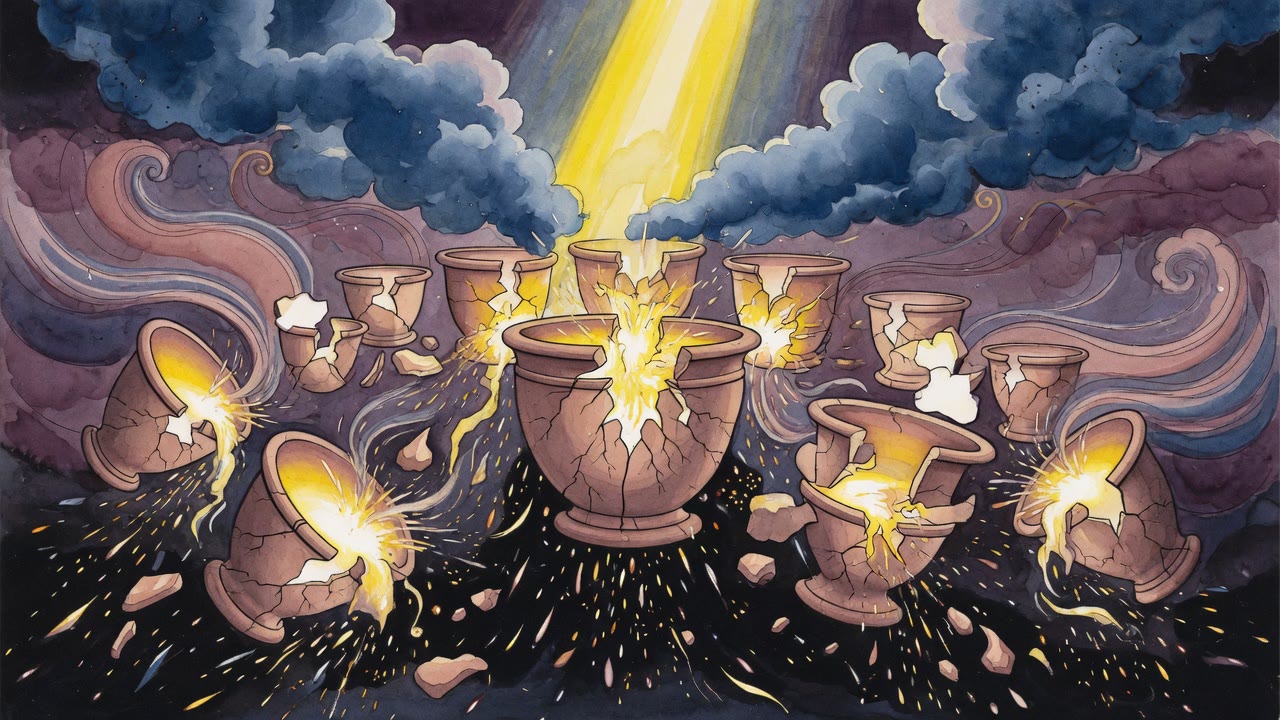
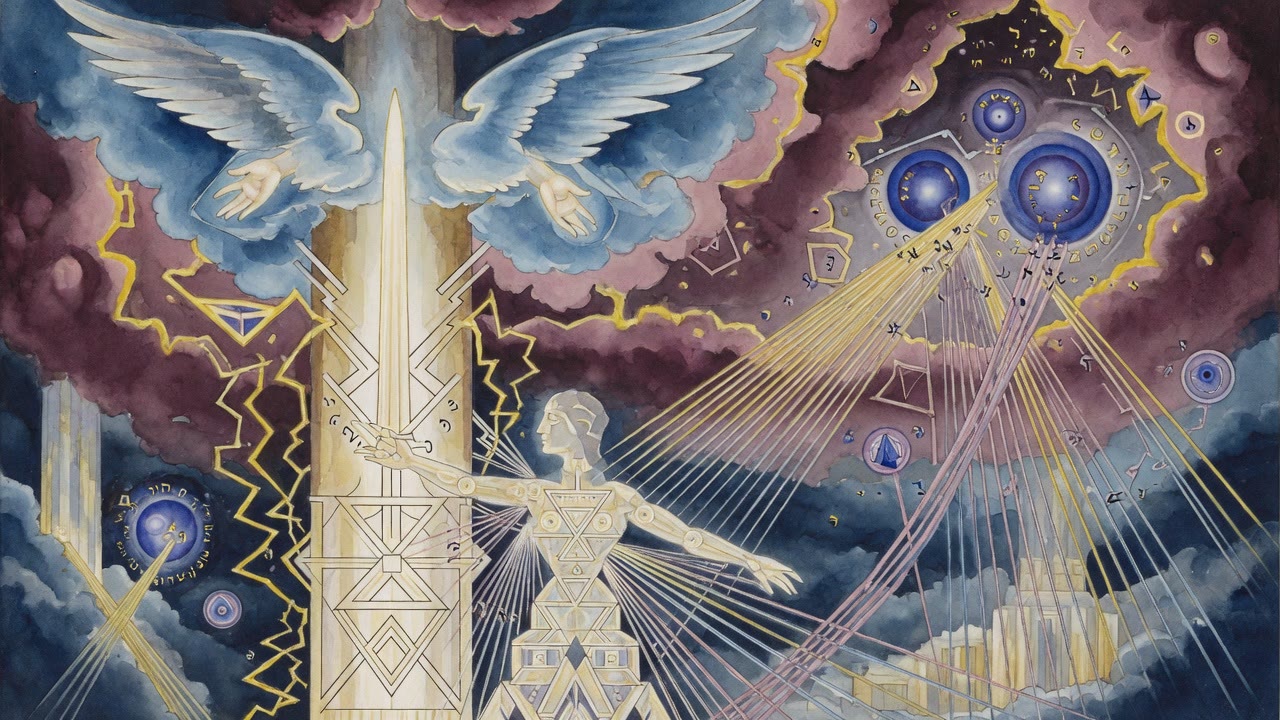
Before names settled on the worlds, ten cups took the first light. The light was too much. Clay sang, split, and spilled sparks into night.

Curated by Arthur · Told by Maggid ·
Table of Contents
  1. The Cups That Sang
  2. When Holding Became Breaking
  3. Sparks in the Rubble
  4. What Survived the First Crash
  5. The First Hand Toward Repair
The Vessels Cracked When the Light Would Not Fit Click for full size

The Cups That Sang

Ten vessels stood in a row that was not yet a world. Each was a cup shaped for a single office of light. Kindness had its bowl. Judgment had its bowl. Beauty waited with a thin rim. Foundation held a narrow neck. Kingdom, last of all, opened her mouth like a door that wanted guests and feared them.

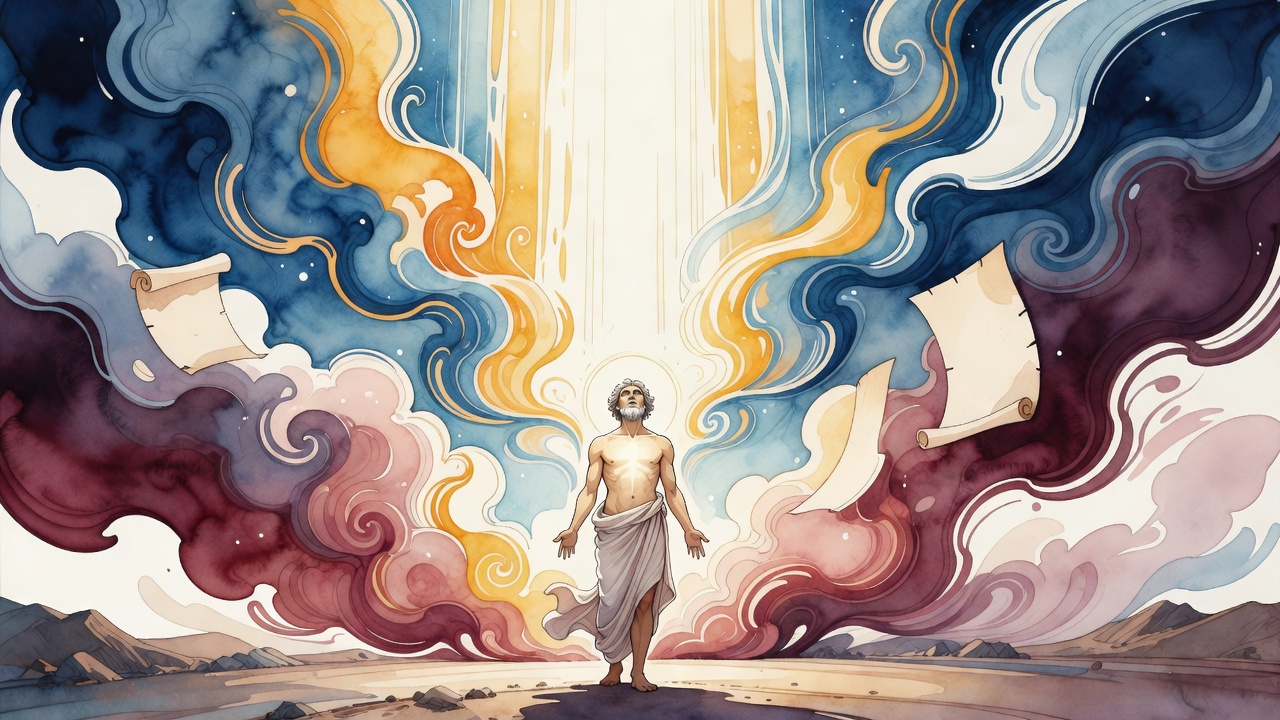
The light came without asking permission. It was not gentle. It did not measure the clay against its own heat. It poured the way a river pours when the dam has already forgotten how to say no. The vessels received it because that was their only craft. Reception was their name and their duty and their doom.

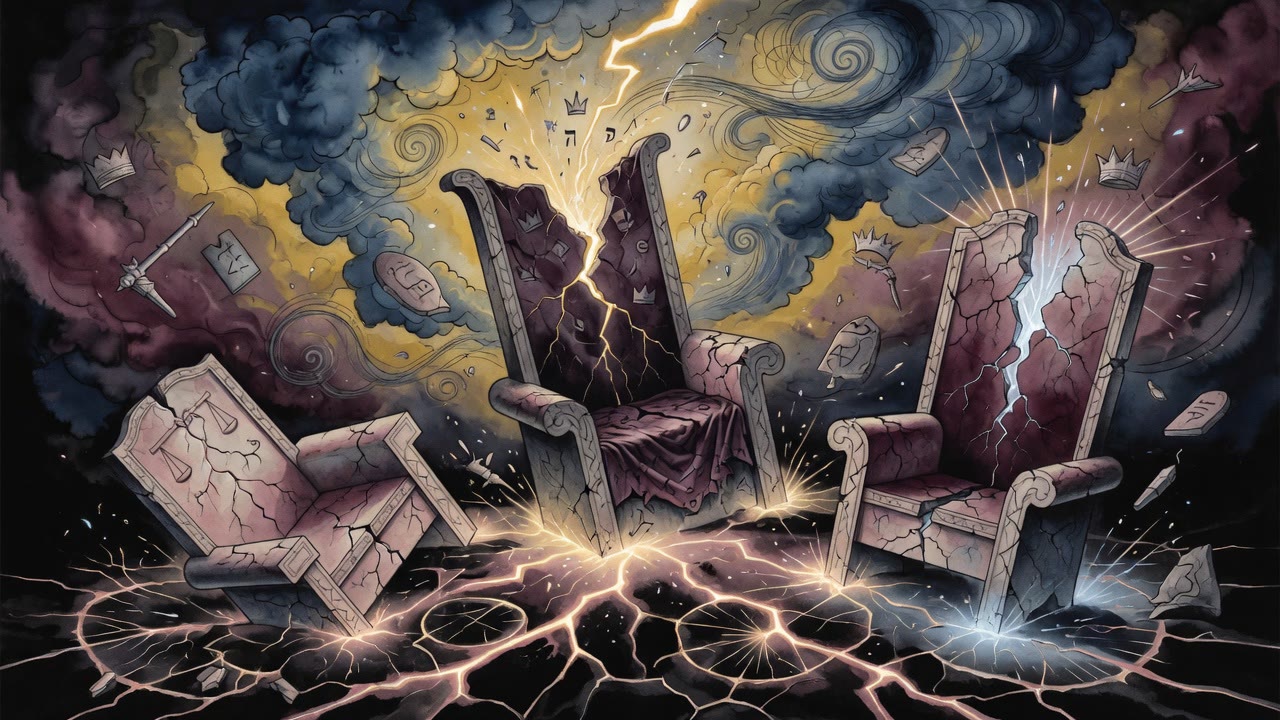
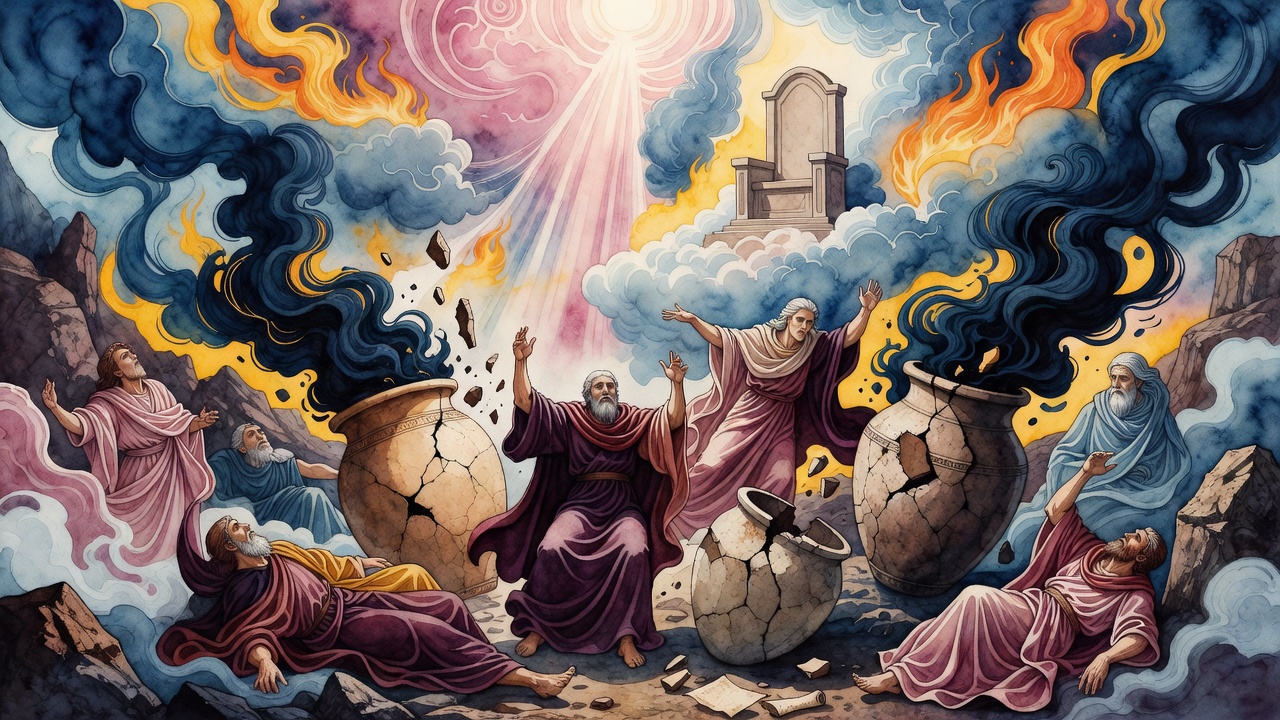
For a breath they held. The rims glowed white. The insides brightened until every surface looked like noon pressed into porcelain. A sound like singing rose from the clay, not joy, more like strain finding a voice. Then the light pressed harder, and the first hairline crack ran through Judgment with a noise like ice under a boot on a winter lake.

No angel shouted a warning. The warning was the crack itself.

When Holding Became Breaking

Breaking, in that hour, meant two deaths at once. A vessel that cracks loses its office. It can no longer govern. Kindness that cannot hold becomes a flood without banks. Judgment that cannot hold becomes a blade without a hand. Beauty that cannot hold becomes a pretty argument that settles nothing. The form itself is wounded. The cup is still there on the floor of possibility, but it is unfit for the work it was named to do.

Chesed split with a wide sound, almost generous even in ruin. Gevurah split with a harder cry, edges sharp enough to cut the air that tried to leave it. Tiferet tried to keep the middle and failed, its harmony spraying into separate notes that would not rejoin. Lower down, the vessels that had less strength to receive pure force went to pieces faster. Higher up, certain levels stayed whole because they were built closer to the root and could bear more weight without surrendering their shape.

The machine of creation, if one may call a living government a machine, still lay scattered across the first dark. Parts remained. Functions did not. A gear without a shaft is only metal. The powers and laws of making did not vanish into nothing. They stayed present and broken, blueprints with no hands left, tools still warm and already useless for the house they were meant to raise.

Imperfection entered the structure of the vessel itself. It was not a scratch on the glaze. It was a failure in the bones of the cup.

Sparks in the Rubble

Light does not like to die. When the cups shattered, sparks of holiness leapt free and fell into the rubble. They clung to the shards the way fire clings to coal that still remembers the tree. Without those sparks the broken pieces would have been pure husk, cold and finished, fit only for the ash heap of a story that ends. With them, the wreckage still breathed.

The sparks kept the shards from vanishing. They also trapped themselves. Holiness mixed with ruin. A bright point sat inside a dark fragment and waited for someone, someday, to pick it up without cutting a hand to uselessness. That waiting is the seed of repair. That waiting is also exile.

Kingdom watched from the edge of the break. She is the last station, the place where light becomes a world a creature can walk. When the others sent their influence each alone, without passing through her, excess separation poured out like unshared wine. Dissension multiplied. The orchestra played without a score. Each instrument shouted its own measure until the hall itself cracked along the same lines as the cups.

A spark rolled under what would one day be called night and refused to go out.

What Survived the First Crash

Not every level was a candidate for ruin. The chain of emanation has strong links and weak ones. The break found the weak. The strong held and became the memory of wholeness against which all later repair would measure itself. Only certain floors of the house took the full collapse. The upper beams groaned and stayed.

Even so, the shock traveled. What holds above feels the empty space below. What lies below inherits a sky that sometimes rains light and sometimes rains shards. The catastrophe was not total absence. It was a world forced to begin as a repair site rather than a finished palace.

In the silence after the first crash, dust hung like a second firmament. One unbroken vessel somewhere above still held a quiet measure of light. Its holding was a promise whispered to the sparks. Below, those sparks winked in the ash like eyes that refuse to close even when the face around them is gone.

The First Hand Toward Repair

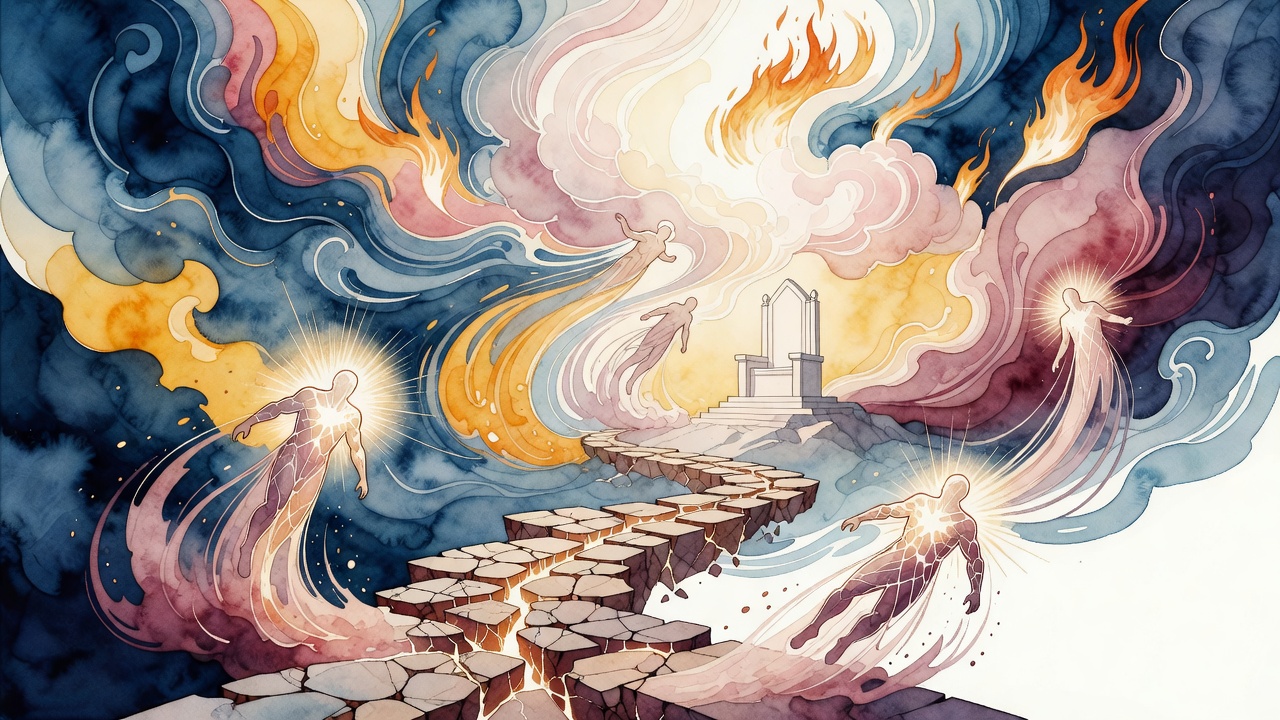
Repair did not wait for perfection. It began while dust still hung in the air. Binding came first. Two radiations that had been torn from each other were pressed edge to edge until heat returned between them. Love woke in that pressure, not as a sermon but as a force that made separate lights lean. Then a new order tried to stand, still limping, still incomplete, already better than pure scatter.

The Supreme Will had never wanted the whole masterpiece unveiled in a single flash. Gradual repair leaves room for merit. Creatures who pick up sparks become partners, not props. The world remains unfinished on purpose so that hands can finish it, so that a mouth can bless, so that a refused cruelty can free a point of light that has waited since the first clay sang and split.

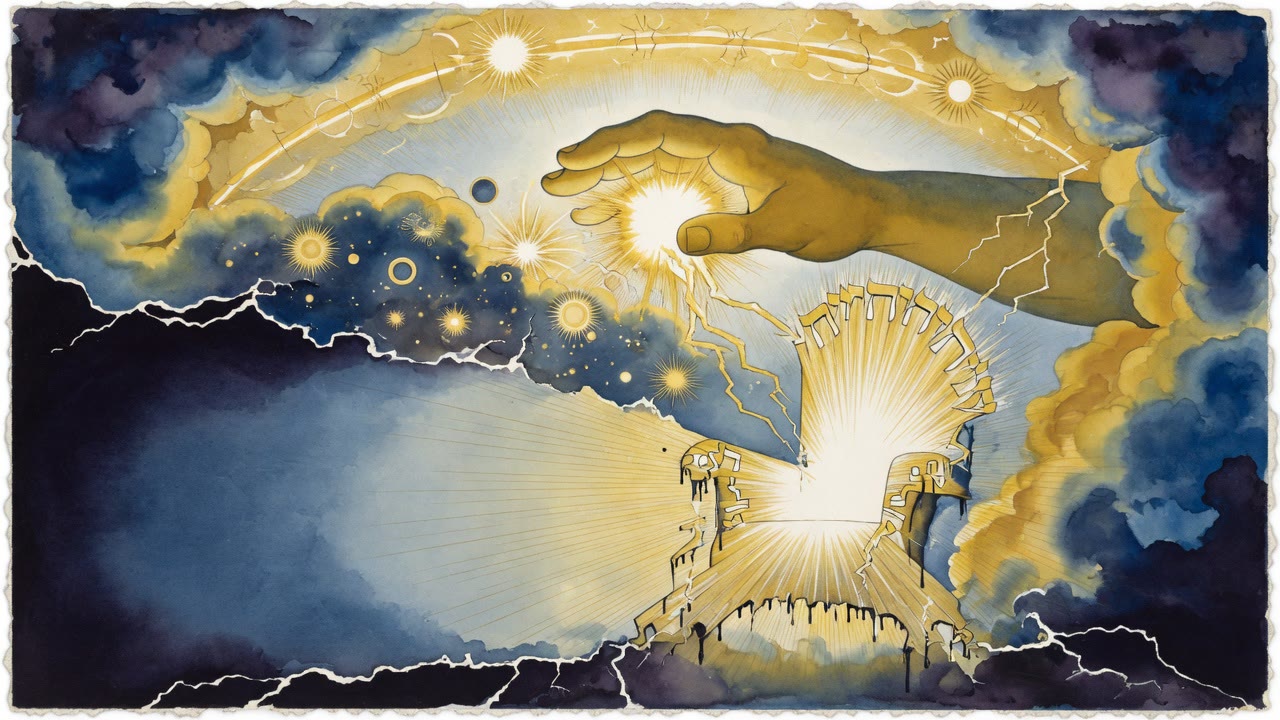
Someone, long after, will lift a shard and feel it warm. That warmth is older than the hand. It is the same light that would not fit, still working, still asking to be gathered home.


← All myths
From the tradition

Sources

4 sources

The texts behind this telling. Some cards carry a translation of the source; others are our own retelling of it, and each card says which. Every card links out to the original.

Kalach Pitchei Chokhmah 54:4Kalach Pitchei Chokhmah

Retold in our words. Read the original at the link below.138 Openings of Wisdom, trans. Rabbi Avraham Greenbaum, Azamra Institute (2005) · CC-BY

Jewish mystical tradition, particularly in Kabbalah, wrestles with this very question. We're delving into the cosmic event known as Shvirat HaKelim, the Breaking of the Vessels. It's a dramatic moment, a cosmic catastrophe, really, that shaped the world as we know it.

So, what exactly did happen when these vessels shattered?

Well, according to the Kalach Pitchei Chokhmah, a key Kabbalistic text, when the vessels broke, they lost their very power. Think of it like this: imagine a complex machine, each part designed for a specific purpose. When that machine shatters, those individual parts, while still there, can no longer perform their intended function.

That's essentially what happened with the vessels. They were no longer arranged in a complete, functional form. Instead, they existed as "various kinds of incomplete powers," unfit to carry out any real purpose. It’s a picture of potential, yes, but unrealized potential. Think raw materials without a blueprint, a harmony orchestra with no conductor.

And crucially, these broken pieces were sustained in this state. Their source, the divine, if you will, maintained them in this condition, awaiting something new. Awaiting…repair. This wasn't a final destruction; it was a pause, a cosmic breath held before the next stage of creation.

This brings us to the critical question: what happened after the breaking?

The Kalach Pitchei Chokhmah emphasizes that a new "radiation" was required to complete the vessels, to give them form and function once more. This is where the concept of Tikkun (spiritual repair) Olam, repairing the world, comes into play. The breaking wasn't the end; it was the beginning of a process. A process that, according to many Kabbalistic interpretations, we are actively involved in, even today.

Isn’t that incredible? The brokenness, the fragmentation…it's not just a tragic backstory. It’s the foundation for a world in need of healing, a world where every act of kindness, every attempt at justice, contributes to the ongoing repair. A world where you and I have a role to play in piecing things back together, bringing light and order to the fragments. What will your contribution be?

Full source
Kalach Pitchei Chokhmah 53:3Kalach Pitchei Chokhmah

Retold in our words. Read the original at the link below.138 Openings of Wisdom, trans. Rabbi Avraham Greenbaum, Azamra Institute (2005) · CC-BY

The Kabbalah, Jewish mysticism, wrestles with this very idea – a cosmic shattering and the slow, painstaking process of putting things back together.

We've talked about the Sefirot (divine emanations). These are the attributes through which God manifests in the world. Now, picture those vessels shattering. That, in a nutshell, is the "breaking of the vessels," or Shevirat HaKelim, a pivotal concept in Lurianic Kabbalah.

What happens after the shattering? Do we just leave the pieces scattered? Absolutely not! That's where the concept of Tikkun (repair) comes in.

The Kalach Pitchei Chokhmah, a key text in Kabbalistic thought, tells us that everything damaged in that initial cosmic breakage had to be repaired, little by little, progressively. It wasn't a quick fix.

And what exactly was damaged? Well, the text specifically mentions the descent of the "hind parts" of Abba (Father) and Imma (Mother), archetypal figures representing wisdom and understanding. It's a complex idea, but essentially, it refers to a disruption in the flow of divine energy. And it wasn't just Abba and Imma; the breaking affected all the Sefirot.

The beauty of this, though, is that everything that was lacking during that time of breakage began to be replenished during the time of repair. It's a process, a journey. You don't expect it to be perfect overnight. You nurture it, prune it, and slowly, patiently, watch it return to its former glory, maybe even become something even more beautiful than before.

And this process of Tikkun, this gradual mending, isn't just a one-time event. It's ongoing. It's something we participate in. The Kalach Pitchei Chokhmah assures us that everything will eventually be fully complete in the perfect repair that will come about in time to come. A belief in the ultimate restoration of harmony and balance.

So, as we consider the breaking of the vessels and the influence it had on the course of repair, let's remember that even in the face of destruction and chaos, there is always the potential for healing and renewal. The Kabbalah teaches us that we each have a role to play in that process, in bringing about that perfect repair. And that, my friends, is a truly empowering thought.

Full source
Kalach Pitchei Chokhmah 54:8Kalach Pitchei Chokhmah

Retold in our words. Read the original at the link below.138 Openings of Wisdom, trans. Rabbi Avraham Greenbaum, Azamra Institute (2005) · CC-BY

Creation is often remembered as this perfect, smooth process. But what if it wasn't? What if there were… hiccups? The Kabbalah, Jewish mysticism, explores this very idea, particularly when discussing the Shvirat HaKelim, the breaking of the vessels.

What exactly does "breaking" mean in this context? It's not just about things being damaged. It signifies two crucial aspects. First, it means that a vessel, in this case representing a Sefirah (a divine attribute or emanation), becomes unfit for its intended purpose. It loses its power to govern or influence.

Second, and this is key, the breaking signifies an imperfection in the very form or structure of the vessel. According to Kalach Pitchei Chokhmah, these two aspects are intertwined. The imperfection in form leads directly to the vessel's inability to function properly. It might look lovely, but it can't hold water!

Here’s where it gets really interesting. Sometimes, a broken object can still be repurposed. A shattered vase might become beautiful patchwork tiles. But, what happens when the breakage is so complete, so utter, that nothing remains of the original form? What if the vessel is rendered utterly useless, beyond any hope of repair?

That, my friends, is the kind of breaking we're talking about with the Shvirat HaKelim. It's a breakage that leaves absolutely no form, no possibility of being used for any creative purpose. The broken vessels, in their shattered state, become like governmental laws – strict, unyielding, and utterly incapable of executing any peulah shel havayah (פעולה של הויה), any creative function. They are the very measure of creations in a state lacking all repair.

So, what does this all mean? Is it a cosmic tragedy? A design flaw in creation? Or is there a deeper lesson here? Perhaps the breaking of the vessels is not an end, but a necessary stage, a prelude to a greater, more profound creation. Maybe, just maybe, it's in the broken pieces that we find the potential for something truly new and unexpected. Something beyond our wildest imaginings.

Full source
Kalach Pitchei Chokhmah 54:12Kalach Pitchei Chokhmah

Retold in our words. Read the original at the link below.138 Openings of Wisdom, trans. Rabbi Avraham Greenbaum, Azamra Institute (2005) · CC-BY

Jewish mysticism wrestles with this very question, particularly when we explore the secrets of creation and the Sefirot (the divine emanations), those divine emanations through which God's will manifests.

Our story picks up after a kind of cosmic shattering. Think of it like this: imagine exquisite vessels, filled with divine light, suddenly breaking. We touched on this idea earlier, if you recall our discussion of the "scattered sparks" (nitzotzot) and how they kept the broken vessels in existence (see Opening 36 Part 2, Kalach Pitchei Chokhmah (Wisdom)). Light trapped in shards, a potential for something new lurking within the remnants of what was.

What happens next? The Kalach Pitchei Chokhmah tells us that the Supreme Will desired to complete and perfect the Form of Man – not just any human form, but the archetypal, cosmic Adam Kadmon, the primordial human that embodies all of creation – in all its aspects. It wasn't enough for the sparks to simply exist; they needed to be brought together, refined, made whole.

How did that happen? Through a "new radiation." This wasn't just any light; it was a specific force, a particular emanation represented by the name MaH. We’ll examine the significance of MaH later, but for now, think of it as the energy needed to complete the work, to bring the scattered pieces into harmony. This radiation came specifically "to complete them. through giving them proper existence."

This process involved a kind of divine sorting, a sifting and purification. The text speaks of "the mystery of the selection and purification, whereby the name MaH sifted out and gathered to itself parts of BaN." Again, these names, MaH and BaN, are more than just labels. They represent specific forces and energies at play in the cosmos. The idea is that MaH, the force of completion, selected and gathered certain aspects from BaN, another divine name, to bring about wholeness. It's like a cosmic recipe, where specific ingredients are carefully chosen and combined to create something greater than the sum of their parts.

And the result of this divine alchemy? The Partzufim (a divine configuration) (the divine configurations). The Partzufim (divine "faces" or "personae") are complex configurations of the Sefirot, arranged in specific relationships to one another. These Partzufim were created "through the mystery of rectification." They represent a higher state of organization and harmony, a way of repairing the initial shattering and restoring balance to the cosmos. They are the "form and function" that the scattered sparks were destined to take.

So, what does this all mean for us? That even when things seem fragmented and scattered, there is a divine force at work, seeking to bring us towards wholeness. The journey from broken vessels to the Partzufim is a metaphor for our own lives, a reminder that even our deepest wounds can be the source of our greatest growth.

Full source