6 min read

God Left the World Incomplete So Goodness Could Be Earned

The Intellect poured her cup half full and left the pitcher within her reach. She argued all night. At dawn she filled the cup herself and drank it standing.

Curated by Arthur · Told by Maggid ·
Table of Contents
  1. The Word That Stopped the Sky
  2. The Bread of Another Man's Table
  3. What Was Withheld at the Rim
  4. The Measure Was Taken From the Creature
  5. What She Carried Out at Dawn

The Soul came in past midnight and would not sit down. She had carried the same objection for years, and standing seemed the only honest way to hold it. "I have learned the commandments and the accounts of the beginning," she said. "Not one of them tells me why I wake every morning into a world somebody left half made."
God Left the World Incomplete So Goodness Could Be Earned Click for full size

The Intellect took a pitcher off the shelf and poured her water. He stopped when the cup was half full. Then he set the pitcher on the table between them, close enough that either of them could reach it, and folded his hands.

"Before there was anything, there was nobody to hand anything to," he said. "Good that arrives nowhere is not good given. It is only good kept. So God made someone to stand at the other end of the giving."

She looked at the half cup and left it where it stood.

The Word That Stopped the Sky

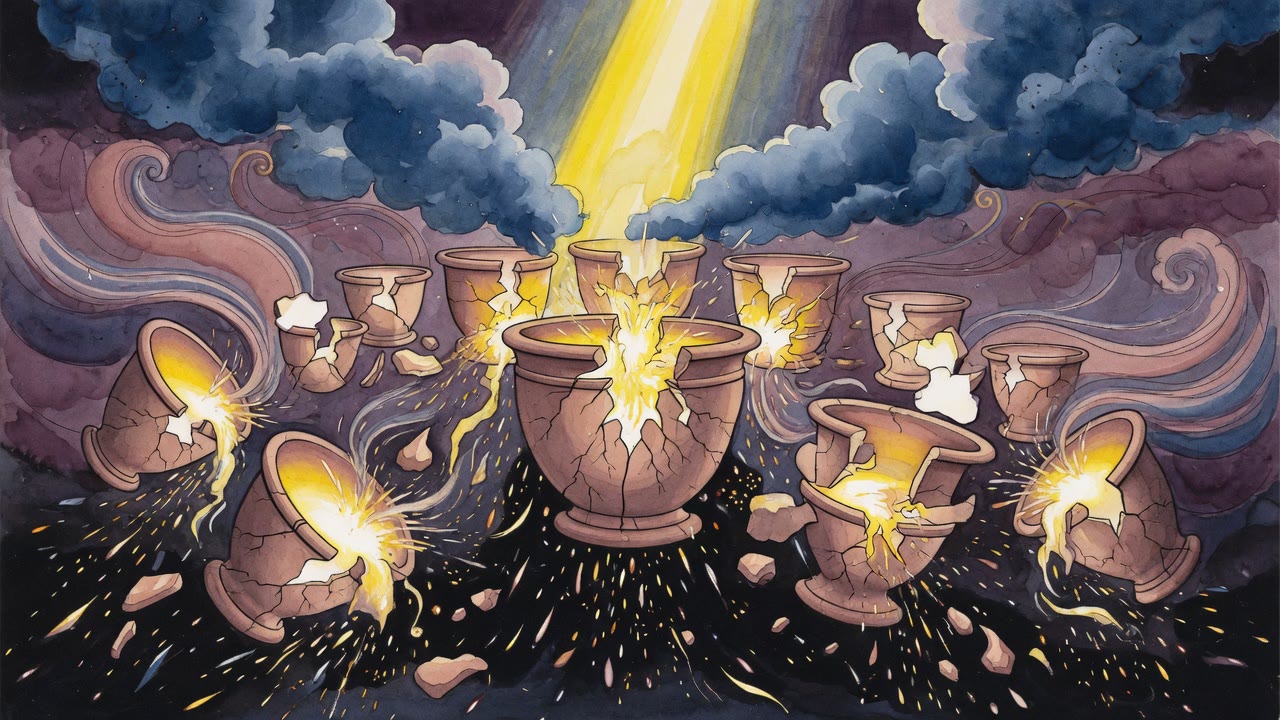
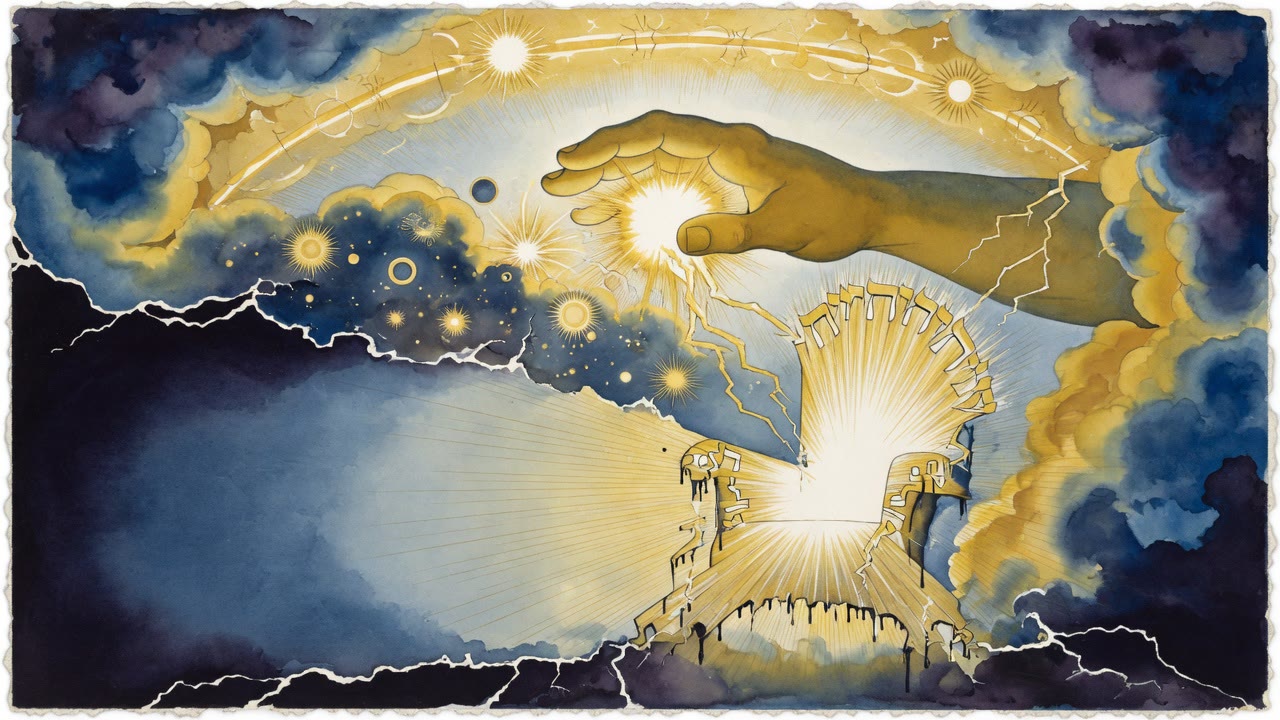
He told her what the heavens did at the beginning, and it went like this. They came off the place where they had been laid down like a bolt of cloth off a table with nobody holding the end. They ran. Nothing woven into them was built to catch, and nothing in them had any reason to stop, since whatever set them moving carried no limit anywhere inside it. The seams went out past anything there was to see and kept going.

Then a word came down on top of them. "Dai." Enough. They stopped on the line where the word caught them, and that line is the one still standing over the rooftops. The name Shaddai (שדי) keeps the moment folded inside it, the One who said to His world, enough.

"He could have let them run," the Intellect said. "Nothing outside Him was able to stop them. He stopped them Himself, which is the hardest thing in the world to witness, because it leaves nothing on the ground to point at. A sky that has been held still looks exactly like a sky."

The Bread of Another Man's Table

She wanted a person and not a sky, so he gave her one.

A man sits down to eat in his neighbor's house in a good year. The bread is warm, the neighbor is generous, nothing whatever is wrong with the meal. The man eats with his eyes on the cloth. He answers when he is spoken to and passes what he is asked to pass, and not once in the whole hour does he lift his face to the face of the one who plowed and reaped and baked it, because every crumb in front of him came out of a field he never walked.

"He is not ungrateful," the Intellect said. "He is ashamed, and the shame is accurate. One who eats what is not his own cannot look his benefactor in the face."

Take the same man to the far side of a harvest he worked himself. The bread is worse. He looks up.

What Was Withheld at the Rim

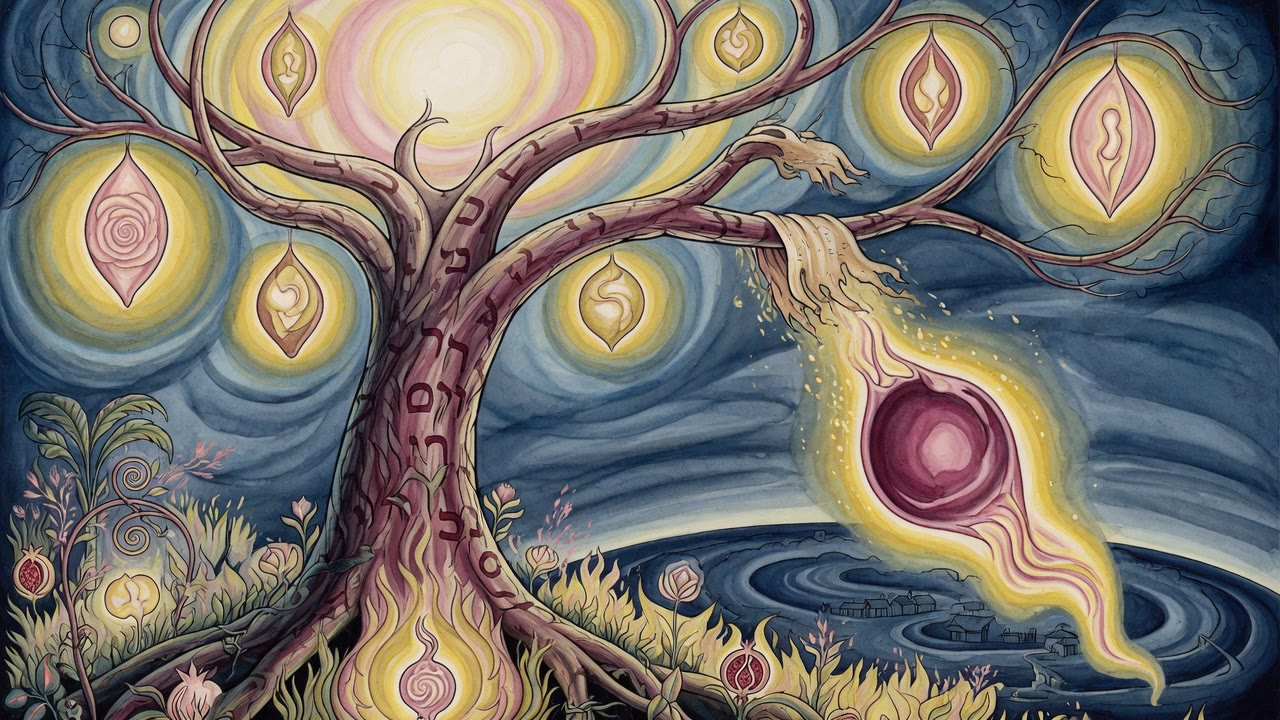
So the making went forward with the power held in. Nothing spilled and nothing ran short by accident. What could have come down whole came down measured, and what came out of it came out deficient on purpose, short by the exact amount a creature could close by working. The lack was cut into the world the way a door is cut into a wall.

"He made them incomplete," the Intellect said. "He wanted the good to reach them in the merit of the effort they spent getting to it. Handed over finished, it would have sat in their hands as that loaf sat in front of that man, and they would have eaten it with their eyes down."

The Soul turned on him. "A world with holes in it is not a kindness. People fall into the holes. Children fall into them."

"They do," he said, and did not soften it. "He held His power back for one purpose, to make the good complete, and complete meant earned. There is no shorter road that ends anywhere near the same place."

The Measure Was Taken From the Creature

The last thing he told her was the strangest, and he told it slowly.

By every rule that runs downward from a maker without limit, the work should have come out without limit, perfection at the first stroke, finished before anyone arrived to touch it. That is what befitted Him. That is not what was done. When the measuring was taken at the beginning, the measure was not His own. It was taken off a creature that did not exist yet. How much light a thing could stand before it went up like straw. How far it could be set from the giver and still keep reaching instead of lying down in the road. Every attribute was cut to the size of a body nobody had made yet.

"He came down to their measure," the Intellect said. "He worked inside a limit He does not have, deliberately, so the ones who were coming would find something left over to do with their hands."

The Soul stood at the shutter a long while with her back to him.

What She Carried Out at Dawn

The room went grey. Through the slats the sky sat exactly where it had been stopped, holding its line above the roofs without any strain in it, as though the word had gone in once and settled and never needed saying twice.

"You poured half," she said.

"I did."

"The pitcher has been in your reach all night."

"In yours as well."

She came back to the table. She stood over the water that was already in the cup, then took the pitcher up in both hands and filled it the rest of the way herself. The water went in without a sound. She drank it standing, the way she had said everything else that night, and went out while the sky held.


← All myths
From the tradition

Sources

5 sources

The texts behind this telling. Some cards carry a translation of the source; others are our own retelling of it, and each card says which. Every card links out to the original.

Da'at Tevunot 16:1Da'at Tevunot

Retold in our words. Read the original at the link below.Sefaria Community Translation · CC-BY

Why did God, blessed be He, decide to create… well, everything?

That's the question at the heart of today’s exploration, and it’s a question the Da’at Tevunot tackles head-on. The Da’at Tevunot, or "Understanding of Discernment," is a profound work of Jewish thought, and in its pages, we find ourselves confronting the very essence of creation itself.

The text frames the answer as surprisingly straightforward, though the implications are anything but. It tells us that the answer hinges on another question. It’s like peeling an onion, but instead of tears, you hopefully get a glimpse of cosmic understanding.

So, what is that other question? Simply put, "Why did the Creator, blessed be He, want to create creations?"

A riddle wrapped in an enigma, served with a side of divine mystery. But stick with me. The Da'at (Knowledge) Tevunot is hinting that the very desire to create is the key. It wasn't a random act. It wasn't a cosmic accident. There was intention. There was a reason.

What was that reason? This seemingly simple question opens up a vast landscape of theological and philosophical inquiry. It forces us to consider the nature of God, the nature of creation, and the relationship between the two. And perhaps, most importantly, it invites us to contemplate our own role in this grand, unfolding story.

Full source
Da'at Tevunot 18:1Da'at Tevunot

Retold in our words. Read the original at the link below.Sefaria Community Translation · CC-BY

While there might not be one definitive answer, Jewish mystical thought offers a perspective that's both beautiful and profoundly hopeful. to a passage from Da'at (Knowledge) Tevunot, a text that explores the intricacies of divine wisdom. It gets right to the heart of the matter.

Speaking through the voice of "the Intellect," that HaShem – may His name be blessed – is, without a doubt, the epitome of goodness. And Goodness isn't just a state of being; it's an active force.

Well, according to Da'at Tevunot, God – may His name be blessed – desired to create beings precisely so that He could bestow His goodness upon them.

Pause. Let that sink in.

The creation of the universe, with all its complexities and wonders, wasn't some random act. It was driven by a fundamental desire to share goodness. "For if there is no one to receive the good then there is no giving of good." It's a simple, elegant idea. Goodness needs a recipient to truly be goodness.

You could say that we, as creation, are essential to the very expression of God's nature.

This notion resonates deeply with other Jewish teachings. The concept of tikkun (spiritual repair) olam, repairing the world, suggests that we are active partners in bringing more goodness into existence. We're not just passive recipients; we're co-creators, in a sense, working alongside the Divine to manifest more of His goodness in the world.

It reminds me of a story. But what if no one ever saw it? What if it remained locked away in a dark room, unseen, unappreciated? The act of creation itself is only part of the equation. The art needs an audience, a recipient, to truly fulfill its purpose.

And perhaps, that's our role in the grand scheme of things. To receive, to appreciate, and to then, in turn, to share that goodness with the world.

So, the next time you're feeling lost or wondering about your purpose, remember this idea from Da'at Tevunot. You are here because you are needed. You are here to receive and to give. You are here to participate in the ongoing unfolding of goodness in the universe. And that, my friends, is a truly profound and beautiful thing.

Full source
Da'at Tevunot 18:2Da'at Tevunot

Retold in our words. Read the original at the link below.Sefaria Community Translation · CC-BY

There’s a fascinating idea tucked away in Da'at (Knowledge) Tevunot, a work of Jewish thought, that speaks directly to this feeling. It gets to the heart of why simply receiving good, even when it's freely given, can sometimes leave us feeling a little… off.

That God, in His infinite wisdom, understood that for goodness to be truly complete, the recipients should receive it through their own efforts. Why? Because then, they become the “masters of this good.” It's not just something handed to them; it's something they've earned, something they have a stake in.

Think of it like this: Imagine two people are given a beautiful garden. One person receives the garden fully cultivated, bursting with flowers and ripe with fruit. The other receives a plot of land, some seeds, and the knowledge to tend to it. Which person do you think will truly appreciate the garden, and feel a sense of ownership and pride?

It's not to say that receiving help is inherently bad. Not at all! We all need help at times. But Da'at Tevunot suggests that there's a deeper, more fulfilling kind of good that comes from active participation.

The text goes on to explain that receiving without effort can lead to a subtle sense of embarrassment. It's that feeling that you're somehow indebted, even if the giver doesn't expect anything in return. The Yerushalmi, or Jerusalem Talmud, in Orlah (1:3, 11a) puts it poignantly: "One who eats not from his own, is ashamed to look at his [benefactor's] face.”

Ouch.

The shame of not contributing, of being solely dependent. It’s not about pride in a negative sense, but rather about the inherent human need to be a contributing member, to feel a sense of agency and self-worth.

This doesn't mean we should refuse help when we need it.

So, the next time you receive an act of kindness, consider how you can also contribute. How can you be a partner in the goodness? Maybe it's offering your skills, expressing sincere gratitude, or simply paying it forward. Because, as Da'at Tevunot suggests, the most complete and fulfilling good is the kind we participate in creating.

Full source
Da'at Tevunot 28:1Da'at Tevunot

Retold in our words. Read the original at the link below.Sefaria Community Translation · CC-BY

It first appears that if God created everything, He'd just, well, create perfection right off the bat. Boom. Done. But according to Da'at (Knowledge) Tevunot, a profound work of Jewish thought, that’s not how it went down.

Instead, "the Intellect" – and here He withheld His full power. As if, the text emphasizes, it were even possible for God to limit Himself! But that's precisely the point.

Why?

He didn't create things to be perfect reflections of His own power. Instead, He created them – us! – deficient. Incomplete. On purpose. We're not meant to be static, perfect beings. We're meant to grow. We are meant to strive. We are meant to become.

And here's the kicker: our completion, our reaching our fullest potential, is our reward. But it's not a reward that's just handed to us. It’s earned. It’s a reward “in the merit of that which [we] exerted effort in order to achieve.” The striving, the learning, the overcoming – that's where the real value lies.

So why would God do this? Why not just create a world of instant, effortless perfection?

Da'at Tevunot gives us a simple, yet incredibly powerful answer: "And this was only from His desire to make complete goodness."

Imperfection leading to complete goodness. But think about it: a goodness that is earned, a goodness that is the result of struggle and growth, is a far deeper, more meaningful goodness than anything that could be simply given.

This idea has profound implications for how we see ourselves and our place in the world. We're not broken. We are created with the potential for wholeness. Our lives aren’t about achieving some impossible standard of perfection, but about embracing the journey of becoming. Each act of striving, each moment of learning, each effort we put forth brings us closer to that complete goodness that God intended for us.

Remember that it's not a flaw, but a feature. It’s an invitation. An invitation to embrace the journey, to strive, to grow, and to discover the complete goodness that lies within you. What could be a more hopeful message than that?

Full source
Da'at Tevunot 26:1Da'at Tevunot

Retold in our words. Read the original at the link below.Sefaria Community Translation · CC-BY

The Intellect, as the text refers to it, poses a compelling idea: God, blessed be He, could have created everything and everyone in utter, absolute completeness. Not only could He have, but according to His own inherent rules, it would have been fitting! A completely perfect God would, logically, create completely perfect works.

So why didn't He?

Da'at (Knowledge) Tevunot suggests that God, in His infinite wisdom, chose to leave the final act of completion to us, to humanity. He created the world, and us, deficient in some way, lacking a certain final polish. It’s as if He deliberately held back His complete and utter goodness, choosing not to impose His absolute greatness on creation. Instead, He shaped things according to His purpose, His sublime intention. That God would willingly restrain Himself, would deliberately create something less than perfect.

This idea echoes in a famous rabbinic teaching about the name of God, Sha-dai. The Talmud (Chagigah 13a) interprets Sha-dai as "He who said to His world, 'Enough!'" The world was expanding, growing, and God said, "Dai!" – enough! According to the Midrash (Tanchuma Breishit, end of Parshat Miketz), the heavens continued to stretch until they were, essentially, reprimanded.

What does this mean? Well, God could have created more. Creation could have been bigger. If He had created according to His own measure, there would be no limits, just as there is no limit to Him and His potential. But He didn't. He created according to the measure of the subject, meaning He measured out characteristics and attributes fitting for what He intended for them.

He limited Himself. He restrained His great ability, so to speak, choosing not to act upon creation according to His own measure, but according to the measure of creation itself. He acted, not from His infinite potential, but from the limitations of the created world.

It suggests that God's greatness isn't just about power and creation, but also about restraint and intention. It’s about creating a space for us, for humanity, to participate in the ongoing act of creation, to complete what He began. What does that mean for us, then? What is our role in “completing” creation? Are we up to the task?

Full source