6 min read

Ha-Satan Came to Isaac's Feast as a Beggar and to Job as a King

Abraham invited every great family in the country to Isaac's banquet and left out the poor. A beggar came to the door anyway and asked for alms.

Curated by Arthur · Told by Maggid ·
Table of Contents
  1. A Beggar in the Doorway
  2. The Queen Who Marched Three Years
  3. The King of Persia at the Gate
  4. Break the Pitcher, Do Not Spill the Wine
  5. The Girdle of Three Bands
Ha-Satan Came to Isaac's Feast as a Beggar and to Job as a King Click for full size

A Beggar in the Doorway

Abraham gave a banquet the day his son was born and invited everyone who mattered. The great men of the age came, and their wives came with them, and the tables went out under the awning where travelers usually ate.

The travelers were not there. Neither was anyone else who had nothing. It was the one guest list in that household's history with no poor man on it, and by the time anybody noticed, the wine was already going round.

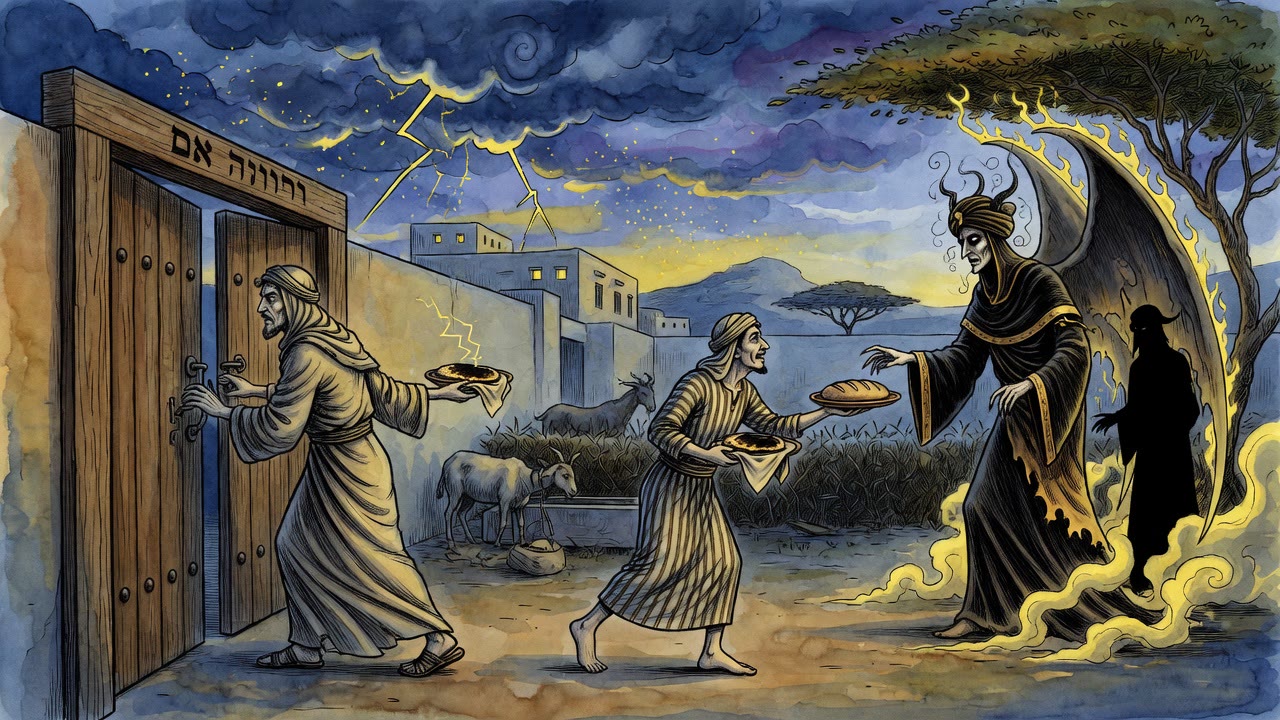
A beggar came to the door and asked for alms.

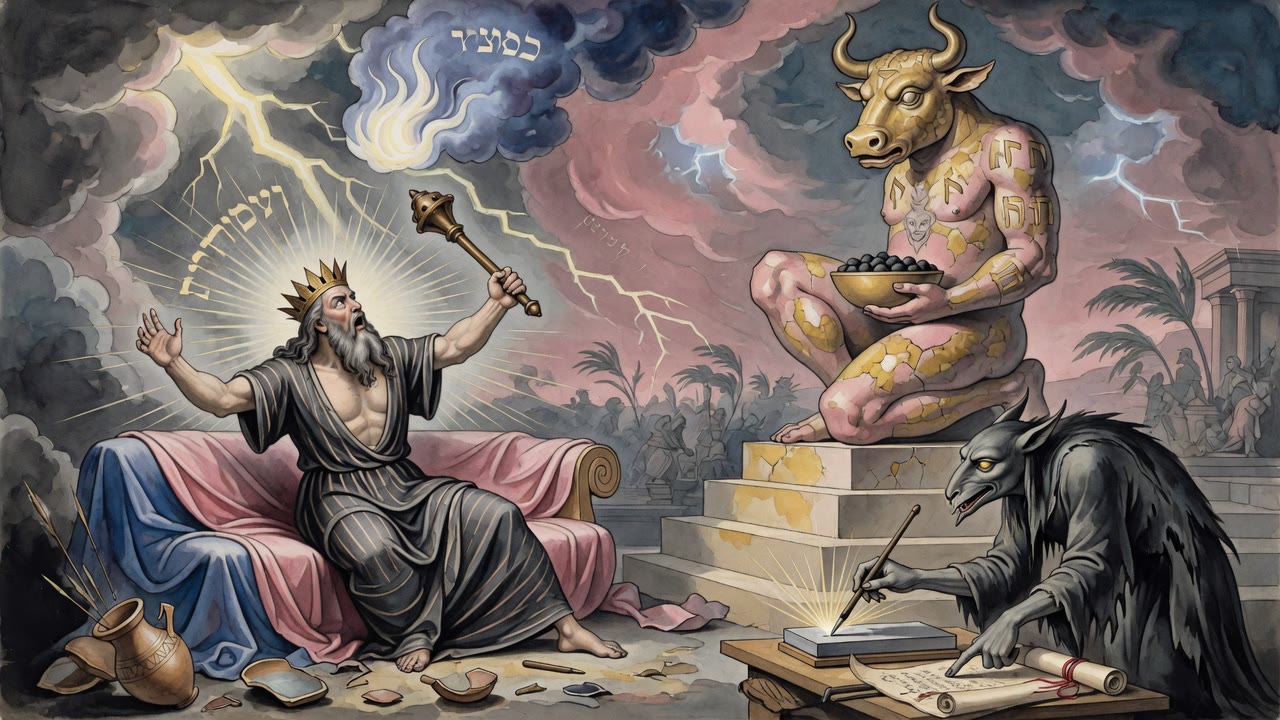
Ha-Satan (the Accuser) (הַשָּׂטָן) will not go near a feast where the poor are eating. He turns up at the other kind. He had been watching the road all day, and when he saw who was going in and who was not, he put on the rags and walked up to the house of the most famous host alive and held out his hand and was sent away with nothing in it.

That was the opening. Everything that happened afterward on the mountain, the wood, the rope, the knife, the boy asking where the lamb was, followed from a man who forgot to set one extra place at his son's birthday.

The Queen Who Marched Three Years

The second time, Ha-Satan was given a rich man and no restrictions on his property.

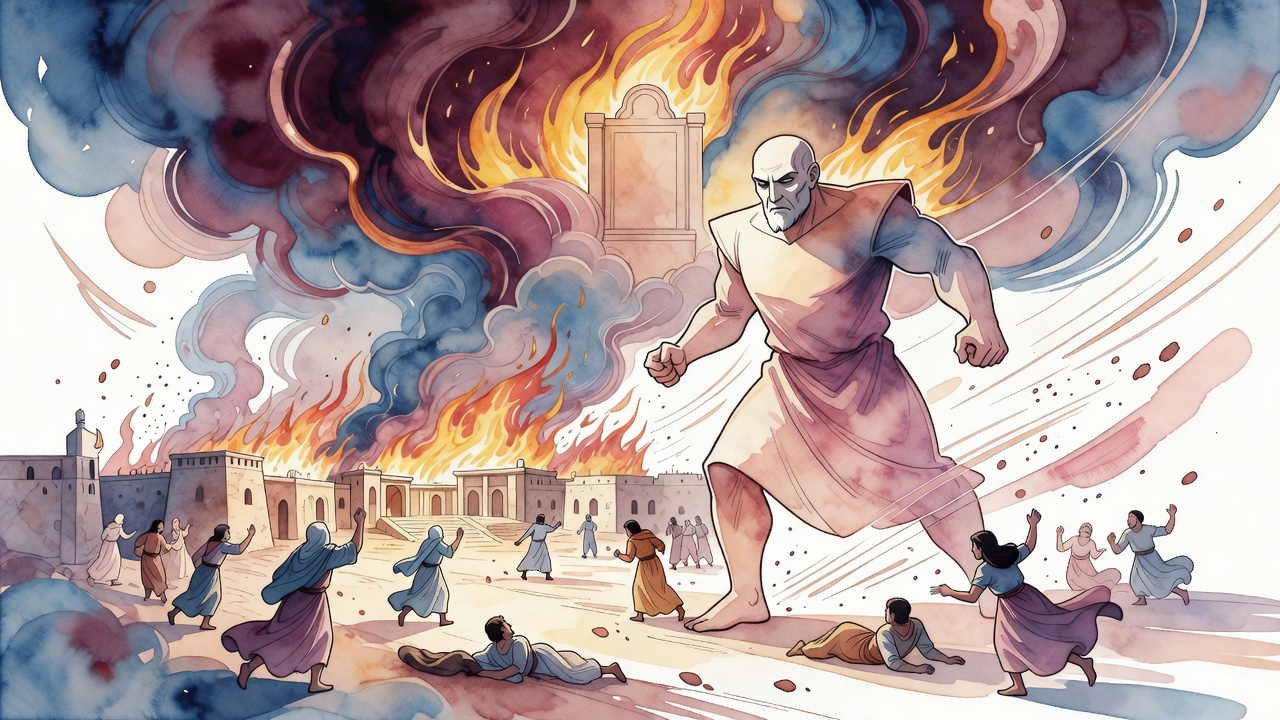
He burned part of Job's cattle where they stood. The rest were driven off by men who had eaten at Job's table, which hurt worse than the burning. Then Lilith, the queen of Sheba, came for the oxen and the donkeys. She lived so far away that it took her and her army three years on the road to reach him, three years of marching toward a man who had never heard her name, and when she arrived she killed the herdsmen and took the animals.

One of them got out. He came in bleeding, with just enough left in him to say what had happened, and he finished the sentence and fell down dead in front of his master.

The sheep the queen had not bothered with were taken by the Chaldeans. Job called for his weapons and meant to ride after them. Then somebody told him that part of what he had lost had gone up in fire that came down out of the sky, and he stopped where he stood.

"If heaven has turned against me," he said, "there is nothing I can do."

The King of Persia at the Gate

None of it worked. Job stayed exactly what he was, and Ha-Satan came back with a bigger instrument.

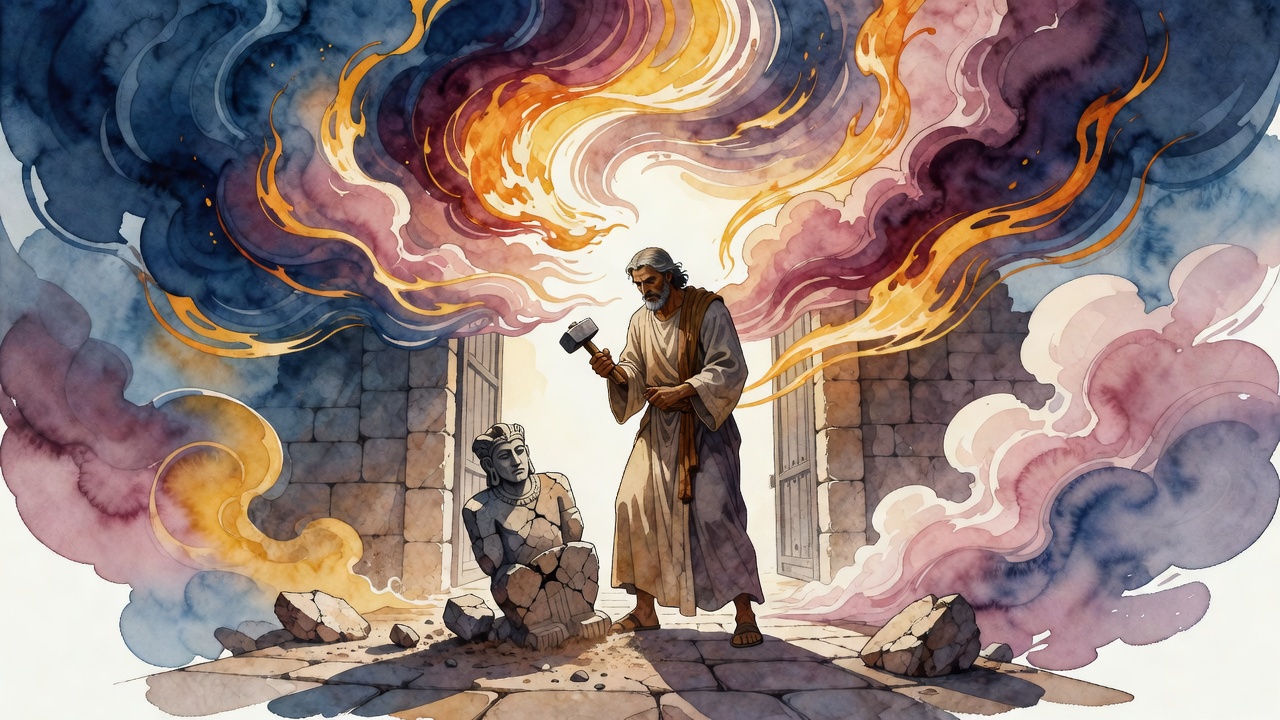
He took the shape of the king of Persia, brought an army against the city where Job lived, laid siege to it, and took it. Then he gathered the citizens in the square and made a speech.

"This man Job has taken every good thing in the world for himself and left nothing for anyone else," he told them. "He also pulled down the temple of our god. Now I am going to pay him back. Come with me and we will strip his house."

They would not do it. Not out of love for Job. His sons and daughters were grown and well connected, and a family like that remembers who came through the door.

So the king of Persia walked over to the house where all ten of Job's children were sitting at their meal and pulled it down on top of them.

When the dust settled and the bodies were visible in it, the citizens went and sacked Job's house, and nobody in the crowd was afraid of anything anymore.

Break the Pitcher, Do Not Spill the Wine

The man did not curse. Ha-Satan went back up and asked for the body itself.

He was given it, on one condition. The soul was not his to touch.

Consider what that instruction actually is. A servant is handed a full pitcher and told to smash it and not lose a drop of the wine. Ha-Satan walked away from that audience holding a job that could not be done cleanly, and in a real sense he was worse off than the man he was sent to ruin.

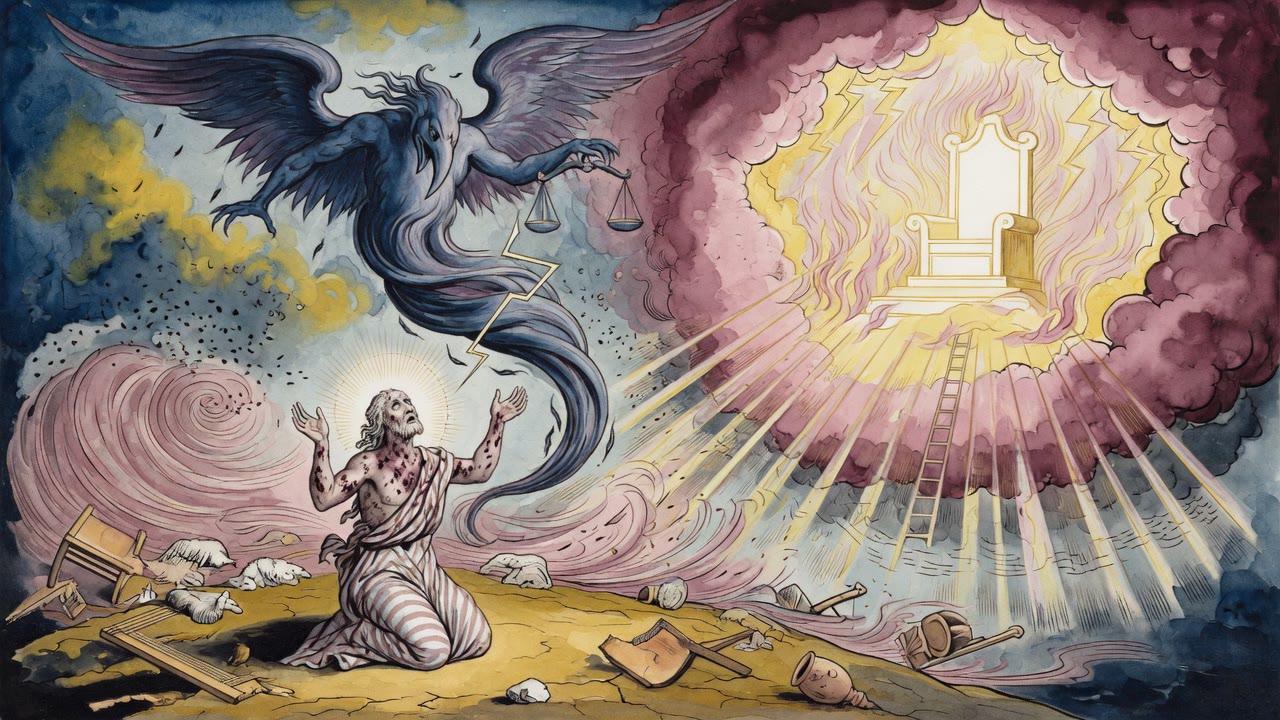
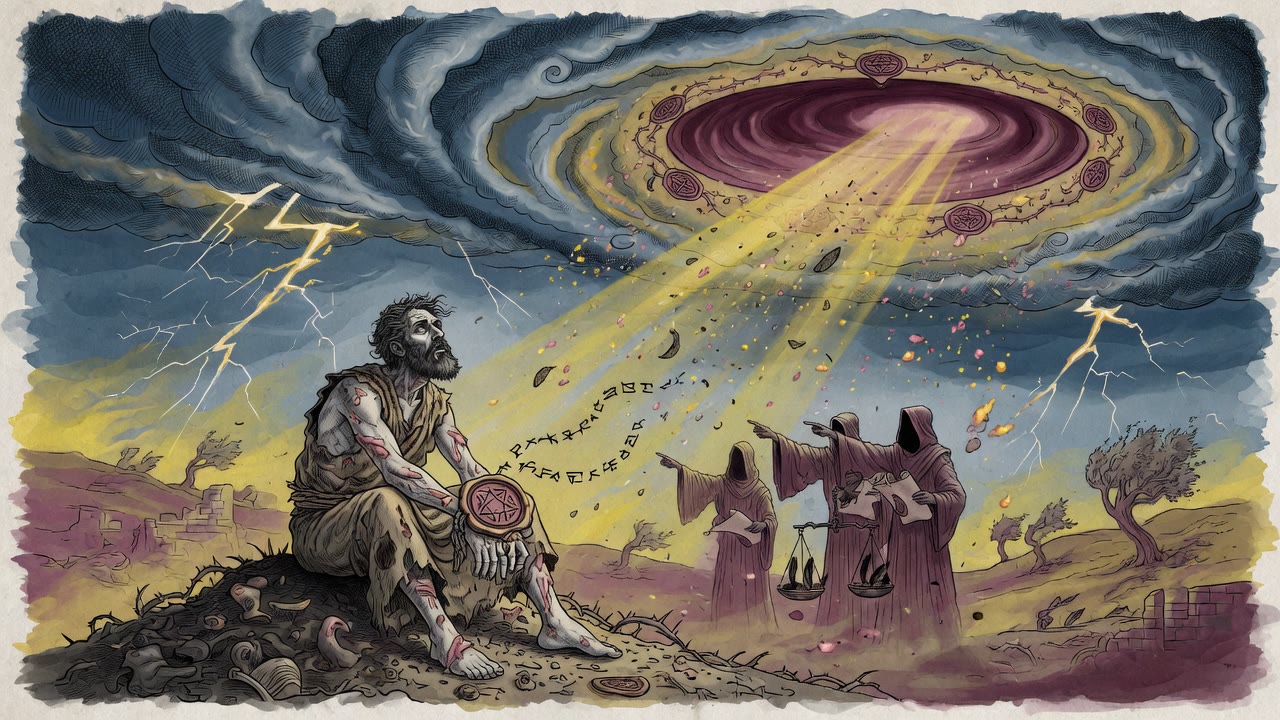
He brought a storm down on the house. The noise threw Job off his seat and left him on the floor for three hours. Then he covered him in sores from the soles of his feet to the crown of his head, and the city put Job outside the wall, and he sat down in the ashes with a piece of broken pot in his hand.

The Girdle of Three Bands

The friends came and sat with him and argued with him for a long time, and one of them, Elihu, was not arguing on his own account at all. He was the instrument, and he was the one the pardon would not cover.

When it was over, Job made an offering for the three who had accused him, and God accepted it. Eliphaz stood up and sang, out loud, because his own sin and his companions' had been pardoned, and in the same breath he announced that Elihu was finished.

Then God came to Job one more time and gave him a belt.

It was made of three woven bands, and Job was told to tie it around his waist. He put it on. The pain stopped, all of it, at once. Then the memory of the pain went too, so that he could not have described what the last years had felt like if anyone had asked him.

And then, standing in the ashes in a borrowed belt, Job was shown everything that had ever happened and everything that ever would.


← All myths
From the tradition

Sources

3 sources

The texts behind this telling. Some cards carry a translation of the source; others are our own retelling of it, and each card says which. Every card links out to the original.

Legends of the Jews 5:209Legends of the Jews

Retold in our words. Read the original at the link below.The Legends of the Jews by Louis Ginzberg (1909) · Public Domain

Even Abraham, the patriarch famed for his boundless hospitality, had moments like that.

The scene: a lavish birthday feast for young Isaac. All the bigwigs are there, wives in tow, celebrating with food and drink. Abraham, a pillar of generosity, is beaming. But there’s an uninvited guest lurking at the edges, a shadow in the doorway.

In Legends of the Jews, Louis Ginzberg tells how this wasn't just any party crasher. It was Satan himself, disguised as a beggar. Why would Satan bother showing up at Abraham’s party? Well, the story goes that Satan makes it a point to attend feasts where the poor are excluded. He snubs those shindigs where everyone’s welcome, but if the needy are left out in the cold, Satan is sure to RSVP.

He’d noticed something crucial: Abraham, in his excitement, had forgotten to invite the poor. And so, disguised as a beggar, Satan saw his opening. He knew that Abraham's home, ironically, was precisely where he needed to be.

That one oversight could have such dire consequences. That a moment of forgetfulness, a seemingly small omission, could pave the way for one of the most harrowing trials in the entire Torah: the Akeidah (עֲקֵידָה), the binding of Isaac. As the story continues, this incident becomes, incredibly, the catalyst for that ultimate test of faith.

Full source
Legends of the Jews 3:24Legends of the Jews

Retold in our words. Read the original at the link below.The Legends of the Jews by Louis Ginzberg (1909) · Public Domain

The story of Job, as we know it from the Bible, is already But the Jewish tradition, especially as elaborated in works like Ginzberg's Legends of the Jews, really fleshes out the details of the cosmic battle raging around him.

Here's a scene you might not be familiar with: Satan, not content with just afflicting Job with boils and misfortunes, decides to take things to a whole new level. He disguises himself – imagine the ultimate deception – as none other than the king of Persia. Why Persia? Well, that detail alone tells us a lot about the historical context in which these legends were being shaped!

So, "King Satan" lays siege to the very city where Job resides. He captures it, and then he addresses the inhabitants. He accuses Job of hoarding all the wealth, leaving nothing for anyone else. He even throws in the accusation that Job destroyed their temple! It’s a classic tactic: turning the people against a righteous man by twisting the truth.

"I will pay him back for his wicked deeds," Satan declares, rallying the people. "Come with me, and let us pillage his house!"

At first, though, the people hesitate. They're afraid! They worry about Job's sons and daughters, who might later rise up and avenge their father's mistreatment. There's a sense of justice, or at least self-preservation, lurking even in this dark scenario.

But Satan isn't one to be deterred by a little hesitation. In a truly horrific act, he pulls down the house where Job's children are gathered. They die in the ruins. The weight of that moment… it’s almost unbearable.

With Job's children dead, the people, now perhaps driven by fear or a twisted sense of obligation, finally succumb to Satan's influence. They sack Job's house, completing the devastation.

What does this episode tell us? It's more than just a story about one man's suffering. It's a stark reminder of the power of deception, the vulnerability of the innocent, and the insidious way that evil can manipulate even ordinary people into committing terrible acts. It emphasizes the sheer audacity of evil, its willingness to target not just the individual, but also their family and community.

Full source
Legends of the Jews 3:42Legends of the Jews

Retold in our words. Read the original at the link below.The Legends of the Jews by Louis Ginzberg (1909) · Public Domain

The story of Job, that paragon of patience, takes a fascinating turn after his infamous trials. It’s a reminder that even in our darkest moments, connection and forgiveness can pave the way for healing and even… divine visions.

So, Job's friends… Remember them? The ones who showed up to "comfort" him, but mostly ended up arguing with him about why he deserved his suffering? Well, despite their less-than-helpful advice, Job intercedes for them. He offers a sacrifice on their behalf, a gesture that’s ultimately accepted by God.

The result? According to Legends of the Jews, specifically in the telling found there, Eliphaz, one of the friends, bursts into a hymn of gratitude, thanking God for pardoning their transgressions. But here's a twist: not everyone gets off scot-free. Eliphaz also announces the "damnation" of Elihu, whom the legend casts as an instrument of Satan. Ouch.

The story doesn't end there. It gets even more… mystical.

God appears to Job yet again, bestowing upon him a special girdle, a belt made of three ribbons. He instructs Job to tie it around his waist. Now, girdles might not sound particularly exciting, but in this case, it's more than just a fashion accessory.

The moment Job puts it on, something incredible happens. All his pain, all the suffering he endured, vanishes. Not just the physical pain, but even the memory of it fades away! It’s as if the girdle acts as a reset button, wiping clean the slate of his anguish.

But wait, there's more! God grants Job an even greater gift: the ability to see "all that ever was and all that shall ever be." Suddenly, Job isn't just a righteous man who suffered unjustly; he's a prophet, a visionary, privy to the secrets of the universe!

What does this all mean? What are we to make of a story where suffering leads to such profound insight? Perhaps it's a reminder that even in the midst of our greatest trials, there’s the potential for growth, for healing, and even for glimpses into the divine pattern of existence. Maybe it’s evidence of the power of forgiveness, both for ourselves and for others. Or maybe, just maybe, it's a reminder that sometimes the most unexpected gifts come wrapped in the most unlikely packages, even in the form of a simple, three-ribbon girdle.

Full source