5 min read

Haman Falls into the Pit He Dug for Mordecai

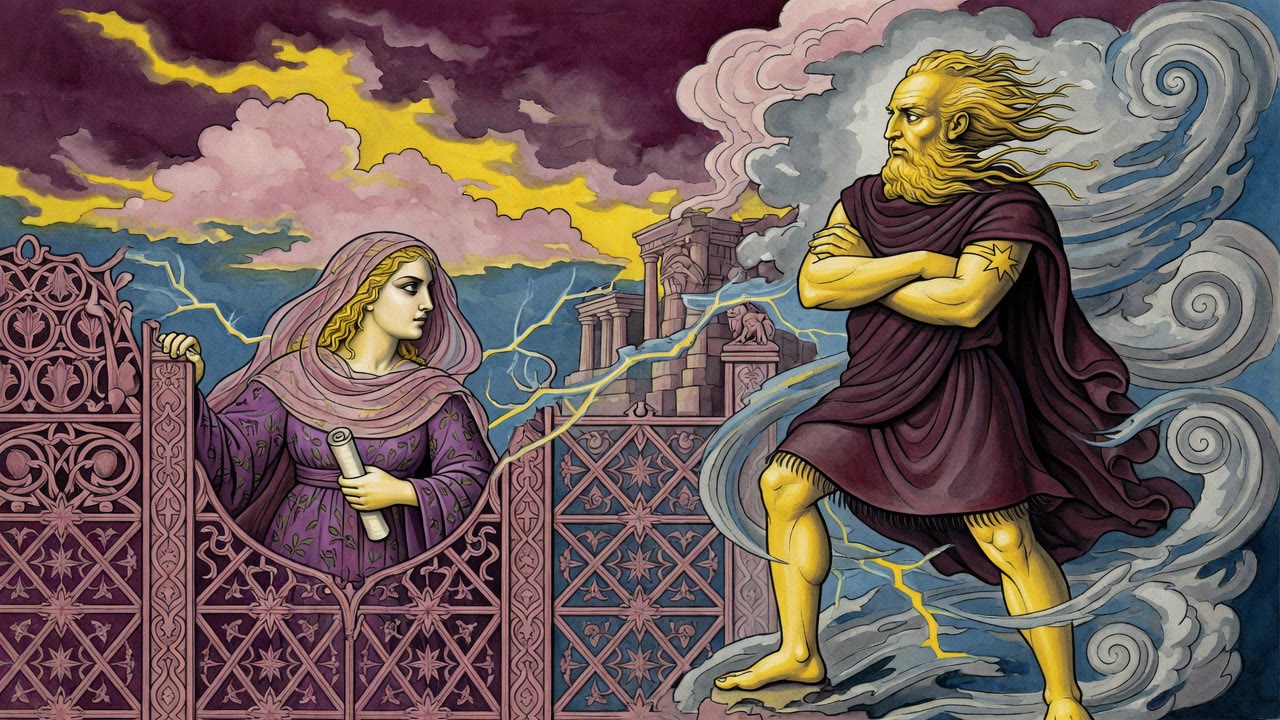
In Shushan the wicked hang curtains with purple cords and pour wine in crystal that mirrors every face, while Haman digs a pit for himself.

Curated by Arthur · Told by Maggid ·
Table of Contents
  1. The Palace That Mirrored Faces
  2. The Pit Digs Back
  3. Praise When the Scaffold Turns
  4. Beyond the Firmament
  5. What the Wood Remembers
  6. Letters, Lots, and Sleep

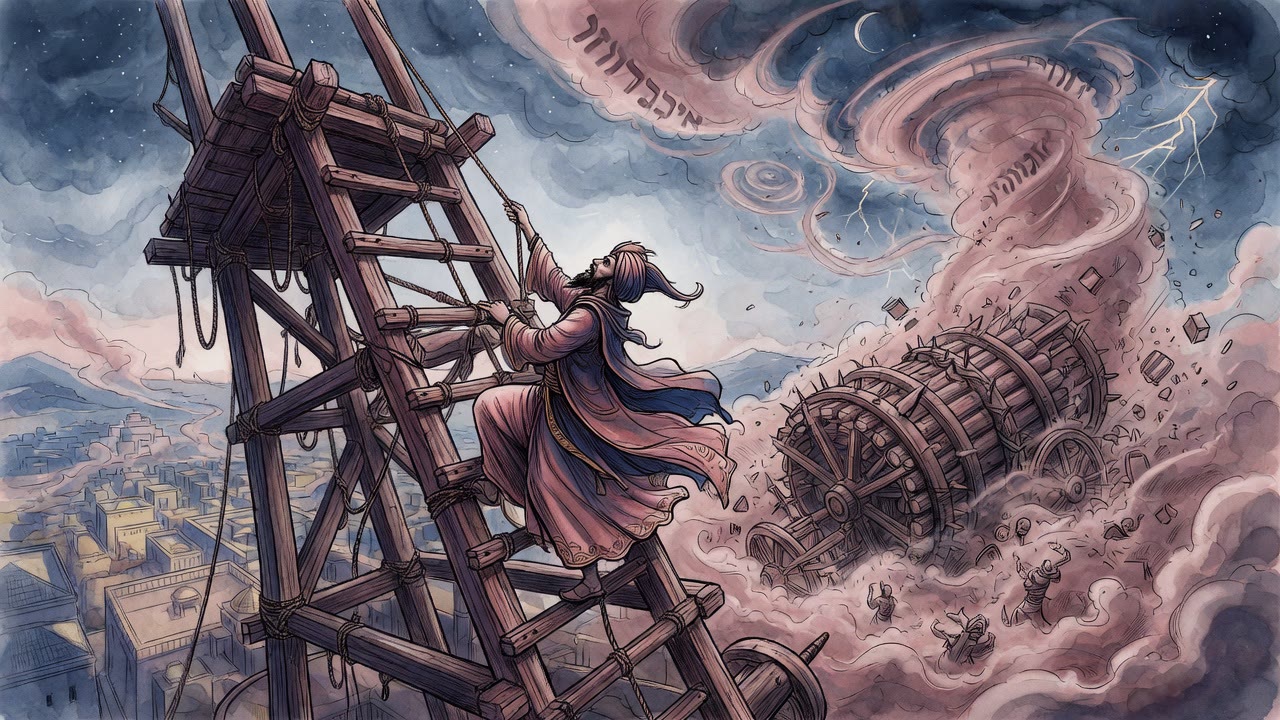
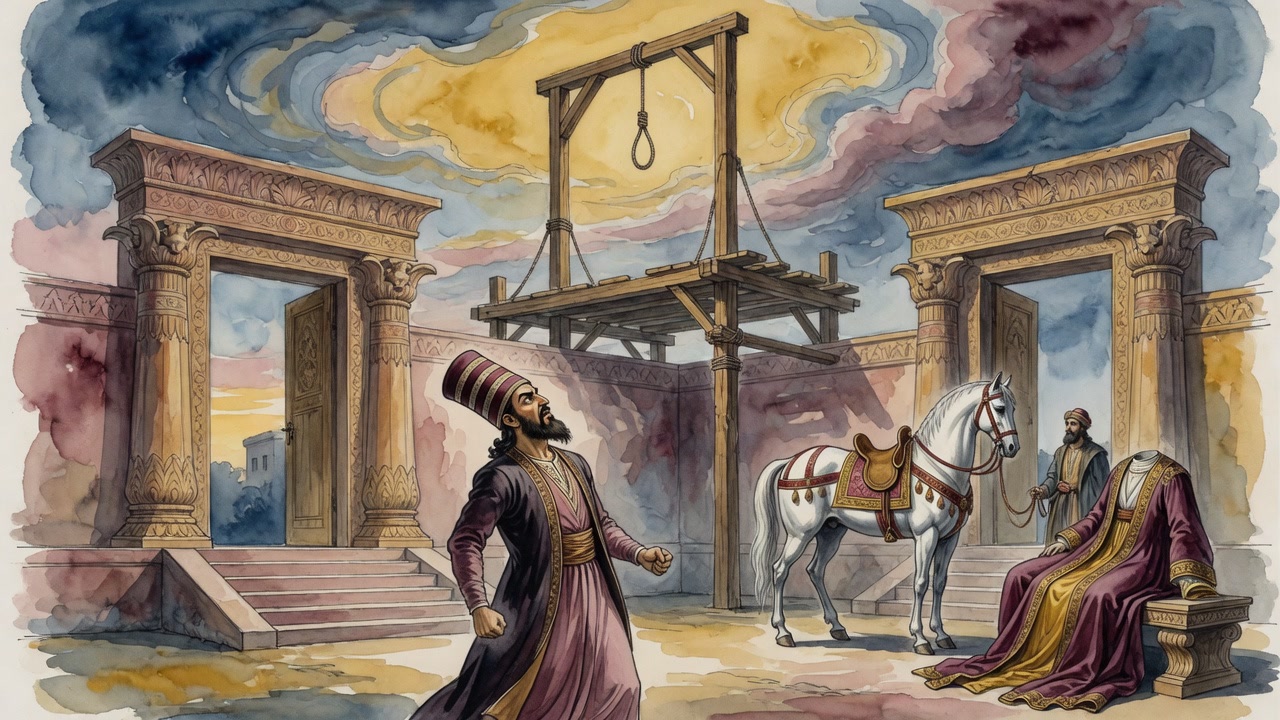
Haman measured the timber before he measured the crime. A gallows tall enough to erase Mordecai. A decree wide enough to erase a people. In Shushan the air smelled of perfume and ink, and the man who hated one Jew built a machine for all of them.

Haman Falls into the Pit He Dug for Mordecai Click for full size

The psalm had already named the end: the wicked dig a pit and fall into the work of their own hands. The midrash does not leave the verse abstract. It points at Haman. Everything he planned against Mordecai turned and wore his own face.

The Palace That Mirrored Faces

Before the noose, the banquet. Drink was served in vessels of gold, says the book, and the sages push the line. Ordinary gold is not rare enough for this king's vanity. Rabbi Pinḥas in the name of Rabbi Yitzḥak says the goblets were finely crafted crystal in which each guest saw his own image, beautiful and costly as gold, and more dangerous, because a man watching himself drink is already half owned by the room (Esther 1:7).

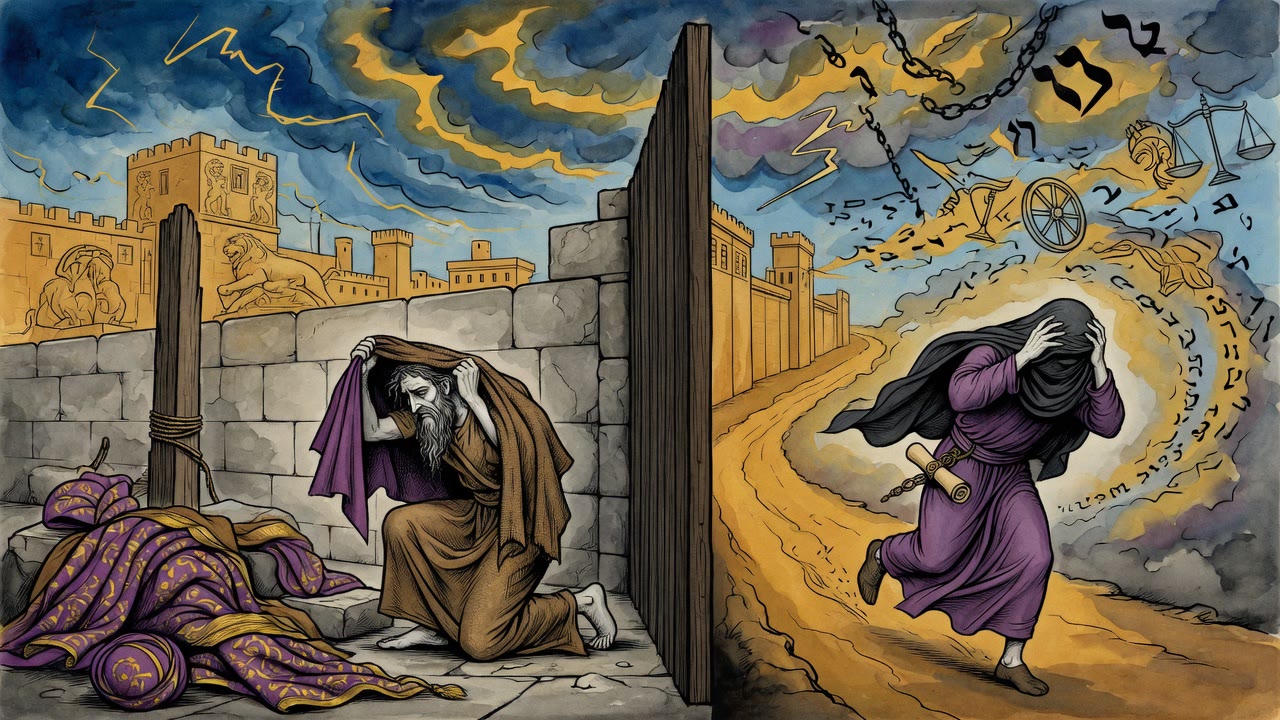
Hangings of white, green, and blue hung on silver rods and marble pillars. Ordinary houses use plain cords. That wicked one, said Rabbi Shmuel bar Naḥman, hung his curtains with cords of fine linen and purple wool. Free men's colors. A floor of alabaster and onyx. Pillars so vast that a later sage claimed he once slept across a single capital with arms and legs stretched.

The empire performed abundance until abundance became a weapon.

The Pit Digs Back

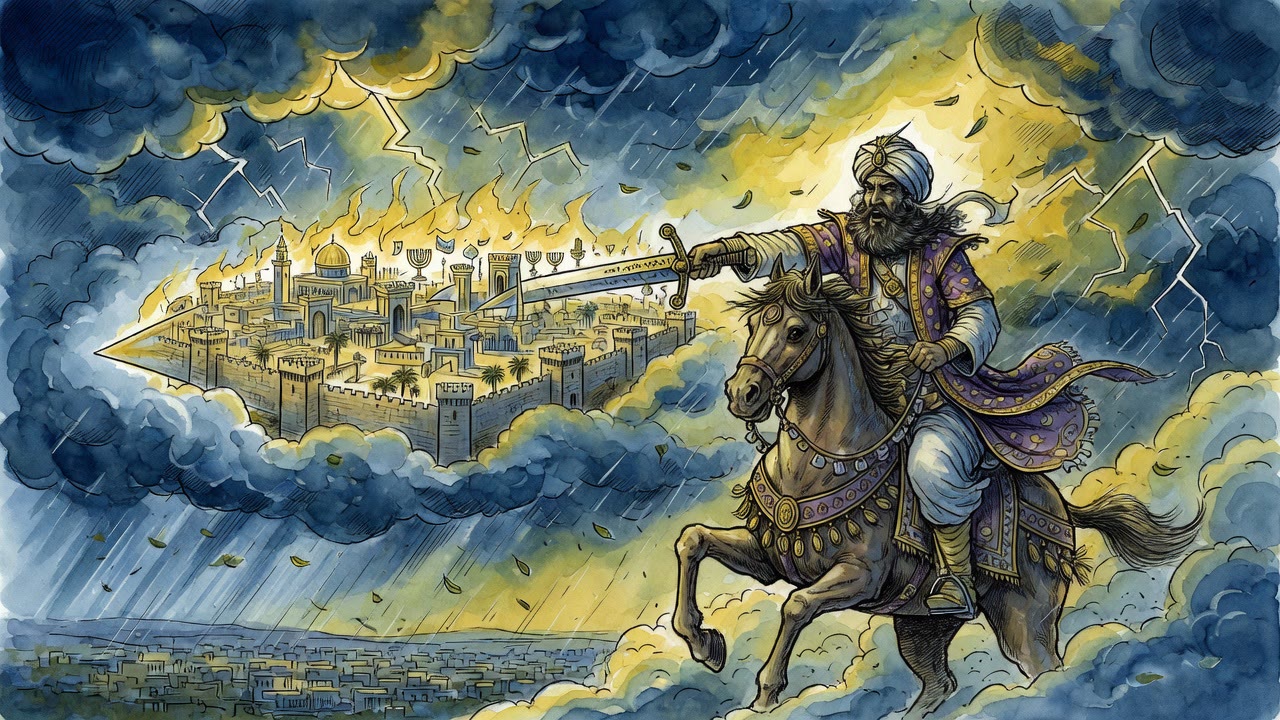
Haman climbed inside that performance. He wanted Mordecai's knee and then Mordecai's neck. He cast lots. He built the scaffold. He went home happy while the city of Shushan reeled.

Then the night the king could not sleep, the chronicle opened, and the gallows changed owners. The midrash presses the psalm against the story until the wood itself seems to lean toward its maker. A pit is dug. The digger falls. Acknowledgment rises from above and below when the wicked collapse, says Rabbi Joshua ben Levi: heaven and earth agree that the trap has found the right throat.

Praise When the Scaffold Turns

"I will praise the Lord according to His righteousness." The sages hear that line as the sound the world makes when a decree reverses. Not gloating only. Recognition. The same court that poured wine in mirrored crystal now watches the builder of the gallows climb it. Mordecai rides the horse Haman prepared for his own glory. Esther speaks. The second letters go out. The day flips.

Shushan had practiced spectacle. God answered with a sharper spectacle: the plot wearing its author's name.

Beyond the Firmament

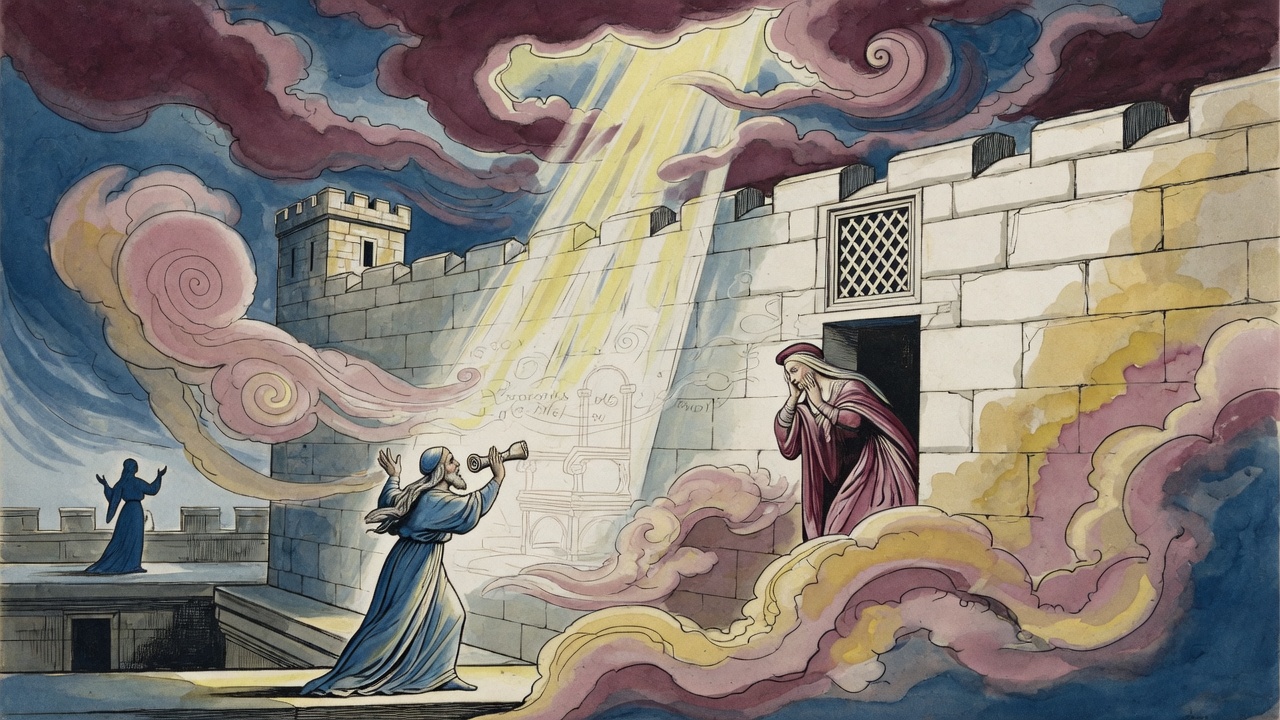
The midrash stretches the scene until it scrapes the sky. Haman's reach is not only local politics. His hatred presses upward, as if he could rearrange the firmament to make room for one man's pride. The fall answers at the same height. When the wicked go down, the praise is not a whisper in a side street. It is a public weighing of scales.

The hangings still flutter in the memory of the feast. The crystal still returns every face. None of that beauty could hold a gallows steady once the lot turned.

What the Wood Remembers

Purim keeps the laughter because the fear was real. A people under a capricious throne learned that a pit can be deep and still belong to the digger. Haman's timber, Haman's letters, Haman's bow to his own plan: each became a door he had to walk through last.

In the courtyards of Shushan, purple cords once held curtains for a king who thought gold and crystal could buy forever. The cords outlasted him as a warning. Measure the wood carefully. It may be measuring you.

Letters, Lots, and Sleep

Haman's hands were busy with more than timber. Lots clattered. Scribes bent over decrees. Seals bit into wax. A date for death was chosen as casually as a date for a feast. In the mirrored goblets of the earlier banquet, men had already practiced seeing only themselves. Haman perfected the habit. He saw a world improved by one empty space where Mordecai bowed.
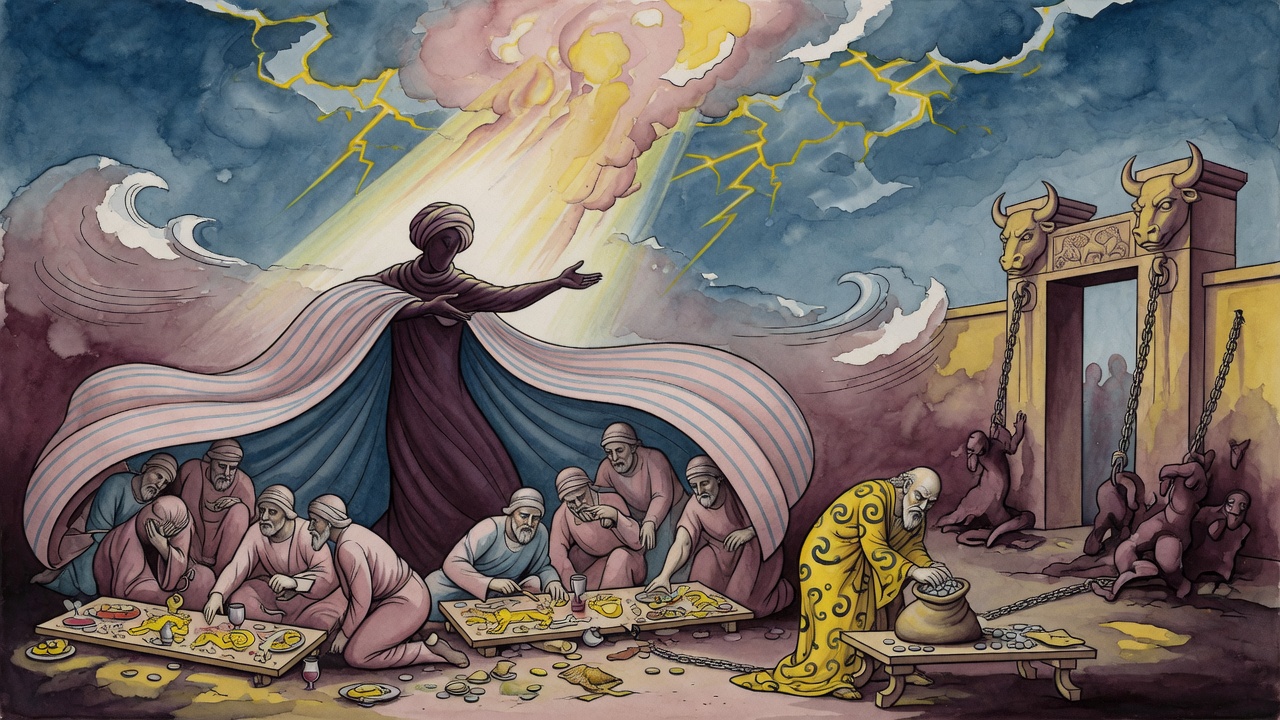
The king's sleepless night is the hinge the storytellers love because it is so small. No angel with a sword. A chronicle opened. A name read aloud: Mordecai, who saved the throne and was not paid. From that unpaid debt the whole machine reverse-threads. The horse. The robe. The parade Haman designed for his own mouth. Then Esther's second banquet, and the finger pointed across the table like a spear made of speech.

When they hang him on his own gallows, the pit theology becomes carpentry. Midrash Tehillim is not content to moralize. It wants you to hear praise rising from below and above, as if earth and heaven were a double choir finally on the same note. The wicked do not only fail. Their failure becomes a public teaching that the firmament itself can endorse.

Walk back through the purple cords and crystal faces of Ahasuerus's house. All that beauty was a rehearsal for blindness. A court that can hang curtains with royal wool can still fail to see a decree's true author until a queen risks her throat and a Jew refuses to bow. The wood remembers who ordered it cut.


← All myths

From the tradition

Sources

3 sources

The texts behind this telling. Some cards carry a translation of the source; others are our own retelling of it, and each card says which. Every card links out to the original.

Midrash Tehillim 7:14Midrash Tehillim

Retold in our words. Read the original at the link below.Rabbi Mike Feuer, Jerusalem Anthology · CC-BY

Midrash Tehillim, a collection of interpretations on the Book of Psalms, explores this very idea. It begins with the image of a pit being dug. "A pit is dug and is excavated. All those who dig it for themselves, the wicked dig it. And in the end, it will fall into the pit they dug. Their toil will return upon their own heads." Strong stuff. The Midrash (rabbinic interpretive commentary) doesn’t leave us hanging with abstract imagery, though. It immediately connects it to a very specific story: Haman. Haman, in the Book of Esther, meticulously plots the destruction of Mordecai and all the Jews. He even builds a gallows! But, as The familiar version gives us, his elaborate plan collapses, and he ends up being hanged on the very gallows he built. The Midrash says, "This refers to Haman, for everything he planned against Mordecai was turned against him."

The Midrash doesn't stop there. It asks, "What is the reason for saying 'I will praise the Lord according to His righteousness'?" Rabbi Joshua ben Levi offers a profound answer: "Wherever you find the downfall of the wicked, there is acknowledgment from above and acknowledgment from below, as it is said, 'I will praise the Lord according to His righteousness.'"

So, what does that mean, “acknowledgment from above and acknowledgment from below?” It suggests a cosmic agreement. When injustice is righted, when the wicked fall into their own traps, it's not just a random occurrence. It's a moment of divine affirmation, a sign that the universe itself recognizes and responds to righteousness. And it’s a moment that inspires praise from us, here on earth.

Rabbi Levi adds another layer. "When God makes us superior to others in the world, it is above all, as it is said (Deuteronomy 28:1) 'And the Lord your God will make you supreme.'" It's not just about the downfall of the wicked, but also the elevation of the righteous. These moments are intertwined, two sides of the same coin.

The Midrash then shifts to the structure of the Psalms themselves. “What is written at the end of the psalm? "To the chief Musician upon Gittith, A Psalm of David." This refers to Edom.” In Jewish tradition, Edom is often used as a symbolic representation of Rome and, later, the forces of oppression and exile. This connects the theme of divine justice to broader historical and theological concerns.

And what comes after? “What is written after the psalm (Psalm 9:1)? "To the chief Musician upon Muthlabben, A Psalm of David." This refers to the future.” The Midrash sees a progression, a movement from the present struggle to a future filled with hope and redemption.

The passage ends with a powerful affirmation: "And what is written at the end? 'I will praise the Lord with my whole heart.' There is acknowledgment from above and acknowledgment from below." The cycle is complete. The downfall of the wicked and the triumph of the righteous lead to heartfelt praise, which in turn reinforces the cosmic agreement between heaven and earth.

Remember the words of Midrash Tehillim. And that’s something worth praising with our whole heart.

Full source
Esther Rabbah 2:10Esther Rabbah

Retold in our words. Read the original at the link below.The Sefaria Midrash Rabbah, 2022 · CC-BY

“Drink was served in vessels of gold and vessels of diverse kinds, and abundant royal wine, in keeping with the king’s bounty” (Esther 1:7).“Drink was served in vessels of gold” – all the drinks served by that wicked one were only in gold vessels. They objected: But is it not written: “All the drinking vessels of King Solomon were of gold, and all the vessels of the House of the Forest of the Lebanon were of pure gold”12The question lies in the fact that drinking out of gold vessels does not appear to have been unique to Aḥasheverosh’s court (Etz Yosef). (I Kings 10:21)? Rabbi Pinḥas says in the name of Rabbi Yitzḥak: Is it not disgusting to drink wine in a gold vessel? Rather, these were goblets of finely-crafted crystal, in which their images were mirrored, and they were as beautiful and valuable as gold vessels.

Full source
Esther Rabbah 2:7Esther Rabbah

Retold in our words. Read the original at the link below.The Sefaria Midrash Rabbah, 2022 · CC-BY

“Hangings of white [ḥur], green [karpas] and blue [tekhelet], fastened with cords of fine linen and purple wool on silver rods and marble pillars, couches of gold and silver, on a floor of alabaster, marble, mother-of-pearl, and onyx” (Esther 1:6). “Ḥur, karpas, and tekhelet” – Akelas translated it: White [ḥur] and green [karpas] linen. Rav Beivai said: sky-blue [tekhelet]. Rabbi Yitzḥak said: Like garments that free men wear. “Fastened with cords of fine linen and purple wool” – Rabbi Shmuel bar Naḥman said: Come and see what the clothing of that wicked one was like; everyone hangs [curtains] with cords of [simple] wool and cords of [simple] linen, and this wicked one [hangs curtains] with cords of fine linen and purple wool. “On silver rods” – Rabbi Ḥiyya the Great and Rabbi Shimon ben Ḥalafta: One said: They were furled like the curtain of a cabinet. The other said: They were folded like the sails of a ship. “And pillars of marble,” – the quarry [from which the marble came] was not revealed to any creature other than to [those from] this wicked kingdom. They objected: But is it not written [regarding the materials assembled for the construction of the Temple]: “And all precious stones and marble stones in abundance” (I Chronicles 29:2)? Solomon would place a gem on one side and a gem on the other side with the marble stones between them. It was easier for Aḥashverosh to craft pillars of silver and gold than to bring pillars of marble from Perak Onsin to Media. If you say that they were cut [into small pieces and reassembled], Rabbi Mattana said: I slept on the capital of one of them, and it was the width of my height with arms and legs extended.

Full source