5 min read

Haman Sewed an Idol on His Robe So Bowing to Him Became Worship

Ahasuerus saw the treasure of Judah's kings and the ten sons standing like a private wall, and promoted Haman. Mordecai was the only man who would not bow.

Curated by Arthur · Told by Maggid ·
Table of Contents
  1. The Ten Sons at His Back
  2. The Needle Over the Heart
  3. The Man Who Stayed at Eye Level
  4. A People, Described
  5. Sold for Nothing
Haman Sewed an Idol on His Robe So Bowing to Him Became Worship Click for full size

The Ten Sons at His Back

Ahasuerus had seen rich men before. His hall was built to hold them, and most of them came in with a gift and a nephew and a request about a tax.

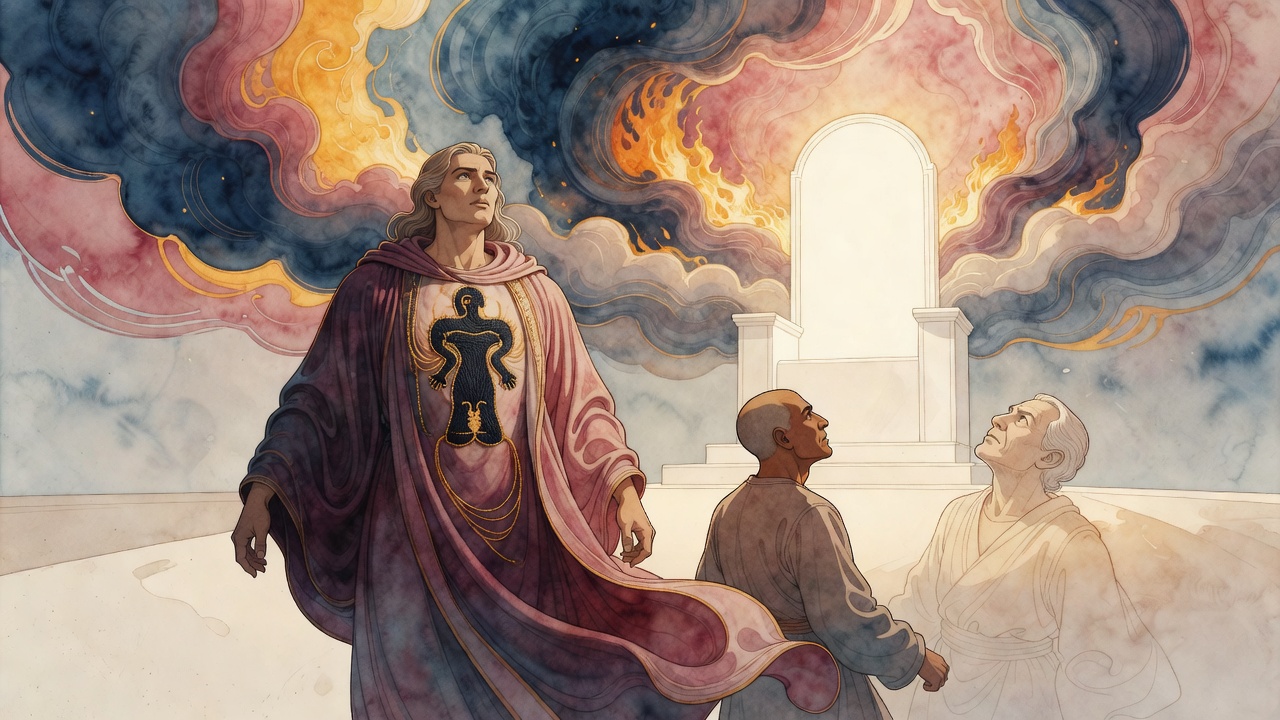
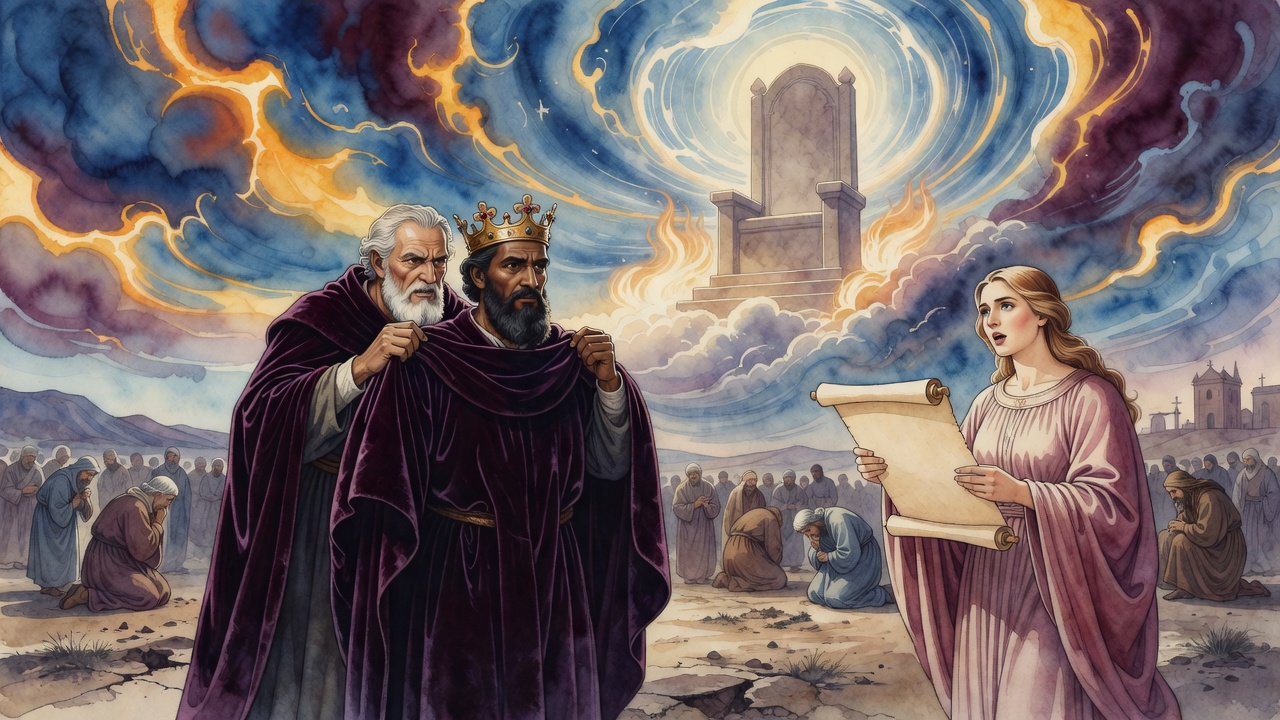
Haman came in with the treasures of the kings of Judah behind him and ten grown sons standing at his back, spaced along the wall like a guard he had paid for out of his own house and did not need the crown's permission to keep. The king counted the sons before he counted anything else. A man who arrives with a private wall is either a danger or an asset, and Ahasuerus decided asset, so he promoted Haman and set his seat above all the princes who were with him (Esther 3:1).

Then the order went out of the palace that everyone in the king's gate would bow to him.

The Needle Over the Heart

A bow to a vizier is only politics, and Haman knew it. Men had bowed to the last one and forgotten his name inside a year.

So he had a tailor brought to his rooms and put his hand flat on his own chest, here, over the heart, and told him what he wanted worked into the cloth. An image of an idol, small, in thread. Not a jewel, which can be taken off at a door, and not a standard, which someone would have to carry. Stitched into the robe he wore into the gate every morning.

After that, every back that bent to him in the street bent to the thing over his pulse, and no one had to be told, and no one had to agree. The king had ordered the bow. Haman had only chosen what he was wearing when it happened.

The Man Who Stayed at Eye Level

He came through the king's gate the way he came through it every morning, and the backs went down in front of him in a wave, servants first, then the clerks, then the men waiting on judgments who had been standing all night.

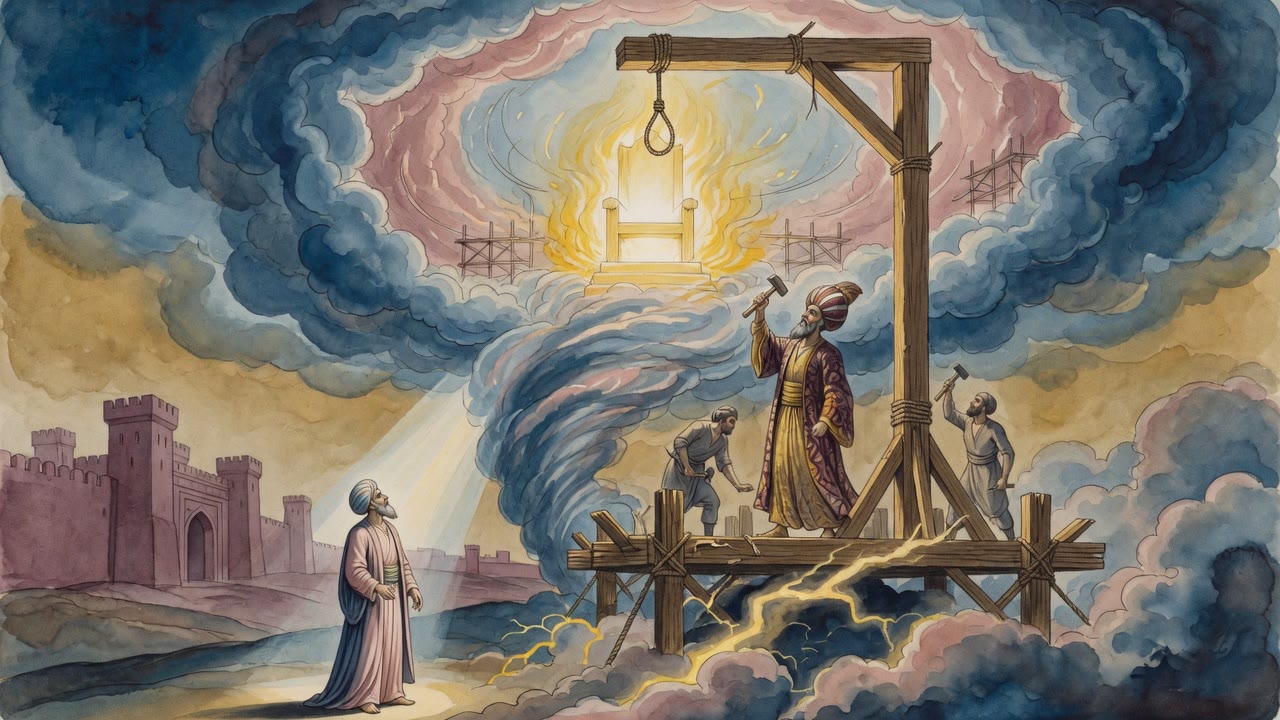
One head stayed where it was. It was at his own height, which is a thing a man notices from a horse the way he notices a lamp left burning in daylight, and it did not move, and it did not look away either. Mordecai bowed not down, nor did him reverence (Esther 3:2). Haman kept riding, because a vizier does not stop in a gate for one man, so he was already past before the whole shape of it reached him: the idol on his chest had just been refused in public, by name, in front of two hundred people who had already gone to the floor.

He got the count wrong by one, and then he counted it again for the rest of the day, and the day after that.

A People, Described

He did not go to the king with a complaint about a man in a gate, because a complaint about one man ends with one man. He went with a description instead, and he kept his own name and his own robe out of it.

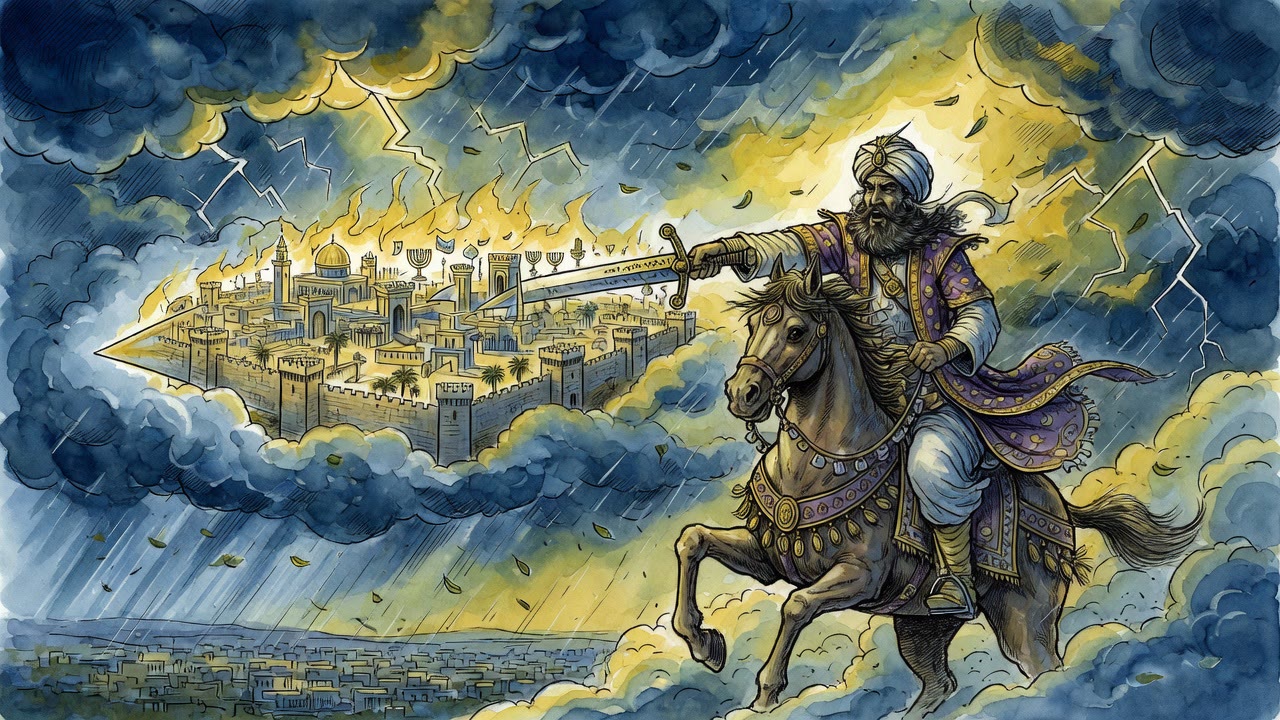
There is a certain people scattered abroad and dispersed among the peoples in all the provinces of thy kingdom, he said, and they are of no benefit to thee, and they do not obey thee, and they do not perform thy will, and it is not for the king's profit to suffer them (Esther 3:8). Every clause of it was an administrative observation. None of it mentioned bowing. Then, because a proposal of that size needs to look like it costs the crown nothing, he offered half of everything he had for permission to destroy them (Esther 3:9).

The hatred underneath was older than the gate and older than Persia, and Haman knew whose grandfathers had fought whose. But he did not put that on the table either. He put money on the table.

Sold for Nothing

The king would not take the money.

He pushed the whole offer back across, which felt for a moment like a refusal, and then he said the rest of it. The silver is given to thee, the people also, to do with them as it seemeth good to thee (Esther 3:11). Behold, they are given into thy hand for nought. Haman had come prepared to pay half his fortune, and he walked out still holding it, with a nation thrown in as a courtesy between officials who understood each other.

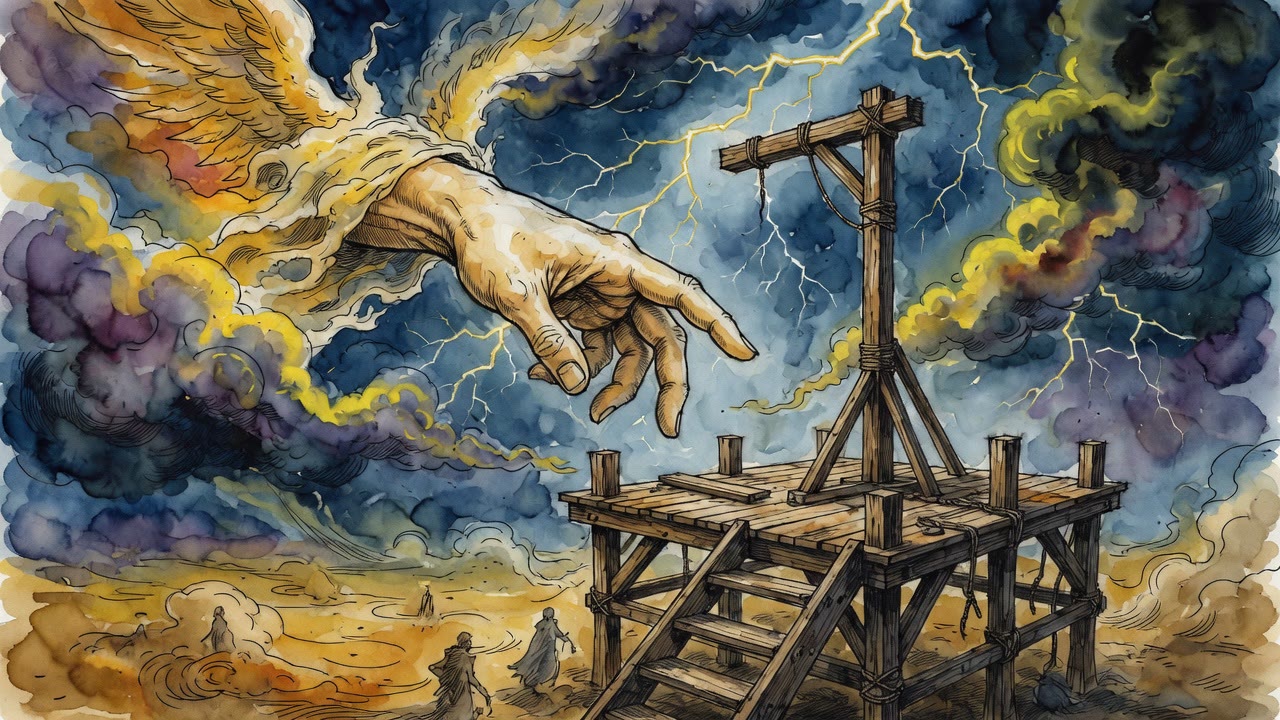
Above the hall the Holy Spirit cried out over the closed transaction, quoting a promise made for a later century: ye were sold for nought, and ye shall be redeemed without money (Isaiah 52:3). Nobody in the room heard it. The clerks were already drafting.

Haman rode home through the same gate that evening, past the same servants, and the head at his own height had not moved.


← All myths
From the tradition

Sources

3 sources

The texts behind this telling. Some cards carry a translation of the source; others are our own retelling of it, and each card says which. Every card links out to the original.

Pirkei DeRabbi Eliezer 50:5Pirkei DeRabbi Eliezer

Retold in our words. Read the original at the link below.Pirke de Rabbi Eliezer, trans. Rabbi Gerald Friedlander, London (1916) · CC-BY

Rabbi Phineas tells us about two incredibly wealthy and powerful men: Korah, within Israel, and Haman, among the nations. Both, in their own way, posed existential threats. But it’s Haman, of the Purim story, who really grabs our attention. He had, as the text puts it, "the treasures of the kings of Judah." How did he get so powerful?

Well, King Ahasuerus (yes, that Ahasuerus of the Purim story) saw Haman’s wealth, saw his ten sons acting as his personal guard, and, impressed, decided to elevate him. As it says in (Esther 3:1), "After these things did king Ahasuerus promote Haman, the son of Hammedatha." Sounds like a classic case of being in the right place at the right time... or perhaps something more sinister was at play.

The king commanded everyone to bow down and show reverence to Haman. Haman, in his arrogance, had an image of an idol embroidered onto his clothing, right above his heart. So, when people bowed to Haman, they were, in effect, bowing to an idol.

Mordecai, bless his courageous heart, saw this and refused to bow. (Esther 3:2) tells us plainly, "But Mordecai bowed not down, nor did him reverence." This act of defiance, this refusal to compromise his principles, set in motion a chain of events that threatened the entire Jewish people.

Haman was enraged, absolutely consumed by wrath. He thought, "These Jews have hated my forefathers for ages, and now I will convince the king to destroy them all!" According to Pirkei DeRabbi Eliezer, this hatred was ancient and deeply rooted.

So, Haman goes to Ahasuerus and paints a picture of the Jews as a disruptive, disobedient, and ultimately useless population. "There is a certain people scattered abroad and dispersed among the peoples in all the provinces of thy kingdom," he says, as recorded in (Esther 3:8), "and they are of no benefit to thee and do not obey thee, and they do not perform thy will, and it is not for the king's profit to suffer them."

And then comes the kicker: Haman offers the king half of his wealth if he agrees to let him destroy the Jews. "If it please the king, let it be written that they be destroyed" (Esther 3:9). The sheer evil of this proposition?

The king, astonishingly, agrees. He tells Haman, "Behold, they are given into thy hand for nought," as it says in (Esther 3:11), "And the king said to Haman, The silver is given to thee, the people also." The king basically says, "Do what you want with them." No questions asked. Just pure, unchecked power handed over to a genocidal maniac.

But even in this darkest of moments, there’s a glimmer of hope. Pirkei DeRabbi Eliezer tells us that the Holy Spirit cried out, quoting (Isaiah 52:3): "Thus saith the Lord, Ye were sold for nought, and ye shall be redeemed without money." This verse becomes a beacon, a promise that even though they were sold for nothing, they will be redeemed without having to pay a price. It is a message that God is still with them, even in the face of annihilation.

This story from Pirkei DeRabbi Eliezer isn’t just a historical account; it's a powerful reminder of the fragility of existence, the ever-present threat of antisemitism, and the importance of standing up for what's right, even when it’s terrifying. And that the courage of one person, like Mordecai, can change the course of history. It makes you wonder, doesn't it, what kind of courage we can muster in our own lives?

Full source
Midrash Tanchuma, Korach 2Midrash Tanchuma

Retold in our words. Read the original at the link below.Townsend 1989 translation of Midrash Tanhuma, S. Buber Recension · CC-BY

(Numb. 16:1:) “Now Korah […] took.” What is written above the matter (in Numb. 15:38)? “Speak unto the Children of Israel and tell them to make tassels (zizit) for themselves.’” Korah quickly said to Moses, “In the case of a prayer shawl (tallit) which is all blue, what is the rule about it being exempt from [having] the tassel?” Moses said to him, “[Such a prayer shawl] is required to have the tassels.” Korah said to him, “Would not a prayer shawl which is all blue exempt itself, when four [blue] threads exempt it? In the case of a house which is full of [scriptural] books, what is the rule about it being exempt it from [having] the mezuzah (which contains only two passages of scripture)?” [Moses] said to him, “[Such a house] is required to have the mezuzah.” [Korah] said to him, “Since the whole Torah has two hundred and seventy-five parashiot in it and they do not exempt the house [from having the mezuzah], would the two parashiot which are in the mezuzah exempt the house?” [He also] said to him, “These are things about which you have not been commanded. Rather you are inventing them [by taking them] out of your own heart.” Here is what is written (in Numb. 16:1), “Now Korah […] took.” (Numb. 16:1:) “Now Korah […] took.” Now “took (rt. lqh)” can only be a word of discord, in that his heart carried him away (rt. lqh). Thus is [the word] used (in (Job 15:1)2), “How your heart has carried you away (rt. lqh) […].” This explains what Moses said to them (in Numb. 16:9), “Is it too small a thing for you that the God of Israel has separated you [from the congregation to draw you near unto Himself, to perform the service of the Lord's tabernacle …?” Plus] that whole passage up to (vs. 29), “If these people die the common death of every person.” The sages have said, “Korah was a great sage and was one of the bearers of the ark, as stated (in Numb. 7:9), ‘But to the children of Kohath He gave no [wagons], because they had the service of the holy objects, which they carried on their shoulders.’” Now Korah was the son of Izhar, [who was] the son of Kohath. When Moses said (in Numb. 15:38), “And put on the tassel of each corner a thread of blue,” what did Korah do? He immediately ordered them to make two hundred and fifty blue shawls for those two hundred and fifty heads of sanhedraot who rose up against Moses to wrap themselves in, just as it is stated (in Numb. 16:2), “And they rose up against Moses, together with two hundred and fifty men from the children of Israel.” And who are they? (Numb. 16:2, cont.) “Princes of the congregation, chosen in the assembly, men of repute.” Korah arose and made them a banquet at which they all wrapped themselves in blue prayer shawls. [When] Aaron's sons came to receive their dues, [namely the] breast and right thigh, they arose against them and said to them, “Who commanded you to receive such? Was it not Moses? [If so,] we shall not give you anything, as the Holy One, blessed be He, has not commanded it.” They came and informed Moses. He went to placate them. They immediately confronted him, as stated (ibid.), “And they rose up against Moses.” And who were they? Elizur ben Shedeur and his companions (the princes), the men (according to Numb. 1:17) “who were mentioned by name.” Although the text has not publicized their [names], it has given clues to their [identity], so that you [can] identify them from the [various] verses. A parable: To what is the matter comparable? To a scion of good parentage who stole articles from the bathhouse. The owner of what was stolen did not want to publish his [name. Rather,] he began to give clues about his [identity]. When they said to him, “Who stole your articles,” he said, “A scion of good parentage, a tall person with beautiful teeth and black hair.” After he had given his clues, they knew who he was. So also here where the text has concealed them and not specified their names, it comes and gives clues to their [identity]. You know who they are. It is stated elsewhere (in Numb. 1:16), “These were elected by the congregation, princes of their ancestral tribes, heads of thousands within Israel.” Then it is written (in vs. 17), “So Moses and Aaron took these men who were mentioned by name.” Now here it is written (in Numb. 16:2-3), “princes of the congregation, elected by the assembly, men of renown. They gathered together against Moses and Aaron.”

Full source
Midrash Tanchuma, Korach 8Midrash Tanchuma

Retold in our words. Read the original at the link below.Townsend 1989 translation of Midrash Tanhuma, S. Buber Recension · CC-BY

(Numb. 16:23–24:) “And the Lord spoke […], ‘Speak unto the congregation, saying, “Get away from about [the dwellings of Korah, Dathan and Abiram].”’” Although Moses heard it from the mouth of the Almighty, he did not tell them to get away until he had gone and warned them, as stated (in vs. 25), “Then Moses arose and went unto Dathan and Abiram.” [This serves] to make their wickedness known, for although Moses went to them on foot, the[se] wicked ones were too stubborn to make amends. What did they do? They were unwilling to come out of their tents to face him. When Moses saw this, he said, “This much [only] it was incumbent upon me to do.” Immediately (in Numb. 16:26) “And he spoke to the congregation, ‘Please move away from [the tents of these wicked people.]’” Our masters have taught: Four [types of people] are called wicked: The one who extends his hand against his companion to strike him. Even though he did not [actually] strike him, he is called wicked, as stated (in Exod. 2:13), “so he said to the wicked one, ‘Why would you strike your comrade?’” "Did you strike," is not stated here, but “would you strike.” The one who borrows and does not repay, as stated (in Ps. 37:21), “The wicked person borrows but does not repay.” The one who has an insolent face but does not feel shame from someone greater than himself, as stated (Prov. 21:29), “A wicked person puts on a brazen face.” And the one who is the author of dissension, as stated (in Numb. 16:26), “Please move away from the tents of these wicked men.”

Two [of these traits] were in Dathan and Abiram, [i.e.,] an insolent face and dissension (mhlqt). Mhlqt ("dissension") is interpreted through its letters. M is for marah ("bitter"); h is for haron ("anger"); l is for lokin ("lash"); q is for qelalah ("curse"); and t is for to'evah ("abomination"). But some say [that t stands for] takhlit ("end"), [since dissension] brings annihilation to the world. (Numb. 16:27:) “So they got away from the dwellings of Korah, Dathan and Abiram.” When they saw this, how Israel had moved away from round about them, they came out cursing and blaspheming, as stated (ibid., cont.), “[they] came out standing (rt. ntsb).” Now [it is stated] elsewhere (in I Sam. 17:16), “Then the Philistine drew near at dawn and in the evening; and he took his stand (rt. ytsb) for forty days.” Moses began by saying, as it is written (in Numb. 16:28-29), “And Moses said, ‘By this you may know that the Lord has sent me…. If these die like the death of every man.” A parable: To what is the matter comparable? To the shoshbin of a king's daughter in whose hands lay the testimonials of her [virginity]. When one of the banqueters stood up before him and cursed the shoshbin and said, “The king's daughter has no virginity”; the shoshbin arose in the presence of the king and said to him, “If you do not have this person brought out in order to execute him in everyone's presence, I shall say, ‘Of course the king's daughter has no virginity.’” Immediately the king said, “It is better for me to kill this person, so that the shoshbin will not give out a bad name concerning my daughter.” Similarly Korah contended with Moses and said, “It was in his own heart and on his own that Moses had said all these things.” He began by saying (in Numb. 16:28-29), “’By this you may know that the Lord has sent me […]. If these die like the death of every man,’ then I also am saying (ibid., cont.), ‘the Lord did not send me,’ and I have spoken from my own heart.”

Full source