The Idol Melts from Gold to Lead in One Hand
He bowed to gold in the morning and melted the face by night. By week's end the same shelf held lead, and the petitions did not notice.
Table of Contents
 Click for full size
The Gold Face Collapsed
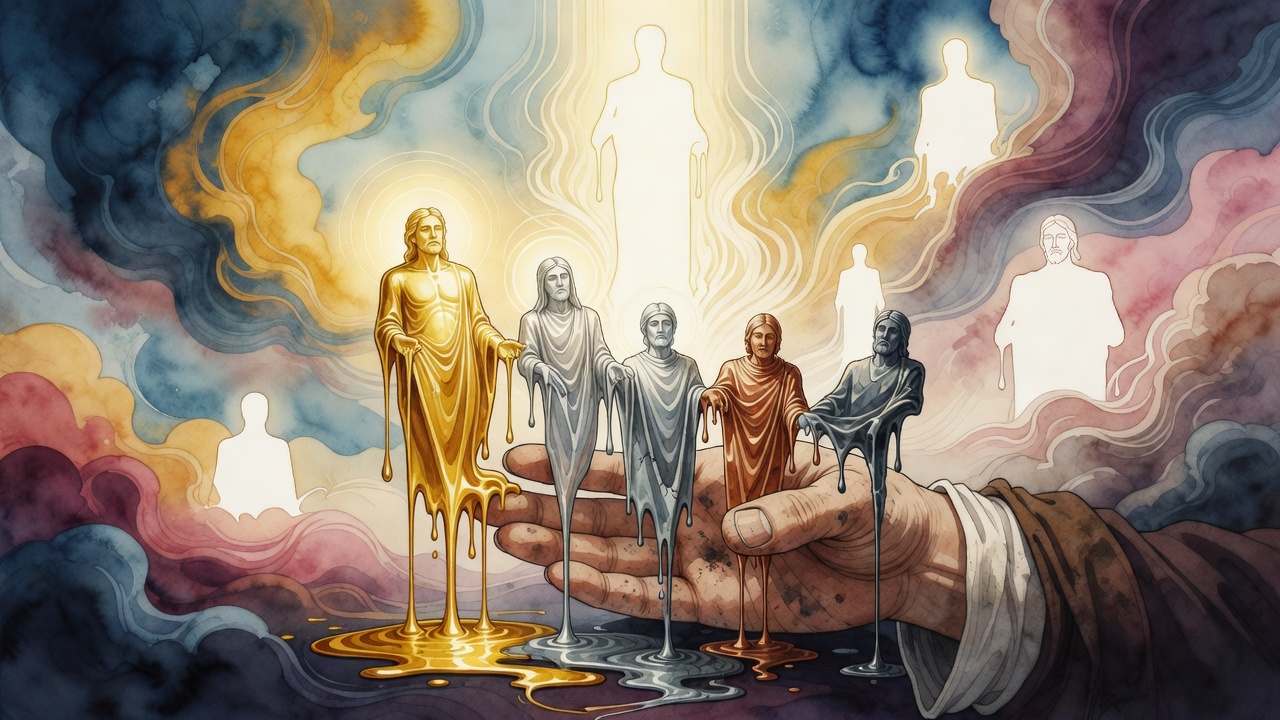
The man kept a god on a shelf above his workbench. It was gold, heavy enough to bruise a palm, polished until it threw the lamp back at him. He bowed to it in the morning. He touched its face before a bargain. He called it protector when a debt collector's shadow crossed the door.
Then the debt came due. Gold was what the collector wanted. The man lifted his god, carried it to the furnace, and watched the face collapse into a bright pool. From that pool he poured a new figure in silver. He set the silver god on the same shelf and bowed again, as if the shelf had not just held a corpse.
Gods That Renew Like Coins
Rabbi Eliezer heard the phrase elohim acherim (אלהים אחרים), "other gods," and refused the soft reading. Acherim, he said, is not only otherness. It is renewal. Idolaters keep remaking their gods the way a trader remakes change.
Gold fails, silver rises. Silver is needed, copper takes the throne. Copper goes to the market, iron stands in its place. Iron is sold for tools, lead finishes the line. Each time the worshipper creates a brand new deity and discards the old one without a second thought. The god of yesterday is the raw material of today.
He pointed to the verse that mocks novelty in worship: "new ones, newly come" (Deuteronomy 32:17). These gods are always new because they are always being replaced. There is no loyalty, no memory, no covenant. There is only metal and the need of the hour.
The man at the furnace lived the teaching before he heard it. He whispered the same petitions to silver that he had offered gold. The petitions did not notice the demotion. Only the collector would notice, when the next metal proved too cheap for the next claim.
Every Material He Tried
At Sinai the command comes hard: "You shall not make for yourself an idol" (Exodus 20:4). The man already knew the loopholes a clever hand will try. Not a carving that stands out from the wall? He could paint a flat one. Not a planted asherah? Wood, then. Not wood? Stone. Not stone? Silver, gold, copper, tin, lead. Not a human form? A beast, a bird, a fish, a creeping thing. Not those? The host of heaven.
He poured copper when silver ran out. He poured iron when copper went to the market. He poured lead last, because lead was what he had. Each time he told himself this metal was different. Each time the shelf accepted the new face as if it had never held another.
The law kept shutting doors. The craftsman kept looking for a cheaper god. Molten gods you shall not make for yourself, the verse says, and still he stood over the pool with a mold in his hand (Exodus 34:17).
Gods as Numerous as Cities
Jeremiah stood in the street and did not soften the charge. "Hear the word of the Lord" (Jeremiah 2:4). Not the word of a court prophet alone. Not the word of a priesthood protecting its share. The word that made the heavens (Psalm 33:6), refused by a generation that wanted local comforts.
"They denied the Lord" (Jeremiah 5:12). "For your gods, O Israel, were as numerous as your cities" (Jeremiah 2:28). In the workshops the same smoke rose. Each street sure its metal was special. Each furnace ready for the next alloy. "I am the Lord your God," denied. "You shall have no other gods," drowned in a crowd of municipal deities. Name taken in vain. Sabbath broken. The covenant was not subtle. The violations marched in order.
Exile is what happens when a people exchanges the Source for the copy and keeps a workshop ready for the next copy. The word that made the heavens waited outside those doors, and the doors stayed shut because a molten face is easier to manage than a living claim.
What Cannot Be Melted
A true God does not depend on the worshipper for existence. An idol depends entirely on its maker, and the maker can unmake it whenever something more useful comes along. That is the absurdity Rabbi Eliezer set on the table. That is the absurdity the craftsman proved with his own furnace.
At night he dreamed the shelf empty and woke relieved, then afraid. Without a face above the bench he felt exposed to debts and weather. So he poured the lead carefully, gave it eyes with a pin, and whispered the same petitions he had once offered gold.
His neighbor, who kept no figure, watched the smoke from the furnace and shook his head. "You are richer in gods than in bread," he said. The craftsman answered that a man needs something to touch. The neighbor answered that a man needs something that cannot be sold when the stomach bites. They parted without agreement. The smoke kept rising.
On the shelf of a faithful house there is no figure to melt. There is only the Name that cannot be poured into a mold. The collector came at dusk. Lead does not pay a silver claim. The pin-prick eyes stared at the empty palm, and the petitions, at last, had nowhere to go.
← All myths