5 min read

God Sent Moses Down Because Israel Made the Golden Calf

God told Moses to descend as Israel unhitched an ox-face from the chariot vision. Gold for the mishkan also cast the calf, and impurity entered the camp.

Curated by Arthur · Told by Maggid ·
Table of Contents
  1. Go Down, Servant
  2. Gold Against Gold
  3. What Entered the Camp That Day
  4. Two Descendings
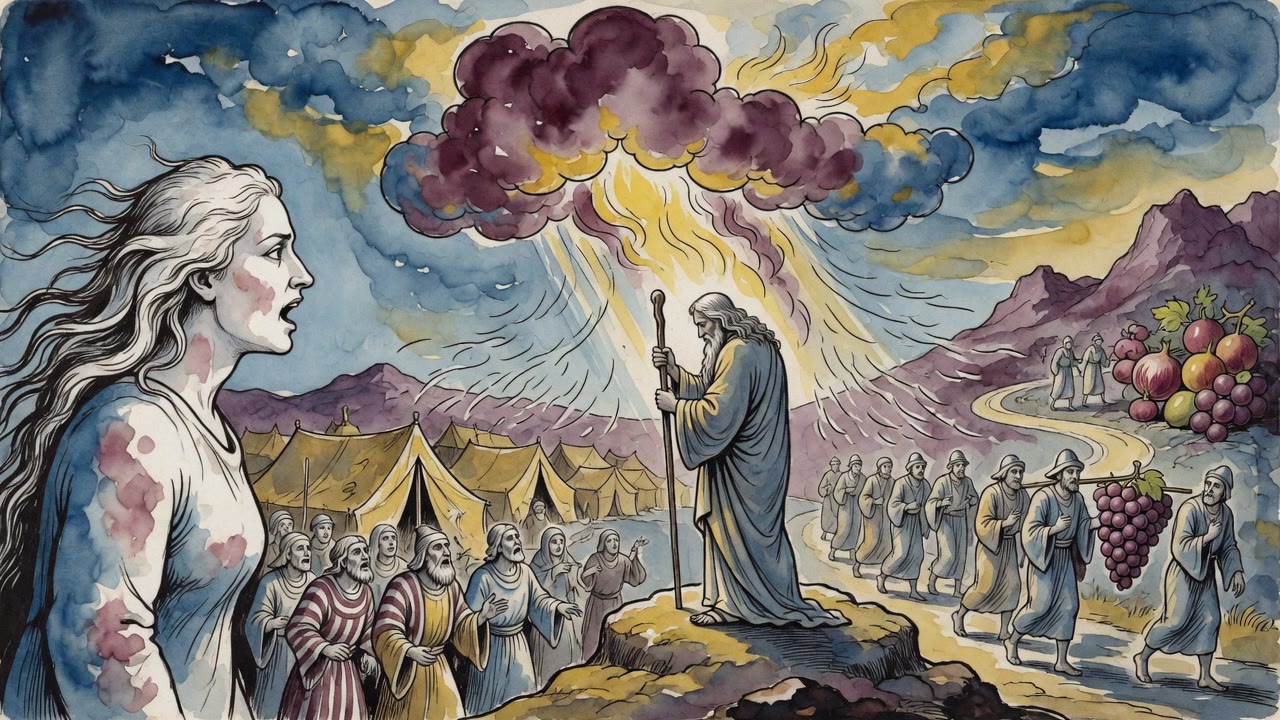
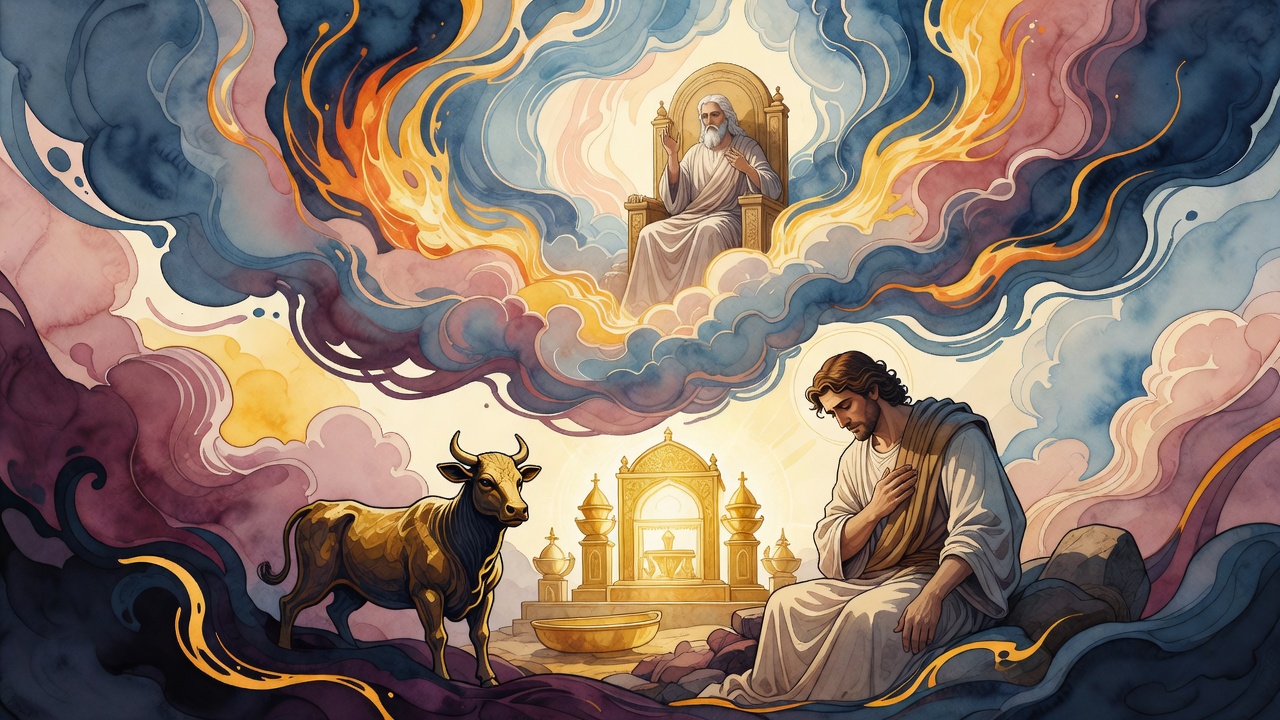
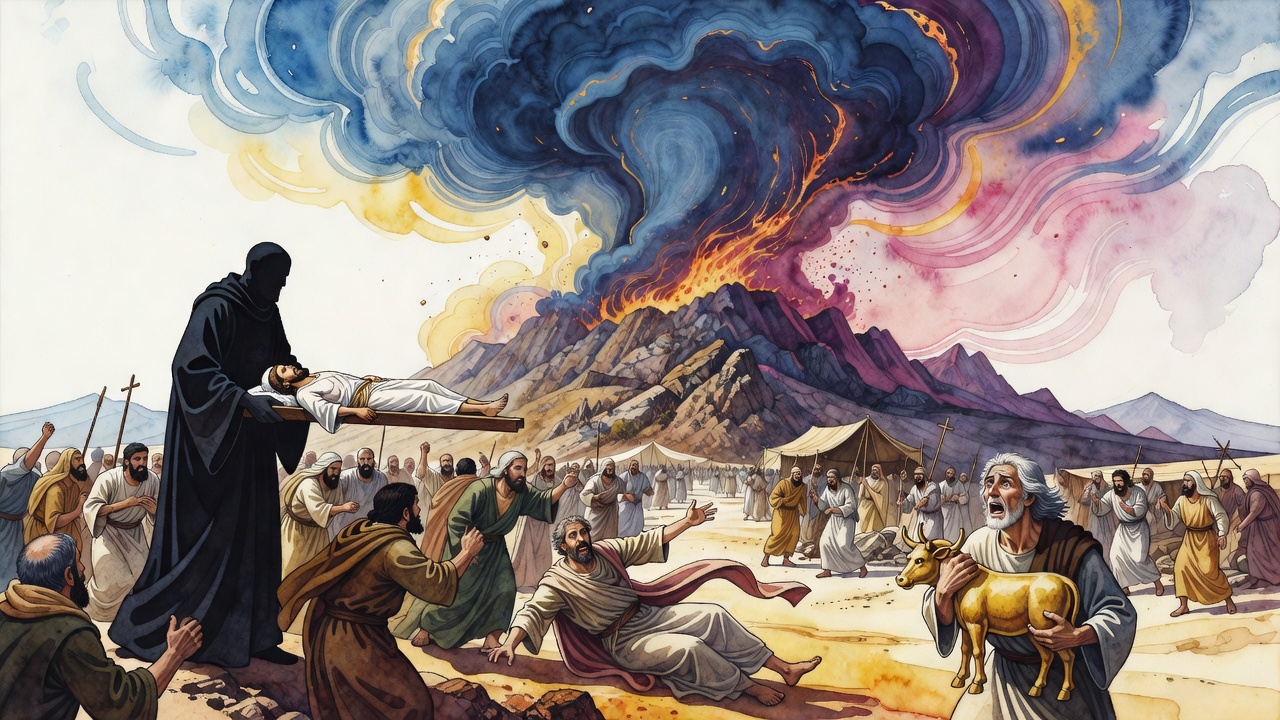
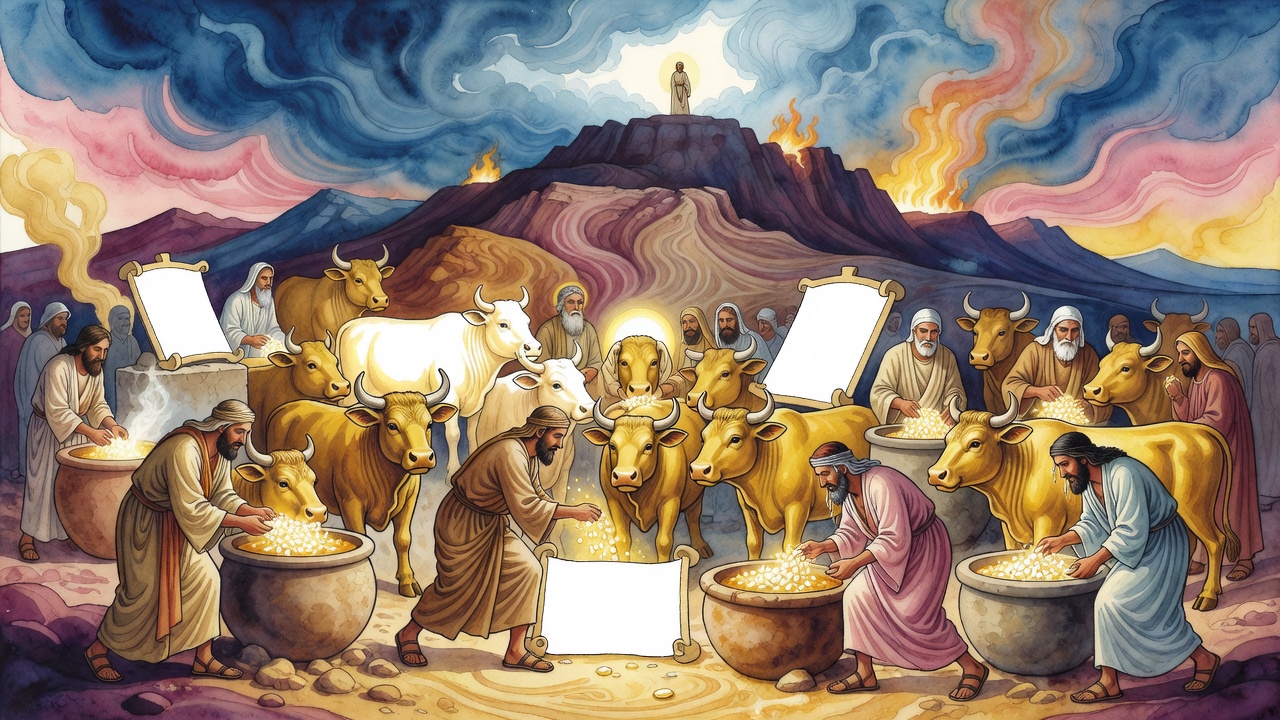
God Sent Moses Down Because Israel Made the Golden Calf Click for full size

Go Down, Servant

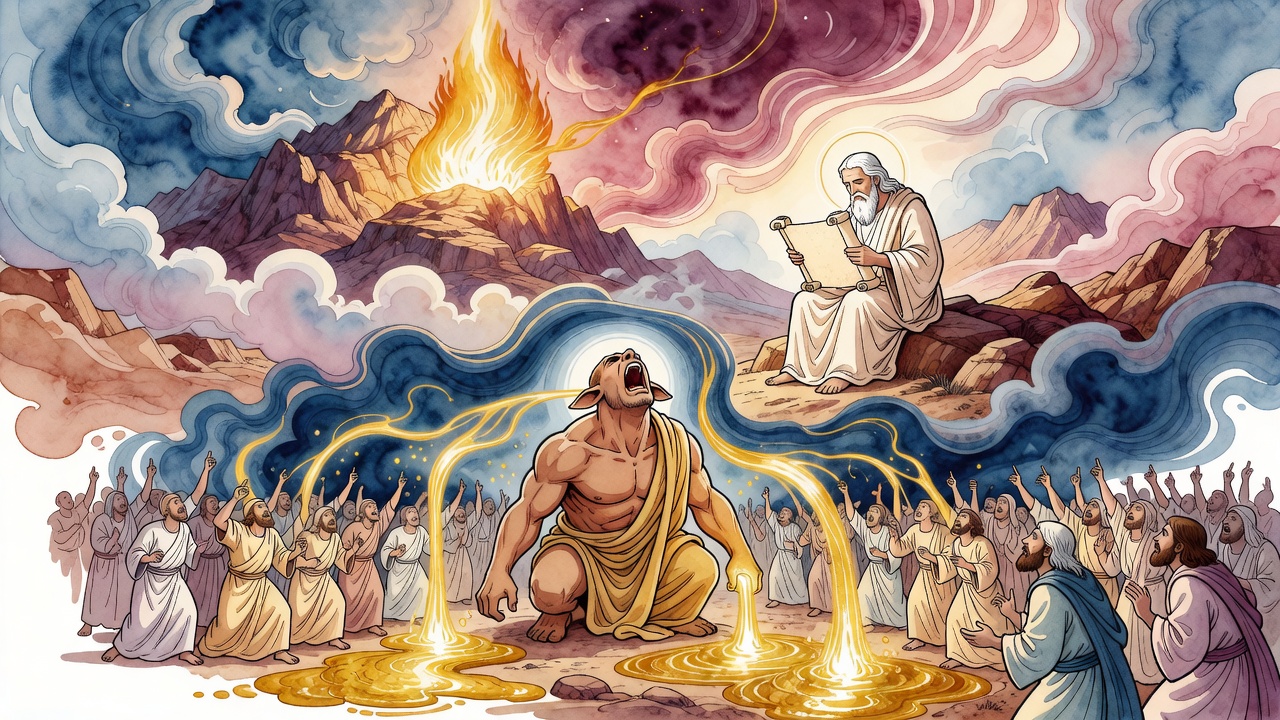
"Go, get thee down" (Exodus 32:7). The Holy One does not soften the order. Mankind has already forced a descent before, at Babel and at Sodom, when God came down to see. A servant matches his master. Moses must leave the cloud and the tablets and walk toward a noise that is already a crime.

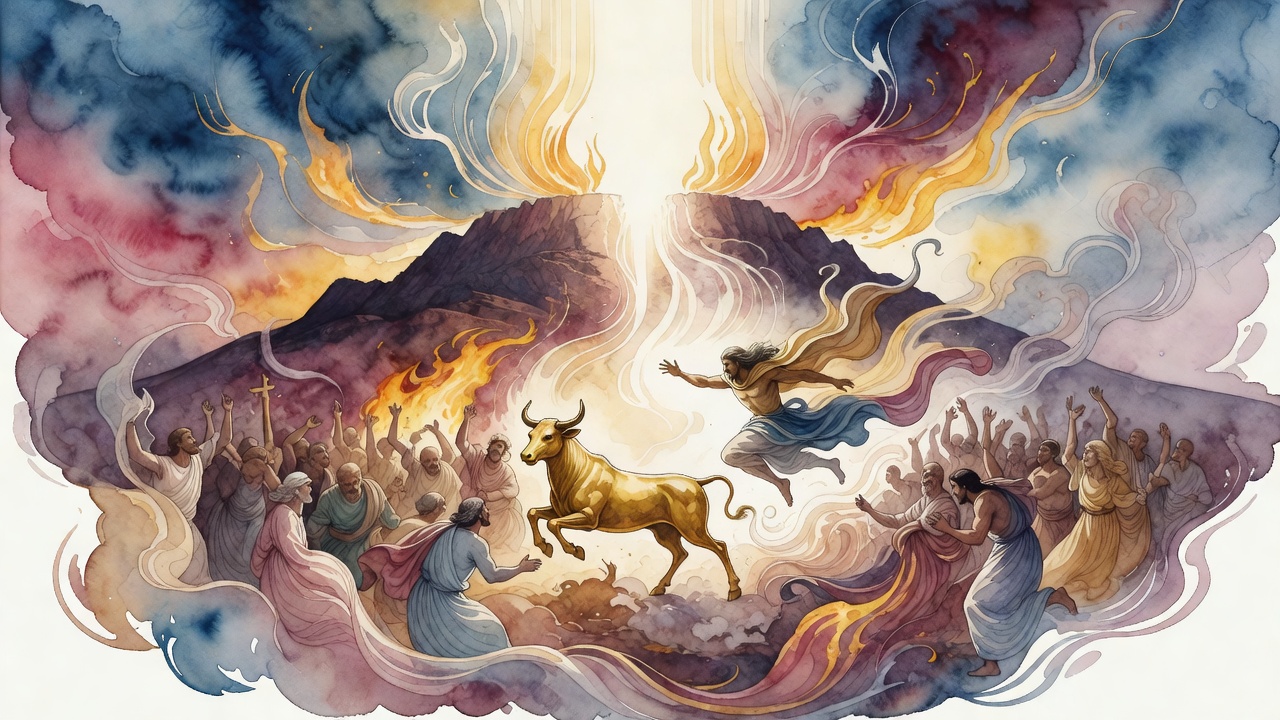
In Moses' heart the sentence forms. There is no forgiveness for this. Heaven answers the unspoken thought with memory of the thorn bush. "I have surely seen." Moses saw one vision. God saw two. He saw them come to Sinai and take the Torah, and He saw them study the chariot with its four faces and unhitch the ox to provoke Him, exchanging their glory for the image of a grass-eating beast (Psalm 106:20; Ezekiel 1:10).

The people in the verse is "thy people," not simply the people. God pins the mixed multitude Moses welcomed when Egypt opened, the penitents he refused to leave behind. God foresaw they would drag Israel toward a calf they already knew how to love. Leadership owns the crowd it gathers, including the ones who smile while they melt earrings into a god that does not speak.

Gold Against Gold

The calf is not made of air. It is made of abundance. Sifrei Devarim hears God say of this thing that it outweighs all they have done, like a final insult that collapses a neighbor's patience after a hundred smaller wrongs. The same gold that will plate the mishkan (the portable sanctuary Israel built in the wilderness) has already poured into a mold of rebellion. One metal, two altars, two stories of the heart.

Rabbi Shimon bar Yochai offers a crueler picture. A man praised for hosting sages who then hosts the enemies of the covenant is suddenly read as always having been a man who receives anyone. The good deeds look like costume. Moses must face a people whose generosity toward a building for God can be recast as the same impulse that feeds an idol.

Another voice pleads the other way. Let the gold of the mishkan atone for the gold of the calf. Extinction was the desert's legal weather for idolatry. Can a later gift cover an earlier fire? The argument itself proves how deep the burn went. Ten trials in the wilderness gather toward this one peak, complaints and doubts stacking until the ox stands in the camp and dances while the tablets still cool in a prophet's hands.

What Entered the Camp That Day

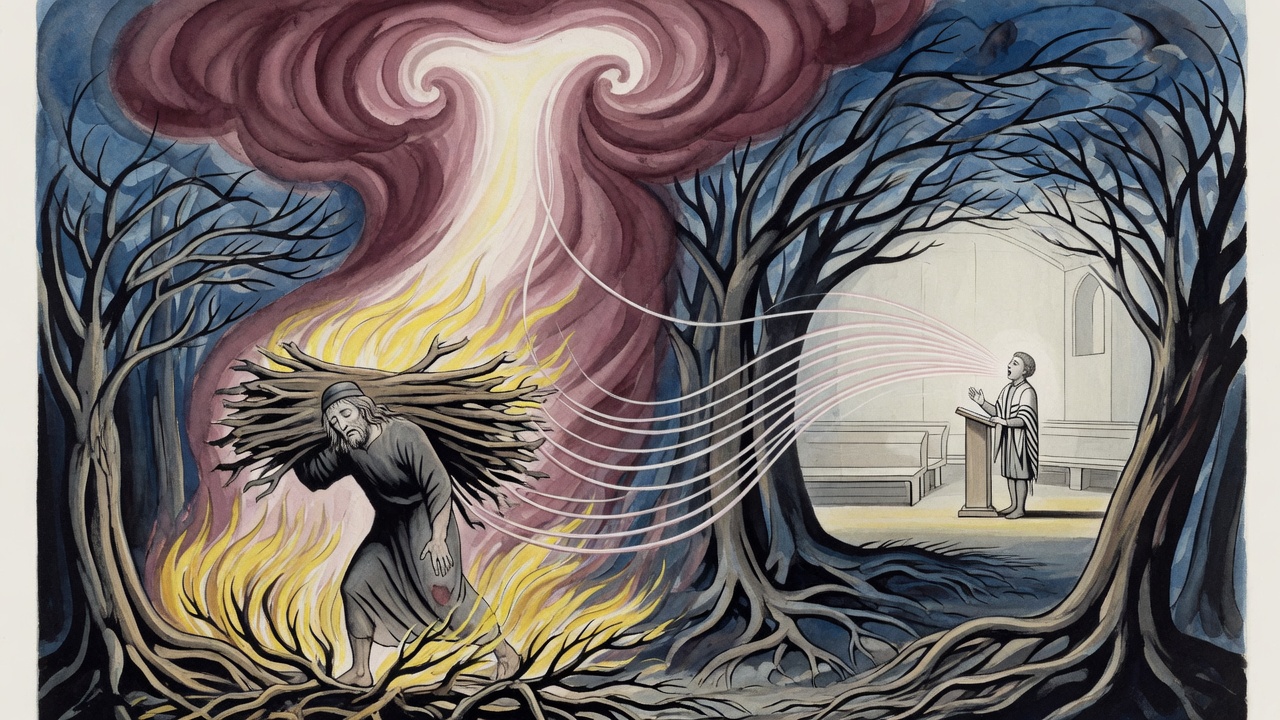
Before the calf, the midrash says, there were no zavim and no lepers among them in the way that later filled the camp with exclusions. Afterward those conditions appear, and contact with death takes its place in the same dark census. Transgression does not stay a private theology. It writes itself on skin and on the map of who may stand inside the curtains.

"And the children of Israel did so, and they sent them outside the camp" (Numbers 5:4) becomes, in this reading, a law that remembers Sinai's failure. Sin opens doors impurity walks through. The people who stood whole enough to hear the voice now manage quarantine because they taught their bodies a new story about distance from holiness.

Moses comes down into that new map. Tablets break. Powdered gold is forced into water. Brothers fall by the sword of Levites. The camp that wanted a god it could see learns the cost of sight without obedience. The mixed multitude's cheer becomes a ledger entry that later priests will still be cleaning when they send the impure beyond the ropes.

Two Descendings

God descends to see shame. Moses descends to stop it. The double motion is the midrash's spine. Heaven will not stay on the peak while the ox is being fed praise. The prophet will not stay in light while his people invent a safer deity from jewelry stripped from ears that once heard "I am the Lord."

"Thy people have dealt corruptly." The phrase is a wound and a rope. It ties Moses to the sinners he must still defend in prayer, the same Moses who will later offer his own book-entry for their lives. Leadership that welcomed the mixed multitude must also stand in the breach when that welcome bears bitter fruit.

The calf falls. The mishkan rises later from willing gifts. Gold remembers both. Every generation that builds something beautiful for God walks past the ghost of a molten animal and decides again which mold the metal will fill. Abundance is never neutral. It waits for a hand to choose the shape of worship.

On the slope the broken letters still shine where they fell. In the camp the smell of burned gold mixes with fear. Above the cloud waits to see whether the servant who came down will also climb back with a people still worth teaching.


← All myths
From the tradition

Sources

3 sources

The texts behind this telling. Some cards carry a translation of the source; others are our own retelling of it, and each card says which. Every card links out to the original.

Midrash Tanchuma, Ki Tisa 21Midrash Tanchuma

Retold in our words. Read the original at the link below.Townsend 1989 translation of Midrash Tanhuma, S. Buber Recension · CC-BY

Go, get thee down (Exod. 32:7). The Holy One, blessed be He, said to Moses: Mankind has already compelled Me to descend from this place to witness its degradation, as is said: And the Lord came down to see the city … Come, let us go down (Gen. 11:5, 7), and I will go down and see (ibid. 18:21). Hence you too must go down, for it behooves a servant to behave like his master. When Moses heard that, he said to himself: Truly, there is no forgiveness for them. The Holy One, blessed be He, was aware of what was transpiring in Moses’ heart, and so He said to him: Have I not already told thee at the thorn bush that I have surely seen (Exod. 3:7)? You saw but one vision, but I have seen two. I saw them coming to Sinai and accepting My Torah, and I also saw that I would descend at Sinai on My chariot with four animals and they would examine it and unhitch one of them in order to provoke Me, as it is said: And they four had the face of an ox, etc. (Ezek. 1:10), and it is written elsewhere: Thus they exchanged their glory for an ass that eateth grass (Ps. 106:20).

Go, get thee down; for thy people … have dealt corruptly. The verse does not say “the people” but rather thy people. The Holy One, blessed be He, said to Moses: It was your people who made the golden calf. When I told you: Bring forth My hosts, My people, the children of Israel (Exod. 7:4), you welcomed also the mixed multitude, saying: Surely it is right to take along the penitent ones. But I foresaw what they would ultimately do; that they would make the golden calf, since they had been idolaters, and would, therefore, lead My people to sin with them. Observe what is written: And he received it at their hand, and fashioned it with a graving tool, and made it a molten calf; and they said: “This is thy god, O Israel” (ibid. 32:4). The verse does not say “This is our god” but rather This is thy god. Hence it was the proselytes who had left Egypt with them who erected it. How much gold did the calf contain? R. Tanhum the son of Hanilai stated: It contained a hundred and twenty-five talents of gold, for that is how much (the letters of the word) molten total arithmetically. R. Issi said: The word masekhah (“molten”) indicates that it would become an evil web to future generations.

Full source
Sifrei Devarim 1:17Sifrei Devarim

Retold in our words. Read the original at the link below.Sifrei by Rabbi Shraga Silverstein · CC-BY

The ancient text of Sifrei Devarim explores just that, exploring the ramifications of the Golden Calf incident.

The verse in question reads, "and an abundance of gold." But it’s not just about the gold itself. According to Sifrei Devarim, God Himself said regarding the Golden Calf, "This thing outweighs all that you have done!

Rebbi, a sage from the Mishnaic period, offered an analogy: imagine someone who has caused their neighbor countless troubles. Then, they add one final, seemingly small offense. The neighbor explodes, "This outweighs everything you have done to me! This weighs upon me more than all!" It's that final straw, that last offense that suddenly makes all the previous good deeds seem insignificant. Is that fair? Perhaps not, but it speaks to the weight of certain actions.

There are other perspectives too. R. Shimon b. Yochai offers a different analogy. Imagine someone who welcomes sages and disciples, earning praise from all. But then, they start welcoming Canaanites, people associated with idolatry and practices seen as antithetical to the community. Suddenly, all the previous good deeds are cast in a different light. People might say, "This is the man's nature – to receive all!" The implication is that the person's motivations were never pure, and the good deeds were just a facade. Moses uses this to say that the Israelites used "an abundance of gold" for both the mishkan, the tabernacle, and for the Golden Calf. Was it the same intention?

R. B'na'ah offers a plea for atonement: Israel served idols, a sin punishable by extinction. So, let the gold used for the mishkan atone for the gold used for the calf! Can one good deed truly erase the stain of a terrible mistake? It's a question that resonates even today.

Then, R. Yossi berebbi Chanina brings up the ten trials in the desert. He sees a connection between the Israelites' behavior at places like the Red Sea, Marah, and Refidim – places where they complained and doubted God – and the ultimate sin of the Golden Calf. He finds allusions to the 10 trials of the Israelites in the verse "in the desert, in the plain." These trials included those at the Red Sea, with water, with manna, with quail, the golden calf, and the spies.

But R. Yossi b. Dormaskith challenges this interpretation. He insists that these are simply place names. "I testify by heaven and earth that we have reviewed all of the sources and they are all place names. It is just that they were thus named because of an event that transpired there." It's a reminder that sometimes, the simplest explanation is the correct one. Yet, the story, even if rooted in geography, still carries the weight of those historical events.

So, what are we to take away from this? Is it a harsh judgment? A call for atonement? Or simply a historical account of a series of events? Perhaps it's all of the above. It's a reminder that our actions have consequences, that some mistakes can overshadow our good deeds, but also that there's always an opportunity for repentance and a chance to rebuild. And maybe, just maybe, it's a reminder that even in our darkest moments, there's always the possibility of finding light.

Full source
Sifrei Bamidbar 1:8Sifrei Bamidbar

Retold in our words. Read the original at the link below.Sifrei by Rabbi Shraga Silverstein · CC-BY

The ancient rabbis certainly did. And in the Sifrei Bamidbar, a mishnah (the earliest code of rabbinic law) of legal commentary on the Book of Numbers, they explore this very idea, using the story of the Israelites in the desert as a powerful example.

The verse in question? (Numbers 5:4): "And the children of Israel did so, and they sent them outside the camp." Seemingly simple. But within these few words, the rabbis find layers of meaning.

Rabbi Yossi Haglili, for example, sees a direct correlation between transgression and consequence. He points out that before the Israelites succumbed to the sin of the Golden Calf, there were no zavim (people with certain bodily emissions rendering them ritually impure) or lepers among them. But afterward, these conditions appeared. He emphasizes just how potent a negative action can be. Our tradition teaches that these three conditions - zavim, lepers, and those who came into contact with the dead (tamei meth) - all manifested on that very same, fateful day (Sifrei Bamidbar 5:4). – a single act triggering such widespread consequences!

Rabbi Shimon bar Yochai offers another perspective on the impact of transgression. Before the Golden Calf, the Israelites witnessed the awesome glory of God on Mount Sinai. As (Exodus 24:17) describes it, "the sight of the glory of the L-rd was like a consuming fire on the top of the mountain in the eyes of the children of Israel." But the key thing is – they didn't fear it. They didn't tremble. They were in a state of awe, but not terror.

However, after they worshipped the idol, everything changed. When Moses descended from the mountain, his face radiant from his encounter with God, as we read in (Exodus 34:30), "Aaron and all of Israel saw Moses, and, behold, the skin of his face shone, and they were afraid to approach him." Fear had entered the picture. Transgression had not only physical consequences, but also a spiritual and emotional one, creating a barrier between the people and their leader, the man closest to God.

But there's also a contrasting theme in this passage: praise for the Israelites. The text emphasizes, "And the children of Israel did so." This highlights their obedience. They followed Moses' instructions. But then the verse adds, "As the L-rd spoke to Moses, so did the children of Israel do." Why the repetition?

The Sifrei Bamidbar explains that this is to teach us that even those who were deemed ritually impure and were being sent outside the camp, the unclean ones themselves, did not protest! They accepted the decree without complaint. This is remarkable! It speaks to a level of collective responsibility and acceptance of divine law, even when it personally impacted them negatively. Think about how hard that would be!

Perhaps it's a reminder that our actions, both good and bad, have far-reaching consequences. That transgression can create distance between us and the divine. But also, that even in the face of adversity, obedience, acceptance, and a sense of communal responsibility can shine through. And maybe, just maybe, that's a lesson that's as relevant today as it was thousands of years ago in the desert.

Full source