5 min read

Israel Casts Thirteen Golden Calves at Sinai

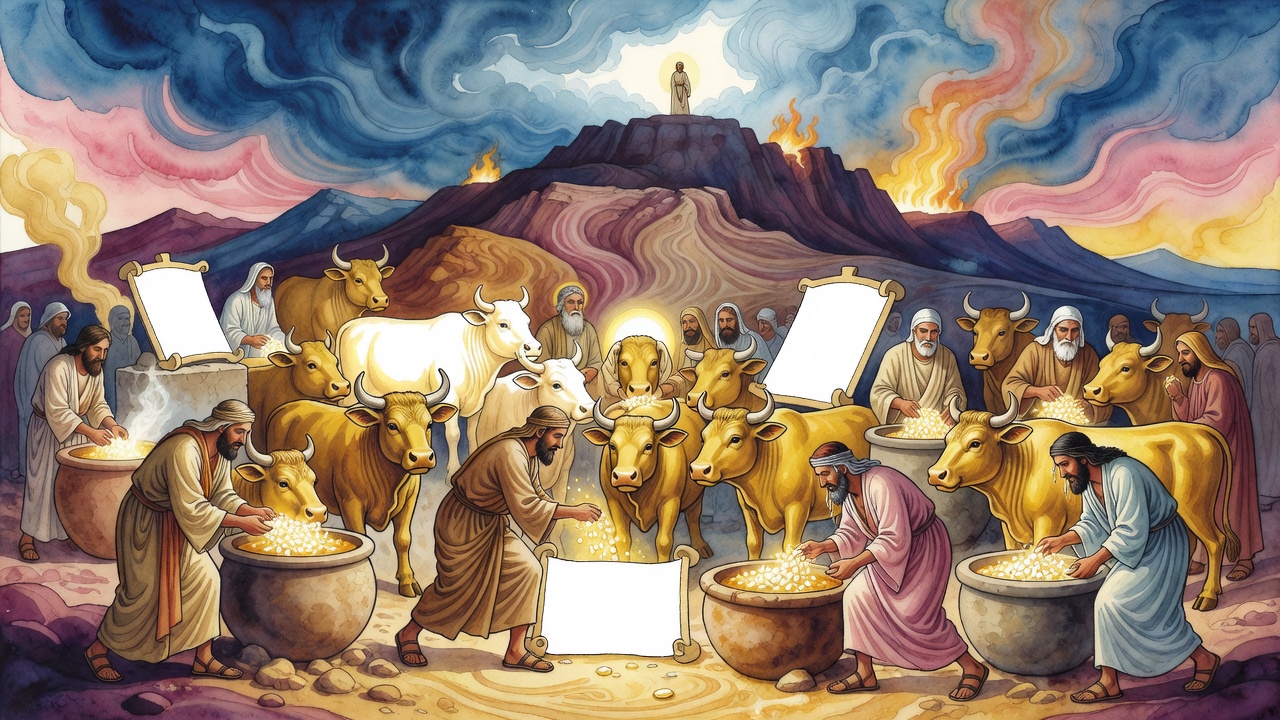
While Moses stays on the mountain, the camp melts gold into thirteen calves and feeds them manna taken from God's own table.

Curated by Arthur · Told by Maggid ·
Table of Contents
  1. Thirteen Fires, Not One
  2. Manna on an Idol's Altar
  3. The Ox They Saw in the Sea
  4. Thirteen Words Against Thirteen Idols
  5. The Rope at Both Ends
Israel Casts Thirteen Golden Calves at Sinai Click for full size

Thirteen Fires, Not One

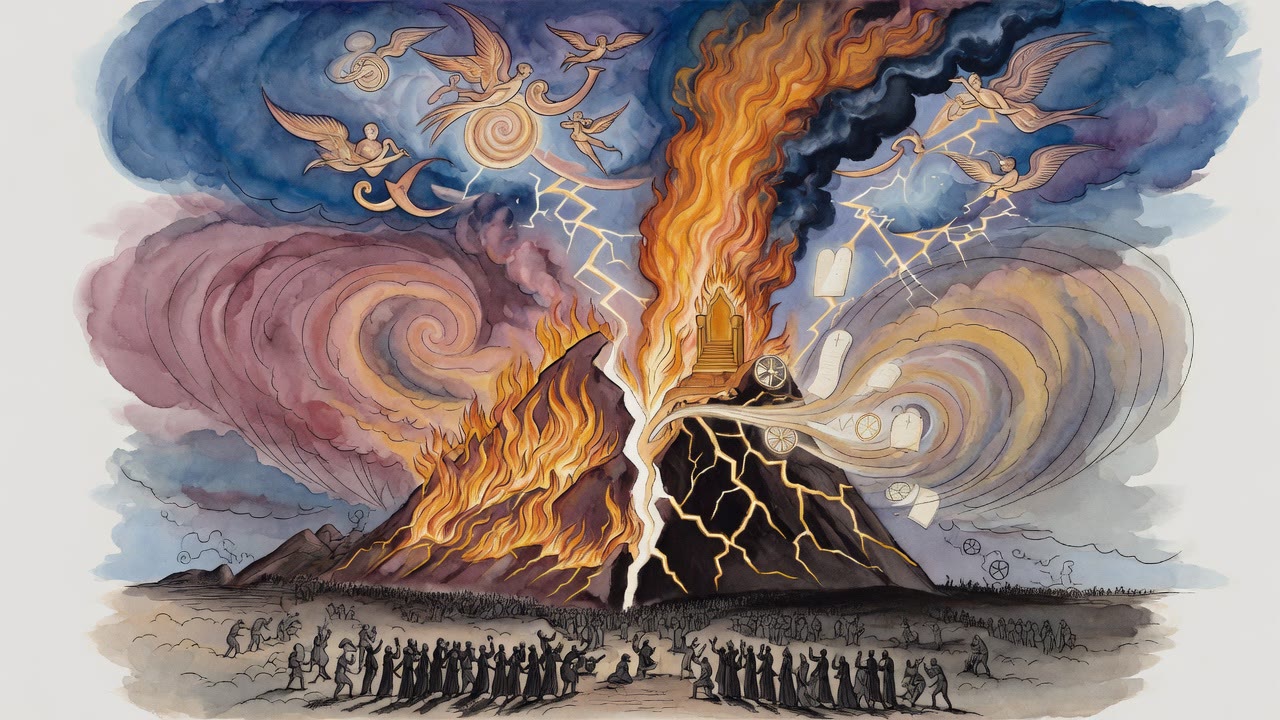
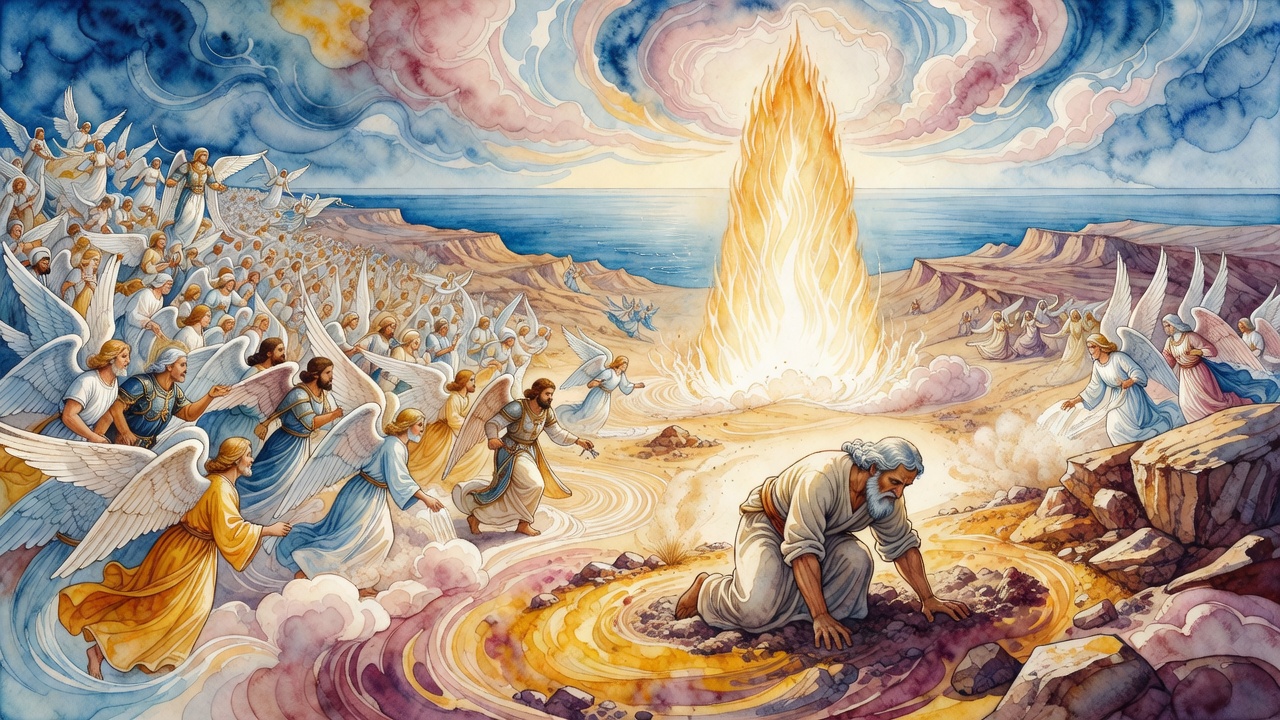
The mountain smoked. Moses had been gone too long for the camp's nerves. Gold came off ears and arms and went into the fire, and what came out was not a single calf. The legends count thirteen. One for each tribe. One more for all Israel together, as if the whole people needed its own beast to stand beside the twelve.

The camp that had stood under thunder now stood under molten animals. Panic had found a shape with horns. Smiths who had melted Egyptian chains for freedom now melted freedom's jewelry into faces that could not speak.

Children learned a new dance around gold that still hissed. Elders argued over which tribe's calf stood taller. The noise rose like a second Sinai with no commandments in it. A man wiped sweat and ash from his forehead and called the shine holy because he needed it to be.

Manna on an Idol's Altar

They did not stop at casting. The manna that fell each morning, bread with no human farmer behind it, became an offering to the calves. Food from God's hand laid before a face of gold. The insult was not abstract. Every grain of that bread had been a daily proof that Heaven still fed them. They returned the proof to a statue.

Smoke rose. The smell mixed desert dust with roasted gift. Infants who had never known Egypt's storehouses watched their parents feed a calf with the same miracle that kept them alive. A woman who had scraped manna at dawn placed a portion on an altar of sand and waited for a statue to thank her.

Nothing thanked her. Gold does not eat. The waste of the gift was the point the legends refuse to soften. Crumbs that had tasted like whatever a hungry person needed now blackened into a joke against the Giver.

The Ox They Saw in the Sea

Why a bull at all? At the Reed Sea the people had seen more than water walls. They beheld the Celestial Throne and the living creatures around it, and of those faces the ox burned clearest in memory. They took a throne-vision and turned it into a craftsman's mold.

They told themselves the ox had helped in the deliverance. A face from the chariot became a partner in the Exodus, then a god beside God. The sin began as misread glory, not as a clean decision to abandon the Name. Memory of salvation became the raw ore of idolatry.

Water had stood like walls. Now gold stood like a god. The same eyes that had watched the sea refuse to drown them watched a calf receive their bread. What had been a glimpse of Heaven's court became a street festival with horns.

Thirteen Words Against Thirteen Idols

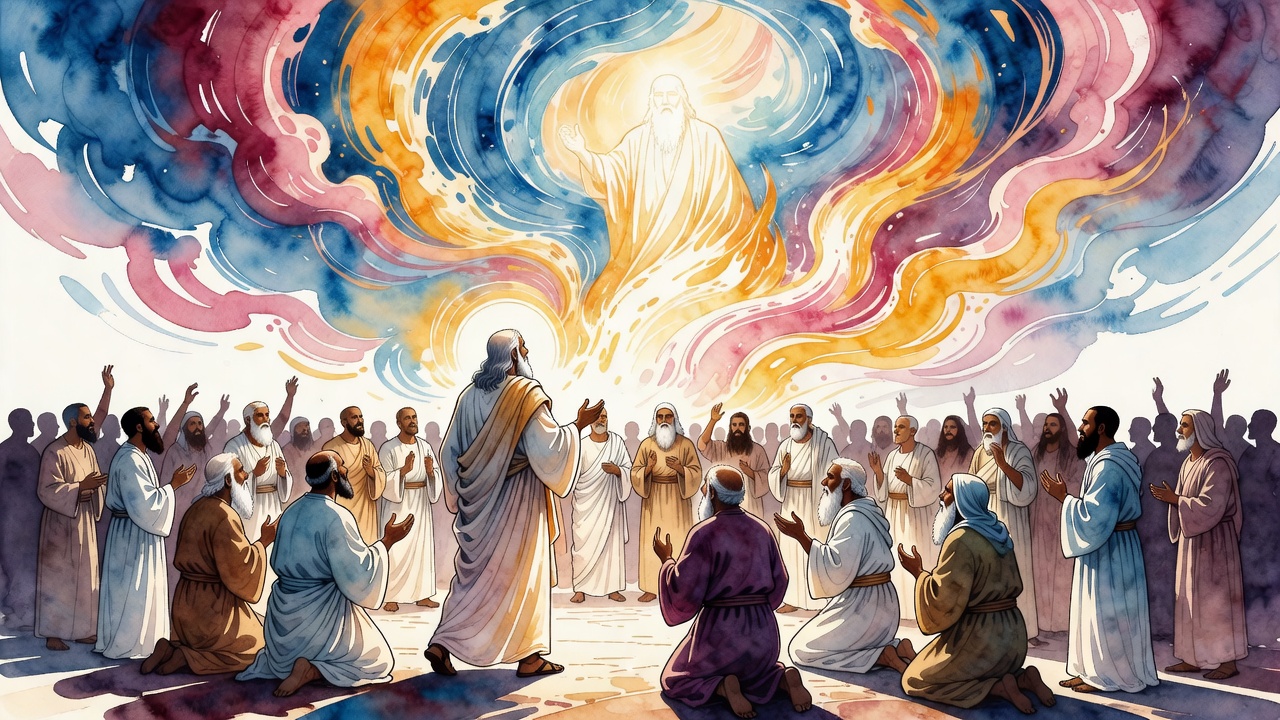
Years later Moses would stand under a different pressure, fighting the decree of his own death, and soften Heaven by speaking the thirteen attributes of mercy. "The Lord, the Lord, a God full of compassion and gracious, slow to anger, and plenteous in mercy and truth" (Exodus 34:6-7). Compassion answered speech that named God's own character back to Him.

At Sinai the people had answered absence with thirteen bodies of gold. The numbers rhyme across the legends without becoming the same story. One thirteen is idolatry multiplied by tribe. The other thirteen is mercy multiplied by names. Between them stands the leader who broke tablets and later offered his life rather than let Israel be ruined.

He who smashed calves would one day refuse a bargain that saved only himself. The same mouth that cursed the camp's metal would later quote Heaven's compassion to Heaven's face.

The Rope at Both Ends

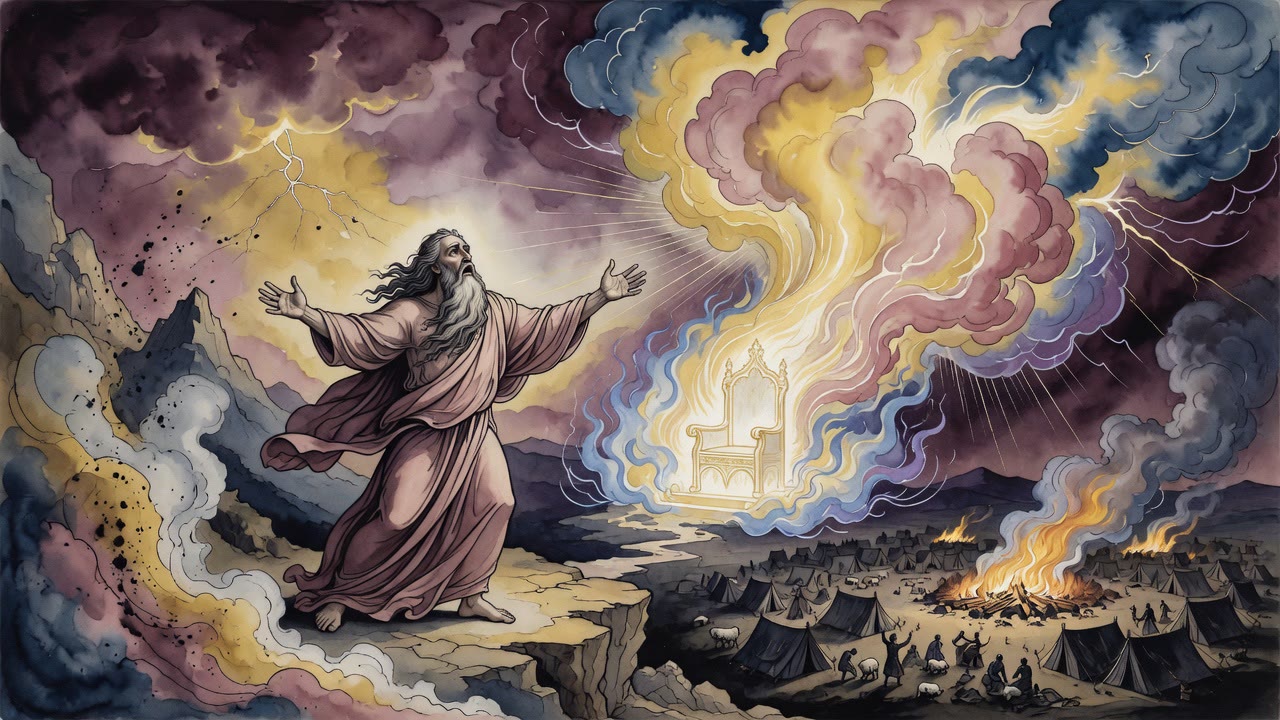
When God finally told Moses he must die outside the Land, He set two vows on the table. Moses dies, or Israel perishes. "I cannot cancel both." Moses refused the bargain that saved him. "Rather shall Moses and a thousand of his kind perish than a single soul out of Israel."

He seized the rope God had offered at both ends and chose the people's survival. Then he asked what the world would say about feet that had walked heaven and hands that had held Torah if those hands ended in ordinary dust. Even a man ready to die for Israel still wanted his life to mean something in the dust.

That is the man who once came down to a camp full of calves. He smashed what they had made. He still chose their survival over his own entrance into the Land. The people who fed manna to thirteen idols became the people for whom he would not trade one soul.

Gold cools in the sand. Mercy moves slower and cuts deeper. The mountain still held the tablets' dust when the camp learned what thirteen can mean when it is not an idol count. Somewhere a broken earring lay half-buried, no longer part of a god, only metal waiting for rain.


← All myths
From the tradition

Sources

2 sources

The texts behind this telling. Some cards carry a translation of the source; others are our own retelling of it, and each card says which. Every card links out to the original.

Legends of the Jews 2:100Legends of the Jews

Retold in our words. Read the original at the link below.The Legends of the Jews by Louis Ginzberg (1909) · Public Domain

The familiar story is this: Moses goes up Mount Sinai, gets the Ten Commandments, and the Israelites, left to their own devices, panic. But the story, as we find it in Legends of the Jews by Rabbi Louis Ginzberg, is even more… intense than it first appears.

It wasn't just one golden calf. Oh no. According to Ginzberg's retelling, they made thirteen. One for each of the twelve tribes, and one representing all of Israel. The sheer scale of the idolatry?

It gets worse. Remember the manna, that miraculous food God provided daily in the desert? Well, the Israelites, in their misguided devotion, used it as an offering to these idols. The very thing sustaining them, a direct gift from God, they offered to a… calf. A golden one, yes, but still.

Why were they so fixated on a bull, an ox? Here's where it gets really interesting. Ginzberg suggests a peculiar explanation: during the crossing of the Red Sea, the Israelites had a vision. They beheld the Celestial Throne – Kisei Hakavod – and the four creatures surrounding it. Of those four, they most distinctly saw the ox.

Now, this is crucial. In Jewish mysticism, particularly in traditions related to the prophet Ezekiel's vision (Ezekiel 1), the Merkabah (chariot) has angelic beings with different faces, including that of an ox.

So, the Israelites, witnessing this vision at the Red Sea, jumped to a rather… unfortunate conclusion. They believed the ox played a vital role in their deliverance from Egypt. That the ox had helped GOD in the exodus. And thus, they reasoned, it deserved worship alongside God. They weren't necessarily rejecting God outright, but adding a partner, an intermediary, in the form of the ox. It’s a fascinating – and ultimately tragic – example of how even a divine revelation can be misinterpreted. How easily we can project our own limited understanding onto the infinite.

How often do we see what we want to see, rather than what's actually there? And what golden calves are we, perhaps unknowingly, worshipping today?

Full source
Legends of the Jews 6:152Legends of the Jews

Retold in our words. Read the original at the link below.The Legends of the Jews by Louis Ginzberg (1909) · Public Domain

It wasn’t exactly a calm, rational discussion – more like a celestial tug-of-war.

The Ginzberg’s says retelling in Legends of the Jews, God was pretty miffed at Moses. Moses wasn’t exactly accepting his fate, that he was destined to die before entering the Promised Land. But, as the story goes, God's anger softened the moment Moses uttered those powerful words: "The Lord, the Lord, a God full of compassion and gracious, slow to anger, and plenteous in mercy and truth; keeping mercy for thousands, forgiving iniquity and transgression and sin." (Exodus 34:6-7).

That’s when things got really interesting. God, in a manner of speaking, laid His cards on the table. "I have registered two vows," He said to Moses, "one that thou art to die, and the second that Israel is to perish. I cannot cancel both vows, if therefore thou choosest to live, Israel must be ruined."

Moses, ever the advocate for his people, wasn't having it. "Lord of the world!" he exclaimed, "Thou approachest me artfully; Thou seizest the rope at both ends, so that I myself must now say, 'Rather shall Moses and a thousand of his kind perish, than a single soul out of Israel!'" He was essentially saying, "Take me instead! I'd rather die than see my people suffer." But then he added a poignant question: "But will not all men exclaim, 'Alas! The feet that trod the heavens, the face that beheld the Face of the Shekinah (שכינה, the divine presence), and the hands that received the Torah (תורה, the Law), shall not be covered with dust!'" It’s a raw, human moment, a plea for recognition of his life’s work.

God, in His infinite wisdom, had a response ready. He countered that the people would say, "If a man like Moses, who ascended into heaven, who was peer of the angels, with whom God spoke face to face, and to whom He gave the Torah, if such a man cannot justify himself before God, how much less can an ordinary mortal of flesh and blood, who appears before God without having done good deeds or studied the Torah, justify himself?'" Ouch. Talk about a divine mic drop.

God then pressed Moses: "I want to know why thou art so much aggrieved at thy impending death."

And Moses, in a moment of vulnerability, admitted, "I am afraid of the sword of the Angel of Death."

God, showing compassion, reassured him: "If this is the reason then speak no more in this matter, for I will not deliver thee into his hand." A small comfort, perhaps, but a comfort nonetheless.

But Moses, ever persistent, had one more card to play. "Shall my mother Jochebed, to whom my life brought so much grief, suffer sorrow after my death also?" He appealed to God’s sense of empathy, reminding Him of his mother's potential suffering.

God’s response is almost…resigned. "So was it in My mind even before I created the world, and so is the course of the world; every generation has its learned men, every generation has its leaders, every generation has its guides. Up to now it was thy duty to guide the people, but now it is ripe for thy disciple Joshua to relieve thee of the office destined for him."

That life is a cycle, with beginnings and endings, and that even Moses, the great lawgiver, wasn't exempt from its natural course. What will we leave behind when our time comes to pass the torch?

Full source